
On this page
Start here
Quick answer
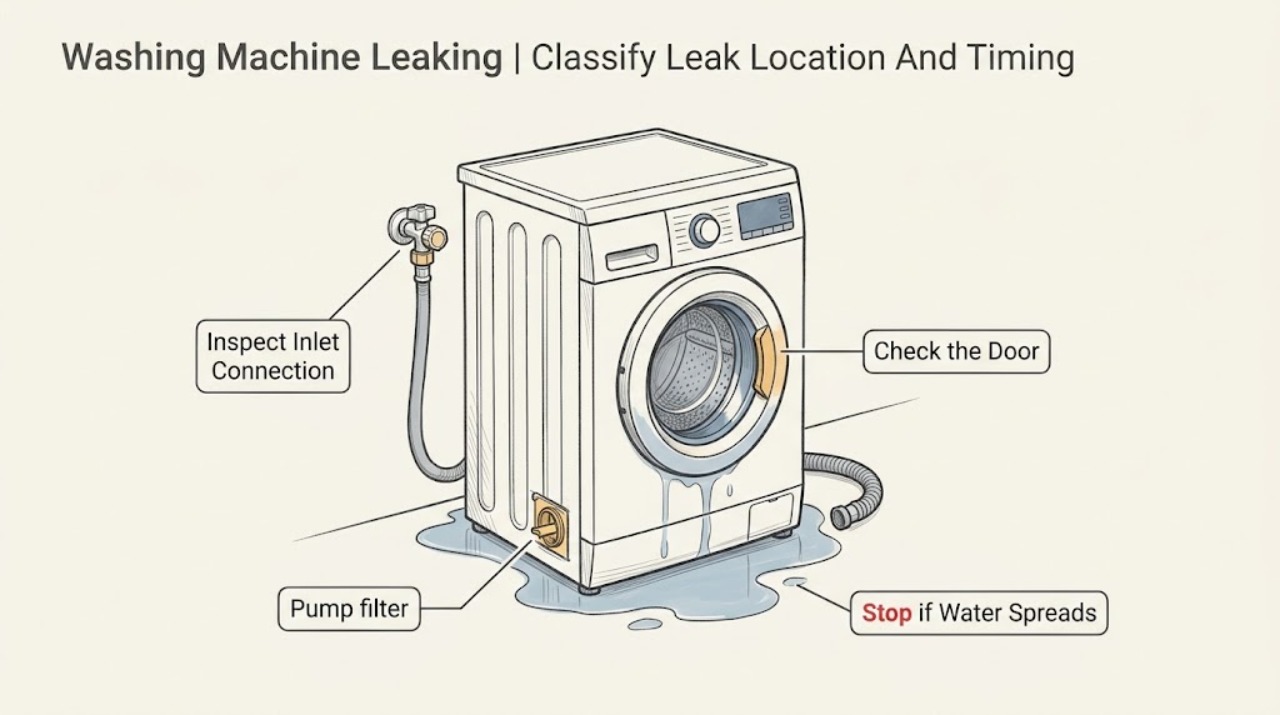
For a leaking Baumatic washing machine, stop the cycle and first locate whether water is coming from the inlet connection, door area, detergent drawer, drain hose, filter cover, or underneath the cabinet. Baumatic's guidance identifies seals around the tap, supply hose, and fill valve and a filter that is not closed correctly as possible leak points; its installation guidance also stresses checking hose connections and the waste route for the exact model. Do only visible, ordinary-access checks and follow the model manual. Stop immediately for a continuing leak, water near electrical parts, smoke, burning odor, damaged hose or cord, an unstable appliance, or any need to move the machine or open the cabinet; arrange qualified service.
Before you begin
Safety first
- This article covers normal controls, visible inspection, ordinary door and drawer access, and only the exact manual's documented filter or drain procedure when residual water can be contained safely. A qualified technician must handle appliance movement, internal panels, water-valve and pump work, electrical measurement, seals, tub, and cabinet repairs.
Work through in order
Diagnostic checks
Use only checks that match the exact appliance or system and its official guide.
-
Check 1
Stop the wash cycle through the normal control and observe from a dry, safe position where water first appears: front door or drawer, lower front filter area, rear inlet, rear waste route, or underneath the cabinet.
Expected result: Record whether water appears while filling, washing, draining, spinning, or while the machine is idle, and whether the leak is a drip, a stream, or an expanding wet area.
Next step: Keep the washer out of operation while an active leak continues. Use the location and timing notes to choose the next visible check or to brief a technician.
Stop if: Do not run another cycle just to reproduce a leak, touch wet electrical areas, or reach underneath a powered appliance.
Why this matters
Why: Timing and location narrow the likely path but do not prove a failed component. A leak during filling points toward the inlet path, while a leak during draining keeps the waste hose, filter, and pump path in scope.
-
Check 2
With the washer stopped and without loosening the connection, inspect the visible tap, inlet hose, and fill-valve area for water tracks, a split hose, a kink, or a connection that does not sit squarely.
Expected result: Record a dry intact inlet path, a wet seal or connection, a cracked or swollen hose, or water that starts at the rear during filling.
Next step: If the path is dry and intact, continue with the front and waste checks. For any active leak, split hose, or inaccessible rear connection, keep the water supply isolated by a qualified person and arrange service.
Stop if: Do not disconnect the inlet hose, replace a seal, open a water-protection device, or pull the washer out of a tight housing alone.
Why this matters
Why: Baumatic identifies the seal between the tap, supply hose, and fill valve as a possible leak source and advises correctly connecting the inlet water pipe. A damaged hose or internal valve seal cannot be confirmed or repaired by wiping the outside.
-
Check 3
Inspect the visible door glass, rubber seal, latch area, and detergent drawer for clothing, residue, a tear, a drawer that is not seated, or water marks above the front edge; do not force a locked door.
Expected result: Record an intact seal and normally closing door, an item trapped in the seal, a torn or displaced seal, detergent or foam escaping from the drawer, or a door that will not latch.
Next step: Remove only a loose visible item, clean only the ordinary-access drawer area as the manual permits, and keep the washer off if water returns. Arrange service for a torn seal, damaged latch, or recurring drawer overflow.
Stop if: Do not remove the door seal, pry the door open, add unapproved chemicals, or run a cycle with a damaged front seal.
Why this matters
Why: A door obstruction or damaged seal can allow water to escape at the front, while excess foam or a drawer issue can make a leak appear higher than the tub. A latch or seal that remains abnormal needs service rather than adjustment by force.
-
Check 4
From ordinary access, inspect the lower front filter cover or kick plate for a visible gap, wet track, or filter cap that is not seated; open it only if the exact manual documents access and residual water can be contained safely.
Expected result: Record a dry, correctly closed cover, water around the filter cap, a cap that will not close normally, or a filter area that is absent or inaccessible on this model.
Next step: If the manual documents this access and the cover can be closed normally, follow only that procedure and inspect for a loose visible obstruction. For continuing water, a stuck cap, or no documented access, stop and request service.
Stop if: Do not open a filter with hot or uncontrolled water, reach toward pump blades, remove an unlisted plinth, or use tools to force the cap.
Why this matters
Why: Baumatic identifies a front filter that is not correctly closed as a possible floor-leak source, and its drain guidance warns that residual water can remain at the pump. A cap that leaks after proper manual handling may indicate a seal, housing, or pump fault.
-
Check 5
Inspect the visible grey waste hose, standpipe or sink connection, and hose support for a leak, kink, loose-looking connection, or routing that does not match the model installation instructions; do not disconnect a full hose.
Expected result: Record a dry correctly supported waste route, water at the sink or standpipe connection, a hose that is crushed or pulled out, or water returning from the household drain.
Next step: Correct only a clearly loose external hose position without moving the appliance. For a blocked household drain, damaged hose, connection leak, or inaccessible route, stop the washer and arrange qualified plumbing or appliance service.
Stop if: Do not cut a sealed sink connection, pull the machine from its housing, pour chemicals into the drain, or disconnect a hose while water can escape uncontrollably.
Why this matters
Why: Baumatic's installation guidance says the waste hose must be supported and routed correctly, and its drain guidance treats a blocked waste connection as a possible source of retained water and spills. A household drain backup is a plumbing issue, not proof of a failed washer part.
-
Check 6
After the appliance is dry and only through ordinary access, note whether the leak followed an overloaded load, excessive suds, or a badly distributed load; compare detergent use and load size with the exact manual.
Expected result: Record normal detergent and load conditions, foam escaping from the drawer, laundry trapped at the door seal, or severe movement and water escaping during spin.
Next step: Use the manual's detergent and loading guidance on a future cycle only after the leak source is no longer active and the appliance is safe. Arrange service for a repeated leak, damaged seal, or unstable movement.
Stop if: Do not run a test cycle with visible damage, active seepage, a detached seal, or an appliance that moves or rocks.
Why this matters
Why: Baumatic's manual lists excessive detergent as a cause of foam spilling from the drawer and identifies unbalanced loads as a cause of abnormal spin behavior. These observations can explain a one-time spill but do not excuse a recurring leak.
-
Check 7
Only when all visible areas are dry, the hoses and covers are correctly positioned by the manual, and no safety condition exists, use one short manual-approved cycle while observing from outside for renewed water.
Expected result: Record no leak, a repeat leak from the same location, a leak from a new location, a warning, a protection trip, or abnormal movement.
Next step: Stop the cycle at the first sign of water and provide the technician the exact location, timing, load, detergent, and prior checks. Do not repeat the test to collect more water.
Stop if: Do not operate with a continuing leak, smoke, burning odor, electrical trip, damaged cord, unstable cabinet, or water near electrical parts.
Why this matters
Why: A dry cycle after a documented external correction supports a resolved installation or closure issue, but it does not rule out an intermittent seal, valve, hose, pump, or cabinet fault. Any repeat leak needs diagnosis.
Use your observations
Decision map
Find the observation that best matches what you see, then follow the next safe action.
-
PATH 01Safety boundary
What you see
Water appears at the tap, inlet hose, or fill-valve area, especially while the washer fills.
Do this next
Keep the washer out of operation and arrange qualified service for a damaged hose, connection, valve, or seal; only a clearly accessible normal tap handle may be left in its safe closed state.
Why this path and its safety boundary
Why it matters: Baumatic identifies the seal between the tap, supply hose, and fill valve as a possible leak path.
Safety stop: Do not loosen fittings, replace a seal, or pull the appliance forward alone.
-
PATH 02Safety boundary
What you see
Water or foam escapes from the door, rubber seal, or detergent drawer.
Do this next
Remove only a loose visible obstruction and follow the manual's ordinary drawer-care guidance. Request service for a torn seal, abnormal latch, or recurring overflow.
Why this path and its safety boundary
Why it matters: A trapped item, damaged seal, door-latch issue, drawer overflow, or excess detergent may be involved; the visible puddle does not identify one failed part.
Safety stop: Do not pry the door, remove the seal, or run a cycle with front sealing damage.
-
PATH 03Safety boundary
What you see
Water appears around the lower front filter cap or kick-plate area.
Do this next
Use the exact manual's filter procedure only when safe residual-water handling and access are documented. Stop for a stuck cap, continuing seepage, or absent access and arrange service.
Why this path and its safety boundary
Why it matters: Baumatic says a front filter that is not correctly closed can leak; residual water can also remain in the pump after draining.
Safety stop: Do not force the cap, reach toward pump blades, or remove an unlisted lower panel.
-
PATH 04Safety boundary
What you see
Water appears at the rear waste hose, sink connection, standpipe, or household drain, or returns during draining.
Do this next
Correct only a visible external hose position without moving the appliance. Arrange qualified plumbing or appliance service for a blockage, damaged hose, or inaccessible connection.
Why this path and its safety boundary
Why it matters: The waste route may be kinked, unsupported, loose, blocked, or incorrectly installed; a household drain obstruction can spill independently of the washer.
Safety stop: Do not cut a sealed connection, use drain chemicals, disconnect a full hose, or pull the washer out of a housing alone.
-
PATH 05Safety boundary
What you see
The event followed heavy foam, an overloaded load, or severe movement during spin, with no continuing leak when idle.
Do this next
Follow the exact manual's detergent and load guidance after the appliance is dry and safe. Request service if water returns or movement remains abnormal.
Why this path and its safety boundary
Why it matters: Baumatic links excessive detergent with foam spilling from the drawer and an uneven load with abnormal spin behavior, but a damaged seal or hose remains possible.
Safety stop: Do not operate with a damaged seal, unstable cabinet, or any recurring leak.
-
PATH 06Safety boundary
What you see
The leak source cannot be seen, appears underneath the cabinet, returns after visible hose and cover checks, or requires moving the washer.
Do this next
Stop using the washer and arrange qualified Baumatic service.
Why this path and its safety boundary
Why it matters: An internal hose, pump, valve, tub, seal, or cabinet fault remains possible and cannot be selected safely from the puddle location.
Safety stop: Do not move the appliance alone, remove the cabinet, or apply power while investigating underneath it.
-
PATH 07Safety boundary
What you see
Water reaches electrical areas, smoke or burning odor appears, the cord is damaged, protection trips, the appliance rocks or shifts, or the leak is a fast uncontrolled flow.
Do this next
Stop the cycle and keep clear. Contact qualified appliance or electrical service; leave and contact local emergency services if there is fire or immediate danger.
Why this path and its safety boundary
Why it matters: This is a potential electrical, fire, water, or physical hazard outside ordinary troubleshooting.
Safety stop: Do not touch wet electrical parts, restart the machine, pull it forward, or investigate behind covers.
Helpful context
Understand the symptom
Find the leak before guessing at a part
A puddle at the front can come from the door or filter area, while water at the back can come from an inlet or waste connection. Water appearing only while filling, draining, or spinning is also a useful clue. Do not run repeated cycles to reproduce an active leak. Dry the accessible floor only if it is safe, keep clear of wet electrical areas, and record the timing and location for service.
Use the model manual as the access boundary
Baumatic provides model-specific advice and asks owners to identify the appliance by its product code or model number. A filter cover, emergency drain, door seal, hose route, and water-protection system are not identical across the range. A procedure shown for one model must not be assumed safe for another, particularly when the washer is integrated or difficult to reach.
A leak that returns after a visible correction needs service
If a connection looks correct and the filter cover is closed but water returns, the source may be an internal hose, pump, valve, seal, tub, or cabinet fault. Baumatic's manual treats persistent faults as an after-sales service matter. Do not tighten hidden fittings, dismantle the cabinet, or select a replacement seal or pump from the puddle location alone.
Safety boundary
Stop conditions
- Stop immediately for an active or fast leak, water near electrical parts, smoke, burning odor, damaged cord or hose, repeated protection trips, unstable movement, or a locked door with water inside.
- Do not move the washer from a housing alone, tip it, remove the cabinet, or reach underneath while it is connected or wet.
- Do not loosen inlet fittings, cut sink connections, disconnect a full drain hose, use drain chemicals, or open an unlisted filter or panel.
- Do not pry the door, remove the door seal, force a filter cap, reach toward pump blades, or run cycles to reproduce a leak.
- Do not select a replacement hose, valve, pump, seal, or filter housing from the puddle location alone; use the exact model manual and qualified diagnosis.
Only after diagnosis
Potential parts
- inlet hose or water inlet valve
Consider this category only after qualified diagnosis finds a leak in the inlet path or a valve fault after the visible tap and hose condition are verified.
Confirm the exact Baumatic model and technician diagnosis before selecting a part; do not loosen water fittings as a user test. - door seal or door interlock
Consider this category only when qualified inspection links front leakage or a start or lock fault to the model's seal or interlock.
Confirm exact model fit and professional diagnosis; do not remove the seal or bypass the interlock. - drain pump or filter housing
Consider this category only when diagnosis finds a pump, filter cap, housing, or drain-path fault after the visible waste route is checked.
Confirm the exact model and manual-defined component configuration; residual-water handling and pump access are service-bound when not documented. - internal hose or tub seal
Consider this category only when qualified inspection locates a leak underneath or inside the cabinet after external connections are ruled out.
Confirm the exact model and technician diagnosis; cabinet and tub access are not user troubleshooting.
When checks do not resolve it
Need a professional?
Arrange qualified Baumatic service when the leak source is underneath or internal, water returns after a visible hose or cover correction, a door seal, latch, filter cap, pump, valve, or hose is damaged, the household drain or installation route is inaccessible, or any electrical, fire, water, or physical safety condition is present.
Safety scope: This article covers normal controls, visible inspection, ordinary door and drawer access, and only the exact manual's documented filter or drain procedure when residual water can be contained safely. A qualified technician must handle appliance movement, internal panels, water-valve and pump work, electrical measurement, seals, tub, and cabinet repairs.
Common questions
FAQ
Where should I look first if my Baumatic washing machine is leaking?
Stop the cycle and locate the first wet point: inlet connection, door or drawer, lower filter cover, rear waste hose, or underneath the cabinet. Baumatic identifies the inlet seal path and an incorrectly closed front filter as possible leak sources; the exact model manual controls access.
Can the inlet hose or fill valve cause a Baumatic washer leak?
Yes. Baumatic points to the seal between the tap, supply hose, and fill valve as a possible floor-leak path. Inspect only from outside; do not loosen the connection or replace a valve without qualified diagnosis.
Could the pump filter cover be leaking?
It can be. Baumatic says the front filter should be correctly closed, and residual water may remain around the pump. Open or clean it only when the exact manual documents access and safe water containment; stop for a stuck cap or continuing seepage.
What if water leaks from the drain hose or sink connection?
Check the visible route and support against the exact installation instructions without disconnecting a full hose or moving the appliance. A blocked household drain, damaged hose, or inaccessible connection needs qualified plumbing or appliance service.
Can detergent or an unbalanced load make a Baumatic washer leak?
Baumatic's manual links excessive detergent with foam spilling from the drawer and an uneven load with abnormal spin behavior. These may explain a one-time spill, but a recurring leak, damaged seal, or unstable machine still needs service.
When should I stop using a leaking Baumatic washing machine?
Stop for any continuing leak, water near electrical parts, smoke, burning odor, damaged cord or hose, repeated protection trips, unstable movement, a locked door with water inside, or any need to remove the cabinet or move the appliance.
Read the exact guide
Official sources
- TROUBLESHOOTINGBaumatic · Official Baumatic manual for specific BFWM models; it supports general fault categories but does not replace the exact model manual.
- OTHER ANOMALIESBaumatic · Official Baumatic manual for specific BWMI models; it supports the cited diagnostic categories, while the exact reader model manual controls the procedure and parts.
- Not draining the water outBaumatic · Official Baumatic advice-centre guidance for listed washing-machine models; access and residual-water handling remain model-specific.
- Installing your washing machineBaumatic · Official Baumatic installation guidance for the listed model; the exact installation instructions control any appliance-specific route or support.
- Washing Machine Help and Advice from BaumaticBaumatic · Official Baumatic washing-machine advice centre; individual guides and access steps are model-specific.
Community feedback
Share a repair observation
Share a plain-text repair observation. Accepted observations are published automatically; this page may take a moment to update.