
On this page
Start here
Quick answer
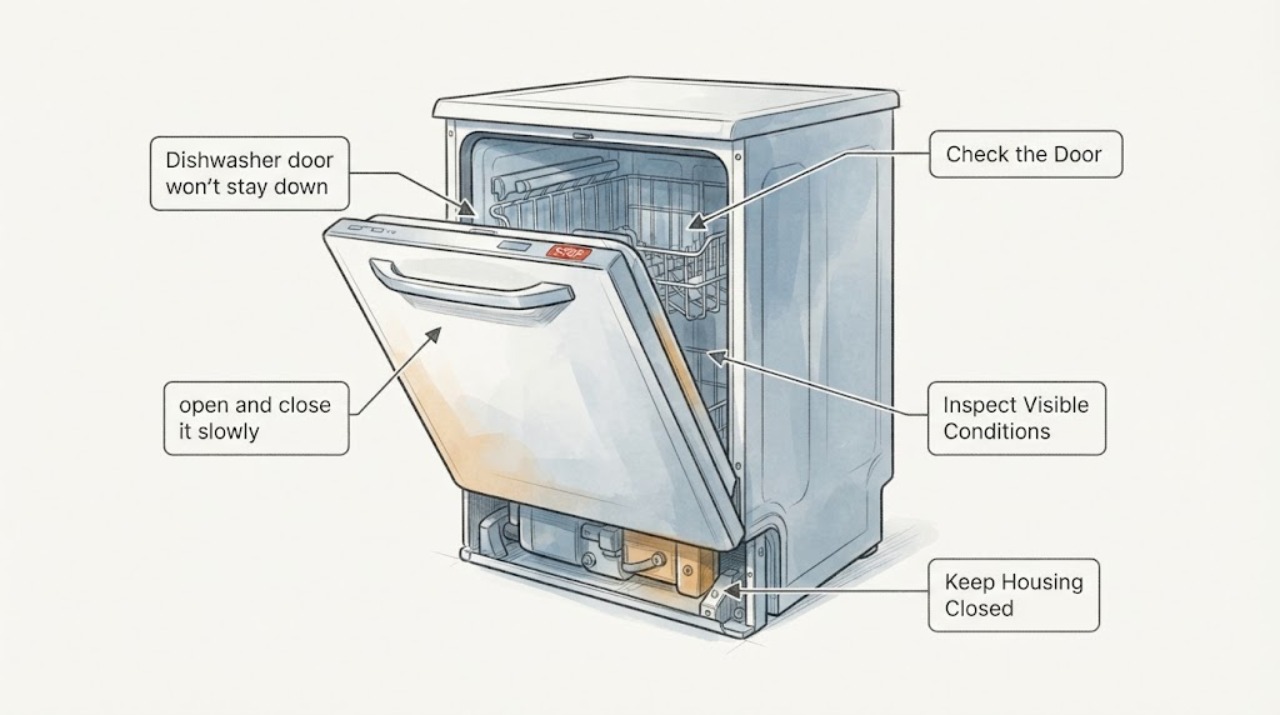
On a newly installed Beko integrated dishwasher, a door that will not stay down should be treated first as an installation, décor-panel, hinge or alignment issue. Beko says an integrated dishwasher uses a custom cupboard door, that the supplied brackets and screws must be used, and that the panel and hinges must be aligned using the model’s installation guide. Do not add weight, bend the hinges, or turn an undocumented spring or tension adjustment. Keep the door supported while checking whether the panel is securely attached, whether it catches the plinth or cabinets, and whether the appliance is level and secured. If the panel is loose, the door drops abruptly, the appliance shifts, connections leak, or the exact manual is unavailable, stop the installation and have the installer or qualified service technician correct it.
Work through in order
Diagnostic checks
Use only checks that match the exact appliance or system and its official guide.
-
Check 1
Keep the dishwasher door supported and inspect the newly fitted décor panel from the front and sides. Check whether the supplied brackets and screws are present and tight, whether the panel is centered, and whether its lower or side edges catch the plinth or adjacent cabinets.
Expected result: The panel is loose, visibly skewed, missing hardware, or catches the surrounding cabinetry; or it is secure and clears the opening.
Next step: If an obstruction is obvious, stop using the dishwasher and have the installer correct the panel using the supplied hardware and exact installation guide. Do not add improvised weights or bend the hinge.
Why this matters
Why: A loose, misaligned or obstructed panel can prevent normal door movement after installation. A clear panel does not prove that a model-specific hinge or balance mechanism is correctly set.
-
Check 2
With the door supported, open and close it slowly through its normal travel without loading it or leaning on it. Note whether it falls abruptly, rises by itself, stops only at one angle, rubs, or moves smoothly but will not remain at the intended position.
Expected result: The door drops suddenly, binds at one point, rubs the plinth, or moves smoothly without staying down.
Next step: Keep the door supported and do not continue test cycles. Photograph the panel and hinge area for the installer, then use the model-specific installation procedure or arrange qualified service.
Why this matters
Why: A sudden drop or binding indicates a safety or alignment concern; smooth movement without balance may depend on the exact panel and hinge design, which cannot be inferred without the model manual.
-
Check 3
Check the appliance’s visible position in the cabinet without forcing it: look for a gap, twist, contact with the plinth, or movement when the door is operated. If safe and accessible, confirm the unit is seated in the pre-measured space and secured as the installation guide requires.
Expected result: The unit shifts, is visibly out of level, contacts the cabinet, or appears stable and clear.
Next step: If the dishwasher shifts or correction requires disconnecting utilities, stop and call the installer or a qualified technician. Do not pull the unit by the door or panel.
Why this matters
Why: A shifted or poorly aligned integrated unit can alter door clearance and panel movement. A stable cabinet fit narrows the check toward the panel or model-specific hinge balance but does not identify a replaceable part.
-
Check 4
Find the Beko model or product number on the rating label and retrieve the matching installation guide before changing any hinge, spring, bracket or panel setting.
Expected result: The model number and manual are available, or the installed model and documentation cannot be identified.
Next step: If the model is known, follow only its documented procedure. If it is unknown or the manual does not cover the symptom, leave the door supported and have the installer or authorised service identify the correct procedure.
Why this matters
Why: The manual determines the correct door-panel hardware and any permitted adjustment. Without it, a generic setting may damage the door or create an unsafe installation.
-
Check 5
Inspect the installation area for water, exposed wiring, a loose cabinet attachment, or a door that could fall onto a person. Keep the dishwasher out of use while any of these conditions remain.
Expected result: There is a leak, exposed electrical connection, unstable appliance, loose panel, abrupt door drop, or none of these hazards.
Next step: If any hazard is present, isolate power and water only if safely accessible and contact the installer or qualified service. Do not run a cycle or continue opening and closing the door to test it.
Why this matters
Why: These are installation and injury hazards rather than routine user adjustments. A visually normal installation may still need model-specific balancing if the door will not stay down.
Use your observations
Decision map
Find the observation that best matches what you see, then follow the next safe action.
-
PATH 01Next step
What you see
The décor panel is loose, skewed, missing supplied hardware, or catches the plinth or adjacent cabinet.
Do this next
Keep the door supported and have the installer refit and align the panel with the supplied brackets, screws and exact model installation guide. Do not improvise weights or fasteners.
Why this path and its safety boundary
Why it matters: The new-installation problem is consistent with panel attachment or clearance, not a confirmed internal hinge failure.
-
PATH 02Next step
What you see
The panel is secure and clear, but the door drops abruptly or binds during travel.
Do this next
Stop using the dishwasher and request model-specific installer or authorised service inspection. Do not bend hinges, disconnect springs or remove the door skin.
Why this path and its safety boundary
Why it matters: A hinge, balance or alignment issue remains possible, but the no-model topic does not establish which mechanism or adjustment applies.
-
PATH 03Next step
What you see
The appliance shifts in the cabinet, is visibly out of level, or correction would require pulling it out or disconnecting water or power.
Do this next
Leave the door supported and arrange qualified installation service. Do not move the dishwasher by its door or panel or operate it with strained connections.
Why this path and its safety boundary
Why it matters: The installation stability or leveling must be corrected before door balance can be assessed safely.
-
PATH 04Next step
What you see
The door, panel and cabinet clearances look normal, but the door still will not stay down and the exact model manual is unavailable.
Do this next
Identify the model from its rating label and obtain the matching installation guide; if the behavior persists, have an installer or authorised technician inspect it before use.
Why this path and its safety boundary
Why it matters: The remaining balance behavior is model-specific and cannot be safely narrowed from Beko’s generic guidance.
Helpful context
Understand the symptom
Start with the new installation, not a guessed hinge fault
The assigned report gives Beko, a dishwasher, a door that will not stay down, and a new-installation condition, but no model number. Beko’s integrated-dishwasher guidance explains that a custom cupboard door is attached to the appliance. Its installation guide says the panel should use the supplied brackets and screws, and that the hinges or bottom plinth may need alignment so the door opens and closes smoothly. This makes panel fit, fastening, clearance and leveling the first checks; it does not justify assuming a broken hinge or changing spring tension.
Support the door and inspect the panel from the outside
Keep one hand or a stable support under the door while checking it. With power and water isolated if the appliance must be moved or the panel fasteners touched, look for a loose cabinet panel, missing or incorrect supplied brackets, screws that have pulled out, a panel edge catching the plinth or adjacent cabinet, or a door that is twisted relative to the appliance. Beko’s décor-door FAQ says the correct hinges and the installation guide are required; a generic hinge or spring setting is not a safe substitute.
Check leveling and cabinet clearance without forcing the unit
Beko’s installation guide says an integrated dishwasher must fit into the pre-measured cabinet space, be secured to the surrounding cabinetry, and have the door panel aligned. Check that the dishwasher has not shifted, that the panel does not hit the plinth or neighboring cabinet, and that the door opens and closes smoothly. Do not drag a connected appliance, hold it by the door or panel, or force the door past an obstruction. If correction requires pulling the appliance out, use the exact model instructions or the installer.
Use the model manual before any adjustment
The supplied topic has no model, and Beko’s manual portal says to search by the appliance model or product number. Installation guides contain model-specific safety, panel, hinge and leveling instructions. Find the rating-label model before attempting any adjustment. If the manual shows a supported adjustment, follow that document exactly; if it does not, leave hinge, cable, spring and counterbalance work to the installer or qualified service technician.
When checks do not resolve it
Need a professional?
Stop using the newly installed Beko dishwasher and contact the installer or qualified service if the door drops abruptly, the panel is loose, the appliance shifts, the door catches or will not close, any water or electrical connection leaks or is exposed, or any check would require pulling the unit out, removing the door, disconnecting springs or adjusting undocumented hinge tension.
Common questions
FAQ
Why can a newly installed Beko dishwasher door fail to stay down?
The first checks are the custom décor-panel attachment, supplied brackets and screws, cabinet clearance, leveling and model-specific hinge setup. Beko does not provide one generic balance setting for every dishwasher, so do not guess a spring adjustment without the exact manual.
Can I add a weight or bend the hinge to balance the door?
No. Beko’s guidance requires the supplied panel hardware and the matching installation guide. Improvised weights or bent hinges can make the door unsafe and can damage the appliance or cabinetry.
What should I do if the dishwasher moves when I open the door?
Stop using it and contact the installer or qualified service. Beko says an integrated unit should fit the cabinet space and be secured to the surrounding cabinetry; do not pull it by the door or panel.
What if I do not know the Beko model?
Find the rating-label model or product number and use Beko’s manual search. The manual includes model-specific installation, safety and troubleshooting information; without it, limit checks to safe visible observations and use an installer or service technician for adjustment.
Read the exact guide
Official sources
- Beko Manuals and User GuidesBeko UK · Opened official Beko manual portal used to direct the reader to the exact model manual because door-panel and hinge procedures vary by model.
- How do I fix the décor door or panel to the dishwasher?Beko UK · Opened official Beko FAQ used to require the correct hinges and exact installation guide for an integrated décor panel; it does not provide a generic adjustment sequence.
- What Is An Integrated Dishwasher?Beko UK · Opened official Beko overview used to establish that an integrated dishwasher sits behind a custom cupboard door and may be fully or slimline integrated; it does not diagnose the assigned door-balance symptom.
- How to Install and Connect a New Dishwasher: A Guide BekoBeko UK · Opened official Beko installation guide used for general integrated-dishwasher installation checks. It does not define a model-specific hinge or spring adjustment.
Community feedback
Share a repair observation
Share a plain-text repair observation. Accepted observations are published automatically; this page may take a moment to update.