
On this page
Start here
Quick answer
If a Beko dishwasher is not draining, switch it off and disconnect it before checking the removable filters and the accessible drain route. Food debris in the filter, a crushed or twisted drain hose, an incorrectly positioned hose, or a blocked sink connection can hold water in the cabinet. Clean and refit the filters, confirm the hose is routed for the exact model, and test once. If water still remains, the pump runs continuously, there is a leak, or the blockage is not safely accessible, stop and arrange qualified appliance service.
Before you begin
Safety first
- The user should not open electrical covers or the pump housing, reach into moving parts, force a built-in appliance out, or use professional drain tools inside the appliance.
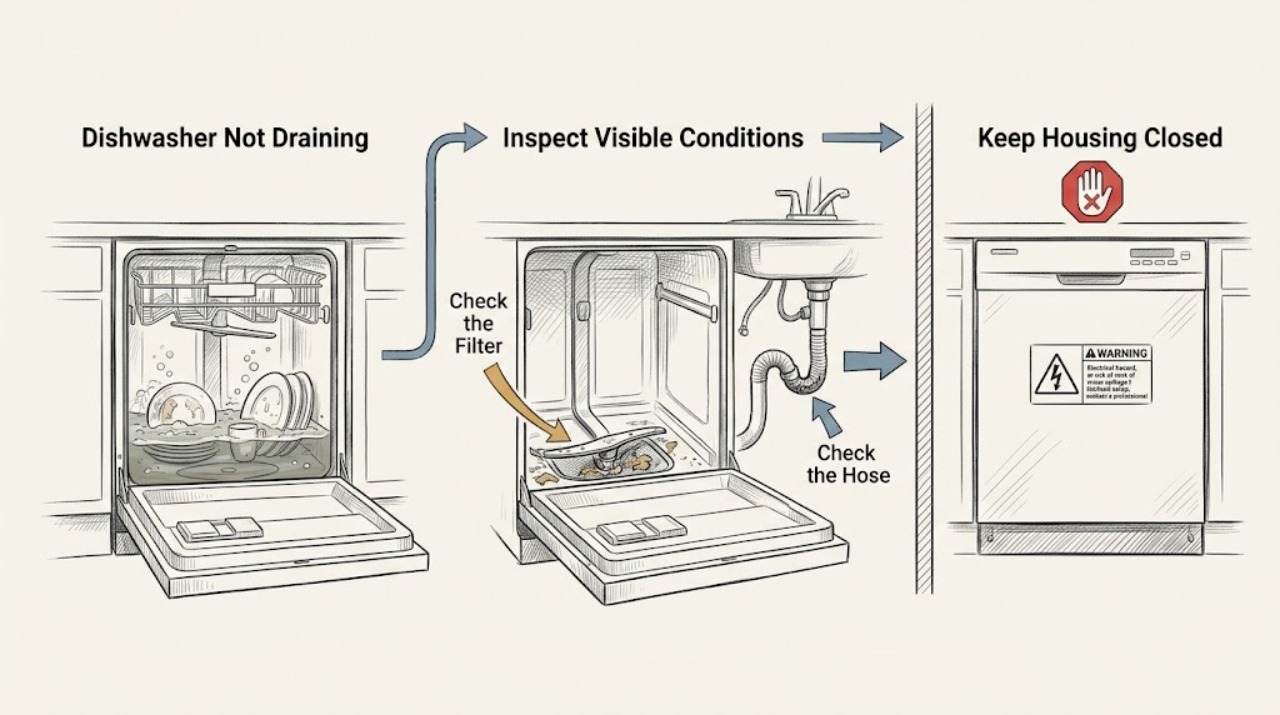
Work through in order
Diagnostic checks
Use only checks that match the exact appliance or system and its official guide.
-
Check 1
Switch the dishwasher off, disconnect it from the mains, and look at the bottom of the cabinet and the sink connection without dismantling electrical parts.
Expected result: Water is pooled after a wash, drainage is slow, the sink drains slowly too, or the dishwasher is empty but has no drainage symptom.
Next step: Continue with the filter and hose checks when water is safely contained. If the sink itself backs up or does not drain, stop using the connection and arrange qualified plumbing help for the household drain.
Why this matters
Why: Pooled water or slow drainage is consistent with a restricted filter, hose, or connected waste path. A slow sink points toward the shared household drain rather than proving that the dishwasher pump is faulty.
-
Check 2
Remove the lower basket, take out the dishwasher's drain filters as shown in the exact model manual, rinse away food residue under a tap, and refit every filter so the coarse filter is enclosed and secured.
Expected result: Food or foreign material is trapped in the filter, the filter is clear, or the filter does not sit securely after cleaning.
Next step: Clear only reachable residue and retest once with the filter correctly fitted. If the filter cannot be refitted, is damaged, or water remains after the retest, leave the appliance disconnected and arrange service.
Why this matters
Why: Debris can restrict the drain opening and contribute to slow drainage or standing water. A filter that is clear and correctly fitted makes the hose or a deeper technical fault more likely; a loose filter can also let debris circulate.
-
Check 3
Inspect the accessible drain hose for a crush, kink, twist, blockage, or an installation position outside the range stated in the exact Beko manual; Beko's general UK guidance describes a hose position between 50 cm and 100 cm above the floor.
Expected result: The hose is visibly pinched or twisted, its connection is blocked, its route is outside the model guidance, or it is accessible and appears clear and correctly routed.
Next step: Correct only an accessible routing issue and test once. Do not pull a fixed appliance out alone or loosen a water connection; if the hose needs removal, a blockage is deep, or the symptom persists, call a qualified technician.
Why this matters
Why: A restricted or incorrectly routed hose can prevent the dishwasher from pushing wastewater away. A clear, correctly routed hose shifts suspicion toward the filter connection, pump, or another internal fault rather than proving which part has failed.
-
Check 4
Check whether the dishwasher's waste connection is attached to a sink or waste outlet that is itself draining normally, and note any gurgling or backflow during the next controlled test.
Expected result: The sink or waste outlet is slow or backed up, wastewater returns toward the dishwasher, or the household drain is clear and the dishwasher still retains water.
Next step: Stop using the appliance if wastewater backs up. Have the household drain cleared by a qualified plumber when that is the source; otherwise provide the model and symptom to an appliance technician rather than opening the pump area.
Why this matters
Why: A slow shared waste path can stop the dishwasher from emptying even when its filter is clean. If the household drain is clear but the dishwasher still cannot drain, a dishwasher-side restriction or technical fault becomes more likely.
-
Check 5
Record the model number from the rating plate at the right-hand edge of the door and note whether the drain problem returns after the filter and hose checks.
Expected result: The same standing water or a recurring drainage indication returns after the accessible path is clear, or the exact model manual gives no safe user remedy.
Next step: Keep the appliance switched off and arrange authorised or otherwise qualified appliance service, supplying the model number and the observed drainage pattern.
Why this matters
Why: A recurring symptom after the basic path is clear is not evidence that a particular pump or part should be replaced; it indicates that further diagnosis is needed.
Use your observations
Decision map
Find the observation that best matches what you see, then follow the next safe action.
-
PATH 01Next step
What you see
The dishwasher has standing water and the filter contains food or foreign material.
Do this next
Clean and correctly refit the filters with the appliance disconnected, then run one test. Escalate if water remains or the filter cannot be secured.
Why this path and its safety boundary
Why it matters: A filter restriction is the most directly supported explanation for this pattern; the noisy or slow drain is less likely to be a confirmed pump failure at this stage.
-
PATH 02Next step
What you see
The filters are clean, but the drain hose is kinked, twisted, crushed, blocked, or routed incorrectly.
Do this next
Correct only a safely accessible routing problem and test once. Arrange service if the hose must be removed or the restriction returns.
Why this path and its safety boundary
Why it matters: The external drain path is a stronger explanation than an internal part replacement; the dishwasher cannot discharge reliably through a restricted route.
-
PATH 03Next step
What you see
The sink or shared waste outlet is slow or backs up while the dishwasher is trying to drain.
Do this next
Stop using that connection and arrange qualified plumbing help for the blocked household drain. Do not use the dishwasher again until the waste path is flowing normally.
Why this path and its safety boundary
Why it matters: The connected household drain is more likely to be limiting discharge than the dishwasher alone; continued dishwasher use may send wastewater back toward the appliance.
-
PATH 04Next step
What you see
The filters, hose route, and connected drain are clear, but water remains or a drainage symptom returns.
Do this next
Leave the appliance isolated and arrange qualified appliance service. Do not open the pump housing or select a replacement part without a model-specific diagnosis.
Why this path and its safety boundary
Why it matters: The remaining pattern is less consistent with an accessible blockage and more consistent with a deeper restriction or technical problem that cannot be identified safely from this symptom alone.
Helpful context
Understand the symptom
Identify what is left in the cabinet
A little moisture below the filter can be normal on some designs, but a pool of water after a completed programme, slow drainage, or a programme that cannot finish points to a drainage problem. Note whether you hear gurgling, thumping, shaking, or a pump that keeps running; that pattern helps distinguish a restriction from a fault that needs service.
Make the first inspection safe
Turn off the dishwasher and disconnect it from the mains before removing filters or examining a hose. Use gloves and towels for standing water. Do not reach into an operating pump, remove electrical covers, force a built-in appliance out, or use professional drain tools inside the machine.
Only after diagnosis
Potential parts
- dishwasher drain hose
Consider this only if the hose is visibly damaged or a technician confirms that a hose restriction cannot be cleared; a single kink or poor route does not by itself prove replacement is needed.
Confirm the exact Beko model, hose length, connection type, and approved fit information before ordering. - dishwasher drain pump
Consider this only after the filters, hose, and connected waste path are clear and a technician confirms a pump fault; standing water alone is not enough to identify the pump.
Drain pumps vary by exact Beko model and revision; use the appliance model and a confirmed diagnosis to verify compatibility.
When checks do not resolve it
Need a professional?
A technician should assess persistent standing water or a recurring drainage fault after the model-specific filter, hose, and connected waste checks.
Safety scope: The user should not open electrical covers or the pump housing, reach into moving parts, force a built-in appliance out, or use professional drain tools inside the appliance.
Common questions
FAQ
Why is my Beko dishwasher leaving water in the bottom?
Start with the disconnected appliance's drain filters, then inspect the accessible hose and connected sink waste. Food debris, a restricted hose, or a slow shared drain can all prevent discharge; if those paths are clear and water remains, arrange service.
How do I clean the filter when my Beko dishwasher will not drain?
Switch off and disconnect the appliance, remove the lower basket and filters as shown in the exact model manual, rinse residue under a tap, and refit the filters securely. If the filter is damaged or the water remains after one test, stop and seek qualified help.
Can a kinked drain hose stop a Beko dishwasher from draining?
Yes. A crushed, twisted, blocked, or incorrectly routed hose can restrict wastewater flow. Correct only an accessible routing issue and follow the exact model manual; do not force a built-in appliance out or loosen a connection if water could spill.
Should I replace the drain pump because water remains?
Not from standing water alone. First rule out the filter, hose, and connected waste path. A pump should be considered only after those checks are clear and a technician confirms the fault for the exact model.
Read the exact guide
Official sources
- Why Is My Dishwasher Not Draining?Beko UK · Beko dishwasher not draining, standing water, slow drainage, or a blocked drain route
- Water will not drain from my Beko dishwasher.Beko UK · Beko dishwasher not draining: drain hose position and filter checks
- Dishwasher RepairsBeko UK · Beko dishwasher not draining when filter and hose checks do not resolve the fault
Community feedback
Share a repair observation
Share a plain-text repair observation. Accepted observations are published automatically; this page may take a moment to update.