
On this page
Start here
Quick answer
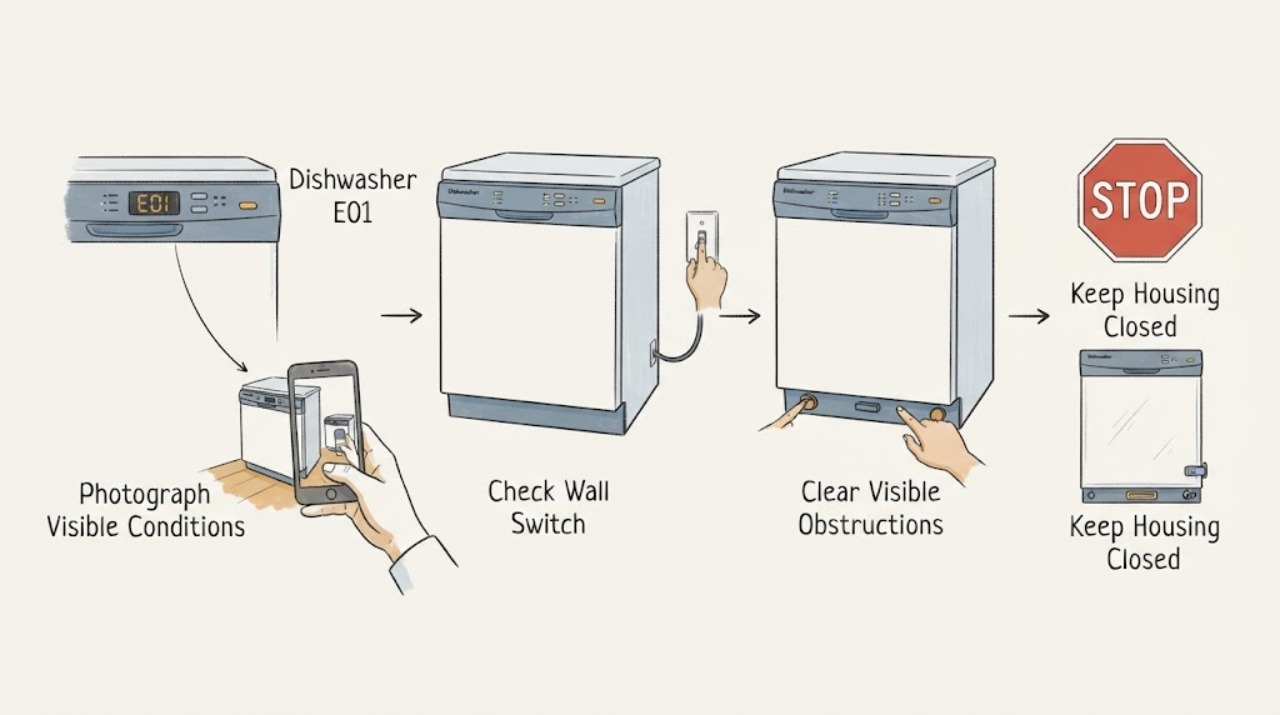
Do not treat Beko dishwasher E01 as a universal code without the model and market. Beko Australia's opened dishwasher help page uses a P1 indicator together with E01 for a water-safety condition involving too much water or a leak, but that regional guidance cannot establish the meaning for every Beko platform. First photograph the complete display and find the product or model number on the door edge. If there is water around the dishwasher, water collecting in or under it, or an active leak, stop the program, close the accessible water valve, and isolate power only when the area is dry and the plug or switch is safely reachable. Do not pull out, tilt, reset repeatedly, open the enclosure, or disconnect a hose under the cabinet. Check only visible supply and drain paths; if E01 persists or the model cannot be matched, use authorized Beko service.
Before you begin
Safety first
- Stop and keep the dishwasher off for active leakage, water near electrical parts, continuing overflow, a damaged cord or outlet, smoke, or a non-latching door. Do not pull out or tilt an unidentified built-in machine, open panels, bypass the door latch, disconnect a pressurized hose, or perform live electrical tests. Close the accessible water valve for an active leak or overflow and isolate power only from a dry, safe location.
Work through in order
Diagnostic checks
Use only checks that match the exact appliance or system and its official guide.
-
Check 1
Photograph the complete display and indicator lights before clearing anything. Record whether the panel shows E01 alone or a P1 indicator with E01, then find the product or model number on the rating plate at the door edge or another user-accessible label.
Expected result: The panel clearly shows P1/E01, shows E01 without P1, shows a different code, or the model and product code cannot be read.
Next step: Keep the photo and identity details for the matching manual or authorized service. If the model is unavailable, limit the response to the water, power, door, and visible hose safety checks below.
Why this matters
Why: Beko Australia's page specifically documents the P1/E01 pairing for excessive water or leakage, but without the model and market that meaning remains conditional. An incomplete code or unidentified platform cannot safely support a part or reset instruction.
-
Check 2
Stop the program. Look around the door, plinth, visible hose connections, and floor for water without pulling the dishwasher from its cavity. If there is active leakage or water collecting around the appliance, close the accessible dishwasher water valve. Isolate power only if the floor and electrical area are dry and the switch or plug is safely reachable without moving the machine.
Expected result: There is active leakage, pooled water, a damp base or plinth, water only inside the tub, or no visible water.
Next step: For active leakage or water near electrical parts, leave the appliance off and arrange authorized appliance service. Do not restore power to see whether E01 clears and do not remove panels or tilt the dishwasher.
Why this matters
Why: Water around or under the appliance makes E01 a water-safety branch and can leave hidden components wet. Water only in the tub may be a drain or normal end-of-cycle condition, but E01 still cannot be mapped confidently without the model.
-
Check 3
With the dishwasher stopped and stable, inspect only the visible water-supply tap, inlet hose, drain hose, drain connection, and accessible sink-trap area for a closed tap, crushed hose, obvious leak, or visible obstruction. Do not disconnect a pressurized connection, reach into the sump, or use a chemical drain product.
Expected result: A visible tap or hose problem is present, the drain connection or sink trap is visibly obstructed, or all accessible paths look normal.
Next step: Correct only an obvious external tap or hose position when it can be done without moving the appliance, then keep it off until the model-specific instructions or service confirm the next step. If the paths look normal or E01 returns, arrange authorized service or a plumbing assessment for a household drain issue.
Why this matters
Why: Beko's general water guidance treats drain installation, bent or blocked supply and drain hoses, and accessible filter or drain obstructions as first external checks. A clear exterior does not rule out an internal leak, water-level protection, valve, pump, or control fault, and does not identify a specific part.
-
Check 4
Without opening the enclosure, note whether the display is lit and whether the door closes and latches normally. If the display is dark, compare another nearby household appliance without touching wet electrical areas; if the door is cracked or will not latch, do not force it.
Expected result: The display is dark, the display is lit but the door will not latch, the door closes normally, or the breaker or fuse will not hold.
Next step: Leave electrical diagnosis to a qualified electrician or appliance technician. For a damaged or non-latching door, stop using the dishwasher and contact authorized Beko service; do not bypass the latch or test wiring.
Why this matters
Why: Beko's start guidance separates household power and door-closure conditions from a continuing technical problem. A dark display or unstable supply is not evidence about E01's water meaning, and a damaged or non-latching door is a safety hardware issue.
-
Check 5
Do not pull out or tilt an unidentified dishwasher, and do not copy a regional E01 recovery sequence or repeat resets. Keep the exact display photo, water observations, and model search result for the service request.
Expected result: E01 disappears after the appliance is switched off, returns when power is restored, or remains continuously displayed.
Next step: Keep the dishwasher out of service until the water path and appliance have been assessed by authorized Beko service. Include the market, full model or product code, code format, water location, and whether the supply valve was closed.
Why this matters
Why: A cleared warning does not prove the leak or water-protection condition is resolved. A returning or persistent code needs the exact manual and a service diagnosis; the absence of a model prevents a safe platform-specific recovery instruction.
Use your observations
Decision map
Find the observation that best matches what you see, then follow the next safe action.
-
PATH 01Next step
What you see
E01 is paired with P1 and there is water around or under the dishwasher, an active leak, or continuing overflow.
Do this next
Stop the program, close the accessible water valve, isolate power only from a dry safe location, and arrange authorized appliance service. Do not pull out, tilt, restart, or open the appliance.
Why this path and its safety boundary
Why it matters: This matches the limited Beko Australia P1/E01 water-safety description, but it still does not identify the leaking component or prove that the same table applies outside that region.
-
PATH 02Next step
What you see
The display says E01 but there is no P1 indicator, the model or market is unknown, or the code cannot be photographed clearly.
Do this next
Keep the machine off, obtain the door-edge model or product code, and use the matching manual or authorized service. Limit user checks to visible power, door, supply, drain, and leak conditions.
Why this path and its safety boundary
Why it matters: The available official P1/E01 evidence cannot be safely generalized to this appliance. The code may belong to a different Beko platform or display convention.
-
PATH 03Next step
What you see
There is no active leak, but an accessible supply tap is closed, a visible hose is crushed, or the drain connection or sink trap is visibly blocked.
Do this next
Correct only the obvious external condition without moving the dishwasher, then follow the exact model manual. If E01 remains, stop and arrange authorized appliance service or a plumber for the household drain side.
Why this path and its safety boundary
Why it matters: An external water-path condition can affect filling or draining and should be corrected before an appliance fault is assumed, but it does not confirm what E01 means on an unknown model.
-
PATH 04Next step
What you see
The display is dark, the breaker or fuse will not hold, the door is cracked, or the door will not latch even after visible loading interference is removed.
Do this next
Leave the dishwasher off and use qualified electrical or authorized appliance service. Do not bypass the latch, open the enclosure, or test live wiring.
Why this path and its safety boundary
Why it matters: This is a household supply or door-hardware branch, not a safe opportunity to infer a water code or open the appliance.
-
PATH 05Next step
What you see
E01 disappears temporarily but returns, or the appliance continues to show the warning after the accessible checks.
Do this next
Stop repeating resets and provide service the exact model or product code, region, display format, water location, visible hose findings, and recurrence timeline.
Why this path and its safety boundary
Why it matters: The underlying condition remains unresolved; a reset or temporary drain does not establish that the appliance is safe or that a specific valve, pump, sensor, or control is defective.
Helpful context
Understand the symptom
What E01 can mean, and why the model matters
In Beko Australia's opened dishwasher FAQ, P1/E01 is associated with excessive water or a leak, and the page describes a safety response while overflowing continues. That is useful evidence for treating E01 as a possible water-safety warning, not a reason to keep restarting. It is not a universal Beko code table: the assigned appliance has no model, product code, or market, so do not carry the P1/E01 pairing to another series as a guaranteed diagnosis.
The safe boundary when a regional page suggests moving the appliance
The Australian FAQ includes a tilt-based clearing sequence for its own help context. Do not copy that movement instruction to an unidentified dishwasher. A built-in appliance may be connected to water, drain, power, or cabinetry in a way that makes pulling it out or tipping it unsafe, and the topic does not establish the required installation or model conditions. Keep the dishwasher stopped and use the external checks below instead.
When checks do not resolve it
Need a professional?
Use authorized Beko appliance service when E01 is persistent or returns, the model or market cannot be matched, the appliance leaks or overflows, water remains unexpectedly, the door will not latch, or diagnosis would require accessing the base, valve, pump, sensor, wiring, or control. Add a qualified plumber when the visible household drain or sink trap is blocked; add an electrician when the display is dark with household power present or the breaker will not hold.
Safety scope: Stop and keep the dishwasher off for active leakage, water near electrical parts, continuing overflow, a damaged cord or outlet, smoke, or a non-latching door. Do not pull out or tilt an unidentified built-in machine, open panels, bypass the door latch, disconnect a pressurized hose, or perform live electrical tests. Close the accessible water valve for an active leak or overflow and isolate power only from a dry, safe location.
Have this ready
- Provide the full model or product code, market or country, a photo of the display and indicator lights, whether P1 accompanies E01, the code timing, water location, supply-valve position, visible hose and drain observations, and whether the code returned after power was removed.
Common questions
FAQ
Does every Beko dishwasher use E01 for an overflow?
That cannot be established without the model and market. Beko Australia's help center associates P1/E01 with too much water or a leak, but that is regional guidance and should not be treated as a universal code table.
Should I tilt the dishwasher to clear E01?
Not when the model, installation, and region are unknown. Do not pull out or tilt a built-in dishwasher as a generic remedy. Stop, close the accessible water valve for a leak, and arrange model-specific authorized service.
Can I reset E01 and keep using the dishwasher if the water disappears?
No. A temporarily clear display does not prove the leak or water-protection condition is resolved. Preserve the code and water timeline, and stop repeating resets if E01 returns.
What model information does service need?
Provide the full product or model code from the rating plate at the door edge, the country or market, the complete display and indicator pattern, where water was seen, and which external supply or drain checks were made.
Read the exact guide
Official sources
- How to fix a dishwasher that won’t take in waterBeko · General Beko US support page used only for visible supply, drain-hose, and accessible drain-filter checks; it does not establish a universal E01 meaning.
- Help Center Result | Beko AustraliaBeko Australia · Opened regional Beko Australia help-center FAQ; it explicitly associates P1/E01 with excessive water or a leak, but it is not a model- or market-universal code table.
- How to fix a dishwasher that won’t startBeko · General Beko US support page used only for external power, door-latch, and authorized-service boundaries; it does not establish a universal E01 meaning.
- Dishwasher RepairsBeko UK · Opened Beko UK repair page used for the location and importance of the product/model number, not for cross-market E01 interpretation.
Community feedback
Share a repair observation
Share a plain-text repair observation. Accepted observations are published automatically; this page may take a moment to update.