
On this page
Start here
Quick answer
Do not apply a Bosch or another brand's E01 meaning to a Beko dishwasher. Beko Australia's opened dishwasher help page maps P1/E01 to a too-much-water or leak condition and says the safety algorithm attempts to discharge water; that evidence is region- and model-scoped. Stop the cycle, switch off power or unplug only from a dry and safely accessible position, and close the dishwasher water valve if it is safely accessible. Check only visible water and accessible external drain connections, and do not pull out a built-in unit, tilt it, open the base, or repeatedly restart it. Find the model label on the right-hand side of the door frame and use the matching regional Beko manual. If E01 returns, water is visible, or the check would require moving panels or testing inside the appliance, keep it out of service and arrange authorized service.
Before you begin
Safety first
- This no-model article is limited to identifying the display, safely isolating accessible power and water, observing visible water and external connections, and locating the model label. Do not pull out or tilt a built-in dishwasher, remove the base or panels, test live wiring, bypass overflow protection, or choose an inlet valve, pump, float, sensor, or control board from E01 alone.
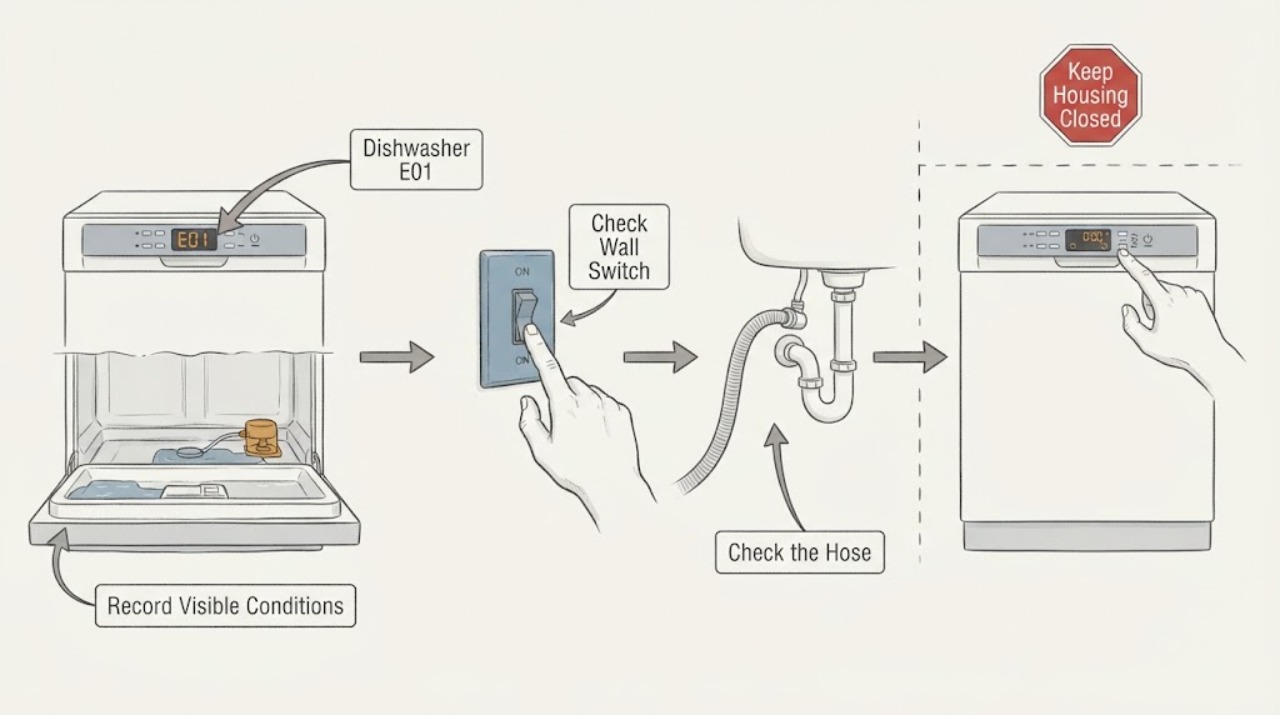
Work through in order
Diagnostic checks
Use only checks that match the exact appliance or system and its official guide.
-
Check 1
Record exactly what the display shows, including E01 versus P1, flashing symbols, and whether the dishwasher is draining continuously. Locate the full model label on the right-hand side of the door frame and note the country or service region.
Expected result: The display is E01/P1 and the model and region can be read, or the display/code or identity is different or incomplete.
Next step: If the identity is incomplete, stop at model lookup and do not decode the code from another brand. If it matches, continue with the safe isolation check.
Why this matters
Why: Beko's opened Australia page links P1/E01, in that regional help context, to excess water or a leak. A different display or missing model prevents safe transfer of that meaning.
-
Check 2
Stop the dishwasher. Switch it off at the wall or unplug it only if the connection is dry and safely accessible, and close the dishwasher water valve if that shutoff is visible and safe to reach. Do not reach behind a wet appliance or repeat the cycle.
Expected result: Power and water can be isolated without moving the appliance, or the connection is wet, inaccessible, damaged, or unsafe to reach.
Next step: If isolation is unsafe, leave the appliance alone and contact service or an appropriate qualified professional. If isolation is safe, inspect only visible areas next.
Why this matters
Why: Isolation limits further filling and electrical exposure; an inaccessible or wet connection is itself a service boundary rather than a reason to move the dishwasher.
-
Check 3
With the appliance stopped, look from outside for water on the floor, at the visible door edge, and at accessible drain-hose or sink-trap connections. Inspect only a connection that is plainly reachable without pulling the dishwasher out or removing a panel.
Expected result: Water or a visible leak is present, the visible external path is obstructed, or no visible water is found.
Next step: Keep the dishwasher isolated when water is present or the code persists. Do not clear an obstruction by opening the appliance; use the exact manual or authorized service for the next step.
Why this matters
Why: Visible water supports the water-safety interpretation but does not identify an inlet valve, pump, float, sensor, or control-board fault. A clear visible area does not rule out water in the base.
-
Check 4
Use the full model number and region in Beko's manual/support lookup, then compare the exact E01/P1 wording and the permitted external checks in that manual. Do not substitute a Bosch code explanation or a manual from a different Beko family.
Expected result: The matching manual confirms the E01/P1 water or overflow mapping, or no matching manual/code mapping can be verified.
Next step: Follow only the matching manual's safe external steps. If no match is available, keep the appliance out of service and provide the model and display details to Beko service.
Why this matters
Why: A confirmed manual mapping narrows the meaning for that model family; an unmatched code remains model-scope unresolved even if another Beko page uses the same characters.
-
Check 5
Arrange Beko or authorized service if E01 returns, the dishwasher remains in drain-only behavior, water is visible, or any next check would require moving the built-in unit, opening the base, or testing wiring or components.
Expected result: The code persists after safe isolation, the machine has water in or under it, or the remaining diagnosis requires protected access.
Next step: Keep power and water isolated when safe, protect the surrounding floor, and give service the model, region, exact display, cycle, visible water location, recent installation history, and any accessible hose observation.
Why this matters
Why: The public evidence supports a water-safety response, not a consumer diagnosis of the failed internal part. Continued operation can worsen water or electrical damage.
Use your observations
Decision map
Find the observation that best matches what you see, then follow the next safe action.
-
PATH 01Next step
What you see
E01/P1 is confirmed on a Beko model whose matching regional manual or help page maps it to excess water, leak, or base-water protection, and water is visible.
Do this next
Keep the dishwasher stopped, isolate power and water only when safely accessible, and arrange authorized service. Do not run another cycle or open the base.
Why this path and its safety boundary
Why it matters: The condition is consistent with the model-scoped water-safety warning; it is not proof of a particular valve, pump, sensor, or board failure.
-
PATH 02Next step
What you see
E01/P1 persists or the dishwasher only tries to drain, but no water is visible from the outside.
Do this next
Leave it isolated, do not tilt or pull out the unit, and use the exact model manual or authorized service to inspect the protected area.
Why this path and its safety boundary
Why it matters: Water may be in a protected base area or the display may have a model-specific meaning that has not been verified; the absence of visible water does not clear the appliance.
-
PATH 03Next step
What you see
The exact regional manual does not identify E01/P1 for the supplied model, or the display is not actually E01/P1.
Do this next
Record the model, region, display characters, and indicator pattern, then use the matching Beko support route. Do not keep restarting to test a guessed meaning.
Why this path and its safety boundary
Why it matters: The Beko code identity is unresolved, so applying the Australia page or another appliance brand's explanation would be an unsupported diagnosis.
-
PATH 04Next step
What you see
The code clears once after safe isolation, no water or electrical hazard is visible, and the exact manual permits a limited external check.
Do this next
Follow only the matching manual, monitor for recurrence without repeated test cycles, and arrange service if E01 returns or any leak appears.
Why this path and its safety boundary
Why it matters: A transient protection event is possible, but a cleared display does not establish that the underlying condition is gone.
Helpful context
Understand the symptom
E01 is not a transferable appliance code. The opened Beko Australia help page calls the related P1/E01 indication a response to too much water or a leak, while Beko support pages require the model number for manual-level instructions. Because Beko code displays and procedures can vary by model and country, use that meaning only as a conditional starting point until the door-frame model label and regional manual match.
A safe first response is to stop the cycle and isolate water and electricity only where the shutoff and power connection are dry and safely reachable. Look for water on the floor and at visible hose or sink connections. Do not pull a built-in dishwasher from its cavity, tilt it, remove its base or panels, or keep restarting it to see whether the code clears.
If the exact manual confirms the E01/P1 mapping and the visible checks do not resolve the condition, the result is a service handoff rather than a part diagnosis. Persistent E01, water in or under the appliance, a wet electrical area, or any need to access the base requires Beko or authorized service.
When checks do not resolve it
Need a professional?
Call Beko or an authorized servicer when E01 returns, water is visible or suspected in the base, the dishwasher remains in drain-only behavior, power or water cannot be isolated safely, or the matching manual is unavailable. Do not continue operating the appliance to identify an internal component.
Safety scope: This no-model article is limited to identifying the display, safely isolating accessible power and water, observing visible water and external connections, and locating the model label. Do not pull out or tilt a built-in dishwasher, remove the base or panels, test live wiring, bypass overflow protection, or choose an inlet valve, pump, float, sensor, or control board from E01 alone.
Common questions
FAQ
What does E01 mean on a Beko dishwasher?
In Beko Australia's opened help-center guidance, P1/E01 is associated with taking too much water or a leak and the dishwasher's safety discharge response. Treat that as a regional/model-scoped mapping; confirm the full model and local manual before applying it.
Can I use a Bosch E01 explanation for a Beko dishwasher?
No. Error-code meanings are manufacturer- and model-specific. Use the Beko model label and matching regional manual; do not transfer a Bosch code meaning or a different Beko family's procedure.
Where is the Beko dishwasher model number?
Beko's US manual lookup guidance says the dishwasher model sticker is on the right-hand side of the door frame. Record the full number and region before looking up E01/P1 instructions.
Should I tilt or pull out the dishwasher to clear E01?
Do not do that on an unspecified built-in model. Keep power and water isolated when safe, inspect only accessible external areas, and use the exact manual or authorized service for any base-water or protected-area inspection.
Read the exact guide
Official sources
- Help Center Result | Beko US DishwasherBeko USA · Opened Beko's US dishwasher help page. It routes owners to model-specific guidance and warns that hot water or steam can escape when opening the door during a cycle; it is used for the external-check and service boundary, not for an unverified universal E01 definition.
- Help Center | Beko USBeko USA · Opened Beko's US support center. It directs owners to select the product, search user manuals by model number, and use the support/contact route for unresolved appliance issues.
- User Manual | Beko USBeko USA · Opened Beko's US manual lookup page. It provides model-number search and says the dishwasher model sticker is on the right-hand side of the door frame; it is used here to require model and region matching rather than as unseen E01 technical evidence.
- Help Center Result | Beko Australia (Dishwashers)Beko Australia · Opened the Beko Australia dishwasher help center. Its P1 FAQ says that taking too much water or a leak can make P1/E01 flash and that a safety algorithm attempts to discharge water. This is regional/model-scoped evidence, not a universal Beko code table.
Community feedback
Share a repair observation
Share a plain-text repair observation. Accepted observations are published automatically; this page may take a moment to update.