
On this page
Start here
Quick answer
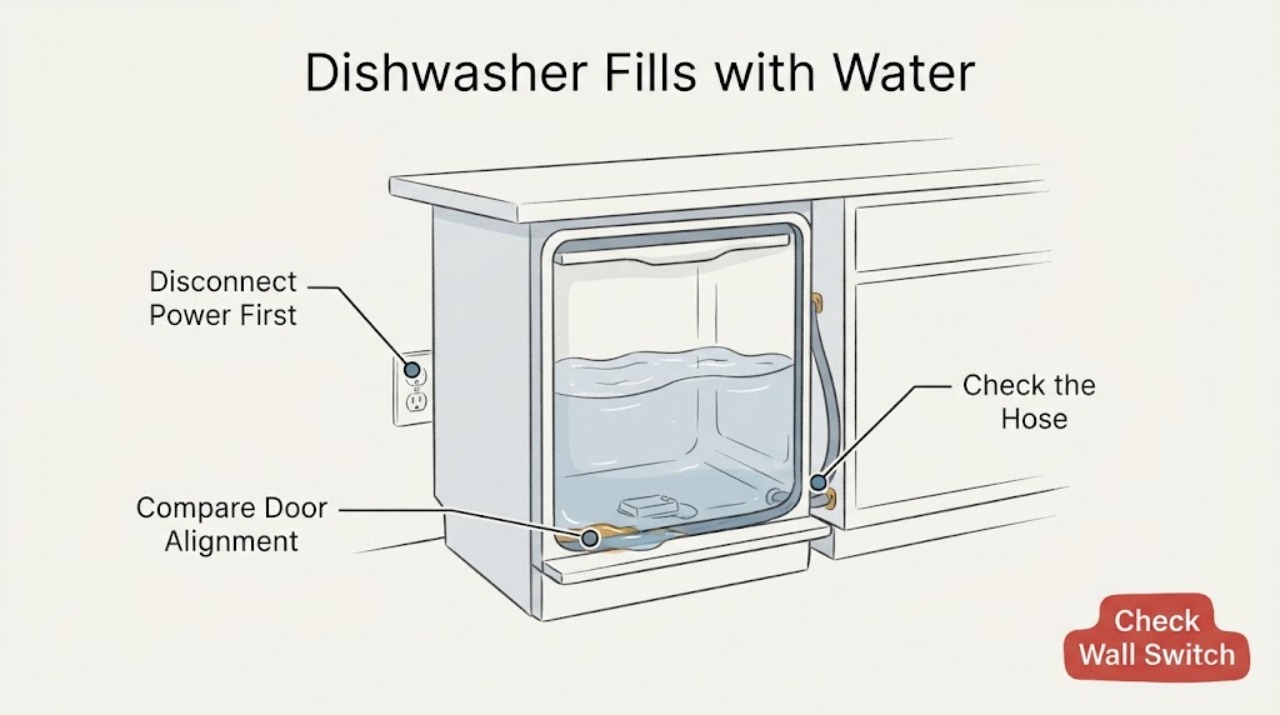
If a Beko dishwasher is gaining water while it is off or is leaking, close the dishwasher's water-supply tap immediately, switch off and unplug it when safe, and mop up the water. Do not run another cycle to locate the leak. First determine whether the water level rises with the supply closed, which points toward retained water or drain backflow, or only when the supply is open, which requires a model-specific water-inlet diagnosis. From the outside, check the inlet and drain hose connections, door seal, drain hose and accessible filter as the exact manual permits. If water returns, the leak is underneath, the source is hidden, or the appliance cannot be made safe without removing panels, leave it isolated and arrange Beko or qualified service; do not test or replace an inlet valve from the symptom alone.
Work through in order
Diagnostic checks
Use only checks that match the exact appliance or system and its official guide.
-
Check 1
Close the dishwasher's water-supply tap, switch off the appliance and unplug it if the plug and floor are dry and safely reachable. Mop visible water and note whether the water was inside the tub, at the door, under the cabinet or at a hose connection.
Expected result: Water stops arriving after the tap is closed, or water continues to appear even with the supply closed.
Next step: Keep the tap closed and the dishwasher isolated while making only the accessible checks below. Do not restart a cycle to reproduce the leak.
Why this matters
Why: Stopping with the tap closed makes an active supply path possible; continued water can be retained water, drain backflow or a separate leak. Neither observation identifies a replacement part.
-
Check 2
From outside the appliance, inspect the accessible water-inlet and drain-hose connections for drips, loose fittings, crushed sections, kinks or a hose that is routed contrary to the exact installation manual. Do not pull an integrated dishwasher out across a wet floor or reach behind energized equipment.
Expected result: A connection or hose is visibly wet, loose, kinked or damaged, or the accessible connections are dry while water was found elsewhere.
Next step: Leave the supply closed. Correct only an accessible connection or hose position exactly as the manual permits; for damage, an inaccessible route or a continuing leak, arrange service instead of opening panels.
Why this matters
Why: Beko identifies inlet/drain connection leaks and a kinked or blocked drain route as external causes that can produce water damage or poor drainage. A dry connection does not rule out an internal leak.
-
Check 3
With the appliance isolated and the door open, inspect the lower door seal and its contact area for food, glass or other debris. Wipe the accessible seal gently with a damp cloth without lifting it out or forcing the door alignment.
Expected result: Debris is trapped at the seal, the seal is torn or displaced, or the door area is clean and the leak is not from the bottom of the door.
Next step: Remove only loose accessible debris. Keep the dishwasher isolated and consult Beko service for a damaged seal, misalignment or any leak that remains.
Why this matters
Why: Beko says debris in the door seal can allow a bottom-of-door leak; a torn or persistently leaking seal requires model-specific repair. A clean seal shifts attention toward the drain route or an internal source.
-
Check 4
If the exact manual permits owner filter maintenance, remove the lower basket and clean the accessible drain filters with water, towels and a container ready for residual water. Check the visible drain hose for blockage or twisting only after power is off; do not use a drain snake, sharp object or internal disassembly.
Expected result: The filter or hose has food residue/blockage and the standing water improves after the permitted clean, or both are clear and water still returns or leaks.
Next step: Reinstall the filter exactly as the manual directs. If the water returns, the leak continues, or the blockage is not safely accessible, stop and request service.
Why this matters
Why: Beko links slow drainage, water collecting in the tray and abnormal gurgling/thumping to a possible filter or drain blockage. Clearing an accessible filter does not prove that an internal leak or inlet fault is fixed.
-
Check 5
Do not perform another cycle while the source of an active leak or unexpected filling is unknown. If the supply remains closed, the floor is dry and the exact manual or service provider has cleared a supervised test, watch one short test only for the first sign of water and stop immediately if water returns.
Expected result: The supervised test remains dry and the water level behaves as the manual describes, or any unexpected filling, leak, overflow, pump-only behavior or floor water recurs.
Next step: For recurrence, close the tap, unplug when safe and provide service with the model, water-level timing, leak location and the results of the hose, seal and filter checks. Do not remove panels or test a valve, float or control.
Why this matters
Why: A dry test does not identify or permanently clear an intermittent fault. Any recurrence confirms that the appliance needs a model-specific diagnosis and should not be left unattended.
Use your observations
Decision map
Find the observation that best matches what you see, then follow the next safe action.
-
PATH 01Next step
What you see
The water level rises only while the supply tap is open, including when the dishwasher is switched off.
Do this next
Keep the tap closed and the appliance unplugged when safe. Do not order or replace an inlet valve from the symptom alone; arrange Beko or qualified service.
Why this path and its safety boundary
Why it matters: An active water-inlet path is possible, but the evidence does not distinguish the inlet valve, control or another model-specific safety condition.
-
PATH 02Next step
What you see
Water remains after a cycle but does not rise with the supply tap closed, and the filter or drain hose shows residue, a kink or a blockage.
Do this next
With power off, clean only the accessible filter or correct the hose route under the exact manual. If water remains or leaks afterward, use service.
Why this path and its safety boundary
Why it matters: Retained water or poor drainage is more likely than random active filling; Beko links water collection and slow drainage with a possible filter or drain blockage.
-
PATH 03Next step
What you see
Water leaks from the bottom of the door and debris is present at the seal, or the seal is damaged or displaced.
Do this next
Remove loose debris only, keep the dishwasher isolated and arrange service for a torn, displaced or persistently leaking seal.
Why this path and its safety boundary
Why it matters: The door-seal area is a supported external lead for a bottom-of-door leak, but a damaged seal or alignment fault needs model-specific repair.
-
PATH 04Next step
What you see
The source is underneath or inside the cabinet, the leak returns after hose/seal/filter checks, or water appears with the supply closed and the appliance isolated.
Do this next
Keep the water tap closed and power isolated, protect the floor and arrange Beko or qualified service. Do not tip the dishwasher, defeat a flood safeguard or run it with panels removed.
Why this path and its safety boundary
Why it matters: The fault exceeds safe external diagnosis. A hidden hose, inlet, drain, base protection or control condition cannot be selected from the symptom alone.
Helpful context
Understand the symptom
Separate active filling from water left in the appliance
Water at the bottom of a dishwasher can be retained after a cycle, return through an incorrectly routed drain connection, or enter through the supply while the appliance is idle. The supplied topic has no model number, so the symptom does not identify an inlet valve, control, float or pump. Closing the supply tap and observing whether the level can rise is a safe classification step; it is not an invitation to open the machine or test an energized component.
A leak changes the stopping point
A small leak is still a water-damage and electrical-safety issue. Beko's public guidance limits the owner checks to accessible seals, hoses and filters, then directs the user to the manual and customer service when the leak continues. Do not repeatedly start cycles, tip an integrated dishwasher, remove side panels, bridge a float or replace a valve based only on random filling.
When checks do not resolve it
Need a professional?
Stop use and arrange service for any active or recurrent leak, water entering while the dishwasher is off, water under the cabinet, a damaged door seal, persistent standing water or a source that cannot be reached without disassembly.
Common questions
FAQ
Why can a Beko dishwasher have water in it after it is switched off?
Water may be retained because draining is restricted or may be entering through the supply, but the symptom alone does not identify the cause. Close the supply tap, isolate the appliance and check only the accessible drain, hose and seal areas under the exact manual.
Should I keep running short cycles to find the leak?
No. An active or intermittent leak can damage the floor and create an electrical hazard. Close the water tap, unplug when safe and use the visible external checks; arrange service if the source is not obvious.
Could a dirty filter make the dishwasher fill and leak?
A blocked filter can contribute to slow drainage and standing water, which may be mistaken for unexpected filling. Beko supports cleaning the accessible filters, but recurrence or a continuing leak needs service and does not prove a valve fault.
Can I replace the water-inlet valve myself?
Do not choose a valve from random filling alone. Beko recommends professional assistance when water-related checks do not resolve the problem; model-specific diagnosis is needed before any internal repair or part selection.
Read the exact guide
Official sources
- My appliance is leaking from the bottom of the door, what should I do?Beko UK Support · Opened Beko UK support FAQ. Used for the documented external checks and service escalation for a bottom-of-door leak; no model-specific seal part or internal repair is inferred.
- How to Install and Connect a New Dishwasher: A Guide BekoBeko UK Support · Opened Beko UK installation guide. Used for accessible connection and hose-routing checks; installation details are conditional on the actual model and site, and the article does not instruct testing an actively leaking unit.
- What To Do When A Dishwasher Did Not DrainBeko UK Support · Opened Beko UK support FAQ. Used for standing-water and drainage observations plus the instruction to switch off/unplug before hose access; model-specific hose dimensions remain manual-dependent.
- How to clean a dishwasherBeko UK Support · Opened Beko UK cleaning guide. Used for accessible filter/seal cleaning and the warning not to use a sharp object on impeller openings; no panel removal or internal repair is suggested.
- Why is my Beko dishwasher not filling with water?Beko UK Support · Opened Beko UK support FAQ. Used for the relationship between water-related problems, draining, inlet-hose condition and the manufacturer's no-self-repair/service boundary; it does not define a fault for an unidentified model that fills while off.
Community feedback
Share a repair observation
Share a plain-text repair observation. Accepted observations are published automatically; this page may take a moment to update.