
On this page
Start here
Quick answer
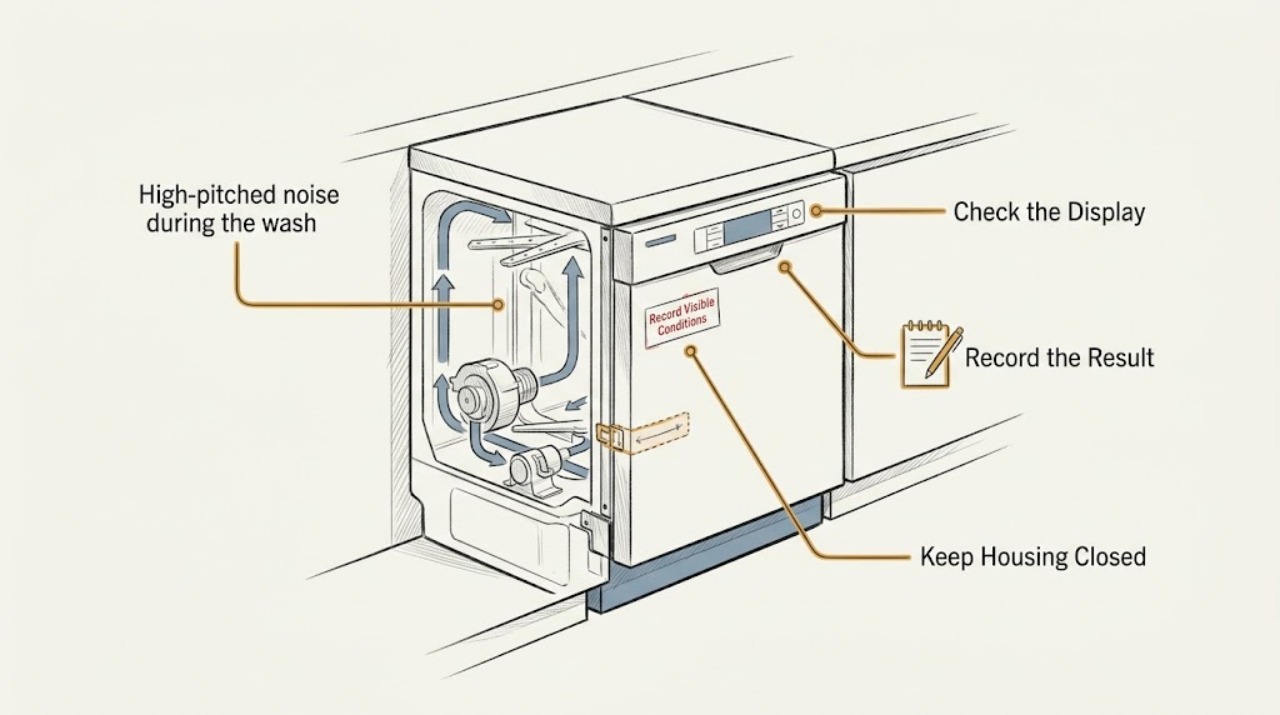
For the Beko BM6046, a constant high-pitched whine during washing should not be declared normal from the sound alone. Beko's official BM 6046 product page identifies the model and lists a 46 dBA noise rating, while Beko's dishwasher guidance treats ordinary clicks, clunks, and hums as possible cycle sounds and sends persistent abnormal operation to service. An exact Reddit report describes the same BM6046 symptom as a constant high-frequency whine; a reply suggests an inverter-motor acoustic signature, but that is community opinion rather than Beko confirmation. First record when the tone starts and whether the dishwasher fills, sprays, drains, and completes normally. With the machine stopped, check only visible dish and spray-arm clearance. If the high pitch remains with an empty load, is severe or escalating, or is accompanied by poor cleaning, draining, a leak, heat, or electrical symptoms, use the new-appliance warranty/return or an authorized Beko service path rather than opening the cabinet or trying to soundproof the machine.
Work through in order
Diagnostic checks
Use only checks that match the exact appliance or system and its official guide.
-
Check 1
Record the full model as BM6046/BM 6046, the programme, the point in the wash sequence when the tone begins, its pitch pattern, and whether the dishwasher fills, sprays, drains, cleans, and completes normally.
Expected result: The tone is constant through circulation, appears only at fill or drain, changes with programme or load, or is joined by a leak, poor cleaning, standing water, heat, or a warning.
Next step: Save a short recording from a safe position and continue with the external load and spray-arm check. Use authorized service promptly for an abnormal operating symptom.
Stop if: Stop the programme for smoke, burning odor, a leak, exposed electrical parts, repeated power trips, severe vibration, or an escalating metal-on-metal sound.
Why this matters
Why: Timing separates a possible drive or pump acoustic signature from water-entry, drain, load-contact, or broader operation faults. Beko's published guidance does not decode a high-pitched tone by itself.
-
Check 2
Stop the programme using the normal control, wait until the spray arms and water movement have ceased, then inspect the loaded racks from the front for dishes touching, a tall item projecting into a spray-arm path, or a loose object.
Expected result: A visible contact point is present, the tone changes after the load is rearranged, or the same high-pitched tone remains with clear spray-arm travel.
Next step: Rearrange only the accessible load and observe one short programme if there is no leak or other fault. If the sound remains or returns empty, stop repeated testing and request service or warranty assessment.
Stop if: Do not force a spray arm, reach into moving parts, remove guards, handle broken glass, or open the cabinet.
Why this matters
Why: A visible contact or load-dependent change supports dish or spray-arm interference. An unchanged tone with clear travel shifts attention toward the circulation drive, pump, installation, or an acoustic characteristic.
-
Check 3
If the tone has appeared on more than one load, run one brief empty observation cycle only with the normal controls and without detergent; stop immediately if the noise is severe or the dishwasher does not operate normally.
Expected result: The tone disappears empty, remains at the same wash stage, changes into grinding or scraping, or the empty cycle shows poor fill, spray, drain, or completion.
Next step: If quiet, reload with clearance around the spray arms. If persistent or abnormal, provide the recording, programme, model, and empty-run result to authorized Beko service or the seller's warranty team.
Stop if: Do not repeat empty runs indefinitely, dismantle the motor or pump, or continue if the noise is harsh, worsening, or paired with another fault.
Why this matters
Why: A quiet empty run makes load contact more likely. A persistent high pitch with an empty tub is not identified by Beko's public guidance as a user-repairable fault and may involve the drive, pump, valve, or installation.
-
Check 4
Check only from outside that the dishwasher is stable, not touching adjacent cabinetry, and installed according to the BM6046 manual; do not pull out an integrated or secured unit to listen at the rear.
Expected result: The cabinet vibrates against the surrounding furniture, the appliance is unstable, the sound changes when the door or cabinet is touched, or the installation is stable.
Next step: Correct only an accessible stability issue using the manual. For a built-in, heavy, or secured unit, have the installer or authorized service agent inspect it.
Stop if: Do not lift, pull, tilt, loosen water or electrical connections, or work behind the appliance while it is connected.
Why this matters
Why: Installation contact can amplify a normal motor or pump tone and can also create a separate vibration fault. A stable installation with an unchanged narrow whine makes the exact-model acoustic/warranty decision more relevant.
-
Check 5
For a brand-new BM6046, compare the recording and cycle behavior with the seller's authorized replacement or service assessment, and keep the purchase and exchange record; do not modify the appliance to reduce the tone.
Expected result: A replacement unit has the same tone with normal operation, an authorized technician identifies a fault, or no safe comparison is available.
Next step: Use the warranty, return, or authorized service path and provide the exact model, recording, cycle phase, load/empty result, and operating symptoms. Keep the machine out of service if a safety symptom appears.
Stop if: Do not add soundproofing, bypass a warranty inspection, open the wash system, or order a pump or motor from the tone alone.
Why this matters
Why: The same sound on another unit can support a model-wide acoustic characteristic but does not prove that the original noise is acceptable. A confirmed fault or abnormal operation takes priority over a community explanation.
Use your observations
Decision map
Find the observation that best matches what you see, then follow the next safe action.
-
PATH 01Next step
What you see
The BM6046 produces a steady narrow high-pitched tone during washing, the load is clear of the spray arms, the dishwasher fills, cleans, drains, and completes normally, and there is no leak, heat, odor, or electrical symptom.
Do this next
Have the seller or authorized Beko service compare the sound with a known-good unit and decide the warranty or return path. Do not open or modify the machine to suppress the tone.
Why this path and its safety boundary
Why it matters: This pattern is compatible with an acoustic motor or pump signature, and the exact Reddit report describes a similar BM6046 experience, but the community explanation is not manufacturer confirmation that every unit should sound this way.
-
PATH 02Next step
What you see
The sound changes when dishes are rearranged, is rhythmic with spray-arm travel, or disappears during an empty run.
Do this next
Rearrange the accessible load with clearance around moving parts and run one normal observation cycle. Request service if the sound returns with a correctly loaded or empty dishwasher.
Why this path and its safety boundary
Why it matters: Load contact or a spray-arm obstruction is more likely than a constant drive tone.
-
PATH 03Next step
What you see
The high pitch remains with an empty tub, becomes grinding or scraping, or occurs with poor cleaning, poor draining, interrupted operation, a leak, smoke, burning odor, or repeated power trips.
Do this next
Stop repeated tests and request authorized Beko service or warranty assessment. Use a qualified plumber if the evidence is water hammer, hose impact, or household pipe damage.
Why this path and its safety boundary
Why it matters: The sound cannot be treated as a harmless acoustic characteristic when operation is abnormal or the empty-run symptom persists; a pump, motor, valve, installation, or electrical issue needs diagnosis.
-
PATH 04Next step
What you see
The cabinet vibrates against cabinetry, the unit is unstable, or the tone changes when the surrounding installation is touched, while the appliance itself completes normally.
Do this next
Have the installer or authorized service agent correct the installation using the BM6046 instructions; do not pull out a built-in appliance or loosen connections as a test.
Why this path and its safety boundary
Why it matters: Installation contact may be amplifying an otherwise normal operating sound or creating a vibration fault.
Helpful context
Understand the symptom
What the BM6046 evidence does and does not show
Beko's Turkish product page confirms the BM 6046 dishwasher and lists a 46 dBA operating-noise rating, but a dBA rating does not tell you whether a narrow, high-frequency tone is expected or acceptable. The exact Reddit report is unusually useful because it describes the same model and the same constant whine during washing. Its reply suggests an inverter-motor whine, but that is a community hypothesis, not a Beko diagnosis. Treat the tone as a comparison and warranty question until the cycle behavior and installation are checked.
Separate a high-pitched drive tone from a load or spray-arm noise
Beko's official help center describes some clicks, clunks, and hums as normal cycle sounds, and says a rhythmic sound can come from an item in the tub. Stop the programme and wait for all movement to cease before inspecting the loaded racks from the front. Look for dishes touching, a tall item in the spray-arm path, or a loose object. If the tone remains unchanged with a stable empty load, a dish-contact explanation is weaker; do not infer a failed pump or motor from the pitch alone.
Use operation and timing as the decision point
Record whether the whine starts during fill, circulation, draining, or drying, whether it changes with programme or water load, and whether the dishwasher still cleans, drains, and completes. A steady tone with otherwise normal operation is compatible with an acoustic motor or pump signature, but Beko's public guidance does not confirm that explanation for the BM6046. A tone that changes with load, becomes grinding or scraping, or appears with a cycle fault needs the corresponding service branch.
A brand-new unit should use its warranty or return path
The exact report concerns a brand-new BM6046 and says another unit was exchanged but a less intense tone remained. That pattern can be consistent with a model-wide acoustic characteristic, but it can also hide an installation or unit-specific fault; the thread does not establish the outcome. Compare the tone with a demonstrator or replacement only through the seller or authorized service process. Do not add insulation, remove panels, alter the pump, or continue running a sound that is accompanied by a leak, burning smell, electrical trip, or interrupted programme.
When checks do not resolve it
Need a professional?
Have this ready
- Full BM6046 model and serial information, market, purchase date, programme, recording, exact cycle phase, load versus empty result, installation/contact observations, whether another unit was compared, and any leak, heat, odor, electrical, cleaning, or draining symptom.
Common questions
FAQ
Is a high-pitched whine normal on a Beko BM6046 dishwasher?
There is an exact BM6046 community report of a constant high-frequency whine and a reply suggesting an inverter-motor sound, but that is not Beko confirmation. Beko's official guidance describes ordinary clicks, clunks, and hums, not a universal BM6046 high-pitch allowance. Compare the sound and operation through the seller or authorized service path.
Could dishes or the spray arm cause the noise?
Yes, if the sound is rhythmic or changes with the load. Stop the dishwasher, wait for movement to cease, and inspect from the front for dishes touching or a tall item in the spray-arm path. If the same high pitch remains with an empty load, contact service rather than forcing the spray arm or opening the cabinet.
Should I run the BM6046 empty to test the whine?
One brief empty observation cycle can help separate load contact from a persistent appliance sound if the dishwasher has no leak or other abnormal symptom. Stop immediately for a severe or worsening noise, and do not repeat tests indefinitely. A persistent empty-run whine needs authorized service or warranty assessment.
Where should I find the BM6046 manual?
Beko's manual support explains that manuals are searched by the exact product model number and include safety, installation, operation, maintenance, and troubleshooting sections. Use the BM6046/BM 6046 model and the market shown on the rating label rather than borrowing instructions from another Beko dishwasher.
Read the exact guide
Official sources
- BM 6046 | Bulaşık MakinesiBeko Türkiye · Exact official Beko Turkey product page for BM 6046; the market and suffix should be confirmed from the appliance label before warranty or manual decisions.
- Beko dishwasher troubleshooting: cycle noisesBeko · Official Beko dishwasher support guidance; it covers common clicks, clunks, hums, knocks, rattles, and water hammer but does not certify a BM6046 high-frequency whine as normal.
- Beko Manuals and User GuidesBeko UK · Official Beko manual-support page; it establishes that model and market documentation should control installation, safety, maintenance, and troubleshooting steps.
- Help! Brand new Beko BM6046 Dishwasher high-pitched noiseReddit r/Appliances · Exact-model lived-experience evidence for a constant high-frequency wash noise. The reply's inverter-motor explanation is a hypothesis, not manufacturer confirmation or proof of part fit, safety, or acceptable noise.
Community feedback
Share a repair observation
Share a plain-text repair observation. Accepted observations are published automatically; this page may take a moment to update.