
On this page
Start here
Quick answer
A 7 kHz reading by itself does not establish that a Beko BDFN26640WC is defective. Beko publishes 44 dBA airborne noise for this exact model, but that is an overall noise specification, not a 7 kHz pass/fail limit. First record when the tone occurs, whether it changes with the load or an empty tub, and whether the dishwasher still fills, washes, drains, and completes. A stable tone with normal operation may be monitorable or scheduled for daytime; a tone that is harsh, worsening, present with an empty dishwasher, or paired with poor operation, a leak, burning odor, smoke, or power trips is a stop-using-and-service situation. Do not identify a pump, motor, or valve from frequency alone.
Before you begin
Safety first
- Do not open the cabinet, remove guards, reach into a moving tub, loosen water connections, or perform live electrical tests. Stop immediately for smoke, burning odor, an active leak, exposed electrical parts, flooding, or repeated tripping.
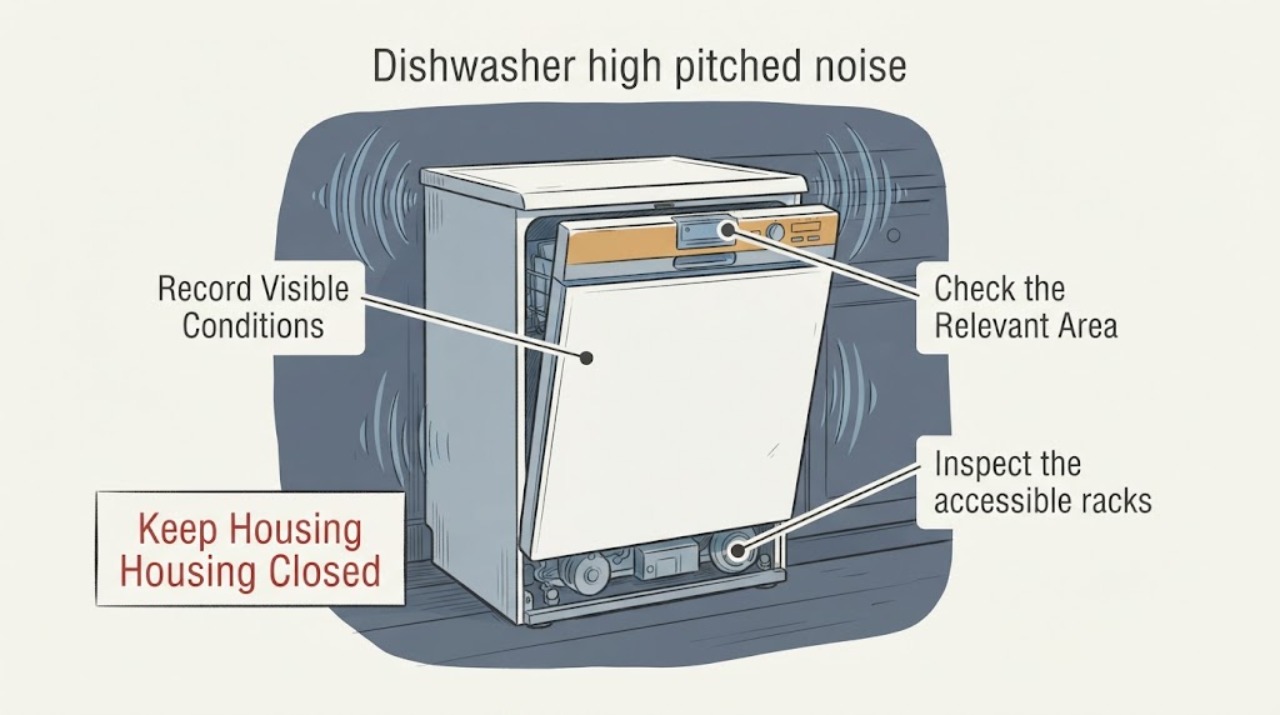
Work through in order
Diagnostic checks
Use only checks that match the exact appliance or system and its official guide.
-
Check 1
From outside the dishwasher, confirm the rating-plate model is BDFN26640WC and write down the sound level shown by any meter separately from the reported 7 kHz frequency; do not treat either measurement as a component test.
Expected result: The Beko product record identifies BDFN26640WC and lists 44 dBA airborne noise; it does not list a 7 kHz limit or name a part for that tone.
Next step: Use the timing and operating checks below to classify the sound. If the rating plate does not match, stop applying this model-specific page and use the correct manual or service channel.
Why this matters
Why: The exact model and its overall noise specification provide context, but the pitch alone cannot distinguish a normal operating tone from a failing pump, motor, valve, or installation-related vibration.
-
Check 2
Listen from a safe position for one normal cycle and record whether the high-pitched sound is brief or continuous and whether it starts during filling, washing, dispensing, draining, or the end of the program; a phone recording can be made without touching the appliance.
Expected result: A short tone tied to the same cycle event is different from a tone that continues through the cycle or changes abruptly. Note whether the dishwasher still fills, sprays, drains, and completes normally.
Next step: If the noise is severe, escalating, or accompanied by a leak, smoke, burning odor, repeated tripping, or failure to complete, stop the program and do not run another cycle for comparison. Otherwise continue only with the load check below.
Why this matters
Why: Beko documents some clicks, clunks, hums, and snaps as normal cycle sounds when operation is normal, but its guidance does not establish a normal high-pitched frequency. A persistent or unusual sound with interrupted operation needs service rather than a frequency-based part guess.
-
Check 3
After stopping the program and waiting until movement and spraying have ceased, inspect the accessible racks for a tall item, utensil, or dish that can touch a spray arm or another item; rearrange the load with clear spray-arm travel and do not reach into a moving tub.
Expected result: A visible contact point or a tone that changes or disappears after rearranging supports load or spray-arm interference. No contact and no change make the load a weaker explanation, but still do not identify an internal part.
Next step: Run one ordinary observation cycle only if there is no leak or other abnormal behavior. If the same tone returns with a correctly arranged load, use the empty comparison and service branch rather than repeatedly rearranging dishes.
Why this matters
Why: Beko says continuous knocking can result from spray arms hitting dishes and recommends rearranging them; that check is relevant to a new tone whose sound may be transmitted through the cabinet, even though it cannot prove the source of a 7 kHz tone.
-
Check 4
If the sound has occurred on more than one correctly arranged load and the appliance has no safety symptom, run one brief empty cycle using the normal controls and no detergent; stop immediately if the sound is severe or operation is abnormal.
Expected result: A quiet empty cycle makes dish-to-dish or dish-to-spray-arm contact more likely. A tone that remains at the same stage with no dishes makes the load less likely and should be documented with the recording and timing.
Next step: If it is quiet empty, reload with clearance and monitor. If it remains noisy empty, stop further test cycles and request authorized Beko service with the model, program, stage, recording, and operating symptoms.
Why this matters
Why: An empty-versus-loaded difference is a useful decision point, but a persistent empty-machine tone does not identify whether the source is a pump, motor, valve, fan, or cabinet vibration. Beko directs persistent unusual noise or abnormal operation to authorized service.
-
Check 5
Compare the sound with the dishwasher's functional result and, if the only issue is nighttime disturbance, note whether the BDFN26640WC's normal delay-start option can schedule a cycle when the room is unoccupied; do not move the appliance or open a panel to make it quieter.
Expected result: Normal filling, washing, draining, and completion with no leak or electrical warning supports monitoring or daytime scheduling. Poor cleaning, standing water, interrupted operation, a warning, or a noise that is too loud or unusual changes the decision even if the cycle eventually completes.
Next step: Use delay start only when the appliance is otherwise operating normally and there is no safety concern. For abnormal operation or a persistent empty-machine tone, stop using it and arrange authorized service.
Why this matters
Why: The model page lists a manual time-delay function, while Beko's noise guidance makes normal operation an important boundary. Scheduling can reduce nighttime disturbance, but it is not a repair and does not make an abnormal sound safe.
Use your observations
Decision map
Find the observation that best matches what you see, then follow the next safe action.
-
PATH 01Next step
What you see
The tone is brief and tied to one cycle event, and the BDFN26640WC fills, washes, drains, and completes without a leak or other warning.
Do this next
Record it once, monitor for change, and use daytime scheduling if the otherwise normal sound is disruptive at night. Escalate if it becomes continuous, unusually loud, or affects operation.
Why this path and its safety boundary
Why it matters: The sound may be a normal operating event, but Beko does not publish a 7 kHz signature, so frequency alone does not confirm that conclusion.
-
PATH 02Next step
What you see
The sound changes or disappears after a stopped, correctly rearranged load, but the empty comparison is quiet.
Do this next
Keep clearance around the spray arms and monitor one normal cycle. Stop if dishes are damaged or the sound returns regardless of the load.
Why this path and its safety boundary
Why it matters: Load movement or spray-arm contact is more likely than a model-specific electronic or motor diagnosis.
-
PATH 03Next step
What you see
The same high-pitched tone remains with an empty dishwasher or occurs throughout every cycle despite a stable load.
Do this next
Stop repeated testing and contact authorized Beko service. Provide the exact model, program, cycle stage, recording, duration, and whether washing and draining remain normal.
Why this path and its safety boundary
Why it matters: The load is less likely, but the 7 kHz reading still cannot select a pump, motor, valve, or other part safely.
-
PATH 04Next step
What you see
The noise is paired with a leak, poor draining or washing, interrupted operation, smoke, burning odor, exposed wiring, repeated power trips, or a harsh worsening sound.
Do this next
Stop the dishwasher, isolate power only from a safe accessible control or household disconnect if needed, keep clear of water and electrical parts, and arrange qualified appliance service. Use a qualified plumber if the evidence points to household pipe or wall damage.
Why this path and its safety boundary
Why it matters: This is not established as a normal cycle sound; continuing to run the appliance to measure its frequency increases risk and can worsen damage.
Helpful context
Understand the symptom
The model identity matters here: Beko's product record identifies BDFN26640WC as a full-size freestanding dishwasher and lists 44 dBA for airborne noise. That specification helps set an overall loudness context, but it does not describe the pitch spectrum and does not make a phone app's 7 kHz reading a component diagnosis. Beko's own sound guidance treats several short cycle sounds as potentially normal when the appliance operates normally, while unusual noise with abnormal operation should go to authorized service.
Because this dishwasher is being heard at night, judge both the appliance symptom and the nuisance level. A recording made from a safe distance, the cycle stage, and the result of one controlled load-versus-empty comparison are more useful to a service agent than the frequency number alone. Do not open the cabinet or continue cycles just to reproduce a sound that is severe or accompanied by another fault.
When checks do not resolve it
Need a professional?
Call an authorized Beko service agent when the tone persists with an empty dishwasher, returns every cycle after the load is rearranged, is too loud or unusual, or occurs with interrupted operation, a leak, poor draining or washing, smoke, burning odor, or repeated power trips.
Safety scope: Do not open the cabinet, remove guards, reach into a moving tub, loosen water connections, or perform live electrical tests. Stop immediately for smoke, burning odor, an active leak, exposed electrical parts, flooding, or repeated tripping.
Have this ready
- Provide BDFN26640WC, the program and cycle stage, whether the sound is loaded or empty, a recording made from a safe distance, the approximate duration, any meter reading, and whether the machine fills, sprays, drains, and completes.
Common questions
FAQ
Does 7 kHz prove that the Beko dishwasher is defective?
No. It is a useful description to give service, but Beko's exact-model listing provides an overall 44 dBA noise specification rather than a 7 kHz pass/fail limit. Use cycle timing, load-versus-empty behavior, and functional symptoms to decide what to do.
What if the dishwasher is quiet when empty but noisy with dishes?
A load or spray-arm contact becomes more likely. Stop the program, wait for movement to cease, rearrange accessible dishes with clearance, and monitor one normal cycle. If the sound returns regardless of the load, request service.
Can I run it at night if the cycle still finishes?
Only if there is no leak, burning smell, smoke, repeated power trip, or other abnormal operation and the sound is not severe. The exact model page lists a time-delay function, so scheduling daytime operation can reduce disturbance, but delay start is not a repair for a persistent or worsening tone.
Read the exact guide
Official sources
- BDFN26640WC | Enëlarëse jomontuese (16 karakteristikat e vendit, Madhësia e plotë) | BEKOGLOBALBeko · Exact model product page; locale is Kosovo/Albanian, so use it for the model and published technical specifications, not for an unlisted 7 kHz limit.
- Help Center ResultBeko · Beko's official dishwasher noise FAQ; it describes several normal cycle sounds, load or spray-arm checks, and service escalation when operation is abnormal, but does not define a high-pitched spectral threshold.
Community feedback
Share a repair observation
Share a plain-text repair observation. Accepted observations are published automatically; this page may take a moment to update.