
On this page
Start here
Quick answer
On the UK-market Beko BDIN38640F, a lower spray-arm assembly that catches the basket while the dishwasher is empty should be treated as a clearance or fitment problem first, not as a drain-pump diagnosis. Beko identifies this exact model as an integrated dishwasher with CornerIntense rotating spray arms, and its loading guidance says to rotate the upper and lower arms by hand before a programme and prevent any rack or item from touching them. Switch the appliance off, open the door, pull the lower basket out, and turn the arm by hand to identify whether it catches at one fixed point, has visible looseness or damage, or turns freely by hand but makes a powered scraping sound. Do not run it to reproduce contact, force the integrated unit out, remove the spray-arm assembly, or guess a replacement part; persistent contact with an empty basket needs model-specific service.
Before you begin
Safety first
- Do not pull the integrated dishwasher from its cabinet, remove the lower spray-arm assembly or rack rails, reach into the sump, defeat the door interlock, operate with the door open, probe live wiring, or install a guessed arm, basket, pump, or motor part.
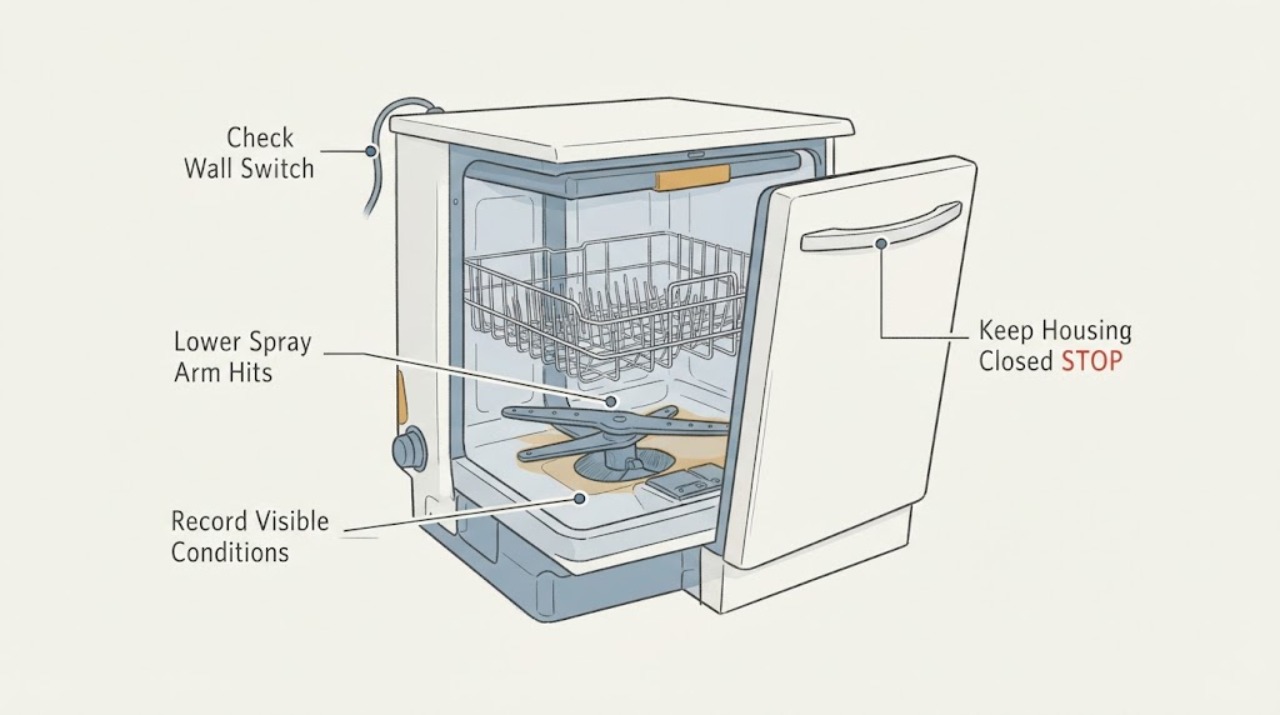
Work through in order
Diagnostic checks
Use only checks that match the exact appliance or system and its official guide.
-
Check 1
Confirm that the rating label reads BDIN38640F and record whether the contact occurs with the lower basket empty, with the upper basket and any cutlery tray in their normal positions, or only after dishes are loaded. Note whether the sound is a dry scrape, a single click at one point, or a noise only when water is running.
Expected result: The exact model is BDIN38640F and the lower arm catches with an empty rack, the model or market differs, or the noise appears only with a particular load or rack position.
Next step: If the model or market cannot be confirmed, stop part selection and retrieve the matching Beko manual or arrange service. If the contact is genuinely present with empty racks, continue only with the power-off clearance checks.
Stop if: Do not start a programme merely to reproduce the collision, and do not pull an integrated dishwasher out of its cabinet.
Why this matters
Why: Beko lists BDIN38640F as an integrated full-size model with CornerIntense spray-arm technology and several basket components. The exact model and whether the machine is genuinely empty determine whether this is a clearance issue or ordinary loading interference; another model should not inherit this page's fitment assumptions.
-
Check 2
Switch the dishwasher off, keep the door open, and pull the lower basket forward. From a dry, accessible position, turn the lower spray-arm assembly slowly by hand through a full rotation. Watch the exact place where it contacts the basket and check whether the arm sits level, has unusual vertical play, is cracked, or stops freely between basket positions.
Expected result: The arm catches at one repeatable basket point, turns freely without contact, or has looseness, a crack, a raised edge, or a failure to remain seated.
Next step: If the arm catches, leave the dishwasher unused while the obstruction is isolated. If it is loose, cracked, or will not stay seated, stop and arrange authorised service. If it turns freely, continue with the basket and rack checks without running a cycle.
Stop if: Do not force the arm past the contact point, remove its hub, insert a tool into the sump, or operate the dishwasher with the door-switch mechanism bypassed.
Why this matters
Why: A repeatable hand-turning contact is more consistent with physical clearance or fitment than with a water pump. Free hand rotation does not clear the appliance for use if the powered sound remains; looseness or damage requires a model-specific assessment rather than a guessed arm or pump.
-
Check 3
Inspect the empty lower basket from above and below for a bent tine, raised wire, displaced folding support, damaged wheel, foreign object, or a basket that is not fully on both rails. Pull the basket out and reseat it squarely, then repeat the hand-rotation check; do not bend the basket or spray arm to create clearance.
Expected result: The lower basket or one of its supports is visibly out of position or damaged, the basket reseats and the contact disappears, or the basket looks normal and the contact remains.
Next step: If the basket was visibly mis-seated and now clears the arm, load nothing until the basket rolls evenly and the arm still rotates freely. If a wire, tine, wheel, or support is bent or the contact remains, stop and arrange service for the exact model.
Stop if: Do not straighten a spring-loaded or welded rack part, remove wheels or supports, or use tape, glue, or improvised spacers near the spray arm.
Why this matters
Why: Beko's loading guidance warns that overcrowding or contact can restrict spray-arm movement and recommends checking arm freedom before selecting a programme. A clearance change after reseating the basket points to an accessible rack-position issue; persistent empty-basket contact is not explained by dish loading alone.
-
Check 4
Check the upper basket and any fitted cutlery tray for an abnormal height, a loose end stop, or an accessory protruding into the lower-arm path. Confirm that both baskets and their rails are in their normal positions and that no removable rack feature is resting on the lower basket.
Expected result: A rack or accessory is visibly low, skewed, loose, or different from the normal arrangement, or the upper and lower assemblies look correctly positioned while the lower arm still catches.
Next step: Restore only a clearly documented, user-adjustable rack position and repeat the hand check once. If an end stop, rail, tray, or basket is damaged or its correct position is uncertain, leave the dishwasher off and provide the exact model and photos to authorised service.
Stop if: Do not dismantle rack rails, pull the machine forward, or force an accessory into a position that does not latch normally.
Why this matters
Why: This model has multiple basket and rack components, including an adjustable upper basket and removable cutlery tray. A changed rack position can create a collision even when the lower basket itself appears intact; a normal arrangement with repeatable contact shifts concern toward a damaged or incorrectly fitted assembly.
-
Check 5
Look for witness marks, chips, a loose fastener, or plastic fragments around the lower arm and basket, and check the tub floor and filter area only from the normal open-door position. Keep the appliance disconnected from use if there is any leak, sharp fragment, scorched material, or visible damage.
Expected result: There are fresh rub marks or fragments, the arm and basket are visibly damaged, the tub is wet beneath an apparent leak, or no damage is visible and the arm still makes the same contact.
Next step: Stop using the dishwasher and arrange authorised service for any damage, debris, leak, or persistent contact. Give the technician the contact location, photos, exact model, and whether hand rotation or rack reseating changed it.
Stop if: Do not reach through the filter opening, remove covers, recover fragments from the sump with tools, or continue cycling the dishwasher to see whether the noise worsens.
Why this matters
Why: A fresh mark or fragment shows that continued operation could worsen mechanical damage or send debris into the pump area, but it does not identify which internal part failed. A leak or heat/electrical sign is a safety boundary, not a reason to run another test.
-
Check 6
If the lower arm turns freely by hand and no rack or accessory touches it, do not perform a powered test with the door interlock defeated. Record whether the scraping or clicking was heard only during an actual programme, whether cleaning performance changed, and whether there was water leakage or an error indication.
Expected result: The arm is quiet by hand but the powered programme produced scraping or clicking, or the sound has disappeared after a clearly visible rack correction.
Next step: If any powered-only noise returns, stop using the dishwasher and arrange service. If the correction removed the contact and there are no marks, leaks, or other symptoms, monitor without deliberately overloading or repeatedly retesting the empty machine.
Stop if: Never latch the door against an obstructed switch, run the appliance with the door open, or probe live wiring to identify the source of the sound.
Why this matters
Why: Free hand rotation cannot rule out a water-driven or vibration-related fault when the sound occurs only under power. The absence of contact after a visible rack correction supports that correction, but a powered-only recurrence needs diagnosis of the exact assembly and should not be converted into a pump or control-board conclusion.
Use your observations
Decision map
Find the observation that best matches what you see, then follow the next safe action.
-
PATH 01Next step
What you see
The lower spray arm catches at one repeatable point only when the lower basket is installed, and the contact disappears after the basket is pulled out and reseated squarely.
Do this next
Use the corrected rack position only if it latches normally and the spray arm completes a quiet hand rotation. If any rack part is bent, loose, or repeatedly shifts, keep the dishwasher off and arrange model-specific service.
Why this path and its safety boundary
Why it matters: This pattern makes a basket position, rail, wheel, tine, or accessory-clearance issue more likely than a drain or wash pump fault.
-
PATH 02Next step
What you see
The dishwasher is empty, the basket and accessories are in their normal positions, and the arm still rubs or clicks at the same location during hand rotation.
Do this next
Do not run another programme or bend the parts for clearance. Photograph the contact point and arrange authorised Beko service with the exact BDIN38640F model and market information.
Why this path and its safety boundary
Why it matters: A persistent empty-basket collision is less consistent with user loading and more consistent with a damaged, loose, mis-seated, or distorted spray-arm or rack assembly. It does not identify a replaceable part by sound alone.
-
PATH 03Next step
What you see
The arm is loose, cracked, visibly damaged, leaves plastic or sharp fragments, or a leak or scorching is present.
Do this next
Keep the dishwasher switched off; isolate water or power only from a safe, dry position if necessary, and arrange authorised service. Do not remove the arm, reach into the sump, or substitute an unverified part.
Why this path and its safety boundary
Why it matters: The problem has crossed from a simple loading check into a mechanical, water, heat, or electrical safety boundary. Continued operation could worsen damage or spread debris.
-
PATH 04Next step
What you see
The arm turns freely by hand with the racks empty, but a powered programme produces scraping or clicking, or the model label and basket arrangement cannot be confirmed.
Do this next
Stop testing, preserve the sound description and photos, retrieve the exact Beko manual or rating-label details, and book qualified service if the noise recurs.
Why this path and its safety boundary
Why it matters: A powered-only noise cannot be safely attributed to the lower spray arm, pump, motor, or control without model-specific service diagnosis. An identity mismatch also makes the supplied basket clearance assumptions unreliable.
Helpful context
Understand the symptom
Why an empty-basket collision matters
If the lower spray arm hits while no dishes are loaded, ordinary loading error is less likely. The useful first distinction is where and how the contact occurs: one repeatable point on the basket suggests a rack, tine, wheel, or arm-position problem, while rubbing through the whole rotation or noticeable looseness needs service assessment. A short normal spray-arm sound is not the same as a dry scrape or click that occurs at the same position every turn.
Keep the check external
The BDIN38640F is an integrated 220–240 V dishwasher, so access behind the cabinet is not a useful consumer test. Work only with the appliance stopped and the door open. A lower basket can be pulled out for visibility, but do not remove the spray-arm assembly, probe the sump, pull the appliance from its housing, or defeat a door or safety switch.
When checks do not resolve it
Need a professional?
Request model-specific service for repeatable empty-basket contact, any looseness or visible damage, fragments, leaks, powered-only scraping, or uncertainty about the correct basket and spray-arm arrangement.
Safety scope: Do not pull the integrated dishwasher from its cabinet, remove the lower spray-arm assembly or rack rails, reach into the sump, defeat the door interlock, operate with the door open, probe live wiring, or install a guessed arm, basket, pump, or motor part.
Have this ready
- Provide the rating-label model BDIN38640F, market, programme and stage when the sound occurred, whether the racks were empty, the exact contact location, photos of the basket and arm, whether hand rotation was clear, and whether reseating a rack changed the sound.
Common questions
FAQ
Should the lower spray arm touch the basket when the Beko BDIN38640F is empty?
No. Beko's loading guidance says to rotate the upper and lower spray arms by hand before selecting a programme and avoid contact with racks or items. If the lower arm catches an empty basket, leave the dishwasher off and check clearance and fitment rather than treating the sound as normal.
Could this just be a dish-loading problem?
Only if the contact disappears when the dishes or a visibly mis-seated rack feature are removed. A repeatable collision with empty baskets points to clearance, rack position, or a damaged or loose assembly; it does not prove that the pump is defective.
Can I remove the lower spray arm to see whether it is bent?
Do not remove the spray-arm assembly for this check. With the appliance stopped and the door open, inspect it and turn it gently by hand from the normal access position. If it is loose, cracked, or does not stay seated, use authorised service for the exact model.
What if it turns freely by hand but scrapes during a cycle?
Do not defeat the door switch or run repeated tests. A powered-only sound may involve vibration, water-driven movement, or another assembly, and the public Beko guidance does not select a pump or motor part from that symptom. Record when it occurs and arrange model-specific service if it returns.
Read the exact guide
Official sources
- Integrated Full Size Dishwasher with Fast45 BDIN38640FBeko UK · Exact UK-market BDIN38640F product page; the task's spaced form is BDIN38640 F. Used for model and configuration identity, not as a universal repair manual.
- How To Load A Dishwasher For Best ResultsBeko UK · Beko UK dishwasher loading guidance; applied here to the user-accessible clearance check and not to hidden parts or model-specific disassembly.
Community feedback
Share a repair observation
Share a plain-text repair observation. Accepted observations are published automatically; this page may take a moment to update.