
On this page
Start here
Quick answer
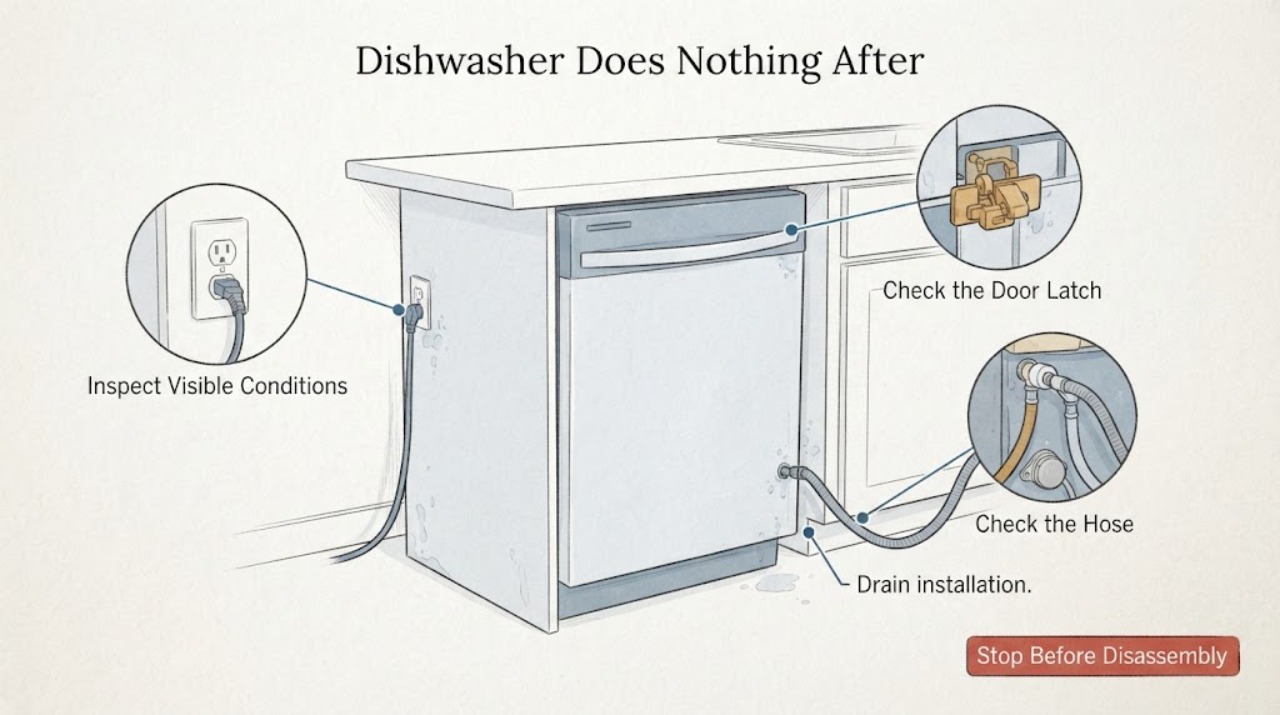
For a Beko DFN05320W that worked once and then appears to do nothing, first separate a dead control panel from a selected programme that has not started, a door that is not registering closed, and an installation path that is stopping the machine at water entry or drainage. This model is a freestanding DFN05320 variant with a programme knob, no remaining-time display, one cold-water supply, and a drain route that must not be kinked when the machine is pushed back. With the dishwasher dry and safe, check the dedicated outlet or breaker without opening the appliance, confirm the door closes and latches, and inspect the visible inlet and drain hoses for kinks or a recently displaced connection. If the panel remains dark, the socket or cord is damaged, water is present under the machine, a pump runs without clearing water, or the door will not latch, stop and use a qualified electrician, plumber, or authorised Beko service agent. Do not pull the appliance out under load, open panels, enter service mode, or make live tests.
Work through in order
Diagnostic checks
Use only checks that match the exact appliance or system and its official guide.
-
Check 1
With the dishwasher dry and stopped, turn the programme knob to the documented off position and observe the control panel: note whether any indicator lights appear, whether the selected control responds, and whether the home circuit has tripped. Check the appliance's accessible plug and socket only for obvious looseness, heat damage, or moisture; do not remove covers or touch electrical terminals.
Expected result: The panel is completely dark, the socket or cord is damaged or wet, the breaker trips again, or the panel lights normally.
Next step: If there is heat damage, moisture, a damaged cord, or repeated tripping, stop using the dishwasher and arrange qualified electrical service. If the panel is lit and safe, continue with the door and installation checks; do not repeatedly reset a tripping breaker.
Why this matters
Why: Beko says a dark display can result from a power failure and directs electrical repair to a qualified electrician. A lit panel makes total loss of supply less likely, so the next split is door, programme, water, or drain state rather than a guessed control board.
-
Check 2
Confirm the programme knob is set to a real wash programme and press the model's start control only as the exact manual describes; then close the door firmly and listen for the latch to engage. Inspect the door edge and gasket for a plate, utensil, packaging piece, or damage that prevents full closure, without forcing the latch.
Expected result: The knob was between positions, the door does not close or latch, the panel gives no start response, or the door closes and latches with the same no-operation symptom.
Next step: Correct only an obvious control position or accessible obstruction. If the latch is cracked, loose, or never engages, stop and request authorised service; do not bypass the interlock or keep slamming the door.
Why this matters
Why: Beko states that a dishwasher will not start when it detects the door as open. A mispositioned control or closure obstruction is a user-state issue; a door that latches but does not start moves the investigation toward supply, drain protection, or a technical fault.
-
Check 3
Inspect the visible installation after the unit has remained powered off: confirm the cold-water tap is open, the inlet hose is not crushed, and the drain hose is not kinked, pulled loose, or pushed into an unsuitable route. If the dishwasher was recently pushed back, compare the hose and cable position with the installation guidance; do not pull an integrated or heavy unit farther than is safe.
Expected result: A hose is pinched or kinked, the tap is closed, a drain connection is loose or leaking, the hoses look clear, or a pump sound is present without water entering or leaving.
Next step: If there is a leak or wet electrical area, close the water supply if safe and stop. Correct only a plainly visible external kink or connection supported by the manual, then allow one supervised test if the appliance is otherwise safe. If the route is clear but the same symptom returns, arrange authorised service rather than opening the machine.
Why this matters
Why: Beko identifies a closed tap, kinked hose, poor drain installation, or blocked path as reasons a dishwasher may not take in water or may stop protecting itself. A hose that became restricted when the machine was pushed back is especially relevant after a first successful wash. Clear-looking hoses do not rule out an internal valve, pump, sensor, or control issue.
-
Check 4
With power disconnected and the tub safe to access, look for standing water and clean only the accessible filter area according to the DFN05320W manual. Observe whether water is absent, slowly draining, or remaining after a brief pump sound; do not reach into a running pump or remove a sealed bottom panel.
Expected result: The tub is dry, water remains, the accessible filter contains debris, or the pump continues to hum without clearing water.
Next step: Refit any accessible filter securely after cleaning and test only once when safe. If water remains, the pump runs on, or access would require disassembly, stop and request service or plumbing help for an independent household drain blockage.
Why this matters
Why: Beko says a dishwasher that cannot drain may not take in new water, and recommends checking the drain hose and drain filter. A filter obstruction can explain a programme that appears stuck; a clear filter with persistent water points to the external drain route or an internal drain fault.
-
Check 5
Record the complete sequence for service: exact model and rating-label information, panel-light state, programme-knob position, door-latch result, whether the unit was recently pushed back, inlet and drain-hose observations, standing-water status, and any leak, hum, click, or flashing pattern. Do not start an unverified service mode or repeatedly cancel and restart the programme.
Expected result: The fault disappears after an external correction, or it remains with safe power, a latched door, an open cold-water tap, clear visible hoses, and no accessible drain blockage.
Next step: For persistence, contact an authorised Beko service agent with the record and ask them to verify the installation and test the relevant supply, drain, door-interlock, and control stages. Keep the dishwasher stopped if it leaks, hums without moving water, or shows an electrical symptom.
Why this matters
Why: A change after correcting the installation supports an external setup issue. Persistence after those checks is no longer a good reason to guess a pump, valve, latch, or control part; it needs a model-specific technical diagnosis.
Use your observations
Decision map
Find the observation that best matches what you see, then follow the next safe action.
-
PATH 01Next step
What you see
The control panel stays dark, the accessible socket or cord is wet or heat-damaged, or the breaker trips again when the dishwasher is selected.
Do this next
Stop using the appliance and arrange qualified electrical service; do not open the dishwasher or repeatedly reset the breaker.
Why this path and its safety boundary
Why it matters: This is an electrical-supply or safety branch, not evidence that the dishwasher's internal board is the failed part.
-
PATH 02Next step
What you see
The panel lights, but the programme knob is not on a valid programme or the door does not close and latch as expected.
Do this next
Correct only the control position or accessible obstruction. If the latch is damaged or will not engage, request authorised service and do not bypass it.
Why this path and its safety boundary
Why it matters: The no-start symptom is consistent with a programme-selection or door-interlock state. Beko says the dishwasher will not start when it detects the door open.
-
PATH 03Next step
What you see
The machine was pushed back after installation and a water or drain hose is now kinked, the tap is closed, a connection leaks, or water remains in the tub.
Do this next
Make water and electrical areas safe, correct only a clearly visible external routing issue, and use plumbing help for an independent drain blockage. Do not pull the unit under load or dismantle it.
Why this path and its safety boundary
Why it matters: An installation restriction or drain-protection condition is more likely than a confirmed internal component fault; Beko notes that inability to drain can prevent water intake.
-
PATH 04Next step
What you see
The panel is powered, the door latches, the cold-water tap and visible hoses are normal, the accessible drain path is clear, and the same no-operation or pump-without-progress symptom remains.
Do this next
Stop repeated testing and arrange authorised Beko service with the exact model, installation history, control state, and observations. Do not enter service mode, open panels, or make live measurements.
Why this path and its safety boundary
Why it matters: The remaining possibilities are internal supply, drain, interlock, sensor, or control stages that cannot be distinguished safely from the outside. The first successful wash does not justify a specific part diagnosis.
-
PATH 05Next step
What you see
There is water under the machine, an active leak, smoke, burning smell, arcing, a damaged power cable, or another electrical abnormality.
Do this next
Stop the cycle, isolate power and water only if it can be done without contact with unsafe areas, keep clear, and arrange qualified appliance, plumbing, or electrical service.
Why this path and its safety boundary
Why it matters: The symptom has crossed the safe user-check boundary and may involve water damage, shock, or fire risk.
Helpful context
Understand the symptom
The first useful observation is not a part name but the machine's state: is the panel dark, is a programme selected but silent, is a faint pump sound present, or is the programme stopping after it tries to fill? DFN05320W listings show a programme knob and no remaining-time display, so a static-looking panel is not the same as a missing countdown. The exact model's installation also matters because pushing a freestanding unit back can pinch an inlet hose, drain hose, or power cable.
A first wash that worked does not prove the installation is correct for every position. The machine may have been moved farther back, a hose may have become restricted, or a connection may now be leaking. Keep the checks external and dry; do not remove the rear cover, force the door, short the latch, or use an unverified service sequence.
When checks do not resolve it
Need a professional?
Contact an authorised Beko service agent when the DFN05320W remains inactive after safe power, door, cold-water, visible hose, and accessible filter checks; when the latch will not engage; or when a pump runs without clearing water. Stop immediately for leaks, water near electrical parts, smoke, burning smell, arcing, damaged wiring, or repeated breaker trips. Use a qualified electrician for a supply fault and a plumber if the household drain is blocked independently of the dishwasher.
Common questions
FAQ
Why did the Beko DFN05320W work once and then appear to do nothing?
A first successful wash does not prove that a hose stayed clear after the dishwasher was pushed back. Check the panel state, door latch, cold-water tap, and visible hose routing before assuming an internal part failed. The exact Reddit report describes the same timing but has no verified manufacturer resolution.
Does the DFN05320W have a remaining-time display that should count down?
The opened Beko DFN05320 product listing identifies a programme knob and says there is no remaining-time display. Judge progress from indicator lights, water intake, pump activity, and the selected programme rather than expecting a countdown on the panel.
Can a drain problem stop the dishwasher from taking in water?
Yes. Beko's water-intake guidance says that if the appliance cannot drain, it may not take in water. Check the visible drain route and accessible filter with power disconnected; persistent standing water or a pump that runs without clearing it needs service.
Should I pull the dishwasher out or enter service mode to find the fault?
No. Installation work requires power and water isolation, and Beko warns against pinching cables or hoses when repositioning the appliance. Keep checks external and safe; do not open panels, bypass the door interlock, or use an unverified service sequence.
Read the exact guide
Official sources
- Beko DFN05320W Dishwasher stuck doing nothing after 1 wash that worked.Reddit r/appliancerepair · Exact user report for Beko DFN05320W; it documents the symptoms and attempted observations but is not an official diagnosis and has no verified resolution.
- Freestanding Full Size Dishwasher with Quick Programmes DFN05320Beko Ireland · Opened Beko Ireland product page; model codes include DFN05320W. It identifies the freestanding DFN05320 platform, programme knob, no remaining-time display, cold-water supply, voltage/frequency, and overflow safety.
- How to fix a dishwasher that won't take in waterBeko · General Beko dishwasher support page used for the relation between drain installation and water intake, visible hose/filter checks, and service escalation; exact model instructions take priority.
- How to fix a dishwasher that won't startBeko · General Beko dishwasher support page used for the power, water-tap, door-closure, and service boundary; it does not claim an exact DFN05320W internal diagnosis.
- How to install your Beko dishwasherBeko · General Beko dishwasher installation guidance used for external checks; the exact DFN05320W product page supplies the model identity and regional connection specifications.
Community feedback
Share a repair observation
Share a plain-text repair observation. Accepted observations are published automatically; this page may take a moment to update.