
On this page
Start here
Quick answer
The timing after adding salt does not prove that salt caused a completely dark Beko DFN05X11S. Beko's UK product page lists DFN05X11S as the silver DFN05X11 dishwasher, and the matching manual lists household power, the appliance fuse, water supply, the door, and the On/Off control as separate reasons a machine may not start. Before any reset, look from a dry, safe position for spilled salt, salty water, dampness around the base, a loose salt-reservoir lid, burning smell, heat, or a tripped breaker. If salt water may have entered the base, the plug, or the socket, do not re-energize it; close the water tap if safely reachable and arrange authorized service or an electrician. If everything is dry and other appliances have power, check only the accessible plug, wall switch, cord, and household breaker once—without opening the plug or dishwasher. Then verify the exact model and door closure. Do not repeatedly reset a trip, pour water into the tub to flush salt, dismantle the door or base, bypass the door interlock, or make a live electrical test.
Before you begin
Safety first
- Do not re-energize a dishwasher when salt water or other moisture may have entered the base, plug, or socket. Do not repeatedly reset a breaker, open the plug or dishwasher, bypass the door interlock, pour water into the tub to flush salt, or perform live electrical tests. Do not operate with a damaged cord, plug, socket, leaking connection, smoke, burning odor, heat, or sparking.
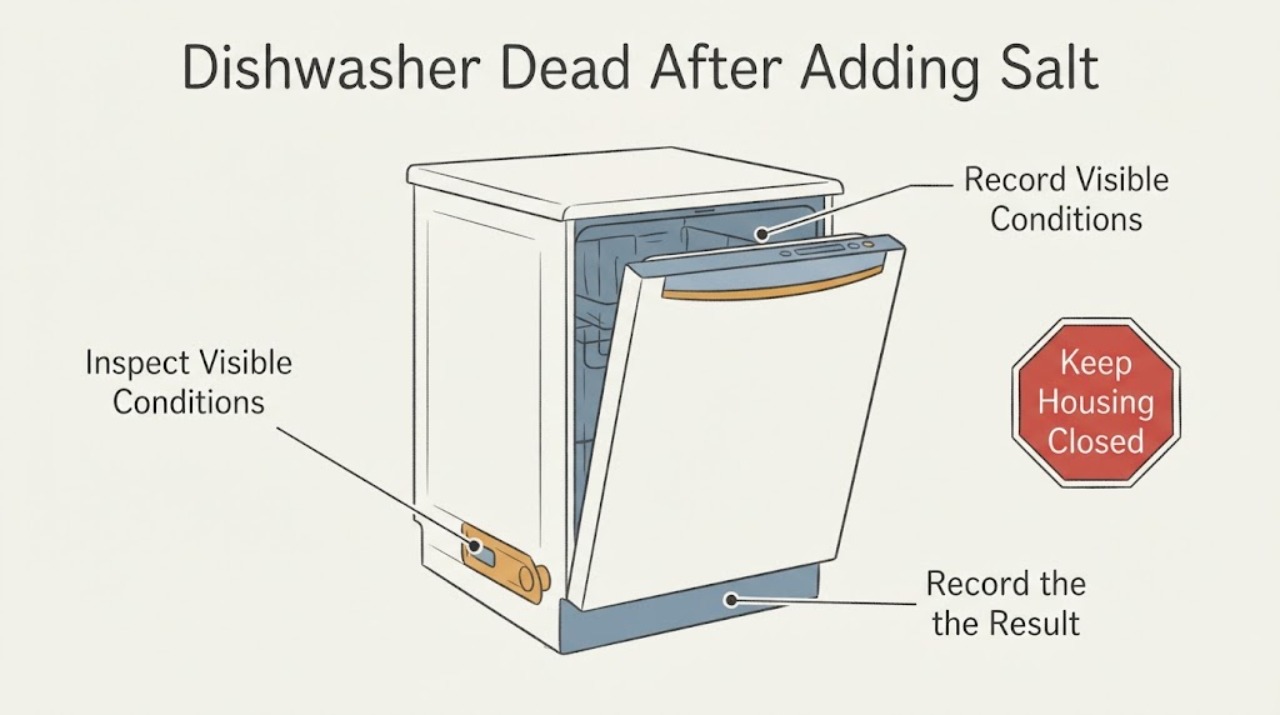
Work through in order
Diagnostic checks
Use only checks that match the exact appliance or system and its official guide.
-
Check 1
Do not touch the plug, socket, or control panel with wet hands. From a dry, safe position, look for spilled salt or salty water around the salt opening, door bottom, floor, plug, or socket, as well as burning smell, heat, smoke, sparking, or visible damage. If there is active water near electrical parts, keep clear and isolate the supply only from a dry safe location.
Expected result: The machine and connections are dry, or there is dampness, salt crust, pooled liquid, odor, heat, smoke, a spark, or visible electrical damage.
Next step: If any wet or electrical hazard is present, do not re-energize or try to flush the salt. Close the dishwasher water tap only if safely reachable, keep people away from the area, and arrange authorized appliance service or an electrician; use emergency help for active smoke or fire.
Stop if: Do not pour water into the dishwasher, wipe inside a live base, operate a wet plug, or repeatedly try the On/Off control.
Why this matters
Why: A dry appliance permits limited external checks. Salt water or another wet electrical area creates a shock, corrosion, or fire concern, and the power-off timing cannot show whether the water reached the base.
-
Check 2
Read the rating label without moving or opening the dishwasher and confirm Beko DFN05X11S, the country or market, and the supply marking. Note whether the panel went completely dark immediately after salt was added or whether the machine first completed a programme, and record whether the salt-reservoir lid was tightened.
Expected result: The label matches DFN05X11S, the suffix or market differs, the lid is loose, or the timing is only a sequence with no visible spill or wetness.
Next step: If the identity or supply marking is uncertain, stop model-specific troubleshooting and provide the complete label to Beko service. If the model matches and the area is dry, continue with external power checks only.
Why this matters
Why: The exact Beko manual lists DFN05X11S but covers several variants, so a different suffix can change the plug, control, or installation details. Timing without a spill is not causal evidence; a loose lid increases the possibility of salt leakage but still does not prove electrical damage.
-
Check 3
Check the room lights and one known-working appliance, then look at the dishwasher's accessible wall switch, plug seating, cord, and socket from outside. If a household breaker or fuse has operated and the area is dry with no damage, use the home's normal reset procedure once; do not open the plug or alter its fuse or wiring.
Expected result: Other appliances are also dark, the dishwasher plug or socket is loose or damaged, the breaker trips again, or other appliances work but the Beko panel remains dark.
Next step: For a wider outage use the normal household electrical route. For damage or a repeat trip, stop and use a qualified electrician. If the home supply is normal but the dishwasher stays dark, leave it off and arrange authorized Beko appliance service.
Stop if: Do not reset repeatedly, use an extension lead, remove a plug cover, open a wall outlet, or test live wiring.
Why this matters
Why: A wider outage points toward household supply. A damaged or repeatedly tripping supply is an electrical safety issue. If the home has power but this dishwasher remains dark, the fault is more appliance-specific; the salt timing still does not select a component.
-
Check 4
If the panel lights after the dry external power check, close the door normally and inspect only the visible door edge, gasket, racks, and dishes for an obstruction that prevents the door from sitting flush. Do not force the latch or reach into a partially latched machine.
Expected result: The door closes flush and the On/Off or programme light responds, or the door springs back, the latch area is damaged, or the panel remains completely dark.
Next step: Remove only an accessible loading obstruction and try one normal closure. If the latch or door is damaged or the machine still does not recognize it, stop using it and arrange authorized service; if it remains dark, return to the power/service branch.
Stop if: Do not bridge the door interlock, push the latch with a tool, or operate with the door misaligned.
Why this matters
Why: Beko's manual lists an open door as a reason the machine does not start, but door recognition is separate from a no-power panel. A damaged latch or hinge needs service rather than a bypass.
-
Check 5
With the appliance unpowered and the salt area dry, inspect only from above for an obviously loose salt-reservoir lid or salt scattered around the filling opening. Do not remove the lower basket to reach hidden areas, lift the dishwasher, remove panels, or pour water into the tub to rinse it.
Expected result: The lid is tight and no spill is visible, salt is scattered around the opening, the lid is loose, or dampness extends below the tub or toward the base.
Next step: If the appliance is completely dry and the lid is visibly loose, correct only the lid seating as the manual permits and tell service exactly what spilled. If dampness may have entered the base or the panel is still dead, do not re-energize; use authorized service.
Stop if: Do not use a wash programme as a salt-flush experiment when the machine is dead, do not dismantle the salt reservoir, and do not continue if corrosion or wetness is visible.
Why this matters
Why: The manual says spilled salt can remain under the lid, dissolve, loosen the lid, and contribute to corrosion; it also says overflowing salty water should be flushed by operation after adding salt. That guidance assumes a functioning, dry appliance and does not make it safe to power a machine whose electrical area may be wet.
-
Check 6
If the panel is lit and the door closes, check that the nearby water tap is open and that the visible inlet connection is not obviously kinked or leaking. Confirm the On/Off or programme-selection control and use only the exact manual's documented start control; do not open a water or electrical connection.
Expected result: The water tap is off or unavailable, a visible connection leaks, the controls light but no programme starts, or water and controls appear normal.
Next step: Restore water access only if safe and accessible, then try the normal programme once. For a leak, inaccessible connection, or continued no-start with normal power, stop and arrange authorized service.
Stop if: Do not pull out the dishwasher, loosen hoses, repeatedly start programmes, or continue when water is near electrical components.
Why this matters
Why: Beko lists no water, an open door, and an unpressed On/Off control as separate no-start conditions. A leak or water near electrical parts is a safety escalation, not a reason to keep pressing start.
-
Check 7
Prepare a service handoff with the exact label, market, time salt was added, amount and type of salt, whether water was added to the reservoir, lid position, any visible spill or dampness, panel state, breaker history, plug or socket condition, door response, and what happened on the one safe external power check.
Expected result: The appliance remains dark, power returns but a programme will not start, the breaker trips again, or a technician can see salt-water or electrical evidence.
Next step: Request an authorized Beko service diagnosis that starts with the supply and moisture condition and then assesses the control and interlock as needed. Do not order or install an internal part from the timing alone.
Stop if: Do not treat a reset, a newly replaced household fuse, or one brief return of lights as proof that the dishwasher is safe to run.
Why this matters
Why: A timeline separates a coincidental household or appliance power event from a possible salt spill or moisture-related event. It does not identify a control board, fuse, latch, or other part without model-specific diagnosis.
Use your observations
Decision map
Find the observation that best matches what you see, then follow the next safe action.
-
PATH 01Next step
What you see
Salt water, dampness, salt crust, burning odor, smoke, heat, sparks, or visible damage is present around the dishwasher base, plug, cord, or socket.
Do this next
Keep the DFN05X11S unpowered, close the water tap only if safely reachable, and arrange authorized appliance service or a qualified electrician. Do not re-energize to flush salt.
Why this path and its safety boundary
Why it matters: The salt event now has a plausible moisture or electrical-safety connection, but the affected internal path is not identifiable from outside.
-
PATH 02Next step
What you see
The home is dark as well, or the household breaker or fuse does not remain on after one normal, dry reset.
Do this next
Stop resetting and use a qualified electrician. Keep the dishwasher off until the supply and appliance are assessed.
Why this path and its safety boundary
Why it matters: The immediate decision is household electrical safety, not a Beko salt or door diagnosis. A repeat trip may indicate a fault in the supply or appliance.
-
PATH 03Next step
What you see
Other appliances work, the accessible power path is dry and undamaged, but the Beko panel remains dark after confirming the plug, wall switch, and normal household supply.
Do this next
Leave the appliance off and arrange authorized Beko service. Do not open the plug or dishwasher, bypass protection, or perform live tests.
Why this path and its safety boundary
Why it matters: The fault is narrowed to the dishwasher's power entry, control, or another internal path, but the salt timing does not choose a fuse, board, or other replacement part.
-
PATH 04Next step
What you see
The panel lights, the door closes flush, and the water tap and On/Off control are normal, but no programme begins.
Do this next
Stop pressing controls repeatedly and use authorized Beko service. Do not bypass the door lock or dismantle the appliance.
Why this path and its safety boundary
Why it matters: The manual's external start conditions appear satisfied, so a control, interlock, or other technical fault is more likely than the salt indicator itself.
-
PATH 05Next step
What you see
The salt lid was loose or salt spilled, but the appliance and all visible electrical connections remain completely dry and power is normal.
Do this next
Seat the lid only as the matching manual permits and document the spill. If the panel is still dark or any dampness appears, do not run a salt-flush cycle; arrange service.
Why this path and its safety boundary
Why it matters: The salt procedure may explain the indicator or corrosion risk, but it still does not prove that the subsequent no-power symptom was caused by salt.
Helpful context
Understand the symptom
Why the salt event is a clue, not a diagnosis
Adding salt immediately before the panel went dark creates a useful timeline, but it does not establish that salt damaged the electrical system. Beko's own troubleshooting list keeps power, the household fuse, water, the door, and the On/Off control as separate start conditions. The salt-specific decision comes first only when there is evidence of spilled salty water or dampness near the base, plug, or socket: leave the appliance unpowered rather than trying to flush it or repeating a reset. If the machine and connections are dry, treat the timing as a coincidence until the normal external power and door checks show otherwise.
What the exact model and market change
The Beko UK page lists DFN05X11S as the silver version of the 60 cm DFN05X11 dishwasher and shows a 220–240 V, 50 Hz connection. The opened manual names DFN05X11S among the covered models but also covers several DFN05 variants, so use the rating label and the actual local manual before interpreting a plug, fuse, indicator, or control behavior. A different suffix, country, or supply arrangement should be handed to Beko or an authorized service agent rather than filled in from a similar Beko dishwasher.
When checks do not resolve it
Need a professional?
Use authorized Beko appliance service when the DFN05X11S remains dark with normal household power, when the panel returns but the cycle will not start, when salt or moisture may have reached the base, or when diagnosis would require the door panel, base, power entry, control, or interlock to be opened. Use a qualified electrician for a damaged socket, cord, household supply, or repeat breaker trip.
Safety scope: Do not re-energize a dishwasher when salt water or other moisture may have entered the base, plug, or socket. Do not repeatedly reset a breaker, open the plug or dishwasher, bypass the door interlock, pour water into the tub to flush salt, or perform live electrical tests. Do not operate with a damaged cord, plug, socket, leaking connection, smoke, burning odor, heat, or sparking.
Have this ready
- Provide DFN05X11S, rating-label market and supply marking, the salt type and amount, whether water was added to the reservoir, lid and spill observations, exact timing, panel state, external power result, breaker history, door response, and any leak or odor.
Read the exact guide
Official sources
- 60cm Dishwasher with 11.5 Litre Water Consumption DFN05X11Beko UK · Opened Beko UK product page for the DFN05X11 family; it lists DFN05X11S as the silver model code and provides the family product and support route.
- Dishwasher User's Manual DFN05X11S, DFN05Q10W, DFN05310S and related DFN05 modelsBeko · Opened official Beko PDF whose first pages list DFN05X11S among the covered dishwasher models. It is used for model-family user-level instructions and explicitly scoped where the manual covers several variants.
Community feedback
Share a repair observation
Share a plain-text repair observation. Accepted observations are published automatically; this page may take a moment to update.