
On this page
Start here
Quick answer
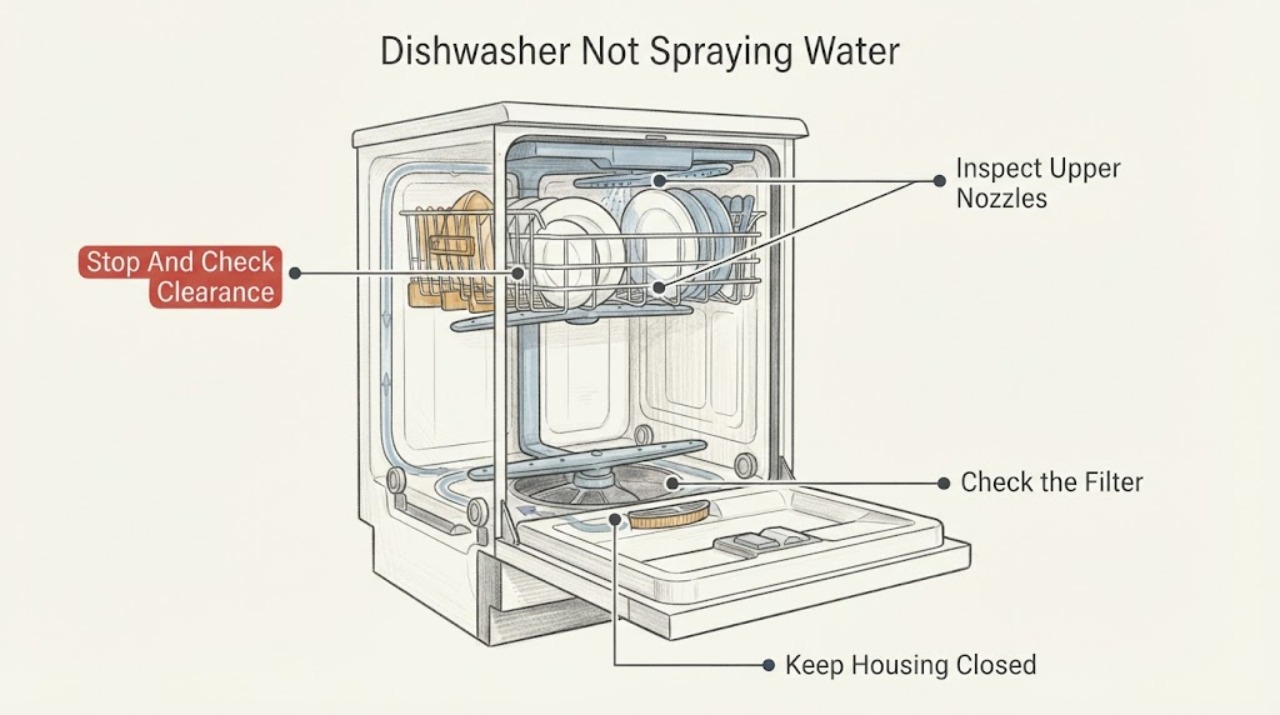
First stop the dishwasher and let it cool before reaching inside. With the machine empty and off, check that the upper spray arm can turn freely, that dishes are not touching it, and that its holes are not blocked. Beko says blocked spray-arm holes can restrict water release, and its support guidance also points to loading and filter checks. Rinse the arm and clean the filter only in the way allowed by the exact model manual. If the arm remains dry or ineffective after those external checks, or there is a leak, standing water, unusual electrical smell or visible damage, leave the dishwasher off and arrange qualified Beko service; do not open panels or diagnose a pump, valve or manifold from the symptom alone.
Work through in order
Diagnostic checks
Use only checks that match the exact appliance or system and its official guide.
-
Check 1
Cancel the programme, switch the dishwasher off and wait for hot water and steam to clear. Remove or reposition any item that touches the upper spray arm, then rotate the arm gently by hand.
Expected result: The arm is blocked by a dish or utensil, or it turns freely with no visible obstruction.
Next step: Run the next check only with the appliance off. If the arm was obstructed, reload without contact and observe the cleaning result; if it was free, inspect the nozzles.
Why this matters
Why: Beko says overcrowding or contact with the arm can restrict its movement and block water jets; free movement does not prove that water is reaching the arm.
-
Check 2
With the dishwasher off, inspect each upper spray-arm opening for food residue, scale or another blockage. Follow the exact Beko manual if the arm is user-removable; where that manual permits removal, rinse it under a tap and clear the openings without damaging the arm.
Expected result: The holes are visibly blocked, or they are open and water can pass through the arm when rinsed.
Next step: If blocked, refit the arm exactly as the manual shows and ensure any model-specific fastener is secure. If the holes are open or the arm remains ineffective, continue to the filter and service-boundary checks.
Why this matters
Why: Beko explains that blocked holes reduce water release into the tub and can leave dishes poorly rinsed. Open holes do not establish that the circulation system is healthy.
-
Check 3
Remove the lower rack and inspect the drain filter only after the appliance is off and cool. Use the complete model manual to identify the filter, remove it, and rinse away food residue; do not remove an unfamiliar mechanism or reach into a guarded area.
Expected result: Food debris is clogging the filter, or the filter is clean and correctly seated.
Next step: Refit the filter as the model manual specifies. If the upper-arm symptom remains, stop troubleshooting at the user-accessible level and arrange service rather than opening the base or pump area.
Why this matters
Why: Beko says a dirty or clogged filter can impair drainage and cleaning performance, but a clean filter does not prove an upper-arm pump or water channel fault.
-
Check 4
Reload the dishwasher so the upper arm and detergent dispenser have clearance, scrape excess food from dishes, and select a programme suitable for the load. Do not use a running cycle as a hand-access test.
Expected result: The upper arm was obstructed or the load/programme was unsuitable, or the same upper-rack symptom returns with correct loading.
Next step: If correction restores coverage, continue normal maintenance. If not, record the model and symptom and request qualified service; do not infer a failed internal part.
Why this matters
Why: Beko links loading, programme choice and food residue to wash coverage and filter contamination; recurrence with correct loading leaves the cause unresolved.
-
Check 5
Keep the dishwasher off and arrange qualified service if the upper arm remains dry or ineffective after the documented external checks, or if there is a leak, standing water, unusual noise, electrical smell, repeated trip or visible damage.
Expected result: The symptom persists after the arm, clearance, loading and filter checks, or a safety warning is present.
Next step: Give the service provider the full model number, cycle used, whether the lower arm works, whether water remains in the tub, and what was observed. Do not open panels, bypass interlocks or test internal wiring/pump parts.
Why this matters
Why: The public Beko guidance supports user-level cleaning and loading checks but does not identify a model-independent internal component diagnosis for this symptom.
Use your observations
Decision map
Find the observation that best matches what you see, then follow the next safe action.
-
PATH 01Next step
What you see
A dish, utensil or rack position touches the upper arm or prevents it from turning freely while the appliance is off.
Do this next
Reload with clearance, turn the arm by hand again, and use the dishwasher only after the moving parts are unobstructed.
Why this path and its safety boundary
Why it matters: The loading arrangement can block the spray path and reduce coverage without proving an appliance failure.
-
PATH 02Next step
What you see
Food residue or mineral deposits are visible in upper spray-arm holes.
Do this next
Clean and refit the arm only by the exact model instructions; if the symptom remains, stop at external checks and arrange service.
Why this path and its safety boundary
Why it matters: Beko says blocked holes can prevent enough water from being released into the tub.
-
PATH 03Next step
What you see
The arm turns freely, the nozzles and filter are clean, and the load leaves the spray path clear, but the upper rack is still not rinsed.
Do this next
Do not diagnose or replace an internal part from the symptom alone. Keep the appliance safe and contact qualified Beko service with the model and observations.
Why this path and its safety boundary
Why it matters: The symptom is not explained by the supported user checks; a pump, manifold, inlet or other internal cause is possible but unconfirmed.
-
PATH 04Next step
What you see
There is leaking, standing water with an electrical concern, an unusual electrical smell/noise, a protection trip or visible damage.
Do this next
Stop using the dishwasher, isolate power or water only when it is safe to do so without touching damaged equipment, and arrange qualified service. Do not restart it to test.
Why this path and its safety boundary
Why it matters: This exceeds a spray-arm cleaning check and can create water or electrical risk.
Helpful context
Understand the symptom
Start with a safe, model-neutral inspection
Cancel the cycle, switch the dishwasher off and wait until hot water and steam have cleared. Do not put a hand into a running wash or reach toward a moving arm. With the racks accessible and the appliance off, turn the upper arm by hand and look for a dish, utensil or rack position that prevents movement. Beko says items touching the spray arms can block water jets and reduce cleaning effectiveness.
Clean the upper arm and filters only as the manual permits
Look through the upper arm nozzles for food residue or mineral deposits. Beko's support instructions describe rinsing the arm under a tap and clearing blocked nozzles, with the upper-arm nut tightened when it is refitted. Because Beko dishwasher layouts vary, use the complete model manual for the removal direction and for filter location. A clogged filter can also reduce wash performance, so remove food debris and rinse it only according to that manual.
Use the result to decide whether service is needed
If the arm turns freely, its holes are open and the rack is correctly loaded but the upper rack still receives little or no water, the public Beko guidance does not identify which internal circulation part has failed. Do not call a pump, inlet valve or water channel defective from this symptom alone. Keep the appliance off if it leaks, leaves standing water, smells electrical, trips protection or has visible damage, and give the technician the model number and what you observed.
When checks do not resolve it
Need a professional?
Contact qualified Beko service if the upper arm still does not spray after model-documented cleaning, correct loading and filter checks., Stop using the dishwasher for a leak, standing water with an electrical concern, electrical smell, repeated trip, unusual noise or visible damage., Do not open panels, reach into a running cycle, bypass a door interlock, test internal wiring, or replace a pump, valve or manifold based only on this symptom.
Have this ready
- complete dishwasher model number
- cycle and load used
- whether the lower spray arm works
- whether the upper arm turns freely when off
- whether holes or filters were blocked
- any leak, standing water, unusual noise, electrical odor or protection trip
Common questions
FAQ
Can a blocked upper spray-arm hole stop water from reaching the top rack?
Yes, Beko says blocked spray-arm holes can reduce water release and leave dishes poorly rinsed. Clear the arm only using the exact model instructions; this does not prove an internal pump or manifold fault.
Should I remove the upper spray arm?
Only if the complete manual for your Beko model documents it. Beko's US support page describes turning the upper-arm nut counterclockwise, rinsing the arm and tightening the nut again, but individual layouts and fasteners can differ.
Could the filter cause the upper arm not to spray?
A clogged filter can contribute to poor cleaning or drainage, so Beko recommends regular filter cleaning. Use the model manual for the filter type and location; a clean filter does not identify the cause of an arm that remains dry.
What if the upper arm still does not work after cleaning?
Stop at the user-accessible checks and contact Beko or qualified appliance service with the model and observations. Beko UK advises contacting customer care when cleaning and loading measures do not resolve the problem and does not recommend attempting appliance repair yourself.
Read the exact guide
Official sources
- My Beko dishwasher is not rinsing thoroughlyBeko UK · Beko dishwashers; supports spray-arm and filter checks without asserting an internal part failure.
- How do I remove and clean the filters?Beko UK · Beko dishwashers; filter type and location remain model-dependent.
- How To Load A Dishwasher For Best ResultsBeko UK · Beko dishwasher loading guidance; applies to clearance checks rather than internal diagnosis.
- Why Is My Dishwasher Not Cleaning Properly?Beko UK · Beko dishwashers; supports blocked filter/spray arm, loading and escalation guidance.
- How to fix a dishwasher that's not cleaningBeko · Beko dishwasher support; exact model is not supplied, so removal instructions are treated as model-dependent.
Community feedback
Share a repair observation
Share a plain-text repair observation. Accepted observations are published automatically; this page may take a moment to update.