
On this page
Start here
Quick answer
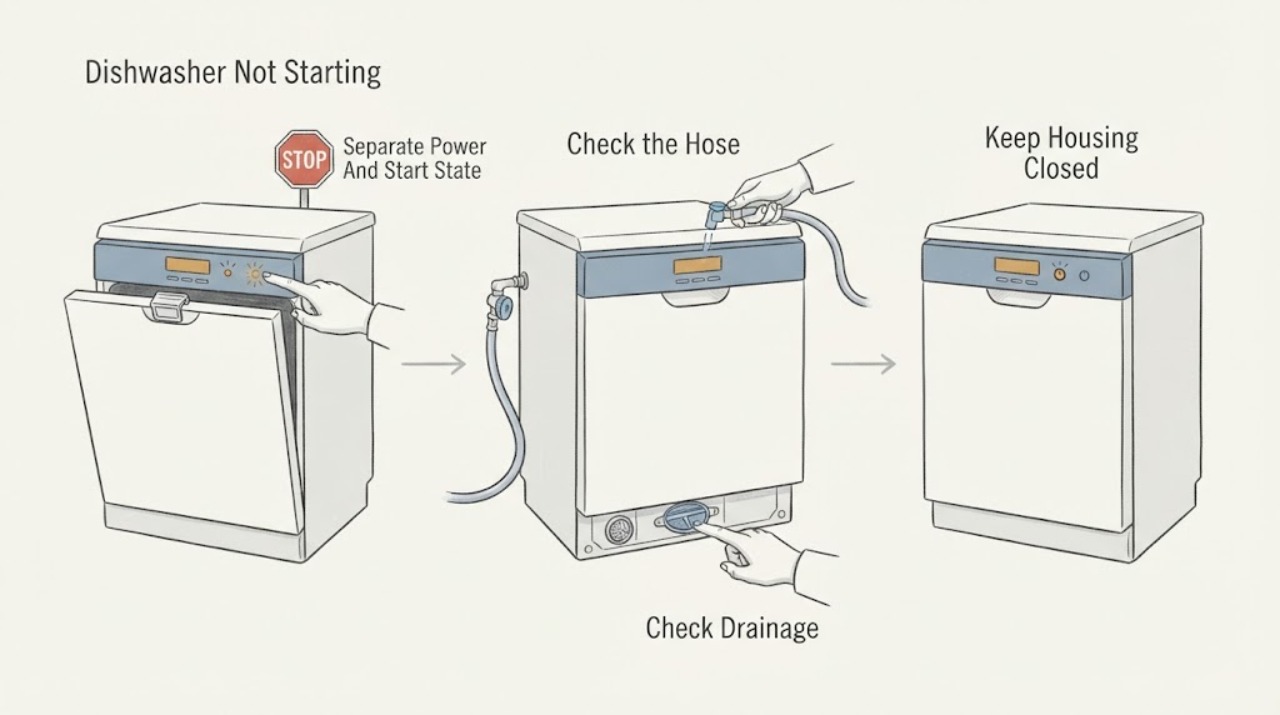
First determine whether the dishwasher is completely dead or has power but will not begin the water stage. Beko's official start guidance supports checking household power, the water-supply tap and firm door closure. If it has power but does not take in water, check the tap and visible hoses for a kink or blockage, and remember that a dishwasher that cannot drain may also refuse to take in water. With power and water isolated safely, clean only the accessible drain filter if the model manual permits it. Do not bypass the door latch, open the cabinet or assume a failed inlet valve from the symptom. If the display shows a model-specific water or overflow warning, there is a leak, the hose is damaged, or the dishwasher still will not start after the external checks, close the water supply and arrange Beko-authorized service.
Work through in order
Diagnostic checks
Use only checks that match the exact appliance or system and its official guide.
-
Check 1
Press the documented power/start control once and observe whether the display or indicator lights respond; if the panel is lit, close the door firmly and check for the normal latch engagement without forcing it.
Expected result: The display remains dark, the display is lit but the cycle will not start, or the door does not latch/close normally.
Next step: For a power problem, check the household supply from a safe location and use a qualified electrician if the circuit is faulty. For a door/latch problem, leave the dishwasher unused and arrange authorized service; do not bypass the latch.
Why this matters
Why: A dark panel points first to household power or the appliance supply. A lit panel with no start can be blocked by door-state detection; a damaged or non-latching door is a service condition.
-
Check 2
If the dishwasher has power and the door latches, confirm the water-supply tap is open and inspect the visible supply and drain hoses for kinks, crushing, blockage or leakage without pulling the appliance out unsafely.
Expected result: The supply tap is closed, a hose is kinked/damaged, water is unavailable at nearby taps, or the visible connections are clear.
Next step: Open the tap only if there is no leak and the installation permits it; straighten only an accessible kink. Replace leaking or damaged hoses through the model-appropriate service path. If the water supply is unavailable, resolve that household issue before testing the appliance again.
Why this matters
Why: Beko identifies a closed water supply and bent or clogged hoses as reasons a dishwasher may not take in water. A damaged hose is a flooding risk; a clear visible hose does not prove the inlet valve is sound.
-
Check 3
With the dishwasher stopped, cooled and safely isolated from power and water as the model manual requires, inspect the visible drain route and clean the accessible drain filter only if the model's user instructions allow it; do not open the pump or base.
Expected result: Standing water, a kinked/clogged drain hose or food debris in the accessible filter is present, or the drain path appears clear.
Next step: Restore the accessible filter and hose exactly as the model manual describes, then try one normal cycle only if there is no leak or warning. If water remains or the restriction is internal, stop and arrange service.
Why this matters
Why: Beko states that inability to drain can prevent water intake and identifies hose and filter restrictions as checks. A clear filter does not rule in or rule out an internal pump, valve or control fault.
-
Check 4
Record the exact model number and any displayed icon, light pattern or code before repeating a cycle; compare it with the model's Beko manual rather than applying another dishwasher's code meaning.
Expected result: A named water/overflow warning appears, no warning appears, or the symbol cannot be identified from the available model documentation.
Next step: Use the exact manual or give the model and observed display to Beko support. If an overflow/leak warning persists, close the water valve and leave the dishwasher off while arranging service.
Why this matters
Why: Beko manuals use model-dependent warnings and service boundaries. Without the exact model, a generic water-inlet label cannot identify a universal part or procedure.
-
Check 5
Stop user troubleshooting for an active leak, overflow, damaged hose, non-latching door, repeated no-fill/no-start condition after the external checks, or any need to access wiring, a valve or the pump.
Expected result: The fault repeats or a water/electrical/mechanical hazard is present.
Next step: Close the water supply, keep the appliance off and arrange Beko-authorized service. Use a qualified electrician for a supply fault; do not bypass the door, open the cabinet or perform live testing.
Why this matters
Why: Beko routes persistent technical problems to authorized service and does not support a universal internal diagnosis from this symptom alone.
Use your observations
Decision map
Find the observation that best matches what you see, then follow the next safe action.
-
PATH 01Next step
What you see
The display is dark, or it is lit but the door does not close and latch normally.
Do this next
Resolve a household electrical issue with a qualified electrician or arrange Beko service for a damaged/non-latching door. Do not bypass the latch.
Why this path and its safety boundary
Why it matters: Beko's no-start guidance treats household power and door closure as separate first checks; the symptom does not establish a water-inlet component failure.
-
PATH 02Next step
What you see
The panel works and the door latches, but the supply tap is closed or a visible supply hose is kinked, crushed or damaged.
Do this next
Correct only the safe, accessible supply issue and check for leaks. If the hose is damaged or the problem remains, close the tap and request service.
Why this path and its safety boundary
Why it matters: The finding matches Beko's documented water-supply and hose causes for a no-fill condition.
-
PATH 03Next step
What you see
The dishwasher retains water, the drain path is restricted or the accessible filter contains debris.
Do this next
Clean the accessible filter and correct the model-documented hose routing, then reassess once. Persistent standing water requires service.
Why this path and its safety boundary
Why it matters: Beko says a dishwasher that cannot drain may not take in water, so this is a drain-path branch rather than proof of an inlet-valve failure.
-
PATH 04Next step
What you see
Power, door, tap, visible hose and accessible filter checks are satisfactory but the dishwasher still will not start or take in water, or a leak/overflow warning persists.
Do this next
Close the water supply, leave the dishwasher off and arrange Beko-authorized service with the model number and observed warning.
Why this path and its safety boundary
Why it matters: The public Beko guidance has reached its service boundary; no model is supplied to support a universal valve, flowmeter, pump or control diagnosis.
Helpful context
Understand the symptom
Separate no power, no start and no water
A dark display is a power question. A lit display with no cycle start is often a door-closure or control-state question. A cycle that starts but does not take in water is a supply, hose or drain-path question. Beko's general support pages cover these branches, but they do not make a model-independent diagnosis of an inlet valve or control board.
Why drainage can look like an inlet fault
Beko says a dishwasher that cannot drain itself may not take in water. Check the visible drain route and the accessible filter before assuming the water inlet is defective. Hose heights, icons and filter layouts vary by model, so use the exact manual for any model-specific instruction.
Keep the repair boundary external
The official Beko UK FAQ advises against attempting to repair the appliance yourself and routes unresolved filling problems to support. Do not bypass the door latch, open the base, remove an inlet valve or perform live electrical tests. A leak or overflow warning changes the priority to shutting off water and obtaining service.
When checks do not resolve it
Need a professional?
Arrange authorized service for a damaged or non-latching door, persistent no-start/no-fill condition, or a warning that returns after the external checks., Close the water supply and stop using the dishwasher for active leakage, overflow or a damaged hose., Do not bypass the door latch, open the cabinet or perform live electrical tests.
Have this ready
- complete model and serial information
- whether the display is dark, lit or showing a named warning
- whether the door latches normally
- water-supply tap, visible hose, drain and filter observations
- whether there is standing water, a leak or an overflow warning
Common questions
FAQ
Why will my Beko dishwasher not start when it seems to have a water fault?
Check power, door closure and the water-supply tap first. If the panel works but no water enters, inspect visible supply/drain hoses and the accessible filter because Beko notes that a drainage problem can prevent water intake. Persistent faults need authorized service.
Can a blocked drain stop a Beko dishwasher from taking in water?
Yes. Beko's official no-water guidance says that if the dishwasher cannot drain itself, it may not take in water. Check the visible drain route and model-accessible filter before assuming an inlet-valve failure.
Should I replace the Beko water inlet valve?
Not from this symptom alone. Check power, door, tap, visible hoses, drain path and the accessible filter according to the exact model manual. If the issue persists or water is uncontrolled, close the tap and arrange authorized service instead of opening the valve or bypassing a safety device.
Read the exact guide
Official sources
- How to fix a dishwasher that won’t take in waterBeko · Official Beko US support page opened directly. Supports drain/inlet relationship, visible hose checks, accessible drain-filter cleaning, door closure and service boundary.
- Why is my Beko dishwasher not filling with water?Beko UK · Official Beko UK FAQ opened directly. Used for its regional water-pressure/tap/hose and no-self-repair guidance; the pressure range is not generalized across regions or models.
- How to fix a dishwasher that won’t startBeko · Official Beko US support page opened directly. Supports power, water-supply tap, door/latch and authorized-service checks; exact model controls remain applicable.
Community feedback
Share a repair observation
Share a plain-text repair observation. Accepted observations are published automatically; this page may take a moment to update.