
On this page
Start here
Quick answer
If a Beko dishwasher leaves food on the bottom-rack dishes while the upper rack is cleaner, start with the lower spray arm and the way the bottom rack is loaded. Beko says blocked spray-arm holes reduce water delivery, and its loading guidance says large or nested items can block spray movement and water flow. With the dishwasher switched off and safe to handle, check that the lower arm turns freely, rinse accessible nozzles, reload dishes with dirty surfaces facing the center and space between items, then check the filter, detergent, and selected programme. If both racks remain poorly cleaned after these checks, the cycle uses normal settings, or there is a leak, smoke, burning odor, or electrical problem, stop using the dishwasher and arrange authorized service.
Before you begin
Safety first
- Do not open sealed panels, test live wiring, reach into a pump, bypass a safety control, or order a pump, heater, or thermostat based only on poor bottom-rack cleaning.
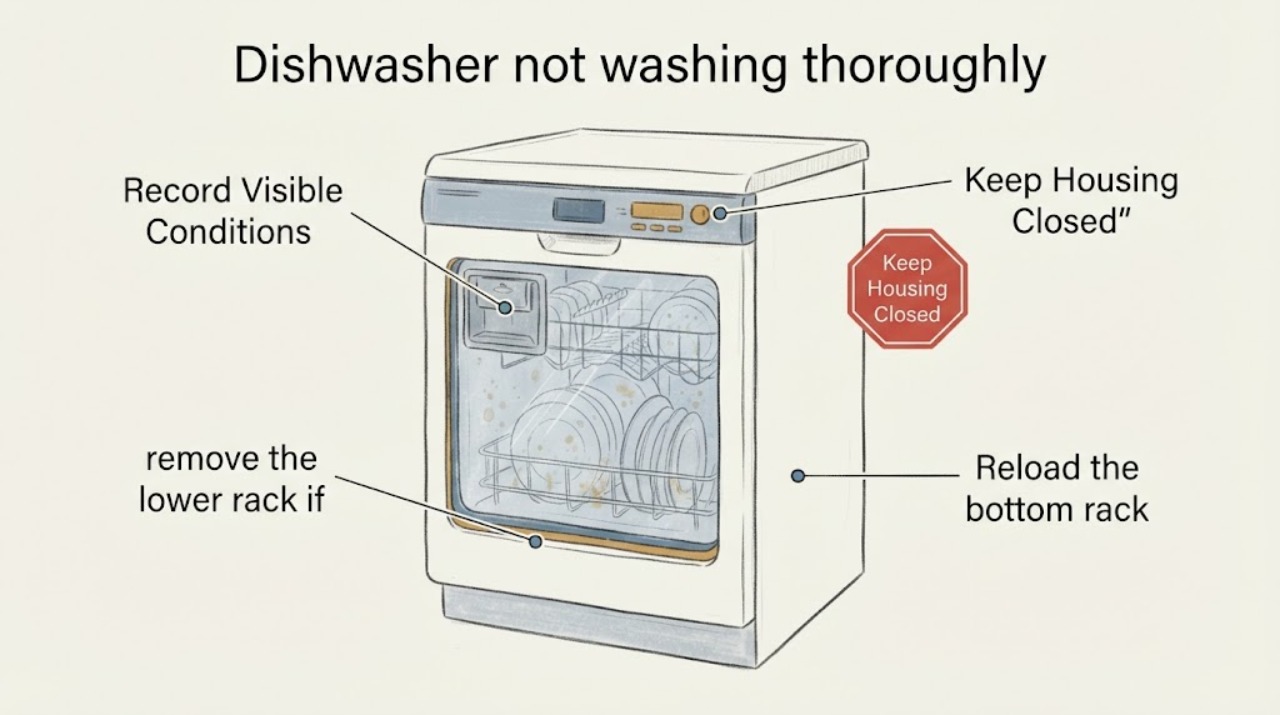
Work through in order
Diagnostic checks
Use only checks that match the exact appliance or system and its official guide.
-
Check 1
Compare a few clean and dirty items by rack after the cycle ends. Record whether residue is limited to the bottom rack, concentrated behind one large item, or present across both racks; also note whether the detergent dispenser opened.
Expected result: Only bottom-rack items are dirty, one blocked area is dirty, both racks are dirty, or detergent remains in the dispenser.
Next step: For a bottom-rack-only pattern, inspect the lower spray arm and rack arrangement first. For both racks or retained detergent, continue with the filter, programme, and dispenser checks instead of replacing a part based on residue alone.
Why this matters
Why: Bottom-rack-only residue makes lower spray coverage or loading more likely than a general cycle problem. Dirt on both racks points toward a broader filter, programme, detergent, water-temperature, or technical issue; detergent remaining in the dispenser adds a release or loading clue.
-
Check 2
After switching the dishwasher off and allowing it to be safe to handle, remove the lower rack if needed and inspect the lower spray arm holes. Rinse the arm under a tap and clear only visible nozzle debris with a soft brush; refit it so it is seated correctly and turns freely.
Expected result: Nozzles contain food or mineral debris, the arm catches or cannot rotate freely, or the arm is clear and spins without obstruction.
Next step: Correct only the visible blockage or seating issue, then run one controlled test with a normally loaded bottom rack. If the arm is clear but the bottom rack remains dirty, move to loading and filter checks; do not open the pump or cabinet.
Why this matters
Why: Beko says blocked spray-arm holes reduce the water released into the tub, which can leave detergent incompletely dissolved and dishes poorly rinsed. A clear, freely moving lower arm makes that accessible cause less likely but does not rule out an internal circulation fault.
-
Check 3
Reload the bottom rack with large or heavily soiled items spaced between the tines, dirty faces toward the center, bowls and pans angled downward, and no item touching or overhanging the lower spray arm. Manually rotate both arms before starting.
Expected result: A pan, bowl, tray, or nested item blocks the arm or detergent lid, items are double-stacked or crowded, or both arms rotate freely with open water paths.
Next step: Run the same suitable programme with the corrected load and compare the same type of item. If the lower rack is still consistently worse with free arm movement, continue with filter and programme checks and arrange service if the pattern persists.
Why this matters
Why: Beko says incorrect stacking can obstruct spray-arm movement, the dispenser lid, and water flow. The bottom-rack guide says spacing and orientation improve coverage; a rack-specific improvement after reloading supports a coverage problem rather than a failed internal part.
-
Check 4
With the dishwasher switched off and unplugged, remove only the accessible drain filter according to the model manual and rinse away food debris. Scrape or wipe excess food from heavily soiled dishes before the next load; do not force a filter or reach into a sealed pump area.
Expected result: The filter has food build-up, the filter is clear, or it is stuck, damaged, or inaccessible.
Next step: Refit a clean filter fully and retest once only if the appliance is dry and safe. If the filter cannot be removed safely, water remains, drainage is abnormal, or cleaning does not improve, stop and arrange authorized service.
Why this matters
Why: Beko says a dirty filter can reduce cleaning effectiveness and that food debris can also clog the filter and drain hose. A clean filter lowers the likelihood of that accessible restriction but cannot prove that an internal pump or circulation path is healthy.
-
Check 5
Check the detergent dispenser and detergent condition before a test: the compartment should be dry, the detergent should not be damp or clumped, the lid should close, and only dishwasher detergent, rinse aid, and salt intended for the model should be used. Select a programme and temperature suitable for the soil level.
Expected result: The dispenser is wet or blocked, detergent is damp, the lid cannot open freely, the programme is too mild for the soil, or these conditions are normal.
Next step: Correct only the loading, dispenser, detergent, or programme selection issue and compare one test load. Do not add hand dish soap, bleach, vinegar, or other unapproved chemicals; escalate if the result does not change.
Why this matters
Why: Beko says a wet or damp dispenser can prevent full detergent release, while an unsuitable programme or low water temperature can leave tough food behind. If these conditions are normal and only the bottom rack remains dirty, the lower water-coverage pattern remains more significant.
-
Check 6
After one controlled retest with a clear lower arm, open load paths, clean filter, and suitable programme, compare the same bottom-rack items again. Check the floor and accessible hose or door-seal area for leaks, scorching, or water near electrical parts.
Expected result: Bottom-rack cleaning improves, both racks remain poor, the pump or cycle behaves abnormally, or a leak, smoke, burning odor, damaged cord, or electrical sign is present.
Next step: Stop for any leak, smoke, burning, sparking, shock, flooding, damaged cord, or water near electrical parts, and isolate power only from a dry safe location. Otherwise, keep the dishwasher off and arrange authorized service when the pattern persists or internal work would be required.
Why this matters
Why: Improvement after an accessible change supports a loading, spray-arm, filter, detergent, or programme cause. No improvement across a controlled load makes an internal water-circulation, heating, sensor, or control fault more concerning; a hazard overrides further cleaning tests.
Use your observations
Decision map
Find the observation that best matches what you see, then follow the next safe action.
-
PATH 01Next step
What you see
The upper rack is acceptably clean, but the lower rack has residue and the lower spray arm is blocked, catches, or is stopped by a pan or bowl.
Do this next
Clean and reseat only the accessible lower arm, correct the load, and run one comparable test. If the arm still will not move freely, stop and arrange service.
Why this path and its safety boundary
Why it matters: The evidence favors a lower water-coverage problem caused by the arm or loading rather than the cycle-not-completing pattern. Beko specifically links blocked spray nozzles and obstructed arm movement to poor cleaning.
-
PATH 02Next step
What you see
The lower spray arm turns freely and its holes are clear, but a large or crowded bottom-rack load leaves residue only where items overlap or face away from the center.
Do this next
Reload between the tines with open space and the dirty surfaces toward the center, then compare one similar load. If all lower-rack positions remain poor, continue to the broader checks and service boundary.
Why this path and its safety boundary
Why it matters: The pattern is more consistent with blocked spray paths or poor item orientation than with a failed pump. Beko says spacing, dirty-side orientation, downward angles, and avoiding double-stacking improve water coverage.
-
PATH 03Next step
What you see
Both racks remain dirty, detergent is not released, the filter is heavily soiled, or the selected programme is too mild for the load.
Do this next
Correct the accessible dispenser, filter, detergent, or programme condition and perform one safe comparison cycle. If cleaning remains poor with normal settings, contact authorized service rather than choosing a pump, heater, or thermostat from the symptom.
Why this path and its safety boundary
Why it matters: The symptom is no longer limited to bottom-rack spray coverage. A dispenser, detergent, filter, programme, or water-temperature issue is more plausible than a rack-specific blockage.
-
PATH 04Next step
What you see
A clear lower arm, correctly spaced load, clean filter, dry dispenser, suitable programme, and one controlled retest do not improve the result, or any leak, smoke, burning odor, sparking, shock, or water near electrical parts is present.
Do this next
Stop using the dishwasher. Isolate power only from a dry safe location when there is no need to touch the wet appliance, and arrange authorized service with the model, programme, rack pattern, photos, and test results.
Why this path and its safety boundary
Why it matters: Persistent failure after the accessible checks makes an internal circulation, heating, sensor, or control problem more concerning; a hazard makes further operation unsafe.
Helpful context
Understand the symptom
Why only the bottom rack may be dirty
A rack-specific result is useful evidence. If the upper rack is acceptable but plates, pans, or bowls in the bottom rack retain food, first suspect the lower spray arm's reach or a load that blocks its rotation or water path. Beko describes spray arms as the parts that release wash water into the tub and says blocked holes can prevent detergent from dissolving fully. This pattern is different from a dishwasher that is slow to finish or cannot drain, although a dirty filter can still reduce overall cleaning performance.
What a clean bottom-rack setup looks like
Beko recommends using the bottom rack for larger, heavily soiled items, placing dirty surfaces toward the center, angling dishes downward, leaving space for circulation, and avoiding double-stacking or overcrowding. A large bowl or pan at the front can also block detergent from reaching other items. These checks are about water coverage, not about replacing a pump or heater from the symptom alone.
When checks do not resolve it
Need a professional?
Arrange authorized Beko service when the bottom rack remains poorly cleaned after the lower arm, loading, filter, detergent, and programme checks; the spray arm will not seat or rotate; both racks are affected; or an internal pump, heating, sensor, or control problem is suspected. Stop immediately for leaks, smoke, burning odor, sparking, shock, flooding, damaged cord, or water near electrical parts.
Safety scope: Do not open sealed panels, test live wiring, reach into a pump, bypass a safety control, or order a pump, heater, or thermostat based only on poor bottom-rack cleaning.
Common questions
FAQ
Why are only the dishes in the Beko dishwasher bottom rack dirty?
Start by checking the lower spray arm and bottom-rack loading. A blocked nozzle, an arm that cannot rotate, a pan blocking the water path, nested dishes, or crowded spacing can limit coverage below even when the upper rack looks clean.
How should I load the Beko dishwasher bottom rack?
Put large and heavily soiled items in the bottom rack, face dirty surfaces toward the center, angle dishes downward, leave space between items, avoid double-stacking, and manually rotate the spray arms before starting. Do not let a pan or bowl block the detergent lid or arm.
Could a dirty filter cause poor bottom-rack cleaning?
Yes, a dirty filter can reduce overall cleaning effectiveness and food debris can contribute to drain restrictions. Unplug the dishwasher and clean only the accessible filter as the exact manual allows. A clean filter does not prove that an internal circulation or pump fault is absent.
Should I replace the pump or heater when the bottom rack is not clean?
Not from this symptom alone. First compare the rack-specific pattern, spray-arm movement, load coverage, filter, dispenser, detergent, and programme. Persistent poor cleaning after those checks needs an authorized diagnosis before any part is selected.
Read the exact guide
Official sources
- How To Load A Dishwasher For Best ResultsBeko UK · Official Beko UK loading guidance covering bottom-rack placement, orientation, spacing, spray-arm movement, and common loading errors.
- How to fix a dishwasher that’s not cleaningBeko · Official Beko US dishwasher troubleshooting guidance for poor cleaning performance across dishwasher loads.
- How to clean your dishwasherBeko · Official Beko US dishwasher cleaning guidance for removable spray arms, filter, grate, and accessible cleaning steps.
- How to fix a dishwasher that won’t rinse properlyBeko · Official Beko US dishwasher troubleshooting guidance for detergent release, loading, and rinse performance.
Community feedback
Share a repair observation
Share a plain-text repair observation. Accepted observations are published automatically; this page may take a moment to update.