
On this page
Start here
Quick answer
Do not assume a continuously lit Beko salt icon means an electronic failure. First find the exact model and region manual, then confirm that the dishwasher uses a salt reservoir and that the reservoir contains dishwasher softening salt with its lid closed. Beko says a first-use setup should be followed by one complete programme before the light turns off; its manuals also warn that the indicator can remain on for a while after filling while salt dissolves, and some models keep it on when the water-hardness setting means salt is not required. Use only dishwasher salt, never table or rock salt, wipe spilled salt/water, and follow the model’s hardness and fill instructions. If the light remains on after the documented cycle and correct setup, or the lid/reservoir leaks, use the exact manual and contact Beko service rather than changing random buttons or opening the appliance.
Before you begin
Safety first
- Do not use table/rock salt, apply a cross-model reset, open the cabinet, bypass safety controls, run cycles with a leaking cap/reservoir, or service the softener/sensor/control yourself.
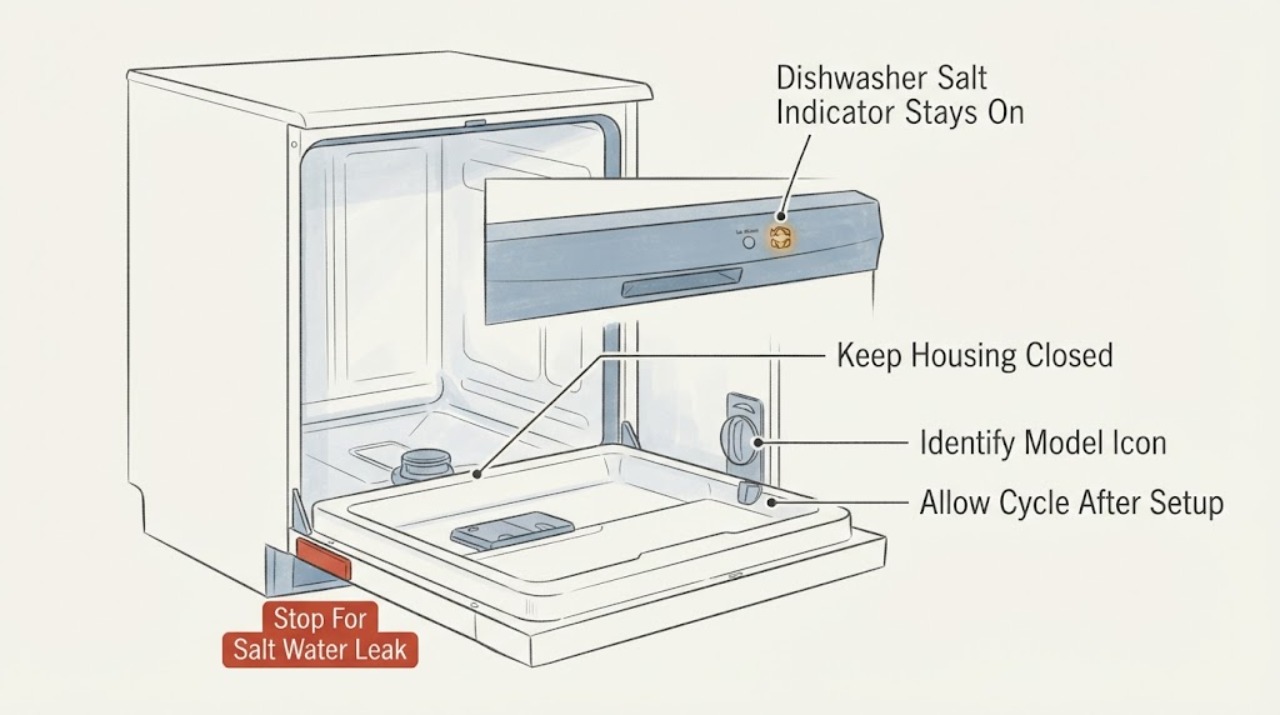
Work through in order
Diagnostic checks
Use only checks that match the exact appliance or system and its official guide.
-
Check 1
Stop the refill or cycle if salt water is pooling, the reservoir cap will not close, the floor is slippery, or water is near electrical equipment; from a dry safe position switch off, disconnect power and close the water tap only as the model manual permits.
Expected result: There is a leak/spill or unsafe wet area, or the area is dry and the cap/reservoir can be observed safely.
Next step: Clean visible spills, leave the dishwasher off and arrange qualified service if the cap/reservoir or electrical area is unsafe. Do not run repeated cycles to clear a leak.
Why this matters
Why: Salt and water can damage the appliance and create slip/electrical risk; a dry area permits only the checks below.
-
Check 2
Record the full Beko model, region, exact salt icon, whether the light appeared after first setup or a refill, and whether a complete programme has finished since then.
Expected result: The model and region are known, or the indicator/model remains uncertain.
Next step: Open the exact manual before changing hardness settings or using a reset sequence. If the identity remains unclear, contact Beko support with the model label.
Why this matters
Why: Beko routes setup, hardness and salt-reservoir instructions through the manual; similar-looking indicators and controls cannot be treated as universal.
-
Check 3
If the model was just installed or the reservoir was filled correctly, run the complete programme or the model-documented post-refill programme once, rather than repeatedly pressing controls to reset the light.
Expected result: The indicator turns off after the documented cycle, remains on temporarily, or remains on after the cycle with correct setup.
Next step: If it clears, no repair is indicated. If it remains on, continue to the model-specific salt and hardness checks; do not assume a failed sensor.
Why this matters
Why: Beko UK says correct first-use setup should clear the light after one complete programme; Beko manuals note that dissolution can delay the indicator change after filling.
-
Check 4
With the dishwasher off and cool, use the exact manual to locate the salt reservoir, confirm dishwasher softening salt is present, and check that the cap is correctly seated; wipe away spilled salt or water.
Expected result: The reservoir is empty, the wrong salt was used, the cap is loose, or the reservoir and cap appear correct.
Next step: Correct only the documented refill condition and allow the model’s stated dissolution/cycle time. If the cap leaks or will not seat, stop and arrange service.
Why this matters
Why: Beko identifies dishwasher-specific salt, secure closure and spill control as part of refilling; a correct fill does not prove the indicator sensor is faulty.
-
Check 5
Use local water-hardness information and the exact Beko manual to compare the configured softener level; do not apply another model’s buttons or numeric table.
Expected result: The manual says salt is unnecessary at the configured hardness, the level is wrong for the local supply, or the setting cannot be confirmed.
Next step: Set the level only through the exact manual. If the setting cannot be confirmed or the indicator remains after the documented adjustment, contact Beko support.
Why this matters
Why: Beko documents that soft-water conditions or a low hardness setting can leave some salt indicators on even when salt is not required; thresholds are model/region specific.
-
Check 6
Contact Beko authorized service when the indicator remains on after the exact manual’s refill, cycle and hardness procedure, the reservoir leaks, the cap will not seal, or another error/safety symptom appears.
Expected result: The light persists, the salt system leaks, or the dishwasher otherwise operates abnormally.
Next step: Provide the model/serial, region, water-hardness information, salt type, refill date, cycles completed and any leak or other error observations. Keep the appliance off if unsafe.
Why this matters
Why: The opened official sources do not prove a failed salt sensor, softener, wiring or control from a persistent icon alone.
Use your observations
Decision map
Find the observation that best matches what you see, then follow the next safe action.
-
PATH 01Next step
What you see
The dishwasher is on first use or was just refilled and has not completed the model-documented cycle.
Do this next
Complete the manual’s safe cycle guidance once and observe the light; do not repeatedly reset it.
Why this path and its safety boundary
Why it matters: The indicator may still be waiting for setup completion or salt dissolution.
-
PATH 02Next step
What you see
The reservoir is empty, the wrong salt was used, the cap is loose or salt/water spilled around the opening.
Do this next
Use only the exact manual’s dishwasher-salt refill procedure, close the cap, wipe spills and stop if the cap leaks.
Why this path and its safety boundary
Why it matters: The refill condition is unresolved and may damage the appliance or prevent correct softener operation.
-
PATH 03Next step
What you see
The exact manual and local water-hardness information show that salt is unnecessary or the softener level is set too low/high.
Do this next
Apply only the model-specific hardness setting and monitor the next documented cycle.
Why this path and its safety boundary
Why it matters: The continuously lit icon may reflect the configured hardness level rather than a failed indicator.
-
PATH 04Next step
What you see
The correct salt, cap, cycle and hardness setting are confirmed but the light remains on or another fault appears.
Do this next
Leave the dishwasher safe and use Beko authorized service with the model and setup history.
Why this path and its safety boundary
Why it matters: A model-specific sensor, softener or control issue is possible but not diagnosed from the icon alone.
-
PATH 05Next step
What you see
Salt water leaks, the floor is slippery, or water reaches electrical equipment.
Do this next
Stop use, isolate utilities only from a dry safe position and obtain qualified service; do not keep running cycles to clear the light.
Why this path and its safety boundary
Why it matters: This is an immediate water, corrosion or electrical safety boundary.
Helpful context
Understand the symptom
Verify the icon, model and region
Record the complete Beko dishwasher model, region, the exact salt icon or wording, whether it appeared after a refill or first installation, and whether the dishwasher completes a cycle normally. Beko’s support page directs owners to the manual when setup details are uncertain. Do not copy a hardness-setting button sequence from another Beko platform or region.
Allow the documented post-setup or refill interval
Beko UK says that after correct first-use setup the salt light should turn off after one complete programme. Beko manuals also explain that different salt particle sizes and water hardness can make the indicator remain on for a while after filling. That waiting/cycle guidance is different from a fault reset: do not repeatedly toggle controls just to extinguish the icon.
Use the right salt and close the reservoir
Beko says to use salt made for dishwasher water softeners, not table or sea salt. The refill guidance places the reservoir below the lower rack, calls for the cap to be closed securely, and says to wipe spilled salt or water; use the funnel supplied with the appliance where the model provides one. The exact reservoir layout and fill method remain manual-specific.
Check water hardness only through the exact manual
The salt indicator can reflect the configured water-softener level rather than a failed lamp. Beko manuals describe cases where very soft water or a low hardness setting means salt is not needed and the indicator can remain illuminated. Measure or obtain the local water-hardness information and use the model’s manual to set the level; do not infer a universal threshold or key combination.
Keep salt spills and service boundaries controlled
Salt and overflow water can damage or corrode dishwasher surfaces, and Beko’s manual safety guidance says to switch off, disconnect power and turn off the water tap before maintenance. If the reservoir cap will not seal, water or salt leaks, the indicator remains on after the exact documented procedure, or the dishwasher shows another fault, stop at external checks and use authorized service.
When checks do not resolve it
Need a professional?
Contact Beko authorized service when the salt indicator remains on after the exact model’s refill, complete-cycle and hardness-setting instructions, when the salt reservoir/cap leaks, or when another error or unsafe condition appears.
Safety scope: Do not use table/rock salt, apply a cross-model reset, open the cabinet, bypass safety controls, run cycles with a leaking cap/reservoir, or service the softener/sensor/control yourself.
Have this ready
- Provide the full model and serial, region, indicator wording/icon, water-hardness information, salt type, refill date, cycles completed, cap condition and any leaks or other symptoms.
Common questions
FAQ
Why does my Beko dishwasher salt light stay on after filling?
Beko says a first-use light should turn off after one complete programme when setup is correct, while its manuals explain that salt dissolution can take time after filling. Some models also keep the light on when water hardness means salt is not required. Verify the exact manual before diagnosing a fault.
Can I use table salt if the dishwasher salt light stays on?
No. Beko says to use special dishwasher softening salt and not table or sea salt. Follow the model manual for the reservoir and hardness setting, and wipe away spills before running the documented cycle.
Should I reset the Beko dishwasher to turn off the salt indicator?
Do not use a generic reset. Beko’s public guidance points to correct setup, a complete programme, the exact manual and support; the opened sources do not establish one universal reset sequence for all Beko dishwashers.
Read the exact guide
Official sources
- How do I add salt and rinse aid?Beko UK Support · Opened official Beko FAQ used for the generic reservoir location/cap and manual referral; exact model instructions remain authoritative.
- The salt light is not going offBeko UK Support · Opened official Beko FAQ used for the first-use/complete-programme guidance and manual/support escalation; exact region/model remains relevant.
- Beko Dishwasher User Manual DDS25841XBeko · Opened official Beko-hosted manual used as a bounded model example for salt-indicator timing, soft-water/hardness behavior and maintenance safety; no DDS25841X button sequence or threshold is generalized to the task’s unknown model.
- How to refill dishwasher salt and rinse aidBeko US Support · Opened official US Beko page used for salt-purpose, reservoir location, funnel/spill control and secure cap guidance; no model-specific button sequence is generalized.
Community feedback
Share a repair observation
Share a plain-text repair observation. Accepted observations are published automatically; this page may take a moment to update.