
On this page
Start here
Quick answer
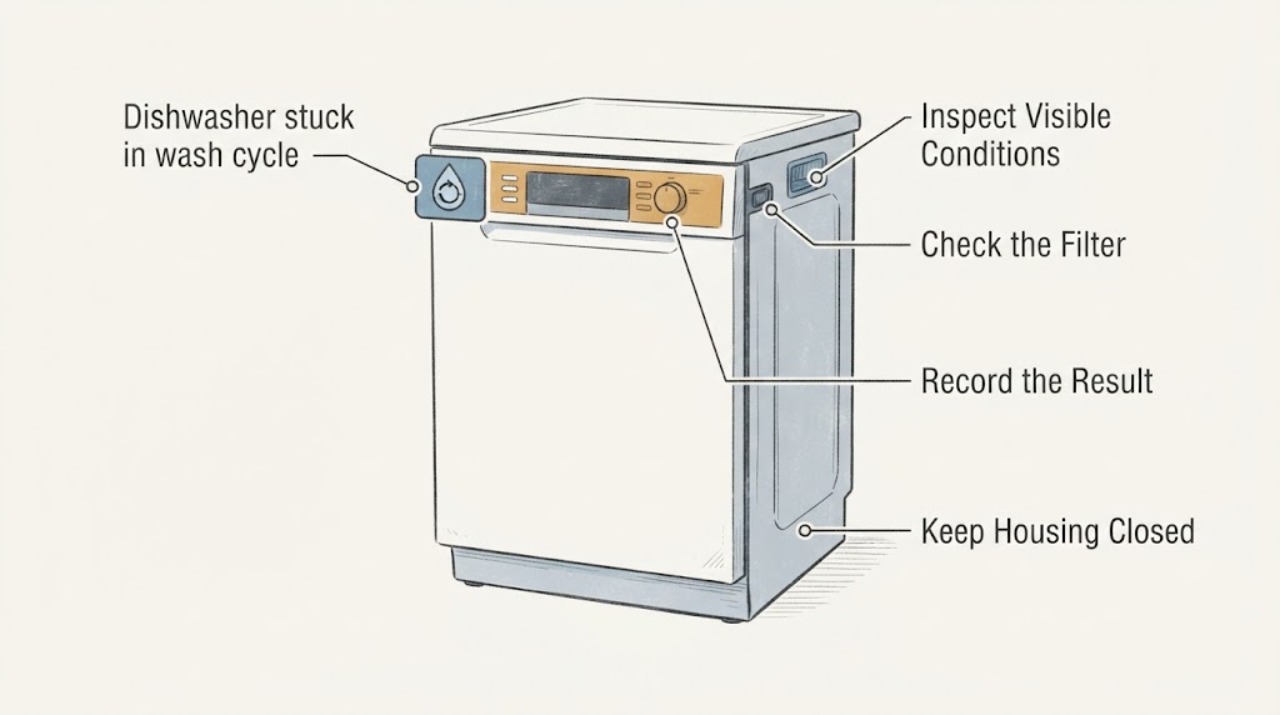
The Beko DW451 product page and its matching user manual identify this as a slim-line integrated dishwasher, but the opened DW451 manual does not define “faulty NTC” as a user-facing code or provide an NTC test. Treat the phrase as an unconfirmed fault hypothesis. Keep the door closed while the dishwasher is operating; if the cycle appears stuck, record whether the pump is still running, whether water remains, whether the water is hot or steaming, and any indicator position. After the machine is safely stopped, unplug it and close the water tap before cleaning or inspecting. Clean and correctly refit the accessible filters, check the spray arms and visible hose routing, then stop and arrange authorised service if the DW451 still does not complete a cycle or does not heat. Do not remove panels, measure live circuits, bypass a door or safety device, or order an NTC/heater from a different Beko model.
Work through in order
Diagnostic checks
Use only checks that match the exact appliance or system and its official guide.
-
Check 1
Leave the door closed while the DW451 is operating. If the cycle appears stuck, observe the panel from outside and record the selected programme or indicator position, the elapsed behaviour, any drain or circulation sound, whether water remains in the tub, and whether any warning indicator is present.
Expected result: The pump continues to run, the machine repeatedly fills or drains, water remains in the tub, the programme indicator does not advance, or the appliance has stopped silently.
Next step: If steam, hot water, leakage, burning smell or abnormal noise is present, stop using the dishwasher and isolate power and water only if they can be reached safely. Otherwise continue only after the appliance is stopped and cool; do not open the door during operation or repeatedly restart it to test it.
Why this matters
Why: These observations separate a possible fill or drain hold from a no-heat report, but none identifies an NTC or heater fault. Hot water or steam can be present even when the cycle is not complete.
-
Check 2
After the appliance has stopped and cooled, unplug it and turn off the dishwasher water tap before cleaning or touching the filter area. Protect the floor with towels if water is present and do not reach into hot or moving parts.
Expected result: The supply can be isolated safely, the tub is cool enough to handle, and there is no active leak; or the appliance remains hot, powered, or leaking.
Next step: If it is not safe to isolate or the appliance is leaking, leave it out of service and arrange authorised service. If it is safely isolated and cool, proceed to the filters and visible checks only.
Why this matters
Why: The first condition permits the manual’s accessible cleaning checks. The second condition is a safety or service boundary and is not a reason to remove panels or continue testing.
-
Check 3
Remove the lower basket only after isolation, clean the DW451 filter system under a tap, and reinstall every filter in its correct position. Inspect the visible spray-arm nozzle openings for food or detergent debris and clean them as the manual describes; do not run the machine without its filters.
Expected result: The filters or spray arms are blocked, damaged, missing, or clean and correctly seated.
Next step: If debris was found, restore the filters and monitor only a normal supervised cycle once the machine is fully reassembled and dry. If the same no-heat or stuck-cycle symptom returns, stop and call service rather than dismantling the sump or heater area.
Why this matters
Why: A blocked filter or spray arm can reduce water action and drainage and can leave a cycle appearing abnormal, but cleaning does not prove or disprove an NTC or heater fault.
-
Check 4
From an accessible position, check that the water tap is open and that the visible inlet and drain hoses are not kinked, crushed or squashed. Do not move the integrated dishwasher or disconnect a hose if doing so requires force or exposes wiring.
Expected result: A tap is closed, a hose is visibly kinked or crushed, the drain routing is outside the manual’s arrangement, or the accessible supply and hose routing look normal.
Next step: Correct only an obvious, safe external hose position with power isolated. If the hose is inaccessible, the unit must be pulled out, or the cycle still stalls, use authorised service and provide the exact DW451 model.
Why this matters
Why: A restricted fill or drain path can interrupt programme progress; normal visible routing does not identify the internal cause of a no-heat symptom.
-
Check 5
If the DW451 still stops in the wash cycle, leaves cold water, or runs for a significant time after the expected end, stop using it and request model-specific service. Give the technician the rating-label model, programme selected, water remaining, temperature/steam observation, indicator position and results of the safe filter and hose checks.
Expected result: The symptom repeats after the external checks, or the machine does not complete a cycle despite normal accessible water, drain and filter conditions.
Next step: Keep the appliance unplugged and the water supply closed if the problem includes leakage, overheating, burning smell or persistent running. Do not test live wiring, bypass the door or float safety, remove panels, or select a replacement NTC/heater by appearance.
Why this matters
Why: The remaining possibilities include an internal temperature-sensing, heating, control, fill or drain problem that the public DW451 user manual does not let a user diagnose safely; “faulty NTC” remains unconfirmed.
Use your observations
Decision map
Find the observation that best matches what you see, then follow the next safe action.
-
PATH 01Next step
What you see
The dishwasher finishes or stops with cold water, but there is no leak and the filters, spray arms and visible hose routing are clear.
Do this next
Keep the appliance out of service and request authorised Beko or qualified appliance service with the DW451 model and the recorded programme and temperature observations; do not perform live tests.
Why this path and its safety boundary
Why it matters: This supports a persistent no-heat or control condition, but the opened DW451 documentation does not identify the NTC, heater or another part as the cause.
-
PATH 02Next step
What you see
Water remains in the tub, the pump runs for a long time, drainage is slow, or the drain hose is visibly kinked or crushed.
Do this next
With power isolated and the machine cool, clean and refit the filters and correct only an obvious accessible hose issue. If water still will not drain, contact service and do not keep restarting the cycle.
Why this path and its safety boundary
Why it matters: The immediate symptom is consistent with a drain-path or filter condition that can prevent normal programme completion; it is not proof of a faulty NTC.
-
PATH 03Next step
What you see
The tap is closed, the inlet hose is visibly restricted, or the dishwasher repeatedly fills inadequately before appearing to stop.
Do this next
Restore only a safe, accessible tap or hose position with the appliance isolated. If the fill problem persists or access requires moving the built-in unit, arrange qualified service.
Why this path and its safety boundary
Why it matters: A water-supply or fill restriction can interrupt the programme before heating; the assigned NTC wording is not established by this observation.
-
PATH 04Next step
What you see
The appliance leaks, gives a burning smell or abnormal noise, remains dangerously hot, or cannot be safely unplugged or isolated.
Do this next
Stop using the dishwasher, keep clear of hot water and steam, isolate power and water only if safely accessible, and request authorised service. Do not open panels or run another test cycle.
Why this path and its safety boundary
Why it matters: This is a safety boundary and may involve an electrical, water or mechanical hazard outside user cleaning guidance.
Helpful context
Understand the symptom
Keep the assigned DW451 identity and separate the symptom from the diagnosis
The official Beko product page identifies DW451 as a slim-line integrated dishwasher and links the DW451 user manual. The task wording describes a dishwasher that is stuck in its wash cycle and is not heating water, while “faulty NTC” is a proposed internal explanation. The opened DW451 manual does not define that phrase as a display code or tell the user to test an NTC. Use the visible symptom and the exact model label for triage; do not turn the hypothesis into a confirmed component fault.
Observe the cycle without opening a hot or operating dishwasher
The DW451 manual warns not to open the door while the machine is operating because water may be very hot and steam may escape. If the programme appears stuck, note the selected programme or indicator position, whether you still hear a drain or circulation pump, whether water is left in the tub, and whether the load or inner door feels warm only after the machine has stopped and cooled. These observations distinguish an apparent long drain or fill condition from a no-heat symptom without claiming which internal part failed.
Use only the accessible cleaning and hose checks supported by Beko
Before cleaning, the DW451 manual says to unplug the appliance and turn off the water supply. With the appliance cold and isolated, remove and rinse the accessible filter system, check that the filters are correctly reinserted, and inspect the spray-arm openings for debris. Beko’s dishwasher guidance also supports checking the drain hose for crushing, kinking or an unsuitable position, and checking the inlet tap and inlet hose when filling is affected. Do not pull an integrated appliance farther than is safe or remove covers to reach an NTC, heater, pump or wiring.
Why a persistent no-heat or stuck-cycle symptom needs service
The DW451 manual’s troubleshooting material supports checks such as water supply, filter cleaning, spray-arm cleaning and loading, but it does not provide a user diagnosis for a temperature sensor or heater. If the dishwasher remains stuck after the safe external checks, repeatedly leaves cold water, or keeps running for a significant time after the expected end, give the technician the exact model and the observations. Beko’s support page says a motor that keeps running after a significant time should be referred to service. A technician must establish whether the NTC, heater, control, water-level, drain or another circuit is actually at fault.
When checks do not resolve it
Need a professional?
Stop using the Beko DW451 and request authorised service if the cycle repeatedly remains stuck, the water stays cold, the drain pump runs for a significant time, water leaks, there is burning smell or abnormal noise, the door or safety mechanism behaves abnormally, or any check would require removing panels, moving the integrated appliance by force, measuring live circuits or bypassing a safety device.
Common questions
FAQ
Does “faulty NTC” confirm that the Beko DW451 temperature sensor has failed?
No. The opened DW451 user manual does not define that phrase as a user-facing code or provide an NTC test. Keep it as an unconfirmed hypothesis until a qualified technician diagnoses the appliance.
Can I open the DW451 door to see whether the water is hot while it is running?
No. The DW451 manual warns not to open the door while operating because water may be very hot and steam may escape. Observe the panel and sounds from outside, then isolate and allow the appliance to cool before any accessible cleaning.
What can I safely check before service?
With the dishwasher cool, unplugged and its water supply closed, clean and correctly refit the filters, inspect spray-arm openings, and check visible inlet and drain hose routing. Beko advises service when external drain and filter checks do not solve the problem.
Should I replace an NTC or heater using a generic Beko part?
No. The public DW451 manual does not establish a part diagnosis or cross-model fit. Keep the machine isolated and have service identify the failed component and exact compatible part from the model documentation.
Read the exact guide
Official sources
- Slim Line Integrated Dishwasher DW451 SilverBeko UK · Opened official product page for the assigned Beko DW451 model; it confirms the exact model and product family but does not define an NTC fault.
- My dishwasher cycle has finished but the motor is still runningBeko UK · Opened official Beko FAQ used only to distinguish a brief drain-pump run from a motor that keeps running for a significant time; it does not diagnose the DW451’s internal cause.
- Water will not drain from my Beko dishwasherBeko UK · Opened official Beko FAQ used for the generic external drain checks that are consistent with the DW451 manual; it does not establish an NTC or heater fault.
- Beko DW451 Dishwasher User ManualBeko UK · Opened official DW451 PDF linked from the exact Beko product page. It supports safe observation, isolation, filter/spray-arm and hose checks, and service boundaries; it does not expose a user NTC diagnostic or confirm the assigned phrase as a code.
- Dishwasher RepairsBeko UK · Opened official Beko repair page used for the professional service boundary and model-number preparation; it does not diagnose the assigned symptom.
- Why Is My Dishwasher Not Cleaning Properly?Beko UK · Opened official Beko FAQ used only for accessible filter, spray-arm and programme-temperature checks; it does not provide a DW451 NTC diagnosis.
- Why is my Beko dishwasher not filling with water?Beko UK · Opened official Beko FAQ used for checking an open water tap and visible inlet-hose restriction when a cycle is not filling; it does not map the assigned phrase to a fault code.
Community feedback
Share a repair observation
Share a plain-text repair observation. Accepted observations are published automatically; this page may take a moment to update.