
On this page
Start here
Quick answer
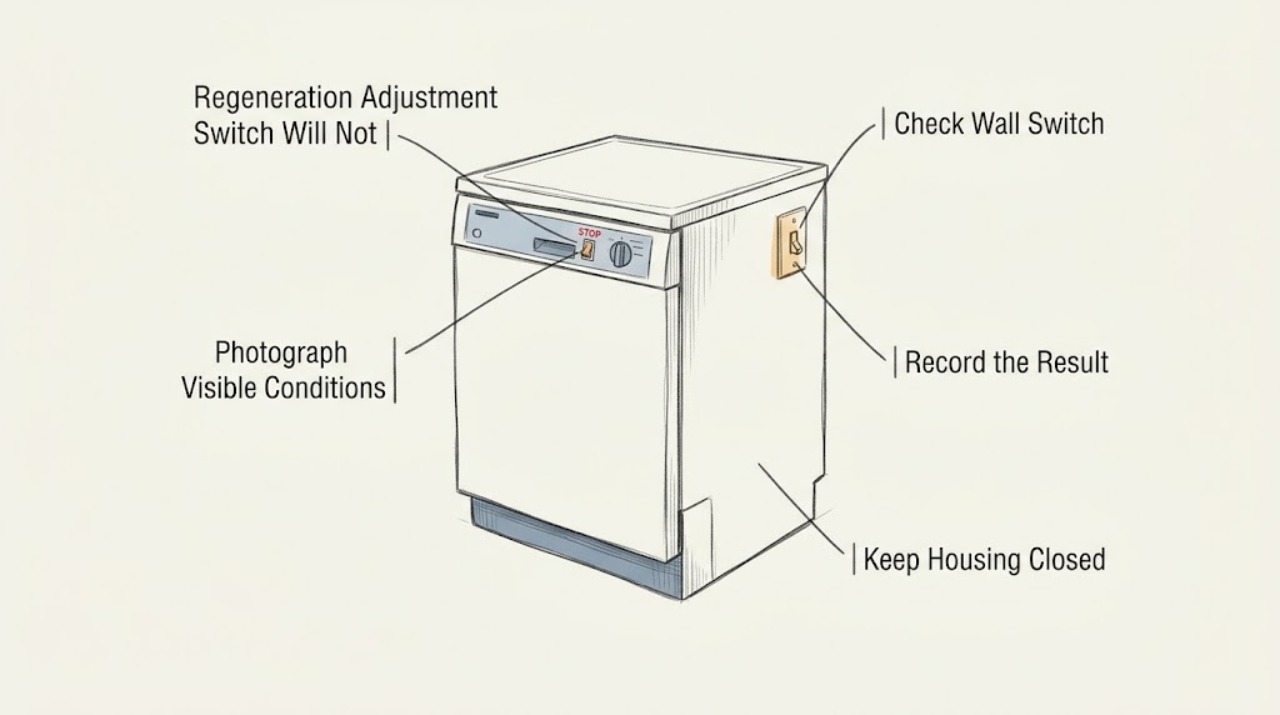
On a new Beko DFS26024W, the small regeneration adjustment switch is part of the water-softening setup, not the dishwasher's main programme selector or the salt-fill cap. Beko's exact-model Quick Guide says to first determine local water hardness, set the matching hardness level on the control panel, and then set the regeneration adjustment switch to the same level. If the physical switch will not move with light, correctly sized tool pressure, stop immediately: do not force it, pry it, lubricate it, or remove panels. Record the panel setting, the visible switch position, the model and market, and whether the plastic is already deformed. A matching public DFS26024W report describes the same immobile switch and deformation after force; the discussion does not establish a safe repair. If the switch is stuck, damaged, at an unexplained position, or the manual supplied with the appliance does not match the exact model, leave the unit as-is and ask the installer or authorized Beko service to inspect or replace the water-softener setting component.
Before you begin
Safety first
- Do not force, pry, drill, lubricate, heat, or bypass the regeneration adjustment switch. Do not remove the salt reservoir, door or side panels, internal packaging, or water-softener housing, and do not use another model's setting sequence. Keep the dishwasher off if the component is damaged or setup cannot be confirmed.
Work through in order
Diagnostic checks
Use only checks that match the exact appliance or system and its official guide.
-
Check 1
Confirm the rating label reads Beko DFS26024W and photograph the switch, the salt-reservoir area, and the control panel before touching anything. Keep the dishwasher off while examining the setup, and do not remove panels or reach behind the tub.
Expected result: The label is DFS26024W, a different suffix or market version, unreadable, or the part being turned is actually the salt cap, a programme control, or another component.
Next step: If the identity is not an exact match, stop and obtain the matching regional manual from Beko. If the identity matches, continue only with the Quick Guide's water-softener terminology.
Stop if: Do not pry off a cap, remove an inner panel, or continue turning a component whose function is uncertain.
Why this matters
Why: Beko's product page and documentation are model-specific. A different model or a different control cannot safely inherit the DFS26024W hardness-setting procedure, and confusing the salt cap with the adjustment switch can damage the wrong component.
-
Check 2
Determine the household water hardness using the supplied test strip or a reliable local water-hardness source as described in the DFS26024W Quick Guide. Note the hardness scale and the level selected on the display; do not choose a level from the switch's current position.
Expected result: The test indicates level 0 through 5, the panel already shows a level, the panel setting is unknown, or the water-hardness information uses a different scale or is unavailable.
Next step: Use the Quick Guide's table and control-panel procedure only when the model and hardness scale match. If hardness or panel status is unknown, record the uncertainty and ask Beko service or the installer to confirm it; do not turn the stuck switch as an experiment.
Stop if: Do not enter an unrelated service menu, repeatedly change settings, or use another Beko model's button sequence.
Why this matters
Why: Beko's table maps water-hardness ranges to levels 0–5 and says the control-panel level is selected first. A physical switch position alone cannot tell you whether the softener is correctly configured, and an unknown hardness value prevents a confident target setting.
-
Check 3
Set or verify the electronic water-hardness level on the control panel exactly as the DFS26024W Quick Guide describes, then save it with the documented On/Off step. Leave the physical regeneration switch untouched if it does not move easily and do not use force to make the two positions agree.
Expected result: The panel accepts and displays the intended r0–r5 level, does not enter the documented setting mode, shows a different symbol, or the panel setting is correct while the physical switch remains at another position.
Next step: Keep a photo of the saved panel level and the physical switch position. If the switch is immobile or mismatched, stop setup and request model-specific service or installer inspection before regular use in hard water.
Stop if: Do not force the switch, pry it with a blade, heat it, spray lubricant, or dismantle the door or side panel.
Why this matters
Why: The electronic setting and physical switch are separate parts of the same water-softening configuration. The Quick Guide establishes that they should match, but it does not establish that a stuck physical switch can be freed by force or that a mismatch is safe to ignore indefinitely.
-
Check 4
Distinguish the regeneration adjustment switch from the salt-reservoir cap and from packaging or transport material using only the supplied manual's labels and diagrams. Inspect from ordinary access for a deformed slot, missing knob, broken plastic, or an obstruction, but do not remove anything that is not plainly packaging designed to be removed.
Expected result: The part is a numbered hardness switch, the salt cap opens normally, the switch has deformed plastic, the control is blocked by an unidentified piece, or the manual diagram does not match the appliance.
Next step: Stop if the switch is damaged, obstructed, or not positively identified. Send the photos and model label to the installer or authorized Beko service and ask whether the softener assembly was damaged or incorrectly fitted during manufacture or installation.
Stop if: Do not remove the salt reservoir, cut internal packaging, pry the switch, or open the appliance to inspect the water-softener housing.
Why this matters
Why: Beko separately describes salt requirements and the regeneration switch. A low-salt indicator or an unopened salt reservoir does not identify a transport lock, and a mismatch between the actual appliance and manual is evidence that the setup instruction may not apply.
-
Check 5
If the switch is already deformed or will not turn with the light, manual-described action, stop the new-appliance setup and document the attempted force, direction tried, current position, panel setting, and whether any salt, water, or detergent has been added. Do not run repeated cycles merely to see whether the mismatch matters.
Expected result: The switch remains stuck, the slot is rounded or cracked, the setting differs from the panel, or the dishwasher has already completed a cycle with the mismatch.
Next step: Keep the unit out of regular service until the installer or authorized Beko service confirms the setting or repairs the component. Preserve the photos and purchase/installation record for a new-appliance warranty request.
Stop if: Do not continue applying torque, drill the switch, bypass the softener, or accept a generic setting from another model.
Why this matters
Why: A stuck or damaged switch is a physical component issue, not a normal power, door, or programme-start problem. The Quick Guide supports matching settings but does not provide a safe owner repair for a deformed control. Running cycles cannot isolate whether softener regeneration is being applied correctly.
-
Check 6
Prepare the service handoff with the exact DFS26024W identity, country or market, water-hardness result and scale, saved panel level, physical switch position, photos of any deformation, whether the salt reservoir was filled, and whether the appliance has been run. Ask the provider to confirm the switch's intended movement and inspect the water-softener assembly without having you force or dismantle it.
Expected result: The provider can match the manual and explain the setting with an intact switch, or the provider cannot match the manual, proposes force, or cannot explain whether the part is the salt cap, hardness switch, or packaging.
Next step: Use only the exact manual's documented setting once service confirms the component. If the appliance is new, request installation or warranty correction before authorizing a user repair.
Stop if: Do not continue setup against resistance or open the machine to help the provider diagnose it.
Why this matters
Why: A matched manual and intact control support a documented setup. An unexplained or damaged control requires service evidence; a generic direction or part recommendation does not prove compatibility or restore the softener setting.
Use your observations
Decision map
Find the observation that best matches what you see, then follow the next safe action.
-
PATH 01Next step
What you see
The appliance is confirmed as DFS26024W, local hardness and the panel level are known, and the physical regeneration switch moves easily exactly as the matching manual indicates.
Do this next
Set the two levels to match, save the panel setting, and follow the exact manual for salt and first-cycle setup. Stop if the switch develops resistance or damage.
Why this path and its safety boundary
Why it matters: The normal setup path is supported: Beko says to set the control-panel hardness level and the regeneration switch to the same level.
-
PATH 02Next step
What you see
The switch is immobile, its plastic is deformed, it is at an unexplained position, or the user has already applied force.
Do this next
Leave the switch untouched, do not run repeated cycles, and request installer or authorized Beko service to inspect the softener setting component and confirm the correct repair.
Why this path and its safety boundary
Why it matters: This is a damaged or unresolved physical-control branch. The exact Beko guide says the positions should correspond but does not authorize force or provide a repair for a stuck switch; the matching community report warns that force can deform it.
-
PATH 03Next step
What you see
The user is looking at the salt-reservoir cap, the main programme selector, or suspected packaging rather than a clearly identified regeneration adjustment switch.
Do this next
Use the exact DFS26024W diagram or ask the installer to identify the part. Do not pry or remove internal material that is not clearly labelled as user-removable packaging.
Why this path and its safety boundary
Why it matters: The target component has not been established. Beko's guide treats salt use and regeneration adjustment as separate setup items, so turning the wrong part can create a new fault.
-
PATH 04Next step
What you see
The supplied manual does not match DFS26024W, the model suffix or market differs, or the control-panel procedure shows symbols not covered by the opened guide.
Do this next
Stop and obtain the matching regional manual from Beko or the installer. Do not borrow a direction, setting sequence, or part fit from another Beko dishwasher.
Why this path and its safety boundary
Why it matters: The model-specific setup evidence is incomplete. Beko reuses similar water-softener terminology, but a different platform can use different control positions or access arrangements.
Helpful context
Understand the symptom
The DFS26024W Quick Guide describes two linked settings: a hardness level selected on the control panel and a separate regeneration adjustment switch. After the local water hardness is known, Beko says to set the panel level and then set the physical switch to the same level. This switch is part of the water-softening setup; it is not the salt-reservoir cap, programme selector, or a control-panel reset.
The guide does not say that every stuck switch is a transport lock, nor does it give permission to force a resistant control. A matching public report describes an immobile DFS26024W switch whose soft plastic deformed when force was applied; later comments suggest a direction, but the thread does not document a verified repair. Treat that as a warning to stop, not as a repair procedure.
Only after diagnosis
Potential parts
- regeneration adjustment switch or water-softener setting assembly
Consider a replacement only after the exact DFS26024W manual and a qualified inspection confirm that the physical switch or softener setting assembly is damaged. A stuck switch does not establish which internal component failed.
Verify the complete model, market, assembly configuration, and service diagnosis before ordering; do not select a switch from a photograph, a generic Beko series, or the setting mismatch alone.
When checks do not resolve it
Need a professional?
Call the installer or authorized Beko service for an immobile or deformed switch, a mismatch between the control-panel level and physical switch, an unidentified component, or a manual/model/market mismatch. For a new appliance, request installation or warranty correction before attempting any repair.
Safety scope: Do not force, pry, drill, lubricate, heat, or bypass the regeneration adjustment switch. Do not remove the salt reservoir, door or side panels, internal packaging, or water-softener housing, and do not use another model's setting sequence. Keep the dishwasher off if the component is damaged or setup cannot be confirmed.
Have this ready
- Provide DFS26024W, complete rating-label and market details, water-hardness result and scale, panel setting, physical switch position, photos of the part and any deformation, the manual version, whether salt or water was added, and whether the dishwasher has completed a cycle.
Common questions
FAQ
Is the regeneration adjustment switch the dishwasher's salt cap?
No. Beko's DFS26024W Quick Guide describes the regeneration adjustment switch separately from salt use and the low-salt indicator. Use the exact diagram to identify the part; do not turn an unidentified cap or control.
Can I force the DFS26024W switch if it is stuck?
No. Stop at resistance. A matching DFS26024W report describes the soft plastic deforming after force was applied. The official guide tells you which level should match but does not authorize force or a user repair for a stuck switch.
Does the control-panel hardness setting replace the physical switch setting?
No. The exact Quick Guide says to set the control-panel hardness level and then set the regeneration adjustment switch to the same level. If the physical switch cannot be set, ask the installer or authorized Beko service to correct or confirm it.
Is a stuck switch a transport lock?
The opened DFS26024W guide does not identify a transport lock for this switch. Do not assume that explanation or cut internal material; use the matching manual and have service identify an obstructed or damaged control.
Read the exact guide
Official sources
- Beko DFS26024W Quick GuideBeko · Official Beko PDF opened for the exact DFS26024W model. It gives the water-hardness panel procedure, hardness table, and the requirement that the regeneration adjustment switch match the panel level; it does not authorize force or define a universal turning direction for a stuck switch.
- Dishwasher Regeneration Adjustment Switch won't turnReddit r/ApplianceTechTalk · Exact DFS26024W setup report used only to document resistance, soft-plastic deformation, and an unresolved panel/switch mismatch. The later direction claim is community advice and is not treated as an official universal procedure.
- DFS26024W: Freestanding narrow dishwasher | BekoBeko · Official Beko product page opened to confirm DFS26024W, its narrow freestanding 10-place identity, and the product documentation links; it does not diagnose a stuck regeneration switch.
Community feedback
Share a repair observation
Share a plain-text repair observation. Accepted observations are published automatically; this page may take a moment to update.