
On this page
Start here
Quick answer
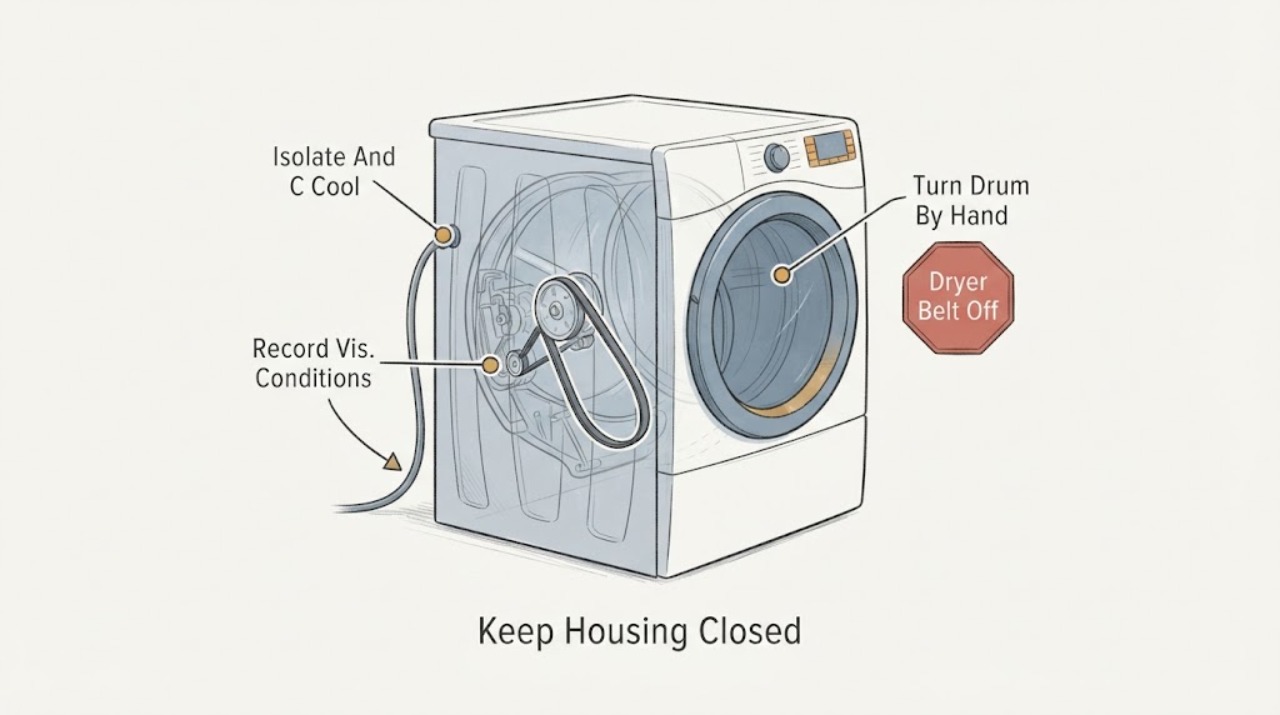
Do not open a Beko dryer or keep running it to prove that the belt is off. Switch it off; if the plug is safely reachable, unplug it and let the appliance cool. With the door open and power isolated, turn the drum gently by hand. Beko says a healthy belt normally leaves the drum with some resistance, while a drum that turns very freely may indicate a damaged or broken belt; a drum that will not turn can instead indicate a jam, seized drum or door-switch issue. That check is a clue, not a diagnosis. Record the full model and the exact drum behavior, then use Beko's model manual or authorized repair path. Beko does not recommend attempting dryer repairs yourself, so belt replacement, cabinet opening and any tensioner or motor work belong to an authorized service agent.
Before you begin
Safety first
- Do not run a dryer with a suspected belt problem, force a jammed drum, open the cabinet, release a tensioner, fit a belt, bypass a door switch or test exposed wiring.
Work through in order
Diagnostic checks
Use only checks that match the exact appliance or system and its official guide.
-
Check 1
Stop the dryer, remove the load if it can be done without reaching into moving parts, and unplug it only from a dry safe position if the plug is reachable; allow the appliance to cool.
Expected result: The dryer is hot, smells burnt, shows smoke/sparking, or can be isolated safely with no visible hazard.
Next step: Leave the dryer off and obtain qualified appliance or electrical help for smoke, burning odor, sparks or a damaged cord/outlet. Otherwise continue only with the single hand-turn check below.
Why this matters
Why: Heat, smoke or electrical damage makes further testing unsafe; a belt symptom does not justify continued operation.
-
Check 2
With power isolated and the door open, turn the drum gently by hand from the door opening; do not reach behind the drum or remove panels.
Expected result: The drum offers some resistance, spins unusually freely, or will not turn/is very difficult to turn.
Next step: Record the result and stop. Do not convert the observation into a confirmed belt diagnosis or continue running the dryer to test it.
Why this matters
Why: Beko says some resistance is expected when the belt is working; very free rotation may indicate a broken belt, while hard or blocked rotation may indicate a jammed/seized drum or another fault.
-
Check 3
Record whether the dryer stopped mid-cycle, hums, makes a grinding or scraping sound, heats without tumbling, or is completely silent; do not restart repeatedly.
Expected result: The drum is free but the motor is silent, the motor hums, the drum is jammed, or the drum does not move while heat is present.
Next step: Give the symptom pattern to an authorized Beko service agent and keep the dryer off until assessed.
Why this matters
Why: A free drum can be consistent with belt damage, but motor, door-switch, seized-drum and other faults remain possible; sound or heat alone does not identify the belt or another part.
-
Check 4
Capture the complete Beko model number, product region and serial information from the rating label or manual before requesting a belt or repair.
Expected result: The exact model is available, or only the brand and symptom are known.
Next step: Use the exact model manual and Beko support path. If the model is unavailable, provide photos and the observed drum behavior to service rather than ordering a part.
Why this matters
Why: Belt dimensions, routing, access and parts fit are model-specific; a generic belt listing cannot establish compatibility.
-
Check 5
Do not remove the rear/top cabinet, release a tensioner, fit a belt, bypass a door switch or test exposed wiring unless an authorized technician performs the repair under the exact model procedure.
Expected result: The proposed next step requires cabinet access, belt routing, tensioner work or electrical testing.
Next step: Stop the repair attempt and book an authorized Beko service visit; do not run the dryer with a suspected off or damaged belt.
Why this matters
Why: Beko explicitly advises against attempting dryer repairs yourself, and the hand-turn clue does not prove which internal part needs replacement.
-
Check 6
Confirm that the issue is drum drive behavior rather than a full water tank, lint/airflow issue or a no-heat complaint; do not treat those conditions as proof that the belt is off.
Expected result: The drum turns normally but the dryer stops, or the drum is free/does not turn and the load is not drying.
Next step: Use the exact model support guidance for the observed condition and arrange service if the drum drive remains abnormal.
Why this matters
Why: Beko identifies several non-belt reasons for a dryer stopping or not performing; a belt concern is strongest only when the drum turns unusually freely or does not tumble.
-
Check 7
Arrange authorized Beko service when the drum spins freely, will not turn, the dryer heats without tumbling, or the symptom returns after a safe external check.
Expected result: A belt-related clue persists or the result is ambiguous.
Next step: Keep the dryer unplugged/off and provide the model, region, drum resistance, sound, heat and odor history to the technician.
Why this matters
Why: The public Beko guidance supports service for a possible broken belt and does not provide a model-neutral DIY replacement procedure.
Use your observations
Decision map
Find the observation that best matches what you see, then follow the next safe action.
-
PATH 01Next step
What you see
The drum turns very freely with power isolated and the door open.
Do this next
Do not run the dryer or open the cabinet; record the model and book authorized service.
Why this path and its safety boundary
Why it matters: Beko says very free rotation may indicate a damaged or broken drive belt, but the observation does not prove the belt is the only fault.
-
PATH 02Next step
What you see
The drum is difficult to turn or will not move.
Do this next
Stop turning it, keep the appliance off and arrange authorized service; do not force the drum or replace a belt based on this symptom.
Why this path and its safety boundary
Why it matters: Beko says this may indicate a seized or jammed drum or a door-switch/other fault rather than a simple belt-off condition.
-
PATH 03Next step
What you see
The drum turns with some resistance but the dryer does not tumble during a cycle.
Do this next
Do not repeat-cycle the dryer. Provide the exact model and symptom pattern to Beko service.
Why this path and its safety boundary
Why it matters: Some resistance is consistent with Beko's belt check, so the belt is not confirmed as off; motor, control, door-switch or another drive issue remains possible.
-
PATH 04Next step
What you see
The dryer heats without the drum turning, or there is a burning odor, smoke, sparking or a damaged cord.
Do this next
Stop immediately, isolate power only if safe, leave the dryer off and obtain qualified appliance/electrical help.
Why this path and its safety boundary
Why it matters: Continued operation can create a fire or electrical hazard, and heat does not identify the failed part.
-
PATH 05Next step
What you see
A replacement belt is being selected without an exact Beko model and region.
Do this next
Use the exact model manual or authorized service channel rather than ordering a generic belt or following another model's repair video.
Why this path and its safety boundary
Why it matters: The belt's fit and routing are not established by brand and symptom alone.
Helpful context
Understand the symptom
Treat “belt off” as a report, not a confirmed diagnosis
A dryer that will not tumble can have a broken or worn belt, but Beko also lists a seized drum, motor fault or door-switch issue among possible explanations. The hand-turn check helps separate a very free drum from a jammed drum, but it does not identify which internal part failed. Do not buy a belt or assume the belt routing from the symptom alone.
Use the door opening for one safe external clue
Switch the dryer off, unplug it only if the plug is safely reachable, and wait for it to cool. Open the door and turn the drum gently by hand without reaching past the drum opening. Some resistance is consistent with Beko's description of a working belt; very free rotation is only a possible belt clue, while no movement or hard binding points to a different or additional problem.
Keep model and region details with the service request
Record the complete model number, serial information if available, region, whether the drum is free or jammed, and whether the dryer hums, stops mid-cycle or makes a new noise. Beko provides manuals and repair support through its support pages, but the belt's fit, routing and access are model-specific. Do not use a belt listing or a video for another Beko series as a fit or procedure confirmation.
Stop instead of opening the cabinet
Beko's guidance does not recommend do-it-yourself tumble-dryer repairs. A belt that has come off may be accompanied by a failed tensioner, pulley, drum support or motor issue, none of which can be safely established from the door opening. Keep the dryer out of service and use an authorized service agent for belt replacement or any cabinet-level inspection.
When checks do not resolve it
Need a professional?
Use authorized Beko service when the drum spins freely, will not turn, the dryer heats without tumbling, the belt is suspected to have come off, or any repair would require cabinet access. Electrical help is appropriate for sparks, smoke, a burning outlet or a damaged cord.
Safety scope: Do not run a dryer with a suspected belt problem, force a jammed drum, open the cabinet, release a tensioner, fit a belt, bypass a door switch or test exposed wiring.
Have this ready
- Provide the full model and region, drum-resistance result, whether the machine hums or is silent, whether it heats, when the symptom began, any scraping or burning odor, and whether the appliance stopped mid-cycle.
Common questions
FAQ
How can I tell if a Beko dryer belt is off?
With power isolated and the door open, turn the drum gently by hand. Beko says a working belt normally leaves some resistance; very free rotation may indicate belt damage. It is a clue rather than a confirmation, so use authorized service for the repair.
Should I replace the Beko dryer belt myself?
Beko does not recommend attempting tumble-dryer repairs yourself. Belt routing, tensioner access and related faults are model-specific; provide the exact model to an authorized service agent.
What if the Beko dryer drum will not turn?
Do not force it. Beko says a drum that is very difficult to turn or will not move may indicate a jammed or seized drum or another fault, so keep the dryer off and arrange service.
What if the dryer heats but the drum does not spin?
Stop using it. Beko's support distinguishes heating from drum drive and directs owners to the not-spinning guidance and technical support; heat alone does not prove a belt failure.
Can I order a universal Beko dryer belt?
Do not order by brand alone. Confirm the complete model and region through Beko's manual or service path, because fit and routing are model-specific and a free drum can have more than one possible cause.
Read the exact guide
Official sources
- Dryer / User ManualBeko · Official Beko manual used only for the general safety boundary against self-repair; no model-specific belt fit or procedure is inferred for the unspecified task.
- Should You Repair or Replace Your Tumble Dryer?Beko UK · Official Beko support guide used only for belt-repair complexity, model-specific parts/support and professional-repair recommendation.
- Why is my tumble dryer not spinning?Beko UK · Official Beko tumble-dryer support page for the drum-resistance check and service boundary; no exact model supplied.
- How to fix a tumble dryer that stops mid-cycleBeko · Official Beko support article used for the free-drum belt clue, power isolation/technical-service path and separation from water-tank causes.
- Why is my tumble dryer not getting hot?Beko UK · Official support page used only to separate heating symptoms from drum-drive symptoms and reinforce no-DIY/service guidance.
Community feedback
Share a repair observation
Share a plain-text repair observation. Accepted observations are published automatically; this page may take a moment to update.