
On this page
Start here
Quick answer
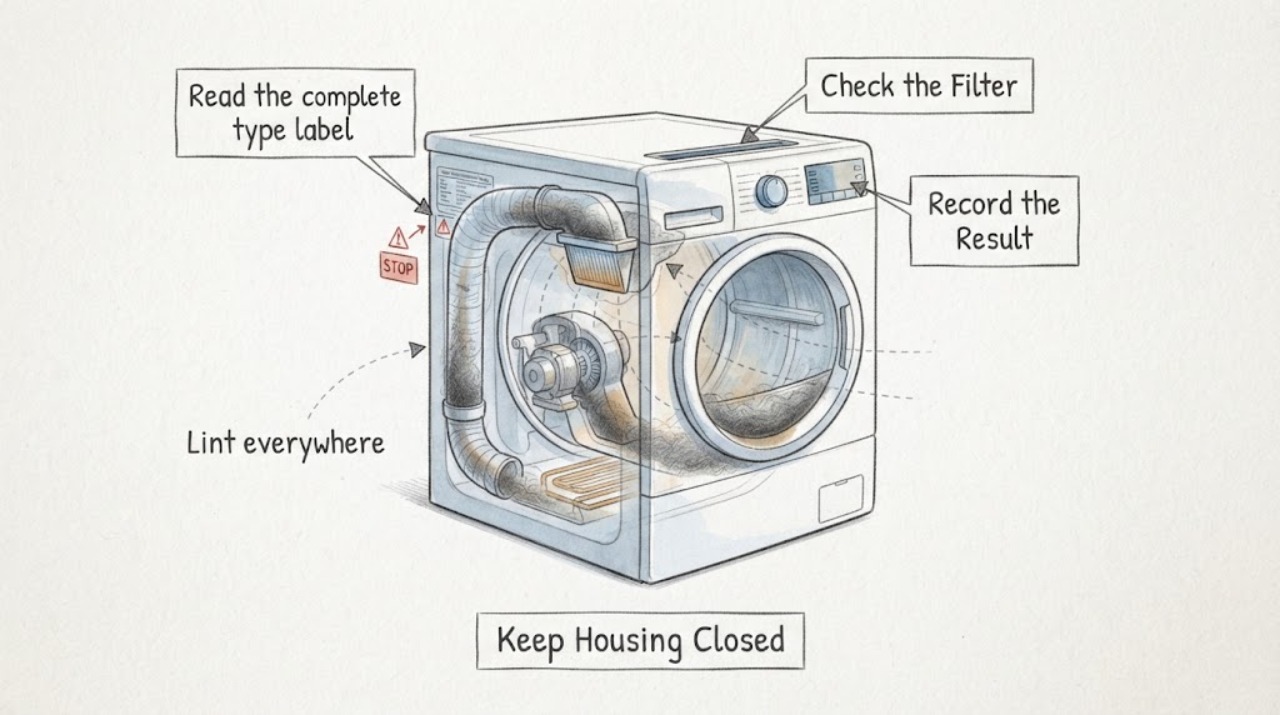
For a Beko DCU 8230 lint-everywhere report, stop the dryer, let it cool and unplug it before cleaning. Beko's DCU 8230-family manual says lint is collected by the lint filter, the filter and loading-door surfaces should be cleaned after every cycle, the filter housing can be vacuumed, and a filter whose pores have become coated should be washed with warm water and dried completely before refitting. It also warns never to operate the dryer without the filter and not to let lint accumulate around the appliance. Check the filter, its seat, the visible door/gasket area and the external ventilation grilles; keep the room ventilated and do not load the dryer excessively. If lint still escapes after those user-accessible checks, or there is smoke, overheating, a burning smell or a damaged cord, stop using it and arrange authorized service rather than opening the cabinet or deep-cleaning internal ducts while energized.
Work through in order
Diagnostic checks
Use only checks that match the exact appliance or system and its official guide.
-
Check 1
Read the complete type label and compare the suffix with the opened Beko DCU 8230 N manual before using its detailed cleaning instructions.
Expected result: The label is DCU 8230 N or another DCU 8230 variant, or the suffix cannot be read.
Next step: Continue with the shared external filter and ventilation checks, but obtain the exact suffix manual before any model-specific maintenance or part decision.
Stop if: Do not remove panels to find the label or use another model's internal-cleaning procedure.
Why this matters
Why: The opened PDF explicitly names DCU 8230 N, while the task uses the shorter DCU 8230 identity. The family relationship is plausible, but a different suffix can change filter or condenser access.
-
Check 2
Turn the dryer off, unplug it from the mains and wait until the drum and interior surfaces are cool before touching the filter, door area or ventilation grilles.
Expected result: The dryer is cool and isolated, or it is still hot, running, wet near the plug, or has a damaged cord.
Next step: Proceed only when safely cool and isolated. For a damaged cord, smoke, burning smell, water near electrical parts or abnormal heat, stop and arrange service without further cleaning.
Stop if: Never clean lint or reach into the appliance while it is powered or hot.
Why this matters
Why: Beko's manual requires unplugging before maintenance and warns that the drum can remain hot; a damaged or faulty appliance must not be operated while awaiting authorized service.
-
Check 3
Remove the visible lint filter, open it as the manual shows, remove lint by hand or with a soft cloth, inspect the mesh for a coated layer or damage, and vacuum only the accessible filter housing.
Expected result: The filter is coated, torn, missing, poorly seated, or the housing contains a visible lint buildup; or the filter is clean, intact and seated.
Next step: Wash a coated filter with warm water only as the matching manual permits, dry it completely, refit it securely, and do not run the dryer without it. If damaged or missing, stop and obtain model-confirmed service/fitment guidance.
Stop if: Do not enlarge mesh openings, tape over damage, insert tools into the filter slot, or vacuum deep internal ducts.
Why this matters
Why: A coated filter surface can clog the pores and allow poor airflow or lint escape. A missing, damaged or mis-seated filter cannot safely perform its collection function. A clean, intact filter makes the cause less certain and does not prove an internal blockage.
-
Check 4
Wipe the accessible inner loading-door surface and gasket with a soft damp cloth, then inspect the front ventilation grilles and the space immediately around the dryer for lint or objects blocking airflow.
Expected result: Lint is packed on the door/gasket or around the front grilles, the grilles are unobstructed, or the room is hot and poorly ventilated.
Next step: Remove only loose accessible lint and objects, keep the grilles uncovered, and ventilate the room as the installation permits. Do not move the dryer far enough to strain connections or open a rear cover.
Stop if: Stop if lint is hot, scorched, wet near electrical parts, or packed inside a grille that cannot be reached safely from the outside.
Why this matters
Why: Beko links door-surface lint and blocked ventilation with drying and filter symptoms, and warns that inadequate ventilation can occur when the installation area is too small. These findings do not identify a failed heater, fan or condenser.
-
Check 5
After the filter is completely dry and correctly installed, use a normal small load only if no safety symptom is present; observe whether lint again appears outside the filter and whether the clean-filter indicator or abnormal heat returns.
Expected result: Lint remains contained and the cycle is normal, or lint escapes again, the warning returns, drying is prolonged, or the dryer overheats.
Next step: Stop using the dryer for recurring lint escape or overheating and arrange authorized service; do not continue test cycles to see whether a hidden blockage clears.
Stop if: Immediately stop for smoke, burning smell, scorching, a damaged cord, or heat that does not dissipate normally.
Why this matters
Why: Improvement after correct filter and airflow maintenance supports an accessible filter/airflow contributor. Recurrence, prolonged drying or overheating is outside a safe user diagnosis and may involve the filter slot, condenser or internal airflow path.
Use your observations
Decision map
Find the observation that best matches what you see, then follow the next safe action.
-
PATH 01Next step
What you see
The type label matches DCU 8230 N or a closely matching DCU 8230 variant and the visible filter arrangement matches the opened manual.
Do this next
Unplug and cool the dryer, complete the visible filter/housing/gasket/grille checks, and keep the filter completely dry before operation.
Why this path and its safety boundary
Why it matters: The manual's user-level lint-filter and door-surface cleaning instructions are reasonably scoped, while internal access remains outside this article.
-
PATH 02Next step
What you see
The lint filter is coated, its pores are blocked, or the filter housing is visibly full of lint.
Do this next
Clean the visible filter and housing as directed, wash and fully dry the filter if a coating remains, refit it, and do not run the dryer without the filter.
Why this path and its safety boundary
Why it matters: Beko identifies clogged filter pores and filter-slot lint as causes of airflow and filter-warning problems.
-
PATH 03Next step
What you see
The filter is clean and intact but lint still appears around the dryer, drying takes too long, or a warning returns.
Do this next
Clear only external grille obstructions and improve room ventilation if safe; then stop and arrange authorized service rather than opening the cabinet or deep-cleaning internal ducts.
Why this path and its safety boundary
Why it matters: The manual also identifies blocked ventilation, inadequate room ventilation and condenser/filter-drawer conditions as possible drying problems, but these observations do not prove an internal component fault.
-
PATH 04Next step
What you see
There is smoke, a burning smell, scorching lint, abnormal overheating, a damaged cord, or lint packed inside an inaccessible opening.
Do this next
Stop the cycle, disconnect power only when safe, keep combustible material away, and contact authorized service. Do not restart the dryer to test it.
Why this path and its safety boundary
Why it matters: Accumulated lint and overheating can create fire or electric-shock risk, and Beko directs faulty or persistent problems to authorized service.
Helpful context
Understand the symptom
Lint outside the filter is a stop-and-check condition
The official Beko product page identifies DCU8230 as a condenser dryer and lists a clean-filter indicator. The opened DCU 8230 N manual says lint and fibers released during drying are collected by the lint filter, but also warns that lint must not accumulate around the dryer and that the appliance must not be operated without its filter. A lint-everywhere symptom can therefore come from a dirty, coated, damaged, mis-seated or bypassed filter, but the opened sources do not prove which internal path is involved.
Keep the first response user-accessible
Unplug the dryer and let the drum cool before cleaning. Work only on the lint filter, its visible housing, the loading-door inner surface and gasket, and the external ventilation grilles. Do not remove the cabinet, reach into a fan or heater duct, reset a thermal device, or run the appliance with a cover or filter removed. If the exact suffix is different from the opened DCU 8230 N manual, use the matching manual for any model-specific maintenance.
When checks do not resolve it
Need a professional?
Use authorized service for recurring lint escape, inaccessible lint buildup, a damaged filter, persistent warning, prolonged drying, overheating, smoke, burning smell or damaged electrical parts. Stop immediately for fire or electrical symptoms.
Common questions
FAQ
Why is lint appearing everywhere on a Beko DCU 8230?
Start with the visible lint filter, its housing, the loading-door inner surface and gasket, and the external ventilation grilles. Beko says a coated filter can clog its pores and that lint must not accumulate around the dryer. Persistent escape after correct cleaning needs authorized service.
Can I wash the DCU 8230 lint filter?
The opened DCU 8230 N manual says to wash the filter with warm water when a layer has built up on its pores, then dry it completely before reinstalling it. Verify the type-label suffix before applying model-specific instructions.
Should I open the dryer to clean lint from the fan or heater?
No. The article limits cleaning to the unplugged, cool, user-accessible filter, housing, door area and external grilles. Beko says not to repair the product yourself and sends persistent faults to authorized service.
When is lint a fire concern?
Stop for scorching, smoke, a burning smell, abnormal heat, lint packed around the appliance or a damaged cord. Do not restart the dryer; disconnect power only when safe and arrange authorized service.
Read the exact guide
Official sources
- Beko DCU 8230 N Dryer User ManualBeko · Opened the official Beko PDF, whose cover names DCU 8230 N. The assigned task uses the shorter DCU 8230 identity, so the article applies the shared external filter and airflow guidance while requiring suffix confirmation before model-specific maintenance. It does not generalize internal condenser access.
- 8kg Condenser Tumble Dryer with B Energy Rating DCU8230Beko Ireland · Opened the official Beko Ireland product page. It identifies the assigned DCU8230 as an 8 kg condenser dryer and lists a clean-filter indicator; it is used for identity and appliance type, not for an internal repair or part-fit claim.
Community feedback
Share a repair observation
Share a plain-text repair observation. Accepted observations are published automatically; this page may take a moment to update.