
On this page
Start here
Quick answer
If a Beko dryer is not heating or clothes stay wet, first confirm that the selected program suits the load and that the dryer is not overloaded. With the appliance stopped and cool, clean the door lint filter and, when fitted, the condenser or filter drawer, and make sure external airflow openings are not blocked. A heat-sensor warning, repeated stopping, a burning smell, smoke, a damaged cord, or persistent no-heat after these checks is a stop-and-service condition; do not open the cabinet or attempt internal electrical or heating repairs.
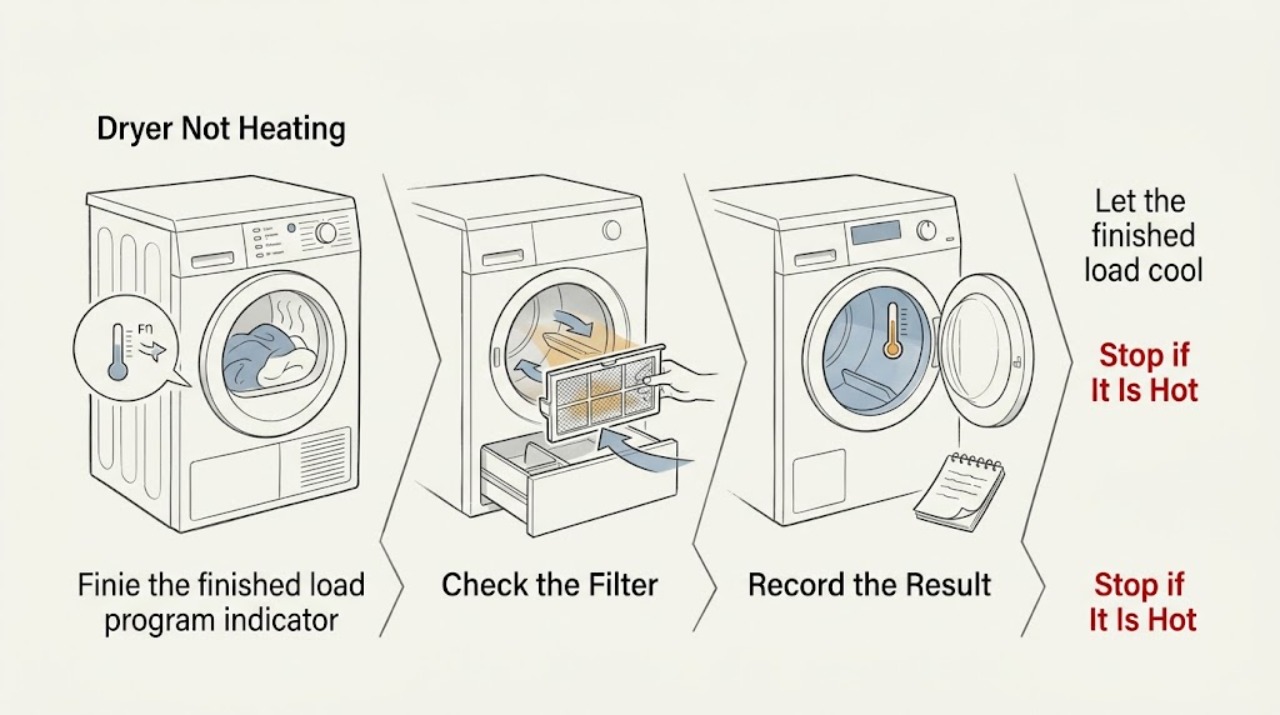
Work through in order
Diagnostic checks
Use only checks that match the exact appliance or system and its official guide.
-
Check 1
Let the finished load cool, then compare its condition with the program and fabric-care guidance; confirm that the selected cycle is intended for the load and that any low-temperature or time setting was intentional.
Expected result: The clothes become acceptably dry after cooling, the cycle was unsuitable for the fabric or load, or the clothes remain wet despite a suitable program.
Next step: Select the documented program for the fabric and run a normal, appropriately sized load once. If the result remains wet, continue with the filter and airflow checks.
Stop if: Do not use a high-temperature program to compensate for a suspected fault or continue if there is a burning smell or smoke.
Why this matters
Why: Beko notes that warm laundry can feel damper than it is and that an unsuitable program can leave laundry wet. Persistent wetness after cooling is a real drying fault, while a program mismatch is an operating-condition issue.
-
Check 2
After the cycle ends and the dryer is cool, remove the door lint filter and inspect its mesh and housing for a visible layer of lint; clean it using the method in the model manual and refit it completely dry.
Expected result: The lint filter or its housing is visibly clogged, or both are clear but drying remains poor.
Next step: Clean and fully dry the filter before reinstalling it, then run one suitable lighter load. If no-heat or poor drying persists, inspect the secondary filter if the model has one.
Stop if: Do not operate the dryer with a missing or wet filter, and do not reach beyond the filter housing into moving or heated parts.
Why this matters
Why: Beko states that a clogged lint filter can prevent complete drying and recommends cleaning the filter after each cycle. A clear filter makes the secondary filter or airflow path the next check rather than proving the heater is defective.
-
Check 3
If the dryer is a condenser or heat-pump model, inspect the user-accessible filter drawer or condenser filter behind the kickplate after the appliance is stopped and cool; check for lint, a warning indicator, or a filter that is not seated.
Expected result: The secondary filter is clogged or its warning indicator is on, the filter is clean and correctly seated, or the dryer does not have this component.
Next step: Clean the applicable filter using the model manual, let washable pieces dry fully, refit all locks and covers, and run one suitable load. If the warning returns or the dryer remains cold, stop and arrange service.
Stop if: Do not run the dryer with an open kickplate, an unlatched filter, or water near an energized appliance; do not remove sealed panels.
Why this matters
Why: Beko explains that a blocked filter drawer or condenser filter restricts drying performance and that these parts need periodic cleaning. The presence of a clean secondary filter moves the decision toward load, airflow, sensing, or a technical fault.
-
Check 4
Check the external air path and load size: make sure front ventilation openings are not blocked and compare the load with the capacity and care instructions in the manual.
Expected result: Ventilation openings are blocked, the drum is heavily loaded, or the external airflow and load size are reasonable.
Next step: Remove only accessible objects blocking the front openings and run a lighter load. If the dryer still does not heat or the cycle ends wet, stop using it and contact authorized service.
Stop if: Do not move a heavy or built-in dryer to reach hidden ductwork, and do not continue if the cabinet becomes unusually hot or smells scorched.
Why this matters
Why: Beko links blocked ventilation and overloading with longer or incomplete drying and warns that overloading can restrict airflow and contribute to overheating. A clear air path and appropriate load make a persistent no-heat symptom more likely to need technical diagnosis.
-
Check 5
Observe the next normal cycle without opening the cabinet: note whether the drum starts, whether the program stops unexpectedly, and whether a drying or heat-sensor warning flashes.
Expected result: The drum runs and the load dries, the drum runs but the load stays cold, the program stops, or a heat-sensor warning flashes.
Next step: Turn the dryer off, remove the laundry when safe, and arrange authorized service for a sensor warning, repeated stop, or persistent no-heat condition. Provide the model and the indicator behavior.
Stop if: Do not spin the drum while the appliance is energized, probe live circuits, bypass a thermal cutout, or replace a sensor or heater without qualified diagnosis.
Why this matters
Why: Beko's manual identifies a flashing drying indicator caused by a heat-sensor failure that ends the program without heating. A persistent cold load, repeated stopping, or a sensor warning is a technical fault, not a reason to bypass a safety device.
Use your observations
Decision map
Find the observation that best matches what you see, then follow the next safe action.
-
PATH 01Next step
What you see
The load dries after cooling when the correct program and a suitable load are used.
Do this next
Continue with the documented program and load size, keeping the lint filter clean after each cycle. Arrange service if the same no-heat symptom returns.
-
PATH 02Next step
What you see
The lint filter, filter drawer, condenser filter, or external ventilation path is clogged or blocked.
Do this next
Clean the applicable user-accessible filter, dry it fully, restore the cover or latch, clear only accessible external obstructions, and run one lighter load.
-
PATH 03Next step
What you see
The dryer runs but remains cold after the program, load, filter, and airflow checks.
Do this next
Stop using the dryer and arrange authorized service for the heating, sensing, airflow, or control system. Do not open the cabinet.
-
PATH 04Next step
What you see
A drying or heat-sensor warning flashes, or the program repeatedly stops without drying.
Do this next
Turn the dryer off, remove laundry when safe, and contact authorized service; do not bypass the sensor or thermal safety system.
-
PATH 05Next step
What you see
There is smoke, scorching, an electrical burning smell, a damaged cord, or repeated protective-device operation.
Do this next
Stop using the dryer and keep clear. Arrange qualified appliance or electrical service; do not reconnect it through an extension or open the cabinet.
Helpful context
Understand the symptom
A dryer can feel cool for two different reasons
Warm laundry can feel damp immediately after a cycle and feel drier after cooling. If the load is still wet when cool, the problem may be a program, load, airflow, or filter condition rather than a failed heater. Start with the checks that Beko makes accessible to the user, then stop before cabinet or heating-system work.
Keep internal heating and electrical work out of the home checks
Do not remove the rear or top cover, bypass a thermal safety device, probe wiring, or attempt to replace a heater or sensor from the symptom alone. Stop the appliance for smoke, scorching, an electrical burning smell, a damaged cord, or any repeated protective-device trip.
Safety boundary
Stop conditions
- Smoke, scorching, an electrical burning smell, a damaged cord or plug, or repeated protective-device operation: stop using the dryer and arrange qualified service.
- A heat-sensor warning, repeated stop, or persistent cold load after clean filters and an appropriate load: turn the dryer off and contact authorized service.
- Do not remove panels, probe live wiring, bypass thermal protection, or attempt internal heater, motor, belt, or sensor repair.
Only after diagnosis
Potential parts
- dryer heating assembly
Consider this category only after qualified diagnosis confirms a heating-circuit fault after program, load, filter, and airflow causes are excluded.
Confirm the complete dryer model and manufacturer fit information before selecting any component; do not infer compatibility from the symptom alone. - dryer heat sensor
Consider this category only if the model's warning behavior and qualified testing identify a sensor fault rather than a blocked airflow path or control issue.
Sensor components are model-specific and require qualified installation; do not order or install from a flashing indicator alone.
When checks do not resolve it
Need a professional?
Arrange authorized appliance service when the dryer remains cold after the program, load, lint-filter, secondary-filter, and accessible airflow checks; when a heat-sensor warning flashes; when the program repeatedly stops; or when the appliance shows smoke, scorching, or electrical damage. Give the technician the exact model, selected program, filter status, load size, and indicator behavior.
Common questions
FAQ
Why does my Beko dryer feel cool even though it is running?
Warm laundry can feel damp immediately after a cycle. If the load remains wet after cooling, check the selected program, load size, lint filter, secondary filter if fitted, and accessible ventilation path. Persistent cold operation needs qualified service.
Can a clogged filter make a Beko dryer stop heating?
A clogged lint filter or secondary filter can restrict airflow and prevent complete drying; Beko recommends cleaning the applicable filters and letting washable pieces dry fully before refitting. If no-heat persists after that check, stop and arrange service.
What does a flashing drying indicator mean on a Beko dryer?
One Beko manual identifies a flashing drying indicator with a heat-sensor failure that ends the program without heating. Turn the dryer off, remove the laundry when safe, and contact authorized service rather than bypassing the sensor.
Read the exact guide
Official sources
- How to fix a tumble dryer that’s not dryingBeko · Applicable to Beko dryers that run but do not dry laundry completely.
- How to fix a tumble dryer that won’t startBeko · Applicable when a Beko dryer has no start response or stops before a drying cycle begins.
- 9 TroubleshootingBeko · Applicable to the Beko dryer manual's listed configuration; exact model manual takes precedence.
- Why is my tumble dryer not getting hot?Beko · Directly applicable to Beko tumble dryers that stop heating or leave laundry wet.
Community feedback
Share a repair observation
Share a plain-text repair observation. Accepted observations are published automatically; this page may take a moment to update.