
On this page
Start here
Quick answer
If a Beko dryer or its laundry is hotter than normal, smells scorched, smokes, or stops during a cycle, stop using it and treat the symptom as a fire-safety concern. If there is smoke, flame, or a burning odor, leave the area and contact emergency help; do not open the appliance or keep testing. If there is no active hazard and the drum has stopped, remove and separate the laundry as soon as it is safe, because Beko warns that heat can continue to build after a mid-cycle stop. Once fully cool, check the lint filter and the model-specific condenser, filter drawer, or vent path, clear visible obstructions, reduce an excessive load, and confirm the dryer has adequate airflow and is not placed near a heat source or flammable material. Do not run repeated cycles to prove a fix. If overheating returns, the drum does not turn, airflow cannot be restored, the appliance trips power, or an internal or thermal component may be involved, leave it unused and arrange qualified Beko appliance service.
Before you begin
Safety first
- This article covers safe observation, removal of a stopped load when the door opens normally, and model-approved external filter and airflow maintenance only. Cabinet removal, heater or fan access, thermal-device bypass, motor or control work, live electrical testing, and fire investigation require qualified service or emergency responders.
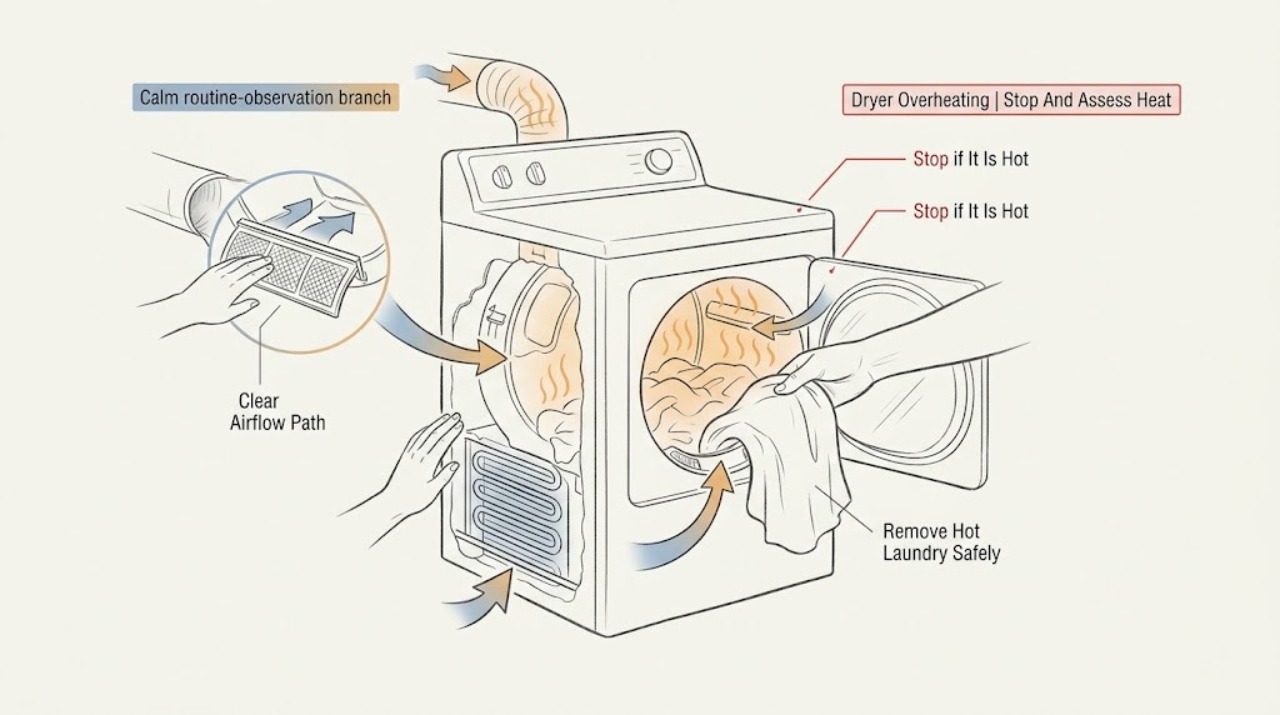
Work through in order
Diagnostic checks
Use only checks that match the exact appliance or system and its official guide.
-
Check 1
If the dryer, drum, or laundry is unusually hot, stop the cycle using the normal control only if there is no smoke or flame; if there is smoke, flame, or a burning odor, leave immediately and seek emergency help instead of opening or testing the appliance.
Expected result: There is active smoke or flame, a strong burning odor, only unusual heat with no visible smoke, or the dryer has already stopped on its own.
Next step: For an active hazard, stay out and follow emergency instructions. For heat without an active hazard, keep the dryer stopped and continue only after it has cooled enough for safe ordinary access.
Stop if: Do not open a smoking or flaming dryer, pour water into it, reach through heat or smoke, or restart it to observe the symptom.
Why this matters
Why: Smoke, flame, or a burning odor can indicate a fire or electrical hazard and cannot be safely diagnosed from the controls. Unusual heat without visible smoke still indicates that airflow, load, placement, or a component fault may be involved.
-
Check 2
If the dryer has stopped and the door opens normally without smoke, flame, or a hot latch, remove the laundry promptly and spread it apart on a safe nonflammable surface; do not leave a warm, bunched load inside a stopped drum.
Expected result: Laundry is hot but intact, one item smells scorched or feels oily, the door will not open normally, or the load is smoking or visibly damaged.
Next step: Let intact laundry cool separately and keep it away from ignition sources. For a scorched, oily, smoking, or locked-door condition, leave the area if needed and arrange emergency or qualified service rather than handling the item or appliance further.
Stop if: Do not pull open a hot or locked door, handle smoking or burning laundry, or put a load back into service to see whether the smell goes away.
Why this matters
Why: Beko warns that heat can continue to build after a mid-cycle stop and that suitable tumble-drying items must be free from oil and other ignitable residues. A locked door or damaged load means the user-safe removal boundary has been reached.
-
Check 3
After the dryer is fully cool and disconnected only as the model instructions require, clean the lint filter and, for a condenser or heat-pump model, the condenser or filter drawer named in the manual; inspect the accessible filter housing for lint without opening the cabinet.
Expected result: The lint filter, filter housing, condenser, or filter drawer is visibly packed with lint; it is clean; the component is missing or damaged; or the manual does not identify the component safely.
Next step: Clean and dry each user-accessible component exactly as the model guide directs, refit it correctly, and do not run another load until all parts are in place. Arrange service if a filter or drawer is damaged, inaccessible, or the dryer overheated despite a clear path.
Stop if: Do not operate without a filter, reach into a fan or heater, remove a kickplate or cabinet, use compressed air into the appliance, or replace a thermal component yourself.
Why this matters
Why: Beko says lint and condenser buildup can restrict airflow and contribute to overheating or long drying. A clean accessible path does not rule out a concealed blockage, fan, heater, sensor, or thermal fault.
-
Check 4
From outside the appliance, check that the front ventilation area and any model-required vent hose are not blocked, kinked, crushed, or covered, and confirm the dryer is not pressed against a heat source, flammable material, carpet that restricts airflow, or an inadequately ventilated enclosure.
Expected result: An accessible vent or grille is obstructed, the room or enclosure is hot or poorly ventilated, the dryer is near a heat source or flammable material, or the visible airflow path is clear.
Next step: Remove only loose external obstructions, restore the installation to the model's required clearance and ventilation, and keep the dryer off until cool. If correcting placement requires moving a stacked or built-in appliance, arrange qualified help.
Stop if: Do not move a heavy or stacked dryer alone, alter venting through a wall, remove panels, place it near flammables, or run it in a closed space without the manual-approved airflow.
Why this matters
Why: Beko states that inadequate airflow or unsuitable placement can allow heat and moisture to build and raise fire risk. A clear visible path does not prove that an internal air channel or fan is clear.
-
Check 5
Review the load that overheated for excessive volume, oil or solvent residue, non-dryer-safe materials, or a drum that was not turning normally; once the dryer is cool and all safe checks are complete, do not perform more than one supervised test with a small, suitable load.
Expected result: The load was excessive or unsuitable, the drum turns normally and heat does not recur, the drum does not turn, or overheating returns despite a suitable load and clear airflow.
Next step: Keep unsuitable or contaminated items out of the dryer. If one supervised test is normal, continue to follow the model's loading and maintenance guidance; if heat returns, the drum fails to turn, or power trips, leave the dryer unused and arrange service.
Stop if: Do not dry oily or solvent-contaminated items, overload the drum, bypass a thermal device, or repeat tests after a second overheating event.
Why this matters
Why: Beko links overloads and restricted airflow with overheating, and warns that oil, dry-cleaning solution, and some other residues can ignite. A non-turning drum or repeat overheating may involve the drive system, heater, sensor, thermal protection, or another internal fault.
Use your observations
Decision map
Find the observation that best matches what you see, then follow the next safe action.
-
PATH 01Safety boundary
What you see
There is smoke, flame, a strong burning odor, or visibly burning laundry.
Do this next
Leave the area, alert others, and contact emergency help according to local procedure. Do not open the dryer or return until it is safe.
Why this path and its safety boundary
Why it matters: This exceeds appliance troubleshooting and may be a fire or electrical emergency.
Safety stop: Do not pour water into the appliance, handle burning laundry, or restart it.
-
PATH 02Safety boundary
What you see
The dryer stopped mid-cycle but there is no smoke or flame and the door opens normally.
Do this next
Remove and spread the laundry safely, let it cool away from ignition sources, then inspect the filter, airflow, placement, and load history only after the appliance is cool.
Why this path and its safety boundary
Why it matters: Residual heat can continue to build in a stopped drum, so the load needs immediate separation before any fault investigation.
Safety stop: Do not leave the load bunched inside, restart with the same load, or open a hot or locked door.
-
PATH 03Safety boundary
What you see
Lint, a blocked condenser or filter drawer, a covered grille, a restricted vent, or poor room airflow is found.
Do this next
Clean the model-approved filters and restore external airflow, then keep the unit cool and perform at most one supervised test with a suitable load.
Why this path and its safety boundary
Why it matters: Restricted airflow is a plausible contributor to excess heat, but clearing an accessible path does not prove the internal dryer is fault-free.
Safety stop: Stop if the filter is damaged, the path cannot be cleared safely, heat returns, or access requires cabinet removal.
-
PATH 04Safety boundary
What you see
The load was excessive, not suitable for tumble drying, or contaminated with oil, solvent, or another ignitable residue.
Do this next
Keep the item out of the dryer, allow safe laundry to cool, and arrange service if the appliance was hot, stopped, smelled scorched, or behaves abnormally again.
Why this path and its safety boundary
Why it matters: The load itself can increase heat or fire risk, and changing the load cannot repair a dryer that has already overheated.
Safety stop: Do not wash or dry an unknown chemical residue as a troubleshooting step or reuse the same contaminated item.
-
PATH 05Safety boundary
What you see
Overheating returns after a clear accessible airflow path and suitable load, the drum does not turn normally, or the appliance trips power.
Do this next
Leave the dryer unused, record the timing and symptoms, and arrange qualified Beko appliance service.
Why this path and its safety boundary
Why it matters: An internal airflow, drive, heater, sensor, thermal-protection, control, or electrical fault remains possible and cannot be diagnosed safely by repeated operation.
Safety stop: Do not bypass thermal protection, open the cabinet, test live circuits, or keep running cycles.
Helpful context
Understand the symptom
Overheating is a stop condition before it is a cleaning task
Hot laundry alone is not enough to identify a failed part, but a dryer or load that is much hotter than usual, smells scorched, smokes, or stops unexpectedly should not be tested repeatedly. Separate the laundry only when the appliance has stopped and the door opens safely; if smoke or flame is present, leave and get emergency help instead of opening the drum.
Restore airflow only from ordinary access
Beko identifies lint filters, condensers, filter drawers, front ventilation, vent hoses on applicable models, room ventilation, and excessive loads as relevant to drying performance and heat. The exact filter arrangement depends on the dryer type and model, so clean only the components named in the owner guide and never remove a cover to reach a fan, heater, or thermal device.
A repeat after cleaning needs service, not a bypass
A clear filter and unobstructed airflow do not prove that the thermal protection, motor, heater, sensor, control, or wiring is sound. If the dryer overheats again, trips power, or the drum is not turning, keep it out of use and give the technician the load, filter, airflow, placement, and symptom timeline.
Safety boundary
Stop conditions
- Stop immediately and seek emergency help for smoke, flame, a strong burning odor, or visibly burning laundry; do not open or restart the dryer.
- After a safe mid-cycle stop, remove and separate warm laundry promptly; do not leave it bunched inside a stopped drum.
- Do not dry items contaminated with oil, solvent, alcohol-based products, or other substances not approved for tumble drying.
- Do not operate without filters, bypass thermal protection, open the cabinet, reach into the heater or fan, or test live electrical parts.
- Leave the dryer unused and arrange qualified service for repeat overheating, a non-turning drum, repeated power trips, damaged cord, or heat that persists after accessible airflow checks.
When checks do not resolve it
Need a professional?
Seek emergency help for smoke, flame, a strong burning odor, or burning laundry. Arrange qualified Beko appliance service for overheating that returns after the model-approved filter, airflow, placement, and load checks; a drum that does not turn normally; repeated power trips; damaged wiring or cord; or any repair requiring cabinet, heater, fan, sensor, motor, thermal protection, or electrical access. Do not continue using a dryer that has overheated until it has been assessed.
Safety scope: This article covers safe observation, removal of a stopped load when the door opens normally, and model-approved external filter and airflow maintenance only. Cabinet removal, heater or fan access, thermal-device bypass, motor or control work, live electrical testing, and fire investigation require qualified service or emergency responders.
Common questions
FAQ
What should I do first if my Beko dryer is overheating?
Stop using it. For smoke, flame, or a strong burning odor, leave and seek emergency help. If there is no active hazard, let the dryer stop and cool, remove and separate the laundry when the door opens normally, then inspect model-approved filters and airflow.
Can a blocked lint filter make a Beko dryer overheat?
Yes. Beko says lint-filter and condenser maintenance supports airflow, while buildup and overloading can restrict airflow and contribute to overheating. Clean only the components named in the exact model guide and do not open the cabinet.
What should I do with clothes left in a dryer that stopped hot?
If there is no smoke or flame and the door opens normally, remove and separate the clothes promptly and let them cool away from ignition sources. Beko warns that heat can continue to build in the drum after a mid-cycle stop.
Can dryer placement cause overheating?
Yes. Beko says inadequate ventilation, blocked airflow, nearby heat sources, and unsuitable enclosures can contribute to overheating and fire risk. Restore only obvious external airflow conditions and follow the exact installation guide.
When should I stop troubleshooting and call for Beko dryer service?
Call for service when overheating returns after safe filter, airflow, placement, and load checks, the drum does not turn normally, power trips, the cord is damaged, or a heater, fan, sensor, thermal device, control, or cabinet would need access. Do not keep running cycles to test it.
Read the exact guide
Official sources
- Why is my tumble dryer not getting hot?Beko UK · Official Beko dryer support page; its airflow and overload guidance is relevant to overheating even though the page is framed around heating performance.
- How to use and maintain your Tumble DryerBeko UK · Official Beko tumble-dryer maintenance guidance used for the assigned dryer overheating topic; the exact model manual controls model-specific components.
- The Significance of Choosing the Right Location for Your Tumble DryerBeko UK · Official Beko placement guidance used for general overheating and airflow checks; the exact installation manual controls required clearance and venting.
- How to troubleshoot potential problems when your tumble dryer is not workingBeko UK · Official Beko dryer troubleshooting guide; its external filter, hose, and control checks support safe differentiation before service.
Community feedback
Share a repair observation
Share a plain-text repair observation. Accepted observations are published automatically; this page may take a moment to update.