
On this page
Start here
Quick answer
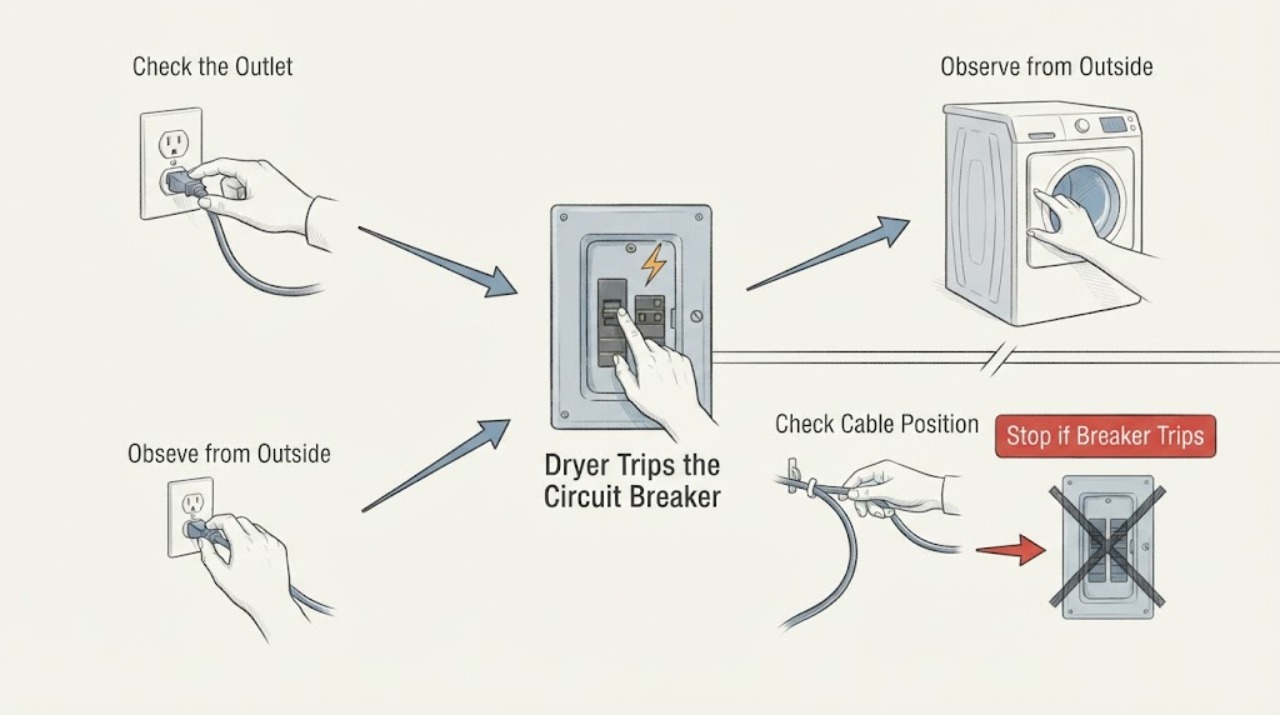
Stop using a Beko dryer that repeatedly trips a breaker. If it is safe to do so, switch it off and unplug it by the plug, then do only external checks: do not use an extension cord, multi-plug or adapter; look for visible cord or plug damage; and note whether other appliances work on the same supply. Beko directs users to a qualified electrician when the supply or fuse is suspect and to an authorized service agent for a technical dryer problem. Do not keep resetting the breaker, open the dryer, test live wiring, or replace a component based only on when the trip occurs.
Work through in order
Diagnostic checks
Use only checks that match the exact appliance or system and its official guide.
-
Check 1
Stop the dryer after a repeated trip and isolate it only from a safe, dry, accessible connection: turn it off and unplug by gripping the plug, not the cord. If the breaker panel, outlet or plug is hot, wet, sparking or smells burned, leave the circuit off and do not handle it.
Expected result: Record whether the trip happened while plugging in, when starting a cycle, or during operation, and whether smoke, heat, arcing or a burning odor was present.
Next step: Do not reset the breaker repeatedly or run another cycle to reproduce the trip. Arrange qualified electrical help for a supply-side hazard and authorized Beko service for the dryer; if there is active smoke or fire, leave the area and use local emergency procedures.
Why this matters
Why: The timing is useful information for a technician, but it does not identify a failed heater, motor, filter, cord or control component. A visible electrical hazard makes further user testing inappropriate.
-
Check 2
Check the supply externally without opening the outlet or dryer: note whether nearby lights or another known-good appliance work, and whether the dryer is connected through an extension cord, multi-plug or adapter.
Expected result: If other appliances also lose power, the problem may be with the household supply. If the dryer is the only appliance affected, or its connection trips the breaker while other loads work, the dryer connection or appliance remains unresolved.
Next step: Do not use an extension, multi-plug or adapter. Have a qualified electrician assess a suspected outlet, circuit, grounding or protective-device issue; do not substitute a different breaker or bypass protection.
Why this matters
Why: Beko says a working household supply with a dryer that still will not start can point to a dryer-side electrical problem, while a supply or fuse concern should go to a qualified electrician. This does not prove which internal component failed.
-
Check 3
Inspect only the visible power cord and plug for cuts, crushing, exposed conductors, melted plastic, looseness or moisture, without moving the appliance into a position that strains the cable.
Expected result: Any visible damage or an abnormal smell or heat at the plug or socket is a stop condition. A cord that looks normal does not clear the dryer after repeated trips.
Next step: Leave the dryer disconnected and arrange qualified electrical or authorized service assessment. Do not tape, splice, replace the plug, or open the cabinet as a user repair.
Why this matters
Why: The Beko manual says not to operate with a damaged cord or plug and directs electrical connection concerns to qualified personnel. A visual check cannot test insulation, leakage current or an internal fault.
-
Check 4
Verify the installation connection from the outside: the dryer should be on the grounded outlet and circuit specified by its exact model manual, with no extension cord, multi-plug or adapter and with the plug accessible.
Expected result: If the setup uses an adapter, power strip, extension or an outlet that is not properly grounded, the installation does not meet the opened Beko manual safety instructions. If it is correctly connected and still trips, the cause remains unresolved.
Next step: Use the exact model manual and a qualified electrician for outlet, grounding, breaker or cord work. Do not change protection values or modify the supplied plug to make it fit.
Why this matters
Why: Connection requirements vary by Beko model and local electrical code. A general article cannot prescribe breaker ratings, rewiring or a replacement cord for an unidentified model.
-
Check 5
Prepare the service report instead of performing an internal test: record the Beko model and serial information, breaker type if known, trip timing, load or program, visible damage, and whether the household supply remains stable with the dryer disconnected.
Expected result: A repeatable timeline helps separate a supply-side event from a dryer-side symptom for the electrician or authorized service agent, but it is not a diagnosis.
Next step: Contact Beko or an authorized service provider with the recorded details. Keep the dryer out of service until the electrical cause and appliance safety are assessed.
Why this matters
Why: Beko public support sends unresolved technical problems to authorized service and model-specific manual guidance; no component or replacement part can be selected from the symptom alone.
Use your observations
Decision map
Find the observation that best matches what you see, then follow the next safe action.
-
PATH 01Next step
What you see
If the outlet, plug or breaker area is hot, wet, sparking, smoking or smells burned
Do this next
Leave the circuit off if safe to do so, keep clear, and contact a qualified electrician or emergency services as appropriate. Do not touch exposed wiring or try to reproduce the event.
Why this path and its safety boundary
Why it matters: There is a visible electrical or fire hazard; normal troubleshooting is no longer appropriate.
-
PATH 02Next step
What you see
If other household appliances also lose power or the protective device trips with the dryer disconnected
Do this next
Leave the affected circuit off and have a qualified electrician inspect it. Do not install a larger breaker or bypass the protective device.
Why this path and its safety boundary
Why it matters: The dryer alone has not been shown to be the cause; the household supply, outlet, circuit or protective device needs assessment.
-
PATH 03Next step
What you see
If the supply appears stable but the breaker trips when the Beko dryer is connected or starts
Do this next
Keep the dryer unplugged and contact an authorized Beko service provider; do not run another cycle merely to confirm the pattern.
Why this path and its safety boundary
Why it matters: A dryer-side or connection fault remains possible, but the trip timing does not identify a heater, motor, filter, cord or control fault.
-
PATH 04Next step
What you see
If the cord and plug look normal and the breaker has not tripped again while the dryer is disconnected
Do this next
Use the exact model manual and obtain service guidance before reconnecting. Do not perform cabinet removal, live measurements or an improvised part replacement.
Why this path and its safety boundary
Why it matters: No visible damage does not prove the appliance is safe to operate after repeated trips.
Helpful context
Understand the symptom
A repeated breaker trip is an electrical symptom, not a confirmed heater, motor, filter or control-board diagnosis. Beko's US support separates a supply/fuse problem, which should go to a qualified electrician, from a technical dryer problem, which should go to an authorized service agent. Because no Beko model was supplied, this guide stays with external observations and the model manual/service boundary.
When checks do not resolve it
Need a professional?
Stop and arrange qualified electrical help for a hot, wet, sparking, smoking or burned-smelling outlet, plug or breaker area, or if the circuit trips with the dryer disconnected. Keep a Beko dryer out of service after repeated trips and contact authorized Beko service for a dryer-side fault. Do not repeatedly reset the breaker, use an extension/multi-plug/adapter, open the cabinet, take live measurements, bypass protection, or choose a replacement part without the exact model and qualified assessment.
Common questions
FAQ
Should I keep resetting the breaker to see whether the Beko dryer will run?
No. After a repeated trip, keep the dryer out of service and do only safe external observations. Beko's support routes supply or fuse concerns to a qualified electrician and technical dryer problems to authorized service; repeated resets do not identify the failed part.
Can I use an extension cord or power strip temporarily?
No. The opened Beko dryer manual says not to connect the dryer through extension cords, multi-plugs or an adapter. Use the exact model manual and a qualified electrician for the required outlet and grounding arrangement.
Does the trip prove the heating element or motor failed?
No. The trip timing can be recorded for service, but it cannot identify an internal component. Keep the dryer disconnected and have the household supply and appliance assessed by the appropriate qualified professional.
Read the exact guide
Official sources
- How to fix a tumble dryer that won’t startBeko · Official Beko US support page for tumble dryers without a supplied model. It supports checking household power, seeking a qualified electrician for a suspected supply/fuse problem, and contacting authorized service for a technical dryer problem; it does not diagnose a component.
- Beko HPD24412W Dryer User ManualBeko U.S., Inc. · Opened as a documented Beko US model manual for safety boundaries only, not as proof that the assigned dryer is HPD24412W. It supports no damaged cord/plug, turn off and unplug for unresolved malfunctions, grounding and qualified-electrician boundaries, no extension/multi-plug/adapter, and no operation until repaired.
- How to fix a tumble dryer that stops mid-cycleBeko · Official Beko US support page. It acknowledges electrical spikes or malfunction as possible explanations for a mid-cycle stop and sends unresolved technical problems to authorized service; its generic unplug/replug suggestion is not used here as permission to repeat a test after a recurring breaker trip.
Community feedback
Share a repair observation
Share a plain-text repair observation. Accepted observations are published automatically; this page may take a moment to update.