
On this page
Start here
Quick answer
A Beko freezer that is warm, frosted or making a liquid sound does not by itself prove a coolant leak. Do not puncture the cabinet, scrape an iced wall, open the sealed cooling circuit, or try to add or release refrigerant. First identify the full model and refrigerant type on the rating label, then inspect only for visible external damage without touching pipes or the power cable. The opened Beko freezer manuals state that if cooling-system piping is damaged or refrigerant is seen, keep away from the refrigerant, keep ignition sources away, ventilate the area without using fans, and call an authorised service agent. If there is no visible damage, Beko supports checking the door seal, frost/airflow and the exact manual; persistent poor cooling still needs service rather than a user diagnosis of a leak.
Before you begin
Safety first
- Do not touch suspected refrigerant, the damaged product or power cable; remove ignition sources, ventilate without fans, and call authorised service. Do not puncture, scrape, open, recharge, recover or pressure-test the sealed circuit.
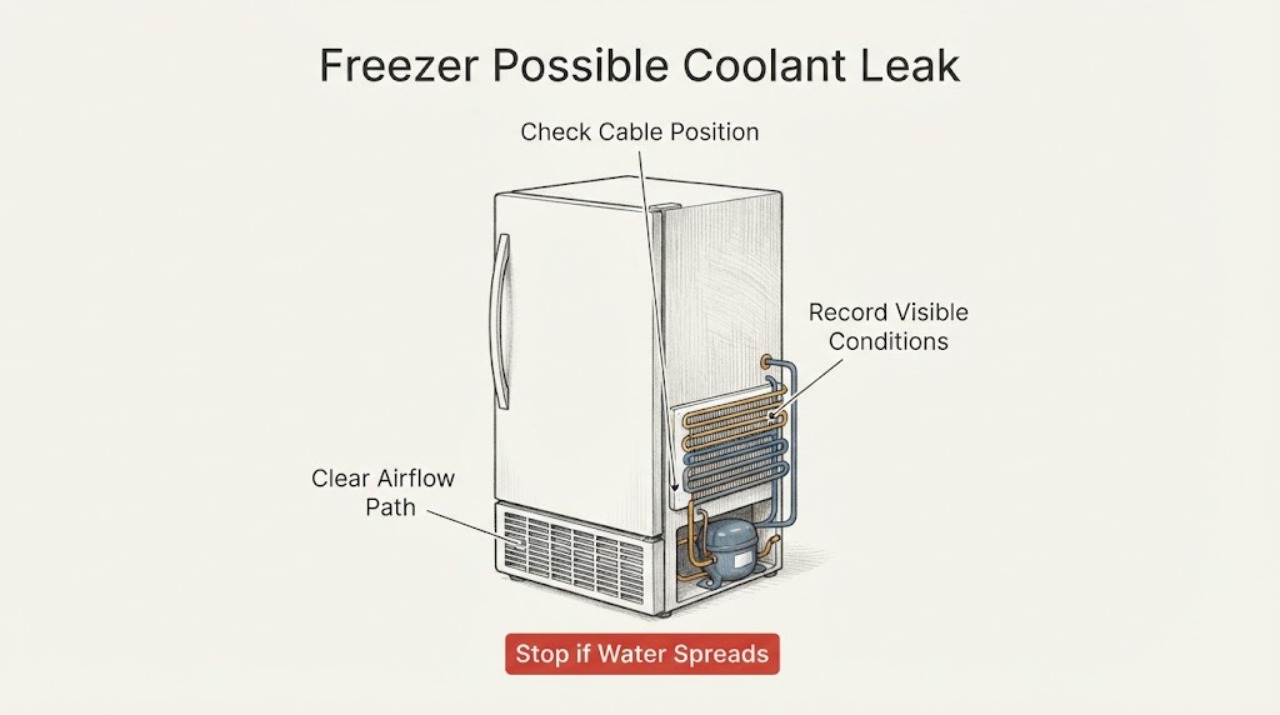
Work through in order
Diagnostic checks
Use only checks that match the exact appliance or system and its official guide.
-
Check 1
Stop using the freezer and move people away from the appliance if you see damaged refrigeration tubing, a wet/oily-looking release at a damaged area, or refrigerant escaping. Do not touch the cabinet, pipes or power cable; remove flames, sparks and other ignition sources from the area, ventilate without using fans, and call authorised service.
Expected result: There is visible pipe/cabinet damage or suspected refrigerant at the appliance, or there is no visible release.
Next step: For visible damage or refrigerant, leave the appliance untouched and use authorised service. If no such sign is present, continue only with the non-invasive identity and external checks below.
Why this matters
Why: The opened Beko manuals identify flammable R600a in their named freezer models, warn against contact with a damaged product/power cable and say refrigerant contact may cause frostbite. They do not authorize a user leak test or repair.
-
Check 2
Read the full model and serial from the rating label without opening the cabinet, and record the refrigerant type shown on that label or in the exact owner manual. Do not assume every Beko freezer uses the same refrigerant or the same cooling-pipe layout.
Expected result: The model/manual identifies the refrigerant and safety instructions, or the model/type label cannot be read.
Next step: Use the exact manual for any permitted external check. If the label/manual cannot be matched, do not inspect the sealed circuit; provide the model/serial and photos to authorised service.
Why this matters
Why: The opened Beko manuals are model-specific even though their safety language is similar, and each says the refrigerant type is indicated on the type label. Model identity is required before service can match the manual or parts.
-
Check 3
With the freezer off and without scraping or piercing anything, inspect only the visible door seal, cabinet exterior, accessible ventilation area and frost pattern. Check whether the door closes/seals and whether frost appears to be restricting airflow; do not remove an interior panel or use a sharp tool to defrost.
Expected result: The door seal leaks cool air, frost is obstructing airflow, or the visible exterior is undamaged and the symptom persists.
Next step: Follow the exact model manual for any safe defrosting or cleaning. If cooling remains poor, stop at the external boundary and arrange service rather than testing refrigerant pressure or opening the system.
Why this matters
Why: Beko's freezer support page identifies door sealing, frost buildup and restricted airflow as external explanations for cooling trouble. An intact exterior does not prove or exclude a sealed-system leak.
-
Check 4
If the concern is a flowing, bubbling or liquid sound rather than visible damage, note when it occurs and whether the freezer otherwise reaches its instructed temperature. Do not use the sound alone to label it a leak or run a forced cooling test.
Expected result: The sound occurs during normal operation and cooling is normal, or the sound accompanies poor cooling, damage or another abnormal condition.
Next step: If cooling is normal and no damage is visible, document the sound and monitor according to the manual. If cooling is abnormal or damage is present, keep the freezer off as appropriate and call authorised service.
Why this matters
Why: The opened Beko manual says sound can be normal even when the compressor is inactive because compressed liquids and gases move in the cooling system. A sound with abnormal operation still needs model-specific assessment.
-
Check 5
Arrange authorised Beko service if the freezer remains warm after the external door/frost checks, if a refrigerant leak is visible or suspected, if the cooling circuit may have been damaged during moving/defrosting, or if the next step would require removing panels, handling refrigerant or testing sealed-system pressure. Protect or discard food according to its actual temperature and local food-safety guidance; do not refreeze food that has thawed.
Expected result: Poor cooling persists, a safety event is present, or internal/sealed-system work would be required.
Next step: Keep the appliance and surrounding area safe, provide the full model/serial and symptom history to service, and do not attempt recharge, recovery, brazing, leak testing or cabinet repair.
Why this matters
Why: Beko directs owners to authorised service for damaged cooling piping and says not to repair the product themselves. The opened manual also states that thawed frozen food should be consumed and not refrozen.
Use your observations
Decision map
Find the observation that best matches what you see, then follow the next safe action.
-
PATH 01Next step
What you see
Cooling tubing or cabinet is visibly damaged, or refrigerant is seen escaping.
Do this next
Keep away, avoid touching the product/power cable and ignition sources, ventilate without fans, and call authorised service.
Why this path and its safety boundary
Why it matters: This matches the Beko manual safety event for damaged cooling piping and possible refrigerant exposure; it is not a user repair condition.
-
PATH 02Next step
What you see
No refrigerant is visible, but the door seal leaks cool air or frost is restricting airflow.
Do this next
Follow the exact model manual for safe defrosting or cleaning; use service if the freezer remains warm.
Why this path and its safety boundary
Why it matters: Beko identifies door sealing, frost and airflow as possible cooling explanations that can be checked externally.
-
PATH 03Next step
What you see
A flowing/liquid sound occurs while the freezer cools normally and there is no visible damage.
Do this next
Document and monitor the sound; request service if cooling performance changes or any damage appears.
Why this path and its safety boundary
Why it matters: Beko says compressed liquids and gases can make sounds during operation, including when the compressor is inactive; the sound alone is not proof of a leak.
-
PATH 04Next step
What you see
The freezer stays warm after the external seal/frost/airflow checks, or the model cannot be matched to its manual.
Do this next
Keep food safety in mind and arrange authorised Beko service; do not open the circuit or add refrigerant.
Why this path and its safety boundary
Why it matters: The cause cannot be established safely from the symptom, and sealed-system diagnosis is outside the user boundary.
Helpful context
Understand the symptom
Do not diagnose a sealed-system leak from cooling symptoms
Warm contents, long compressor runs, frost or a liquid sound can have several explanations. Beko's opened support guidance points to door sealing, frost and restricted airflow, while its manuals say liquid/gas sounds can occur in the cooling system. These observations do not identify a puncture, refrigerant charge or compressor fault.
Treat visible pipe damage as a safety event
The opened Beko manuals state that their named products use R600a and that damaged cooling piping requires no contact with the product or power cable, removal of ignition sources, ventilation without fans, and authorised service. Refrigerant contact can cause frostbite. Keep this boundary ahead of any attempt to defrost, move, open or test the appliance.
Use model-matched external checks only
If no pipe damage or visible refrigerant is present, identify the model and follow its manual for safe external checks. Beko's freezer support page says to check whether cool air escapes at the door seal and whether frost is restricting airflow; it directs owners to the product manual for defrosting. A persistent cooling problem belongs with authorised service.
When checks do not resolve it
Need a professional?
Call authorised Beko service immediately for visible cooling-pipe damage or refrigerant, and call service for persistent poor cooling after external door/seal/frost checks. Keep away from suspected refrigerant, do not touch the product or power cable in the damaged-pipe scenario, keep ignition sources away, ventilate without fans, and do not perform sealed-system or cabinet repairs.
Safety scope: Do not touch suspected refrigerant, the damaged product or power cable; remove ignition sources, ventilate without fans, and call authorised service. Do not puncture, scrape, open, recharge, recover or pressure-test the sealed circuit.
Have this ready
- Provide the full model and serial, refrigerant type from the rating label, photos of visible exterior damage without touching it, temperature observations, frost/seal pattern, sound timing and any moving/defrosting event.
Common questions
FAQ
Does frost or a warm Beko freezer prove a coolant leak?
No. Beko also points to door sealing, frost and restricted airflow as possible causes, and its manual says sounds from compressed liquids and gases can be normal. A leak cannot be confirmed safely from those symptoms alone.
What should I do if I can see refrigerant or damaged cooling tubing?
Stay away from the refrigerant. Do not touch the product or power cable, keep ignition sources away, ventilate the area without using fans, and call authorised service. Refrigerant contact may cause frostbite.
Can I recharge or test the freezer refrigerant myself?
No. The opened Beko manuals direct owners to authorised service for damaged cooling piping and state not to repair the product themselves. Do not open or pressure-test the sealed circuit or choose a refrigerant/part without model-specific service.
Read the exact guide
Official sources
- Beko BVF404W Freezer User ManualBeko · Opened Beko official manual for the exact BVF404W freezer. It independently repeats the named-model R600a damaged-piping, ignition-source, ventilation, authorised-service and frostbite boundaries; it is included to show the safety language is present in another Beko freezer manual, not to infer this task's unseen model.
- Beko FFEP3791W Freezer User ManualBeko · Opened Beko official manual for the exact FFEP3791W freezer. Its R600a and damaged-piping instructions are model-scoped; they support the safety boundary for this model and are not used to claim every Beko freezer has the same refrigerant or pipe layout.
- My Beko freezer is no longer running?Beko UK · Opened Beko UK official freezer support FAQ. It supports checking cool-air escape at the door seal, frost buildup and restricted airflow, and directs owners to the exact product manual for defrosting. It does not diagnose a refrigerant leak.
Community feedback
Share a repair observation
Share a plain-text repair observation. Accepted observations are published automatically; this page may take a moment to update.