
On this page
Start here
Quick answer
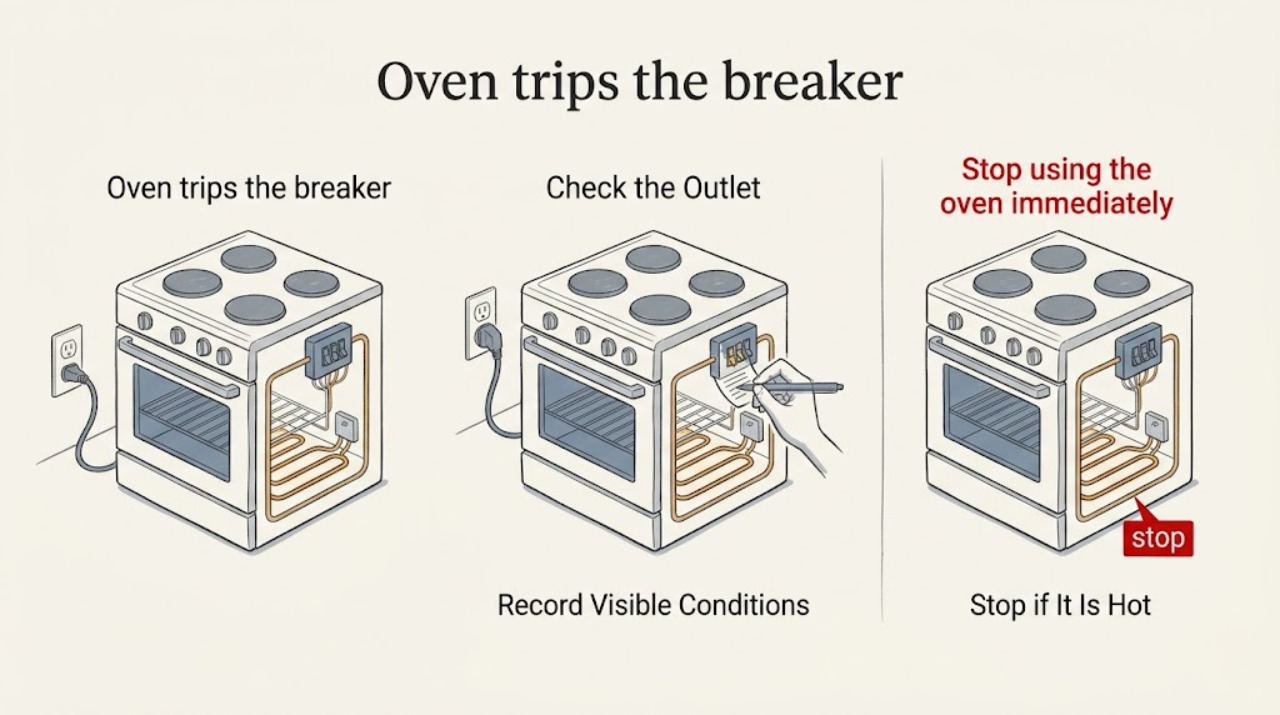
If a second-hand Beko OIF22301XR trips the breaker or fuse when the oven is selected, treat “it is not the heating element” as unconfirmed. Stop using the oven and do not keep resetting the protection to repeat the fault. From a dry, safe position, record whether the trip affects the oven only or other household equipment, when it occurs, and which function was selected; look only for an accessible damaged plug, cord, outlet, or moisture. Beko identifies the OIF22301XR as the right-hinged code for its OIF22301R built-in fan oven, but its general support guidance does not identify the failed internal part. A recurring trip needs qualified electrical or authorised appliance service, not a guessed replacement heater.
Work through in order
Diagnostic checks
Use only checks that match the exact appliance or system and its official guide.
-
Check 1
Stop using the oven immediately after a breaker trip, blown fuse, flash, smoke, burning smell, hot plug, crackling, or visible damage. Leave the protection device in its present state; do not reset it repeatedly or run another cooking function to compare results.
Expected result: The protection stays off, the trip happened once, it trips again on reset, or there is smoke, heat damage, an electrical smell, or arcing.
Next step: For smoke, fire, arcing, or immediate danger, leave the area and contact emergency help as appropriate. Otherwise keep the oven out of use and arrange qualified electrical or authorised appliance service.
Why this matters
Why: A repeated interruption or any heat, smoke, arcing, or damaged connection is an electrical hazard, not evidence for a particular oven part. A single unexplained trip still requires caution because a second-hand installation has unknown history.
-
Check 2
From a dry position and without moving the built-in oven or removing any cover, identify which household protection operated and whether lights or other appliances on the same circuit also lost power. Look only at accessible surfaces for a loose or damaged plug, crushed or heat-marked cord, wet or scorched outlet, or extension lead.
Expected result: Only the oven circuit is off; several household loads are off; the plug, cord, or outlet looks damaged or wet; or no external issue is visible.
Next step: Do not touch a wet, loose, scorched, or damaged connection and do not pull the oven out. Leave the protection off and have the household circuit checked by a qualified electrician; have the oven checked by authorised appliance service when the oven itself is implicated.
Why this matters
Why: Several affected loads make a household supply or overload issue more plausible, while an oven-only trip or visible connection damage keeps the appliance connection or internal circuit in scope. No visible damage does not clear hidden wiring or an internal fault.
-
Check 3
Write down the selected function, temperature setting, timer or clock display, and the exact moment the protection operated: immediately on selecting a function, after the oven had run, or only in one mode. Use the controls only to read their state; do not energise a different mode as a test.
Expected result: The trip is tied to one function, occurs as soon as a function is selected, happens after warm-up, or the display is blank or shows a power-related indication.
Next step: Send the exact sequence and display state with the service request. Do not repeat the selected function, enter a service mode, or perform an insulation or live electrical test.
Why this matters
Why: Timing and mode are useful for a technician to separate a supply event from a function-specific or internal heating-circuit fault, but they do not identify an element, thermostat, sensor, relay, or wiring part for the owner.
-
Check 4
Confirm the identification label and installation record without dismantling the oven: photograph the model and serial label if it is safely visible, and note whether the appliance is plugged into its normal grounded outlet or connected as a fixed installation. Do not substitute an extension lead, adaptor, multi-plug, or temporary supply.
Expected result: The label reads OIF22301XR, the model is different or incomplete, the connection type is unknown, or a damaged/temporary connection is present.
Next step: Give the exact label and connection details to the technician. If the model cannot be confirmed, keep the oven out of service rather than applying another Beko model's wiring or parts information.
Why this matters
Why: Beko's product page lists OIF22301XR as the exact right-hinged model code associated with the OIF22301R built-in fan oven. A different or incomplete label changes which manual and connection requirements apply; an improvised or damaged connection is itself unsafe.
-
Check 5
Prepare a service report containing the model and serial number, protection type, selected function, trip timing, display state, other affected household loads, visible cord or outlet condition, recent cleaning or moisture exposure, and any previous repair or installation work.
Expected result: The report shows a repeatable oven-only trip, a wider household outage, visible connection damage, or an unknown installation history.
Next step: Keep the oven disconnected or otherwise isolated by a qualified person and arrange the appropriate electrical and appliance inspection. Do not buy or fit a heater, thermostat, sensor, fuse, relay, or wiring part based only on the no-heat symptom.
Why this matters
Why: This record gives a professional a safe starting point without treating the user's “not the heating element” conclusion as a diagnosis. Repeated or oven-specific trips require internal fault isolation by a qualified person.
Use your observations
Decision map
Find the observation that best matches what you see, then follow the next safe action.
-
PATH 01Next step
What you see
The breaker or fuse operates again, or there is smoke, arcing, a burning smell, a hot plug, water near the connection, or visible cord damage.
Do this next
Stop all testing, leave the area for immediate danger, and arrange qualified electrical or authorised appliance service. Do not reset the protection again.
Why this path and its safety boundary
Why it matters: This is a live electrical or fire-risk event and is outside user troubleshooting; the cause may be external or internal.
-
PATH 02Next step
What you see
Several household circuits or appliances lost power at the same time, with no oven-specific visible damage.
Do this next
Leave the oven off and have the household circuit and installation assessed by a qualified electrician before any further oven use.
Why this path and its safety boundary
Why it matters: A household supply, circuit loading, or protection issue becomes more plausible than a conclusion about one oven component, although the oven remains untested and unsafe to keep running.
-
PATH 03Next step
What you see
Only the oven protection operates, especially at one selected function or at a repeatable point after starting, while the external connection looks dry and undamaged.
Do this next
Keep the oven out of service and provide the timing and function record to an authorised Beko appliance technician. Do not open panels, bypass protection, or take electrical measurements.
Why this path and its safety boundary
Why it matters: An oven-side connection or internal circuit remains possible, but the pattern cannot distinguish a heater, control, sensor, wiring, or protection fault from outside.
-
PATH 04Next step
What you see
The model label is not OIF22301XR, is incomplete, or the connection has been altered or cannot be identified.
Do this next
Do not apply another model's wiring or part information. Leave the oven unused until the identity and installation are confirmed by a qualified professional.
Why this path and its safety boundary
Why it matters: The exact manual, regional electrical requirements, and service parts cannot be safely selected from the supplied identity.
Helpful context
Understand the symptom
Why a trip changes the diagnosis
A no-heat symptom by itself can come from a function, timer, or supply setting. A breaker or fuse that operates when a particular oven function is selected is a separate safety event. It can involve the household circuit, the connection, moisture or visible damage, or an internal oven circuit; the symptom cannot prove that the heating element is innocent or guilty. Because this is a second-hand appliance, its installation and prior repair history are unknown. Do not open the oven to settle that question.
The safe handoff
The useful evidence is the exact model, the protection device that operated, the selected function, the timing of the trip, what else lost power, and any visible damage or moisture. Give that record to a qualified electrician or authorised Beko appliance technician. The Beko electrical-safety guidance requires the product to be disconnected before repair and says damaged cables and unapproved extensions must not be used.
When checks do not resolve it
Need a professional?
Arrange qualified electrical or authorised Beko appliance service after any breaker or fuse trip associated with the oven, and immediately for repeat trips, smoke, arcing, burning smell, hot or damaged connections, moisture, or an unknown installation. A no-heat symptom after a trip is not enough to select a replacement part.
Common questions
FAQ
Does a breaker trip prove the heating element is bad?
No. It may involve the household circuit, connection, moisture or damage, or an internal oven circuit. The trip timing and selected function help a professional, but they do not identify a part for the owner.
Can I reset the breaker once to see whether the oven works?
For this repeated-short or trip scenario, do not reset it to run another test. Leave the protection in its present state and arrange qualified electrical or authorised appliance service, especially if there was heat, smoke, smell, moisture, or visible damage.
What is the exact Beko model identity?
Beko's discontinued OIF22301R product page lists OIF22301XR as the right-hinged model code. Confirm the label on the appliance before using a manual or discussing parts; do not infer compatibility from appearance.
Read the exact guide
Official sources
- Electrical SafetyBeko · Beko oven electrical-safety guidance; OIF22301XR is not named on this general page, so apply only its safety boundary and defer exact wiring to the model manual.
- The hobs work fine but the main oven is not heating up?Beko UK · General Beko oven no-heat support: clock, fuse, grounded connection, controls, function, timer, and service boundary; OIF22301XR is not named on this FAQ.
- 60cm Single Fan Oven with Fully Programmable LED Timer OIF22301RBeko UK · Beko product identity and specifications for OIF22301R; the model-code table explicitly lists OIF22301XR as the right-hinged code.
- OIF22301R User ManualBeko · Beko manual linked from the OIF22301R product page for the OIF22301XR model-code family; use it for exact installation and operating instructions, not for guessing an internal failed part.
- How to fix a range or an oven that does not heatBeko · General Beko range/oven no-heat guidance and authorised-service boundary; OIF22301XR is not named on this regional page.
Community feedback
Share a repair observation
Share a plain-text repair observation. Accepted observations are published automatically; this page may take a moment to update.