
On this page
Start here
Quick answer
If a Beko oven is not heating, first stop cooking and let it cool if it has been running. Confirm that a cooking function and temperature are selected, the clock or timer is set as required by the model, the door is fully closed, and the appliance has power at its normal grounded outlet. Check only the household fuse or breaker from a safe position; do not remove the oven panels or test live wiring. If these settings and external power checks do not restore heat, or a fuse trips again, stop and arrange authorized appliance service.
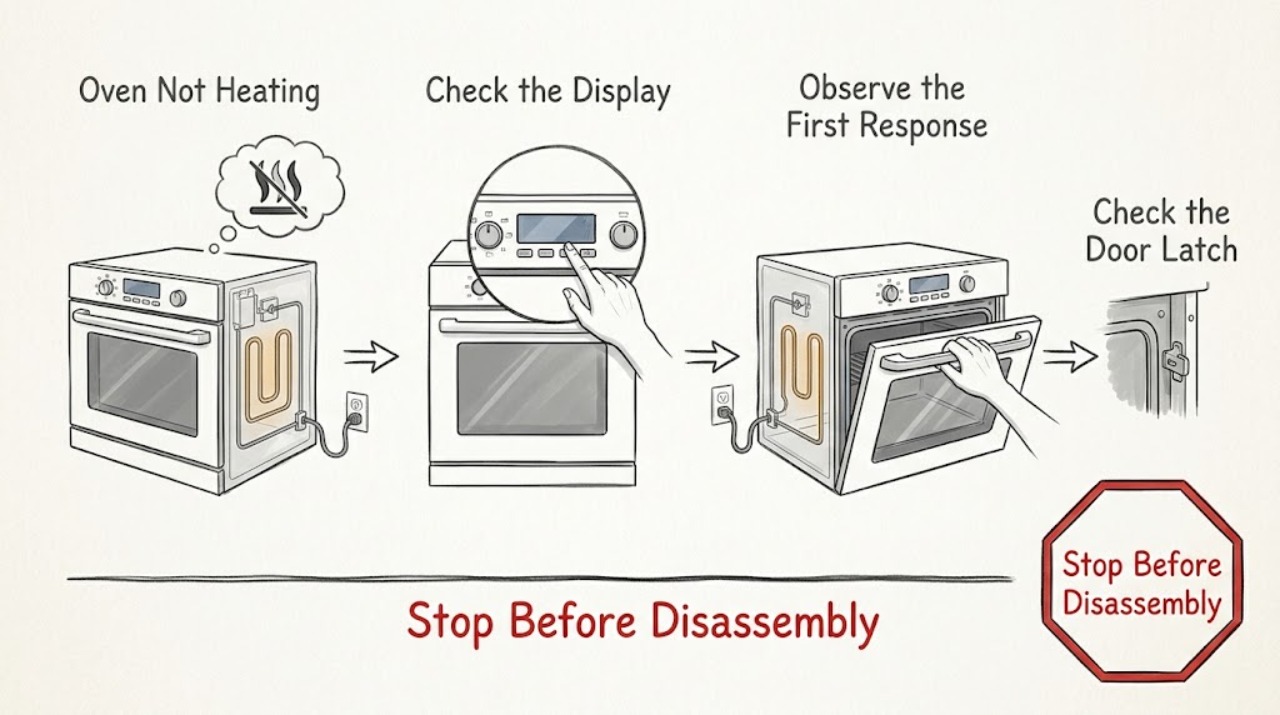
Work through in order
Diagnostic checks
Use only checks that match the exact appliance or system and its official guide.
-
Check 1
Turn the oven off and note whether the display is blank, whether the oven light or fan responds, whether the hob works if this is a range, and whether the appliance stopped after a power interruption. Keep the door closed until hot surfaces have cooled.
Expected result: The whole appliance is without power, the display works but no heating starts, or only the oven section is affected.
Next step: If there is smoke, a burning or gas smell, a damaged cord, or repeated breaker operation, stop and use the safety-service branch. Otherwise continue with the control checks.
Why this matters
Why: A completely inactive appliance points first to an external supply or control state; a live display with no heat makes settings, door status, timer, or an oven heating circuit more likely. A working hob does not prove that the oven circuit is healthy.
-
Check 2
On the control panel, select a normal cooking function and a temperature above room temperature using the symbols and controls shown in the exact Beko manual. For a model with a mechanical minute minder, check whether it is in the manual or continuous-cooking position rather than waiting for an unset timer.
Expected result: The function indicator and temperature setting appear, the timer is set correctly, and the oven begins a heating cycle; or the controls do not accept the selection.
Next step: Correct only the visible setting and observe one heating attempt. If the controls remain unresponsive or the oven still does not heat, do not open the control panel; continue to the power and door checks.
Why this matters
Why: No function or temperature, an unset timer, or an active key lock can prevent heating without a failed heater. If the settings are accepted but the oven remains cold, the fault moves beyond a simple selection error.
-
Check 3
Confirm that the oven door closes completely and that no rack, tray, or debris is preventing the latch area from seating. Do not force the door or adjust its hinges.
Expected result: The door closes normally and the display shows a cooking cycle, or it remains ajar, does not latch, or the oven reports a door-related indication.
Next step: Remove only an obvious obstruction after the oven is cool and try the selected function once. If the door will not close or the symptom returns, stop and request service rather than bypassing the interlock.
Why this matters
Why: Some Beko manuals state that an open door can cancel cooking time and prevent the heaters from operating. A latch or door-sensing fault is not safely diagnosed by bypassing it.
-
Check 4
From a dry, safe position, verify that the appliance plug is fully seated in its normal grounded outlet and look at the household fuse or circuit-breaker status. Do not remove appliance covers or perform electrical measurements at the oven terminals.
Expected result: The outlet and household protection appear available, or the breaker has tripped / the fuse protection is off while other equipment may also be affected.
Next step: If the household protection is safely resettable and does not trip again, make one controlled heating attempt. If it trips again, remains off, or the outlet is damaged or wet, stop and use a qualified electrical or appliance professional.
Why this matters
Why: Beko lists a missing supply, faulty or tripped fuse, or an ungrounded connection among reasons an oven may not operate or heat. A repeated trip can signal a fault rather than a setting problem.
-
Check 5
After the oven is cool and the settings, door, and external supply appear normal, run one short, supervised heating attempt with an empty cavity. Observe whether the oven indicates heating, whether warmth develops, and whether an error, unusual smell, smoke, or breaker operation appears.
Expected result: The cavity warms normally, stays cold despite a valid cycle, or produces a hazardous symptom or repeated electrical interruption.
Next step: Turn the oven off after this single test. If it stays cold or any hazardous symptom occurs, stop using it and arrange authorized service; do not repeat tests or perform live measurements.
Why this matters
Why: Normal warmth after a corrected setting supports a control-state issue. Continued cold operation with valid settings suggests a heater, thermostat, selector, sensor, door circuit, or internal supply fault that cannot be distinguished safely from outside.
-
Check 6
Record the model number, serial number, display message, selected function, timer state, power symptoms, and the result of the one supervised attempt. Find the appliance identification label in the position specified for the Beko oven or range model.
Expected result: The same no-heat symptom recurs after the visible checks, or the oven cannot complete a heating cycle without a fault indication.
Next step: Stop using the oven and give the recorded details to authorized service. Leave internal heating-circuit tests and part replacement to a trained technician.
Why this matters
Why: A repeatable fault after correct settings and available power is evidence for a component or control problem, not a reason to replace a heater speculatively. The model information is needed for safe diagnosis and correct parts identification.
Use your observations
Decision map
Find the observation that best matches what you see, then follow the next safe action.
-
PATH 01Next step
What you see
There is gas odor, smoke, a burning smell, a damaged cord, water near electrical equipment, repeated breaker operation, or visible overheating.
Do this next
Stop the oven and move away from the hazard. If safe without touching the hazard, isolate the appliance using the accessible control; do not create sparks or open panels. Contact the appropriate qualified appliance, electrical, or gas professional.
Why this path and its safety boundary
Why it matters: This is a safety event, not a normal settings check.
-
PATH 02Next step
What you see
The cooking function, temperature, clock, timer, key lock, or door position was not set as required by the exact model manual.
Do this next
Correct the visible control state, close the door, and make one supervised heating attempt. If it still remains cold, use the service branch.
Why this path and its safety boundary
Why it matters: The oven may not have been commanded to heat, and no component replacement is justified yet.
-
PATH 03Next step
What you see
The display and controls are dead, the household protection is off, or the supply remains unreliable after a safe external check.
Do this next
Use a qualified electrical professional for the household supply or an authorized appliance professional for the oven. Do not test appliance terminals or repeatedly reset a tripping breaker.
Why this path and its safety boundary
Why it matters: The oven may have an external supply issue or an internal electrical fault; opening the appliance would add risk.
-
PATH 04Next step
What you see
Settings, door closure, and external power are normal, but the oven stays cold, shows a recurring error, or needs a panel, heater, thermostat, sensor, or wiring test.
Do this next
Stop using the oven and arrange authorized service. Do not bypass the door circuit, remove covers, or perform live electrical testing.
Why this path and its safety boundary
Why it matters: An internal heating or control fault remains possible and cannot be safely isolated by the owner checks.
Helpful context
Understand the symptom
What a no-heat symptom tells you
A Beko oven that has a working display but stays cold may be waiting for a cooking function, temperature, clock, or timer setting. If the controls appear correct, the fault can be in the supply, door sensing, heater, thermostat, selector, or another internal circuit. The exact behavior depends on the model, so use the model-specific manual for symbols and timer operation.
Keep the repair boundary clear
Only inspect controls and household power from a safe, dry position. Do not remove the oven back, expose terminals, bridge a safety device, probe a heater, or test energized wiring. Stop immediately for a burning smell, smoke beyond normal cooking residue, gas odor, damaged cord, repeated breaker operation, or signs of overheating, and use qualified service.
Only after diagnosis
Potential parts
- oven heating element
Consider this category only after a qualified technician confirms that a heating element is open or otherwise faulty with the appliance safely isolated.
Verify the exact model and approved fitment before ordering; no universal element compatibility is assumed. - oven thermostat or temperature sensor
Consider this category only when the technician's diagnosis points to inaccurate temperature control or a failed sensor rather than a settings or supply issue.
Confirm the model-specific component and installation requirements with authorized service before replacement.
When checks do not resolve it
Need a professional?
Use authorized appliance service when correct function, temperature, timer, door, and external power checks do not restore heat; when the breaker or fuse protection trips again; or when diagnosis would require opening the oven, accessing a heater or terminal, bypassing a door circuit, or measuring live voltage. Stop immediately for gas odor, smoke, burning smell, damaged wiring, or water near the appliance.
Common questions
FAQ
Why is my Beko oven not heating even though the display works?
Check the selected cooking function and temperature, the clock or timer, and complete door closure using the model manual. If those are correct, a heater, sensor, selector, door circuit, or internal supply fault may remain and needs authorized service.
Can an unset clock stop a Beko oven from heating?
Yes, Beko UK says many newer ovens will not work until the clock is set, and its guidance also calls out the mechanical timer on applicable models. Use the exact model manual for the correct clock or timer procedure.
What should I do if the oven breaker trips when I try to heat it?
Do not keep resetting it. If the breaker trips again or the outlet, cord, or oven shows damage or heat, stop using the appliance and arrange qualified electrical or appliance service. Do not open the oven to test the circuit.
Should I replace the Beko oven heating element myself?
Do not assume the element is the cause or remove the oven cover based only on a cold cavity. A qualified technician should isolate the appliance, identify the failed component, and verify the exact model fit before replacement.
Read the exact guide
Official sources
- TROUBLESHOOTINGBeko · Beko SLGR30523SS range and oven user manual troubleshooting
- My oven is not heating up.Beko UK · Beko UK oven no-heat FAQ, including clock, power, key lock, function, and mechanical timer checks
- 7751788326_385441930_BBVM12400XPS_1_EN-ITBeko · Beko BBVM12400XPS built-in oven user manual
- How to I fix a range or an oven that does not heat?Beko · Beko range and oven no-heat troubleshooting
Community feedback
Share a repair observation
Share a plain-text repair observation. Accepted observations are published automatically; this page may take a moment to update.