
On this page
Start here
Quick answer
Beko identifies the QDM246B as a discontinued 90 cm built-in multifunctional double oven with fan, static, grill, fan-grill, bottom-heat, pizza, and other cooking programs. Its product page lists separate top and bottom elements for the main cavity and a grill element, so a program that does not visibly energize one element is not by itself proof that the element is faulty: different programs use different heater combinations, and some elements may cycle. If an element is visibly bent, cracked, blistered, touching the cavity, or marked by arcing, do not straighten it, touch it, or run another program. Isolate power only from a dry, safe position, let the oven cool completely, photograph the model and damage, and arrange qualified Beko oven service. If the element looks intact, use the exact QDM246B manual to identify the selected function, temperature, and timer state, then make at most one short supervised check only if there is no damage, smell, smoke, or breaker problem. Do not remove covers, perform a live test, or choose a replacement element from appearance alone.
Before you begin
Safety first
- Owner checks are limited to model identification, allowing the cavities to cool, no-touch visual inspection, recording functions and timer state, checking an accessible external supply from a dry safe position, and one short supervised observation only when the element is intact and no hazard exists. Do not straighten or remove the element, lift the oven from the cabinet, open covers, bypass a door or timer circuit, or perform live electrical measurements.
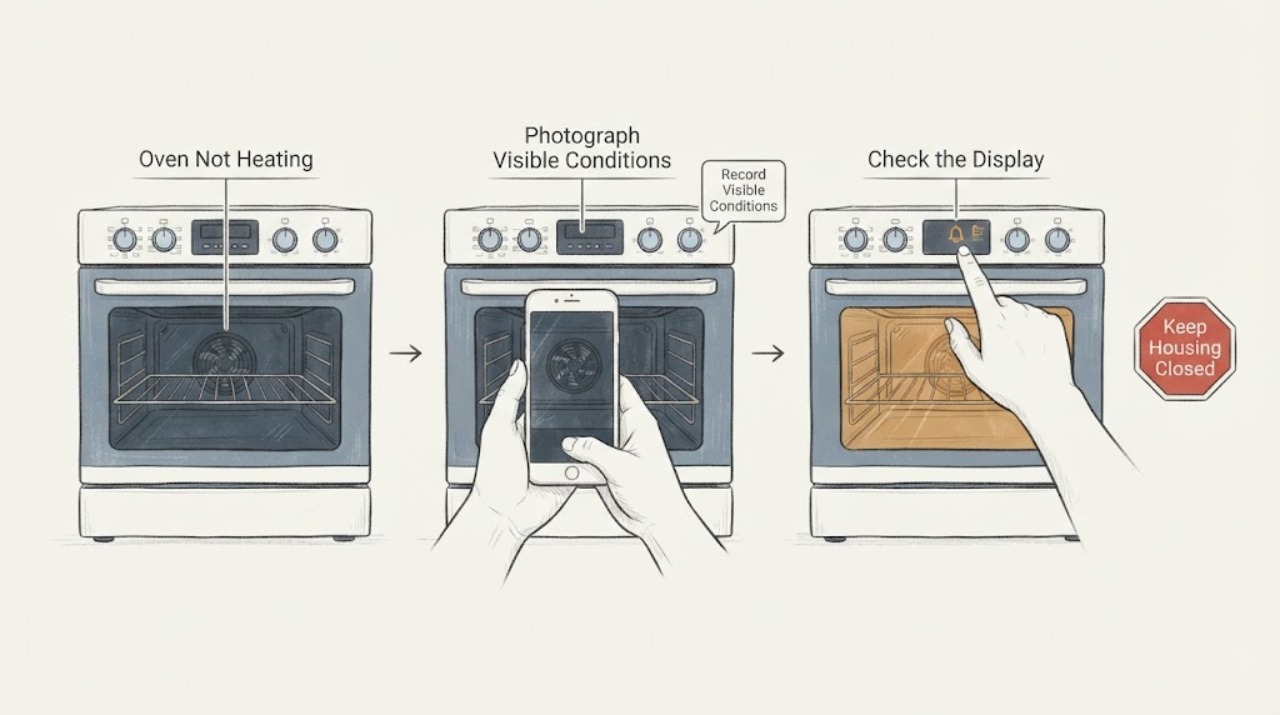
Work through in order
Diagnostic checks
Use only checks that match the exact appliance or system and its official guide.
-
Check 1
Turn the oven controls off and let both cavities cool completely. From outside the cavity, inspect the visible element without touching it or removing a panel; note whether it is bent, cracked, blistered, sagging onto a rack or cavity wall, discolored, or marked by arcing. Record whether the damage is in the main cavity or top cavity and photograph it.
Expected result: The element is visibly deformed or damaged; the element looks intact; or the cavity cannot be inspected safely because it is still hot, smoking, or electrically abnormal.
Next step: If damage or a hazard is present, keep the oven out of use, isolate power only from a dry, safe position if that can be done without approaching the hazard, and arrange qualified service. If intact and cold, continue only with the exact-function identification below.
Stop if: Do not straighten, bend, press, scrape, remove, or electrically test the element; do not reach into a hot cavity.
Why this matters
Why: A damaged element is a physical safety finding, not a setting problem. An intact-looking element does not prove continuity or safe insulation, while heat, smoke, or electrical symptoms override visual troubleshooting.
-
Check 2
Write down the exact QDM246B program symbol or menu name, selected temperature, cavity, timer state, and whether the fan or interior light responds. Match the function to the QDM246B manual before deciding which heater should operate; do not compare a grill result with a fan or bottom-heat result as though they were the same test.
Expected result: Only one function is cold; several functions that should use different heaters are cold; the timer or function was not accepted; or the selected function is unclear.
Next step: Correct only a clearly wrong visible setting using the exact manual. If the function is valid but the oven remains cold, stop repeated trials and arrange service rather than assuming the bent element is the only fault.
Stop if: Do not enter undocumented diagnostic modes, bypass a timer or door circuit, or select a different program to conceal a damaged heater.
Why this matters
Why: Because Beko lists separate top, bottom, and grill elements and multiple combinations, one cold program can indicate a normal function-specific result or a localized heater/control issue. Several unrelated functions failing makes external power, controls, or an internal supply/control fault more plausible, but does not identify a component.
-
Check 3
From a dry, safe position, check the normal household supply and the oven's accessible plug or isolator only as the installation permits. Note whether the display is alive, whether another cavity or the light works, and whether the breaker or fuse has operated. Do not open the oven or probe the heater terminals.
Expected result: The display and other functions are live; the whole oven is dead; the breaker trips again; or the supply area is wet, damaged, hot, or smells burned.
Next step: For a dead, tripping, wet, hot, or burned supply, stop using the oven and obtain qualified electrical or appliance service. If the external supply is normal and there is no visible element damage, continue only to one model-directed supervised observation.
Stop if: Do not repeatedly reset a tripping breaker, remove the rear cover, or use a multimeter on live terminals.
Why this matters
Why: A dead appliance or recurring breaker trip can be an external supply or internal short, and a working display does not prove that the heating circuit is safe. A bent or failed element may be downstream of the control and supply path.
-
Check 4
Only when the oven is cold, the element looks intact, the controls and supply are normal, and there is no smell, smoke, arcing, or breaker issue, make one short supervised heating attempt using the exact QDM246B manual's valid function and temperature. Observe through the closed door whether the expected cavity warmth develops; do not open the door to touch the element or repeat the attempt across every program.
Expected result: The selected cavity warms; it stays cold; the wrong cavity or heater responds; or smoke, odor, arcing, unusual noise, or a breaker trip occurs.
Next step: Turn the oven off after the single observation. If it stays cold, the wrong heater responds, or any hazard appears, stop using the oven and provide the program, cavity, and symptom record to qualified service.
Stop if: Do not run repeated tests, operate with a loose or damaged element, use the oven unattended, or perform a live electrical test.
Why this matters
Why: Warmth on the correct function supports a control or selection issue, while a valid function that remains cold suggests a heater, thermostat, sensor, selector, timer, wiring, or supply fault. A hazard during the attempt means the test must end immediately and does not identify a replacement part.
-
Check 5
Prepare a service record with QDM246B, the full product label and market, affected cavity, element location and shape, selected programs that did and did not heat, timer/display behavior, breaker history, and photographs taken only after cooling. Do not order an element solely because it is bent or because one program is cold.
Expected result: The same no-heat result is repeatable in a valid program; the fault is limited to one heater/function; multiple functions fail; or the evidence is inconsistent.
Next step: Keep the oven out of use if damage, overheating, or electrical symptoms are present and arrange qualified Beko or appliance service. Ask the technician to inspect the element and associated wiring before selecting a part.
Stop if: Do not remove the oven from its cabinet, loosen element terminals, or straighten the element to make it fit.
Why this matters
Why: The program pattern can help a technician narrow the circuit, but it cannot prove a specific heater, thermostat, sensor, relay, wiring, or control-board failure. Exact fitment also cannot be established from the visual shape of an element.
Use your observations
Decision map
Find the observation that best matches what you see, then follow the next safe action.
-
PATH 01Safety boundary
What you see
The element is visibly bent, cracked, blistered, touching the cavity, or marked by arcing, or the oven trips protection when heating is selected.
Do this next
Stop using the oven, isolate power only from a safe dry position if possible, and arrange qualified Beko appliance service. Provide photographs and the affected cavity/program.
Why this path and its safety boundary
Why it matters: This is an internal heating-circuit safety concern. The visible element damage does not establish whether the element, wiring, relay, insulation, or another component also failed.
Safety stop: Do not reshape, insulate, remove, or live-test the element.
-
PATH 02Next step
What you see
The element is intact, the exact function and timer are valid, and one supervised check warms the expected cavity normally.
Do this next
Use the exact manual's normal function and temperature settings, monitor one normal cooking cycle, and stop if the element deforms, arcs, smells, smokes, or trips power again.
Why this path and its safety boundary
Why it matters: The original observation may have been a function-selection, timer, or cavity-selection issue; the product's multiple programs mean not every heater is visibly active in every mode.
-
PATH 03Next step
What you see
The element looks intact but a valid program stays cold, or separate programs that use different heaters all fail to heat.
Do this next
Stop repeated heating attempts and arrange qualified service with the program-by-program record. Do not replace a heater or open the controls without a technician's diagnosis.
Why this path and its safety boundary
Why it matters: The result is more consistent with a heating, thermostat/sensor, selector, timer, wiring, relay, or supply fault than with a simple program misunderstanding, but the failed component cannot be chosen safely from the symptom.
-
PATH 04Safety boundary
What you see
The display is dead, the household protection trips, the supply area is wet or damaged, or smoke, burning odor, arcing, or abnormal overheating appears.
Do this next
Stop using the oven and obtain qualified electrical or appliance help. Do not keep resetting the breaker or open the cabinet to inspect the element.
Why this path and its safety boundary
Why it matters: This is an electrical or fire-safety path, not an owner-level heater check.
Safety stop: Move away from smoke or fire and use emergency services as appropriate; do not create sparks while investigating.
Helpful context
Understand the symptom
The QDM246B is a multifunctional double oven, not a single-heater appliance. Beko's exact model page lists separate main-cavity top and bottom elements, a 2.2 kW grill, fan-assisted and static functions, and several programs that combine or omit particular heat sources. A heater that is not visibly glowing in one program therefore needs to be compared with the function described in the QDM246B manual; it should not be judged by sight alone.
A visibly bent element changes the safety decision. Do not bend it back, push it away from the cavity, touch it while hot, or test its terminals with the oven energized. A deformation can be accompanied by cracked insulation, a short, an arc mark, or damage to wiring, and an owner cannot identify the failed part safely from the shape. Photograph the damage after the oven is cold and leave internal inspection and replacement to qualified service.
Only after diagnosis
Potential parts
- QDM246B-compatible oven heating element
Consider this category only after a qualified technician confirms that the bent or failed element is the cause and identifies the affected cavity and function. A visual bend or one cold program is not sufficient.
Verify the complete product label, cavity, electrical rating, connector arrangement, and technician diagnosis before ordering; do not straighten or fit an element by appearance. - oven thermostat, sensor, selector, relay, or wiring component
Consider only if the technician's model-specific tests show that multiple programs or the associated control path, rather than the element itself, is preventing heat.
Do not infer a control or sensor part from the program symptom; confirm exact model, cavity, and service diagnosis first.
When checks do not resolve it
Need a professional?
Use qualified appliance service for a bent or damaged element, repeated no-heat behavior, a valid program that remains cold, a wrong heater response, recurring breaker trips, or any internal heating, sensor, control, or wiring concern. Use qualified electrical help for household supply, wet, hot, damaged, or repeatedly tripping electrical equipment.
Safety scope: Owner checks are limited to model identification, allowing the cavities to cool, no-touch visual inspection, recording functions and timer state, checking an accessible external supply from a dry safe position, and one short supervised observation only when the element is intact and no hazard exists. Do not straighten or remove the element, lift the oven from the cabinet, open covers, bypass a door or timer circuit, or perform live electrical measurements.
Have this ready
- Provide Beko QDM246B, full product label and market, affected cavity, element location and appearance, exact program symbols or names, selected temperature and timer state, which programs did or did not heat, display and fan observations, one-test result, photographs, and any smoke, odor, arcing, or breaker history.
Common questions
FAQ
Does a bent Beko QDM246B element need to be bent back?
No. Do not reshape or touch it. Let the oven cool, isolate power only from a safe dry position if appropriate, photograph the damage, and arrange qualified service. A bend can coexist with insulation, wiring, or control damage that cannot be assessed by appearance alone.
Why does one QDM246B program heat while another does not?
The QDM246B is a multifunction double oven with separate top, bottom, and grill elements and programs that use different combinations. A cold element in one mode may be expected, while a valid program that should heat but stays cold needs service diagnosis. Use the exact model manual to identify the selected function before judging the element.
Can I use a multimeter to test the bent element?
Not as an owner live test. A qualified technician should isolate the oven and perform any electrical testing safely. Do not remove covers, loosen terminals, or probe an energized heater circuit.
Should I replace the heating element because the oven is cold on several programs?
Not from that symptom alone. Several programs failing can involve an element, thermostat or sensor, selector, timer, relay, wiring, or supply path. Record the exact functions and have qualified service diagnose the QDM246B before ordering a part.
Read the exact guide
Official sources
- High Specification 90cm Built-in Multifunctional Double Oven QDM246BBeko UK · Opened Beko's exact QDM246B product page. It identifies the discontinued 90 cm built-in multifunctional double oven, lists the touch-control display, main-cavity top and bottom elements, grill element, and available cooking functions, and links the model-specific PDF manual.
- Beko QDM246B User ManualBeko · Opened the exact PDF linked from Beko's QDM246B product page. It is the model-specific manual to use for the function symbols, cavity controls, timer operation, and safety instructions; it does not authorize bending, live testing, or owner replacement of a damaged heater.
Community feedback
Share a repair observation
Share a plain-text repair observation. Accepted observations are published automatically; this page may take a moment to update.