
On this page
Start here
Quick answer
A Beko refrigerator banging noise is not enough to identify a failed compressor, fan, or sealed-system part. First note when it happens and whether it comes from the cabinet, rear, freezer, or ice-maker area. Beko's official support says some flowing, bubbling, whirring, clicking, cracking, and defrost noises can be normal, but unusually loud noise or noise with abnormal operation should go to an authorized service agent. Check that the refrigerator is level, stable, clear of the wall and nearby cabinets, and not vibrating against an object; then verify temperatures and door seals. Do not open the cabinet or reach into a moving fan. Persistent banging, worsening noise, warm food, alarms, burning smell, or water near electrical parts requires service.
Before you begin
Safety first
- Limit owner checks to listening from outside, checking placement and visible contact, confirming door closure, visible vents, and temperatures, and recording the model number. Do not remove cabinet or rear covers, reach into fans, manipulate refrigerant tubing, perform live electrical tests, or replace internal parts without exact model instructions.
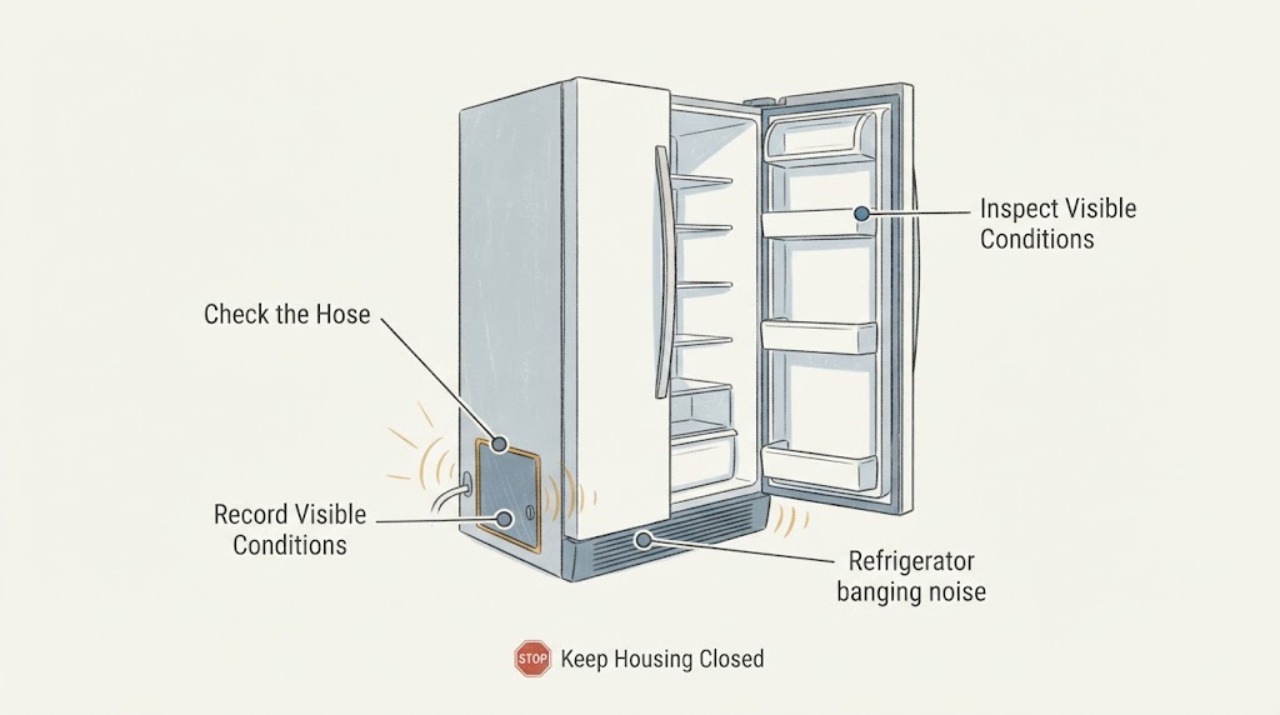
Work through in order
Diagnostic checks
Use only checks that match the exact appliance or system and its official guide.
-
Check 1
Record when the banging occurs and locate it from outside the cabinet: after a door closes, during compressor operation, during defrost, near the freezer or ice maker, or when the refrigerator vibrates.
Expected result: The sound is a brief crack, click, liquid or ice-maker noise, or it is a repeated hard impact, scrape, rattle, or vibration from the rear or cabinet.
Next step: For a brief documented operating sound with normal cooling, continue with placement and temperature checks; for repeated impact or scraping, stop at external observation and arrange service.
Stop if: Do not recreate the noise by opening panels or holding a fan; document the timing and sound for the exact model service path.
Why this matters
Why: Beko identifies several brief operating sounds as potentially normal, but its guidance does not classify an unspecified banging pattern or prove a failed component.
-
Check 2
Check that the refrigerator stands level and stable, with no cabinet, wall, hose, shelf, pan, or loose item touching it; inspect the accessible floor and feet without tilting or dismantling the appliance.
Expected result: The cabinet rocks, a foot is not firmly supported, or an external object is being struck; or the appliance is stable and clear.
Next step: Correct only the accessible placement or contact condition according to the installation guide, then observe whether the noise changes.
Stop if: Continue with temperature and seal checks; do not open the rear cabinet to search for a banging component.
Why this matters
Why: Beko's official noise-reduction guidance says an uneven surface can cause vibration and excessive noise, and recommends checking placement on a flat, level surface. This does not identify a damaged internal part.
-
Check 3
Check the refrigerator and freezer temperatures, visible vents, and door closure; look for a gasket gap or a door that rebounds instead of sealing, without inserting tools into the door or vents.
Expected result: Temperatures are stable and doors seal, or a compartment is warming, a vent is blocked, or a door does not close fully.
Next step: Correct only an accessible loading, vent, or door-closure condition and monitor actual temperatures; arrange service if warming persists.
Stop if: Use the exact model manual or service route instead of changing internal settings or parts by guesswork.
Why this matters
Why: Noise with normal operation is treated differently from noise accompanied by a cooling problem. A temperature or seal issue can make the appliance work harder, but it does not prove the banging comes from the compressor or fan.
-
Check 4
Record the complete Beko model number before looking for model-specific noise guidance; use the label location for the refrigerator layout shown on Beko's official manual page.
Expected result: The full model is available, or only a partial label is readable.
Next step: Use the matching manual and provide the model, noise timing, temperature readings, and location to an authorized service agent if the noise persists.
Stop if: Do not apply another Beko model's diagnostic mode, access step, or part number; obtain the label information first.
Why this matters
Why: Beko's manual lookup is model-number based, and the page lists different label locations for top-freezer, bottom-freezer, side-by-side, and French-door refrigerators. A partial identity cannot establish fan, compressor, or panel behavior.
-
Check 5
Escalate without further testing if the banging is unusually loud or worsening, the refrigerator is not cooling normally, an alarm persists, or there is smoke, burning odor, water near electrical parts, or repeated breaker tripping.
Expected result: One or more safety or performance signs is present, or the sound remains after the refrigerator is stable, clear, and maintaining temperature.
Next step: Stop using the appliance as appropriate, protect food and people, and arrange authorized Beko service.
Stop if: Continue monitoring the documented sound and temperatures; do not replace a compressor, fan, damper, or other part solely from the noise description.
Why this matters
Why: Beko directs owners to an authorized service agent when noise is too loud or unusual or the appliance is not operating normally; the public guidance does not support an owner diagnosis of the internal cause.
Use your observations
Decision map
Find the observation that best matches what you see, then follow the next safe action.
-
PATH 01Next step
What you see
The sound is brief and resembles liquid flow, clicking, cracking, defrost, or ice-maker operation, while cooling and door operation remain normal.
Do this next
Record the timing, keep the refrigerator level and clear, and monitor temperatures rather than replacing an internal part.
Why this path and its safety boundary
Why it matters: Beko lists these categories as potentially normal operating noises.
-
PATH 02Next step
What you see
The cabinet rocks, touches a wall or cabinet, or an external item is being struck when the compressor or cabinet vibrates.
Do this next
Correct only the accessible placement or contact issue and observe the next normal operating cycle.
Why this path and its safety boundary
Why it matters: The official Beko noise-reduction guidance identifies placement and leveling as causes of avoidable vibration noise.
-
PATH 03Next step
What you see
Banging occurs with rising temperatures, a door that does not seal, a blocked vent, or a persistent alarm.
Do this next
Check only the visible door, vent, and temperature conditions, then arrange authorized service if the performance issue remains.
Why this path and its safety boundary
Why it matters: The refrigerator is not operating normally while making the noise, so the sound cannot be treated as a harmless operating noise from the available evidence.
-
PATH 04Next step
What you see
The noise is a repeated hard impact, scraping, electrical buzz, or becomes unusually loud after external placement checks.
Do this next
Stop at the cabinet and contact an authorized Beko service agent; do not remove covers or reach into moving components.
Why this path and its safety boundary
Why it matters: Beko's public guidance does not identify a safe universal internal diagnosis for that pattern.
-
PATH 05Next step
What you see
The model number is missing or the matching manual does not explain the sound for this refrigerator.
Do this next
Use Beko's model-number page and exact manual/service route; do not order a part from the symptom name alone.
Why this path and its safety boundary
Why it matters: The appliance's fan, compressor, ice-maker, and enclosure design remain unresolved, so another model's repair steps or parts would be speculative.
Helpful context
Understand the symptom
“Banging” describes a sound, not a confirmed part failure. Beko's opened help center explains that refrigerators can make several operating noises, including liquid-flow, ice-maker, defrost, clicking, and cracking sounds. Its guidance is to determine where the sound comes from and use authorized service if the refrigerator is not operating normally while making it.
The task does not provide a model number. Begin with observations that apply across layouts: timing, location, stability, clearance, temperature, and door closure. Do not transfer an internal fan, compressor, damper, or refrigerant diagnosis from another Beko model.
Keep checks external. Do not remove the rear cover, reach into a fan, move refrigerant tubing, or repeatedly restart a refrigerator that smells burnt, trips a breaker, leaks near electrical parts, or is warming food.
When checks do not resolve it
Need a professional?
Use the exact Beko manual or an authorized service agent for persistent or unusual banging, abnormal cooling, alarms, electrical symptoms, or any internal access.
Safety scope: Limit owner checks to listening from outside, checking placement and visible contact, confirming door closure, visible vents, and temperatures, and recording the model number. Do not remove cabinet or rear covers, reach into fans, manipulate refrigerant tubing, perform live electrical tests, or replace internal parts without exact model instructions.
Common questions
FAQ
Is a banging noise from a Beko refrigerator normal?
The word banging alone is not enough to decide. Beko says some liquid-flow, clicking, cracking, defrost, and ice-maker sounds can be normal, while unusually loud noise or noise with abnormal operation should be referred to an authorized service agent. Note the timing and location, then check stability and cooling.
Can an uneven floor cause a Beko refrigerator to bang?
Beko's noise-reduction guidance says an uneven surface can cause vibration and increased noise. Check that the refrigerator is level and not touching a wall, cabinet, hose, or loose item. If the sound persists after placement checks, arrange service rather than opening the cabinet.
Does banging mean the Beko compressor is failing?
No. The available official sources do not diagnose a compressor from that sound alone. Check temperatures and door/vent conditions, record the model and timing, and use authorized service for persistent or abnormal operation.
Where do I find the Beko refrigerator model number?
Beko's US manual page lists different locations by layout: top-freezer labels are near the top of the inner left wall, bottom-freezer labels halfway up the inner right wall, side-by-side labels near the bottom of the inner left refrigerator wall, and French-door labels under the crispers.
Read the exact guide
Official sources
- How to Reduce Refrigerator Noise?Beko · Opened the official Beko article directly. It gives general external placement and service guidance, not a model-specific diagnosis or part replacement procedure.
- Beko Help CenterBeko · Opened the official Beko US help center directly. It covers refrigerator noise categories and states that unusual noise or abnormal operation should go to an authorized service agent; it does not diagnose an unspecified banging noise or a particular internal part.
- Beko User ManualBeko · Opened the official Beko US manual page directly. It requires the model number and lists refrigerator label locations by layout; it supports exact-model scoping rather than any unseen noise procedure.
Community feedback
Share a repair observation
Share a plain-text repair observation. Accepted observations are published automatically; this page may take a moment to update.