
On this page
Start here
Quick answer
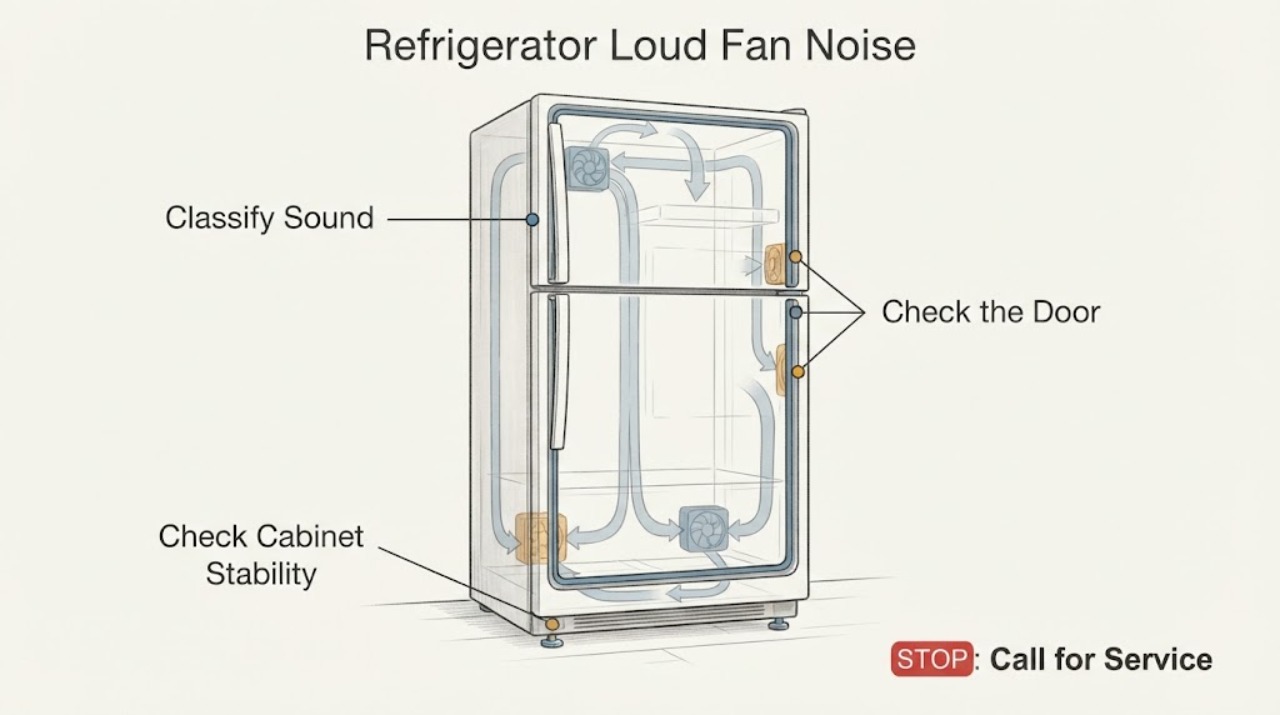
Beko says a blowing or whirring sound can be normal because the refrigerator uses fans and because refrigerant, water-supply or automatic-defrost processes can also make operating sounds. First identify whether the sound is a steady airflow noise or an unusual scraping, rattling or increasing noise. Check that doors close fully, the refrigerator is level and stable, and nothing on top or around it is vibrating. A fan may continue while a freezer door is open on some Beko models. If the sound is unusually loud, persists with abnormal cooling, or cannot be separated from a mechanical fault without opening the cabinet, stop at external checks and contact an authorized service agent rather than removing panels or replacing a fan.
Work through in order
Diagnostic checks
Use only checks that match the exact appliance or system and its official guide.
-
Check 1
From outside the cabinet, listen briefly and record whether the sound is steady airflow/whirring, liquid-flow, clicking, scraping, rattling or an increasing mechanical noise.
Expected result: The sound matches a steady fan or operating-flow sound, or it is new, rough, intermittent or unusually loud.
Next step: Continue with door, stability and cooling observations. Do not open the cabinet to identify the fan by touch.
Why this matters
Why: Beko documents fan and operating-flow sounds as possible normal behavior, while a changed or abnormal sound needs to be assessed with the refrigerator's operating condition.
-
Check 2
Close the refrigerator and freezer doors normally and check from outside that packages are not obstructing the seals or preventing full closure.
Expected result: A door was ajar or blocked, or both doors close fully and the sound continues.
Next step: Reposition only accessible packages and observe normal operation without holding a door open. If the sound and abnormal cooling persist, proceed to service escalation.
Why this matters
Why: Beko says an ajar door can affect operation and instructs owners to fully close it; a correctly closed door does not identify a fan fault.
-
Check 3
Check that the refrigerator stands securely on a flat, durable surface and remove loose objects placed on top or touching the cabinet.
Expected result: The cabinet rocks, the floor is weak/uneven, or an external object was vibrating; alternatively, the installation appears stable.
Next step: Correct only accessible placement or object conditions allowed by the installation instructions. If the noise remains with a stable cabinet, continue to the cooling and model checks.
Why this matters
Why: Beko lists unstable surfaces and objects on the product as noise causes. Correcting them can remove cabinet vibration without proving anything about the fan.
-
Check 4
Record whether both compartments are holding their normal temperatures while the fan noise occurs, without changing settings repeatedly or removing covers.
Expected result: Cooling is normal, or the noise is accompanied by rising temperature, persistent running, frost/condensation concerns or another operating problem.
Next step: For normal cooling, use the exact manual if the sound remains bothersome. For abnormal cooling or a changed mechanical noise, contact authorized service rather than diagnosing a fan or sealed-system part.
Why this matters
Why: A normal cooling result makes a normal operating sound more plausible but does not certify a fan. Beko directs service when the appliance is not operating normally with the noise.
-
Check 5
Record the complete Beko model and region from the appliance label and use Beko's model-specific manual/support path before considering any part or internal inspection.
Expected result: The model is available and the manual explains the sound, or the model remains unknown and the noise persists.
Next step: Follow only the matching manual's external guidance. If the noise is unusually loud, rough, persistent or paired with abnormal operation, arrange authorized service and do not remove panels or replace a fan.
Why this matters
Why: Beko's Help Center routes owners to manuals by model number; without that identity, fan location, control behavior and part compatibility remain unresolved.
Use your observations
Decision map
Find the observation that best matches what you see, then follow the next safe action.
-
PATH 01Next step
What you see
The sound is a steady airflow or whirring sound and both compartments are cooling normally.
Do this next
Monitor the sound and use the exact model manual if it changes. Escalate if cooling becomes abnormal or the sound becomes rough or unusually loud.
Why this path and its safety boundary
Why it matters: Beko documents fan and operating-flow sounds as normal possibilities; loudness alone does not establish a failed fan.
-
PATH 02Next step
What you see
The fan continues briefly while the freezer door is open, but the refrigerator otherwise operates normally.
Do this next
Close the door and avoid repeated open-door testing. Check the exact model manual before treating this behavior as a fault.
Why this path and its safety boundary
Why it matters: Beko's troubleshooting guidance says the fan may continue when the freezer door is open on some products.
-
PATH 03Next step
What you see
The cabinet rocks, the floor is unstable, or an object on top or against the refrigerator vibrates.
Do this next
Remove the object or correct the accessible leveling/stability condition according to the installation instructions, then reassess without opening the cabinet.
Why this path and its safety boundary
Why it matters: The external installation or object can create noise independent of a fan defect.
-
PATH 04Next step
What you see
The sound is unusually loud or mechanical and cooling is also abnormal, or the noise remains after external checks.
Do this next
Stop at safe external checks and arrange authorized service with the full model and observed sound pattern. Do not order a fan or open the refrigerator cabinet.
Why this path and its safety boundary
Why it matters: Beko treats abnormal operation with refrigerator noise as a reason for authorized service; the public guidance does not identify a fan, motor or sealed-system component.
-
PATH 05Next step
What you see
The model cannot be identified and the noise cannot be classified from outside the appliance.
Do this next
Find the model number and use Beko's manual/support route; if the appliance is not operating normally, request authorized service rather than continuing tests.
Why this path and its safety boundary
Why it matters: Fan behavior, door response and service instructions remain model- and region-dependent.
Helpful context
Understand the symptom
Identify the sound before calling it a fan failure
A Beko refrigerator can make a steady blowing or whirring sound while its cooling fan operates. The same appliance can also make liquid-flow, water-supply or automatic-defrost sounds. Listen for the pattern and location without removing covers: steady airflow is different from a new scrape, intermittent rattle, repeated clicking or a noise that increases with abnormal cooling. The sound description matters because Beko's general guidance does not diagnose a particular fan or motor from loudness alone.
Check door state and normal fan behavior
Make sure the refrigerator and freezer doors close fully and that packages are not keeping a door ajar. Beko states that a fan may continue operating when the freezer door is open on some products, so a short period of fan operation during an open-door observation is not by itself a fault. Do not hold a door open to repeatedly test the sound; use the model's manual for any door or display behavior that differs.
Remove external vibration sources
Beko's troubleshooting guidance says an uneven or weak surface can make the refrigerator shake and that objects placed on top can cause noise. Check that the cabinet is stable on a sufficiently flat, durable floor and remove loose objects from its top. These checks address cabinet or installation vibration; they do not confirm that the fan itself is damaged.
Compare the noise with cooling performance
Note whether the refrigerator and freezer are maintaining their normal temperatures while the sound occurs. Beko says ambient conditions, temperature settings, recently loaded food and doors left open can change how long the product runs. If the refrigerator is not operating normally as well as making the noise, treat that combination as a service issue rather than assuming the fan is the only cause.
Use the exact model manual for the next step
The task has no model number. Beko's Help Center provides a refrigerator selection and model-number manual search, so record the full model and region before interpreting fan behavior or ordering a part. If the sound remains unusually loud, becomes intermittent or mechanical, or occurs with poor cooling, stop at the accessible checks and contact an authorized service agent. Do not remove an interior or rear panel, reach into a fan path, defrost with heat, or replace a fan based on this generic symptom.
When checks do not resolve it
Need a professional?
Contact a Beko authorized service agent when the sound is unusually loud, rough or persistent after external checks, when cooling is abnormal, or when internal fan access would be required. Do not select a fan or other part without the complete model and a model-matched diagnosis.
Common questions
FAQ
Is a blowing sound from a Beko refrigerator always a bad fan?
No. Beko says its refrigerators use fans for cooling and that a wind-like sound can be normal. Judge the sound with cooling performance, door state and the exact model manual; unusually loud noise with abnormal operation needs service.
Why might a Beko refrigerator fan keep running with the freezer door open?
Beko's troubleshooting page says the fan may continue to operate when the freezer door is open on some products. That behavior alone does not prove a fan failure.
What should I do if the Beko refrigerator is noisy and not cooling normally?
Check only accessible door, stability and setting conditions allowed by the model manual, then contact an authorized service agent if the appliance still does not operate normally. Do not diagnose or replace a fan without model-specific evidence.
Read the exact guide
Official sources
- How to fix a refrigerator that won't stop runningBeko · Official Beko US refrigerator support for ambient conditions, door state, recent loading, temperature settings and frost/defrost context that can change running time and fan observations.
- TroubleshootingBeko · Official Beko refrigerator manual troubleshooting page; it identifies normal fan/flow noise, fan operation with an open freezer door, external noise causes, operating abnormalities and the authorized-service boundary.
- Help CenterBeko · Official Beko US support hub; it supports model selection/manual lookup and gives general refrigerator and appliance noise/service guidance.
Community feedback
Share a repair observation
Share a plain-text repair observation. Accepted observations are published automatically; this page may take a moment to update.