
On this page
Start here
Quick answer
A Beko refrigerator can make normal cracking or popping sounds as parts expand and contract, gurgling as refrigerant moves, fan noise, defrost-timer clicks, or a compressor hum/pulse. A knocking or rattling sound should be classified by timing and location before assuming a compressor or fan fault. Check that the cabinet is level and not touching a wall, that nothing is resting on top, and that visible packaging is not obstructing an accessible fan area. Do not open panels. If the sound is getting louder, is grinding or scraping, changes cooling, or remains after safe placement checks, stop guessing and arrange Beko or qualified refrigeration service.
Before you begin
Safety first
- Do not open panels, reach into fans, touch refrigerant lines, perform live electrical tests, or attempt an internal repair. Disconnect power only when safe and arrange authorized service for persistent, worsening, metallic, or hazardous noise.
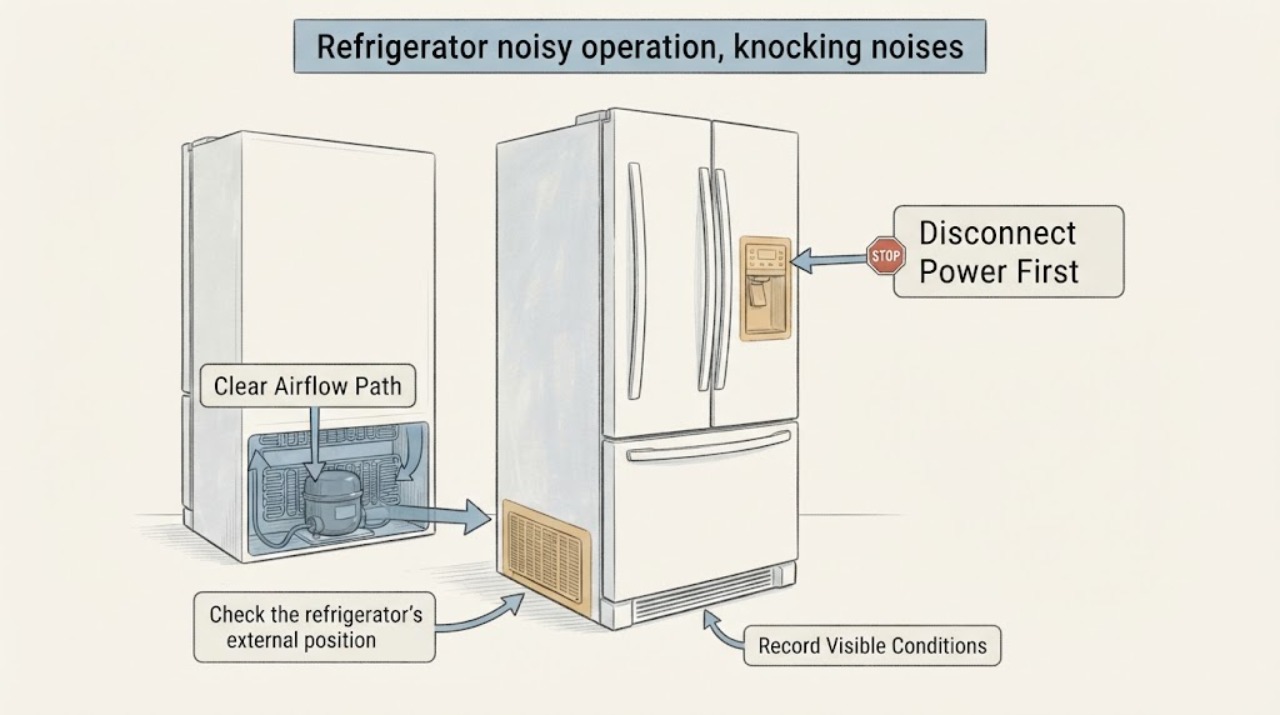
Work through in order
Diagnostic checks
Use only checks that match the exact appliance or system and its official guide.
-
Check 1
Record the full Beko model and the sound’s location, timing, duration, and pattern. Note whether it occurs at startup, during cooling or defrost, when a fan is running, after a door closes, or when the cabinet is touched; also note current refrigerator/freezer temperatures and any cooling change.
Expected result: The sound is a brief crack/pop or click tied to a cycle, a hum/gurgle/fan sound, a vibration/rattle tied to placement, or a persistent/worsening knock with abnormal cooling.
Next step: Use the matching normal-sound or external-resonance branch. If cooling is abnormal or the sound is worsening/metallic, stop repeated testing and arrange service.
Why this matters
Why: Beko documents several cycle-related sounds as normal, while a louder-over-time compressor sound, unusual rattling/scraping, or noise with abnormal operation needs support. The sound pattern does not identify a compressor, fan, relay, or other part.
-
Check 2
Listen without opening the appliance for a brief crack/pop during cooling or defrost, a liquid/gurgling sound, a fan-like airflow sound, a defrost-timer click, or a steady compressor hum/pulse.
Expected result: The sound matches one of Beko’s listed operating patterns and the refrigerator maintains normal temperatures, or it is loud, harsh, repetitive, or getting louder.
Next step: Monitor a matching normal pattern. For a harsh, persistent, louder, grinding, scraping, or unexplained knocking sound, do not open the unit; arrange authorized service.
Why this matters
Why: Beko says expansion/contraction, refrigerant flow, fan operation, defrost timing, and compressor operation can make normal sounds. Beko also says compressor noise that grows louder warrants customer support.
-
Check 3
Check the refrigerator’s external position: gently assess whether it rocks, confirm all accessible feet are firmly supported, and check that the sides/back are not touching a wall or cabinet. Remove objects resting on top of the appliance.
Expected result: The unit rocks, has an external contact, or has an item on top; alternatively, it is stable and clear.
Next step: Correct only safe external placement and keep ventilation clear. If the knock remains or moving the appliance requires access behind it or panel removal, stop and use service.
Why this matters
Why: Beko identifies uneven flooring, unstable feet, nearby surfaces, and objects placed on the product as possible noise contributors. Correcting placement does not prove an internal fault is absent.
-
Check 4
Inspect only visible accessible areas for packaging or food items that could obstruct a fan path; do not remove covers, reach into a fan, or touch refrigerant lines.
Expected result: A visible item is obstructing an accessible fan area, or no visible obstruction is present.
Next step: Remove only the visible obstruction without disassembly. If the sound persists, is metallic, or the obstruction is behind a cover, arrange qualified service.
Why this matters
Why: Beko says grinding, scraping, or rattling may follow an obstruction in a fan blade if fitted, and advises repositioning obstructing items. A clear exterior does not rule out an internal issue.
-
Check 5
Observe whether the refrigerator is holding temperature, whether doors close fully, and whether the sound changes after frequent door opening, a hot-food load, or a recent installation. Do not change internal temperature controls repeatedly to test a noise.
Expected result: Cooling is normal, or the sound is paired with rising temperature, a door left ajar, heavy recent loading, or unusually long operation.
Next step: Close doors, allow temperature to stabilize, and follow the model manual for settings. If temperature remains abnormal or the noise continues/worsens, arrange service.
Why this matters
Why: Beko says ambient conditions, recent loading, door opening, settings, and door sealing can change run time; noise with abnormal operation needs service rather than a guessed compressor diagnosis.
-
Check 6
Stop troubleshooting and provide Beko or qualified refrigeration service with the full model/serial, sound recording if safe, location/timing, placement results, temperature trend, door/clearance observations, and any visible damage or leak.
Expected result: The knock is persistent/worsening, grinding/scraping, accompanied by loss of cooling, water, smoke, electrical odor, or damage, or remains after safe external checks.
Next step: Keep the refrigerator closed and arrange service; disconnect power only if safe and required by the service guidance. Do not open panels, handle refrigerant, or continue operating a potentially damaged appliance to reproduce the sound.
Why this matters
Why: Beko directs support for excessive/unusual noise or noise accompanied by abnormal operation, and its manual says not to attempt repair when the problem persists. The no-model evidence cannot identify an internal part.
Use your observations
Decision map
Find the observation that best matches what you see, then follow the next safe action.
-
PATH 01Next step
What you see
The sound is a brief crack/pop, gurgle, fan noise, defrost click, or compressor hum/pulse, and the refrigerator maintains normal temperatures.
Do this next
Monitor the timing and keep the model manual available. Arrange service if the sound becomes louder, harsh, repetitive, or is paired with cooling or electrical symptoms.
Why this path and its safety boundary
Why it matters: This matches Beko’s listed normal operating sound patterns more closely than a confirmed fault.
-
PATH 02Next step
What you see
The cabinet rocks, touches a wall/cabinet, has an object on top, or a visible accessible item is near a fan path, and the noise changes after the safe external condition is corrected.
Do this next
Keep the unit level, supported, clear of contact, and ventilated. Use service if the noise returns or requires panel/accessory removal to investigate.
Why this path and its safety boundary
Why it matters: External resonance or a visible obstruction was a plausible contributor; this does not identify or clear an internal component.
-
PATH 03Next step
What you see
The knocking is loud, metallic, repetitive, getting louder, or persists with no visible placement/obstruction cause.
Do this next
Stop attempting internal diagnosis and arrange authorized Beko or qualified refrigeration service.
Why this path and its safety boundary
Why it matters: Beko treats unusual or excessive noise as a support issue, and the general page cannot distinguish a fan, compressor, mounting, or other internal cause.
-
PATH 04Next step
What you see
The noise is accompanied by rising refrigerator/freezer temperature, a leak, smoke, electrical odor, damaged cord, or other abnormal operation.
Do this next
Keep doors closed to protect food, disconnect power only if safe, and arrange urgent qualified service; do not open panels or keep cycling the appliance.
Why this path and its safety boundary
Why it matters: The combination exceeds normal-noise classification and may threaten cooling, food safety, or electrical safety.
Helpful context
Understand the symptom
“Knocking” can describe a normal expansion/pop event, a cabinet or floor vibration, a cooling-system sound, or an abnormal mechanical noise. Beko recommends first determining where the sound comes from and whether the refrigerator is otherwise operating normally. Temperature changes, a sound that grows louder, or scraping/rattling changes the service decision.
Classify the sound before diagnosing a part
Record whether the sound occurs at startup, during cooling, during defrost, when a fan runs, after a door closes, or when the cabinet is touched. Beko lists cracking/popping, gurgling, fan noise, defrost clicks, and compressor hum as possible normal sounds; it does not make every loud or repetitive knocking sound normal.
Correct only safe external resonance conditions
Check level, firm floor contact, wall/cabinet clearance, and objects sitting on the refrigerator. A visible package can obstruct an accessible fan area, but removing a panel or reaching into a fan is outside this no-model check.
When checks do not resolve it
Need a professional?
Arrange Beko or qualified refrigeration service when the knocking is loud, metallic, repetitive, worsening, remains after level/clearance/visible-obstruction checks, or is accompanied by rising temperature, a leak, smoke, electrical odor, damaged cord, or other abnormal operation.
Safety scope: Do not open panels, reach into fans, touch refrigerant lines, perform live electrical tests, or attempt an internal repair. Disconnect power only when safe and arrange authorized service for persistent, worsening, metallic, or hazardous noise.
Have this ready
- Full model/serial, sound recording if safe, location and timing, cycle/defrost/fan relation, temperature trend, placement/clearance result, visible obstruction result, door-seal condition, and any leak or electrical symptom.
Common questions
FAQ
Are cracking or clicking sounds normal on a Beko refrigerator?
Often. Beko says cracking or popping can come from expansion and contraction during cooling or defrost, and some frost-free models click as the defrost timer changes state. Noise with abnormal operation or a sound that becomes excessive still needs service.
Why is my Beko refrigerator rattling or knocking?
Check only safe external causes first: uneven feet or floor, contact with a wall/cabinet, objects on top, and visible packaging near an accessible fan path. If the sound remains or becomes metallic, do not open the unit; request service.
Does a long humming sound prove the Beko compressor is failing?
No. Beko says compressor hum or pulsation can be normal, and long operation can follow ambient heat, frequent door opening, recent loading, or temperature stabilization. A compressor sound that grows louder or occurs with abnormal cooling needs support, not a guessed part replacement.
Should I remove the rear cover to find the knocking noise?
No. Beko’s guidance recommends contacting support for excessive or unusual noise and says not to attempt repair when the problem persists. Keep checks external and use authorized service for panels, fans, compressors, refrigerant, or wiring.
Read the exact guide
Official sources
- My Beko fridge is making a clicking sound, is this normal?Beko UK · Opened official Beko UK FAQ. Supports the limited claim that some frost-free Beko models click when entering or leaving defrost; it is not generalized to knocking or every Beko model.
- TroubleshootingBeko · Opened Beko official troubleshooting document. Supports level/floor/object checks, liquid/gas flow and fan sounds as normal, ambient/run-time context, and authorized-service/no-repair boundary. It is used for family-level external guidance, not as a model-specific procedure for this no-model task.
- Should my fridge be making noise?Beko UK · Opened official Beko UK support FAQ. Supports normal crack/pop, gurgle, fan, click, hum/pulse sounds; unusual grinding/scraping/rattling, external contact/ventilation checks, worsening noise escalation, and the no-self-repair boundary.
- My refrigerator is vibrating while working. How do I fix a refrigerator that’s vibrating?Beko · Opened official Beko support page. Supports checking level and stable feet for vibration; it does not diagnose internal knocking components.
Community feedback
Share a repair observation
Share a plain-text repair observation. Accepted observations are published automatically; this page may take a moment to update.