
On this page
Start here
Quick answer
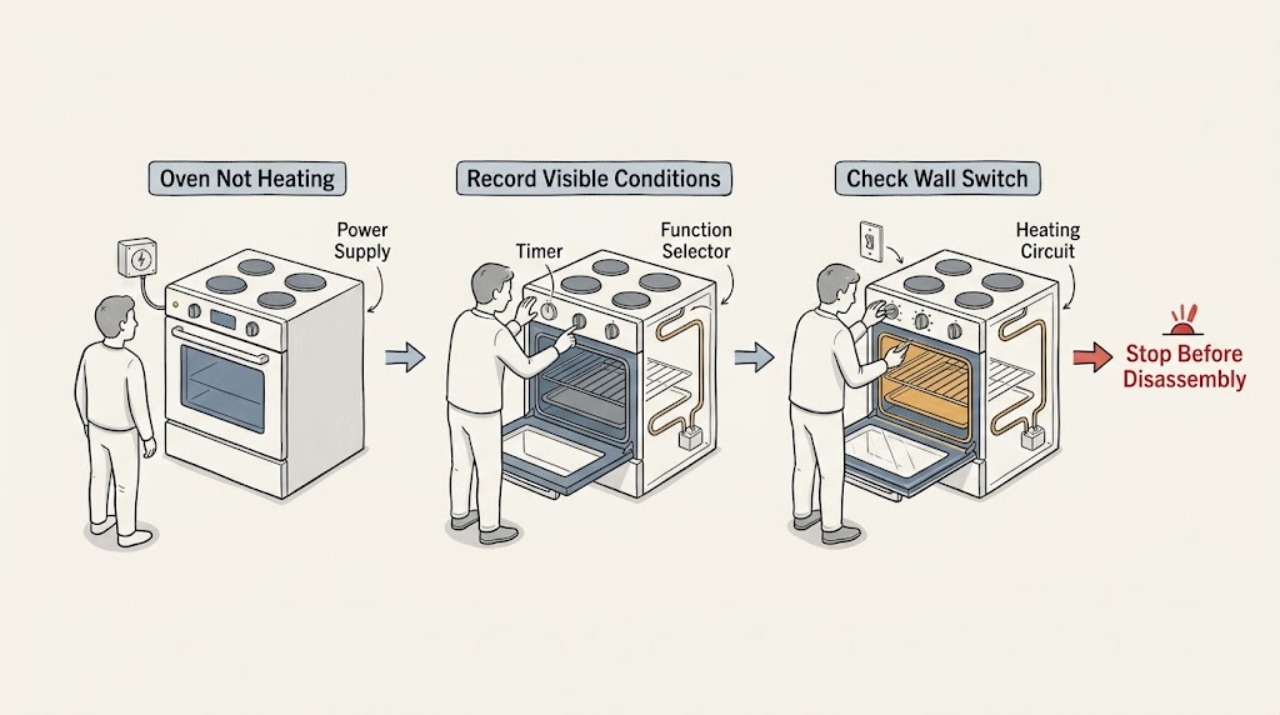
First determine whether the Belling oven is completely off, powered but cold, or heating weakly. Check the accessible power supply, select both an oven function and a temperature, close the door firmly, and confirm the timer is in manual mode rather than Auto if your model has a programmable clock. For an electric oven, let it cool fully if the thermostat has tripped, then make one supervised retry. If only one function remains cold, the thermostat trips again, the controls will not return to manual mode, or a gas appliance has an ignition or gas-supply symptom, stop using it and arrange qualified appliance service.
Work through in order
Diagnostic checks
Use only checks that match the exact appliance or system and its official guide.
-
Check 1
Record whether the oven has no indicators, has power but stays cold, or reaches some heat but remains below the selected temperature; note the selected function and whether the oven is electric, gas, or dual-fuel.
Expected result: The whole appliance is dark, the thermostat lamp never responds, one cooking function is cold, or the oven warms weakly across functions.
Next step: Keep the model number and symptom record, then follow the matching power, settings, timer, or thermostat check below.
Stop if: Stop immediately for smoke, sparking, burning insulation smell, gas smell, a damaged cord, or a control that will not switch off.
Why this matters
Why: A no-power condition points to supply, while a single cold function or weak heating points toward a mode-specific control, heating circuit, thermostat, or door-sealing diagnosis. The exact model and fuel type change the safe next step.
-
Check 2
Check the accessible wall switch, socket, or circuit supply and compare another kitchen appliance, without opening the oven or touching wiring.
Expected result: Other appliances are also without power, or they work while the Belling oven remains dark or unresponsive.
Next step: Restore household power when safe and make one retry. If the oven-only supply remains absent, arrange a qualified electrical or appliance check.
Stop if: Stop for a hot or scorched socket, damaged cable, exposed conductors, or a circuit that trips again.
Why this matters
Why: A wider outage is a household supply condition. If only the oven is affected, Belling directs attention to its electrical supply and, if unresolved, qualified service.
-
Check 3
Set the Belling function selector to a documented oven mode and set the temperature control above room temperature; close the oven door firmly.
Expected result: A function or temperature was unset, the door was not closed, and heat begins after correction; or the settings were already correct and the cavity remains cold.
Next step: Allow the oven to begin a normal supervised preheat using the model's instructions. If no heat appears, continue to the timer and thermostat checks.
Stop if: Do not wedge the door, defeat a door switch, or reach into a heating cavity while energized.
Why this matters
Why: Belling says no heat can result from an incorrectly set temperature control or an open oven door. A correct mode and temperature with no heat moves the problem toward timer, thermostat, or technical diagnosis.
-
Check 4
If the oven has a programmable clock, check that the time of day is set and that the timer is in manual mode rather than Auto; use only the exact model's timer instructions.
Expected result: The clock shows Auto, flashing bars, an unset time, or another automatic-cooking state; or it is already in manual mode with a valid time.
Next step: Return the timer to manual mode or set the time exactly as the manual describes, then make one supervised preheat attempt. If the timer will not accept the setting, arrange service.
Stop if: Do not dismantle the timer or bypass its controls to force heating.
Why this matters
Why: Belling's FAQ and a Belling user guide state that an automatic timer state or unset clock can prevent some ovens from operating. Timer symptoms are control-state issues, not proof of a failed element.
-
Check 5
For an electric Belling oven, turn it off and let it cool fully if the thermostat may have tripped, then make one retry with a correct function, temperature, and timer setting.
Expected result: The oven heats after cooling and one retry, or the thermostat trips again or the oven remains cold.
Next step: If it heats normally, monitor one cycle. If it trips again or remains cold, stop using the oven and arrange qualified appliance service.
Stop if: Do not repeatedly reset a thermostat, operate with a removed panel, or continue if overheating or smoke occurs.
Why this matters
Why: Belling identifies a tripped thermostat as a possible cause of an electric oven not heating. A repeated trip or failed retry is a protection or technical fault requiring diagnosis.
-
Check 6
Compare the result across the available cooking functions without repeatedly opening the door: note whether fan, conventional, grill, or another mode heats, using only modes fitted to the model.
Expected result: All selected functions remain cold, or one function heats while another does not.
Next step: Stop at the observation and give the affected function to a qualified technician; do not remove the rear panel or test live elements.
Stop if: Stop immediately for sparking, an exposed element, abnormal smell, or a mode that remains energized after switching off.
Why this matters
Why: A complete no-heat condition differs from a mode-specific failure. One cold function can point toward that function's heating circuit or selector path, but a user cannot confirm a component without testing.
-
Check 7
If the oven heats weakly rather than staying completely cold, verify the door closes and seals normally, preheat according to the model instructions, and avoid frequent door opening during the check.
Expected result: The door does not seal or the oven loses heat rapidly, or the door closes normally but the oven remains below the selected temperature.
Next step: Arrange service for a damaged seal or persistent under-heating; do not assume a temperature adjustment fixes a failed heating circuit.
Stop if: Do not use the oven if the door glass is cracked, the seal is loose near a heating element, or heat escapes with a burning smell.
Why this matters
Why: A poor seal or open door can make an oven appear not to heat. Continued under-heating with a sound door and correct settings needs thermostat, sensor, element, or control diagnosis.
-
Check 8
If the Belling appliance is gas or dual-fuel and the oven burner does not ignite or the flame will not remain stable, turn the control off and record the symptom without attempting gas-system work.
Expected result: There is no ignition, the flame goes out, gas smell is present, or the gas oven has no obvious hazard but still does not heat.
Next step: For a gas smell or unstable flame, leave the appliance off and use a licensed gas professional. For a persistent no-ignition symptom without a hazard, arrange qualified appliance service.
Stop if: Do not repeatedly release gas, light the burner with an improvised method, or remove gas components.
Why this matters
Why: Gas ignition and flame-safety behavior are model-specific and can create a combustion hazard. A no-heat result on a gas appliance must not be treated like an electric element check.
Use your observations
Decision map
Find the observation that best matches what you see, then follow the next safe action.
-
PATH 01Next step
What you see
The oven and other kitchen appliances have no power.
Do this next
Restore power when safe and retry once; escalate if the supply does not return.
Why this path and its safety boundary
Why it matters: A household supply interruption is more likely than an oven heating fault.
-
PATH 02Next step
What you see
Other appliances work but the Belling oven has no indicators.
Do this next
Do not open the oven; arrange a qualified electrical or appliance inspection.
Why this path and its safety boundary
Why it matters: The oven's accessible supply, fuse, or internal power path may need qualified checking.
-
PATH 03Next step
What you see
The oven has power but no function or temperature is selected, or the door is open.
Do this next
Select a valid function and temperature, close the door firmly, and make one supervised preheat attempt.
Why this path and its safety boundary
Why it matters: The control settings or door state can prevent heating.
-
PATH 04Next step
What you see
The programmable clock is in Auto, has flashing bars, or has no valid time.
Do this next
Return it to manual mode or set the time using the exact model manual, then retry once.
Why this path and its safety boundary
Why it matters: The timer control state may be preventing manual oven operation.
-
PATH 05Next step
What you see
An electric oven's thermostat has tripped and the oven is fully cool.
Do this next
Make one retry with correct settings; if it trips again or stays cold, arrange service.
Why this path and its safety boundary
Why it matters: Belling identifies the trip as a possible no-heat cause.
-
PATH 06Next step
What you see
One cooking function is cold while another heats.
Do this next
Stop testing and provide the affected function and model to appliance service.
Why this path and its safety boundary
Why it matters: The symptom is mode-specific and may involve that function's circuit or control path.
-
PATH 07Next step
What you see
The oven heats weakly and the door does not seal normally.
Do this next
Stop using it if the seal or glass is damaged and arrange service; do not adjust internal heating parts.
Why this path and its safety boundary
Why it matters: Heat loss through the door can make the oven appear under-heating.
-
PATH 08Next step
What you see
The gas oven does not ignite, the flame will not remain lit, or gas smell is present.
Do this next
Turn controls off, stop using the appliance, and use licensed gas or appliance service as appropriate.
Why this path and its safety boundary
Why it matters: Gas ignition and flame safety require qualified diagnosis.
-
PATH 09Next step
What you see
Correct power, settings, timer, door, and thermostat checks do not restore heat.
Do this next
Arrange appliance repair with the model, affected function, and all observations; do not order a component from the symptom alone.
Why this path and its safety boundary
Why it matters: The remaining fault is technical and cannot be identified safely from external symptoms alone.
-
PATH 10Next step
What you see
Smoke, sparking, burning insulation smell, cracked glass, exposed wiring, or uncontrolled heat is present.
Do this next
Turn controls off if safe, isolate power only when safe, keep clear, and arrange qualified service.
Why this path and its safety boundary
Why it matters: This is an immediate stop-use condition, not a preheat problem.
Helpful context
Understand the symptom
A cold oven can have a control-state cause
Belling's published checks separate a dead appliance from an oven that has power but no heat. A missing function or temperature, a timer left in Auto, an open door, or a tripped thermostat can prevent normal heating without proving that a heating element has failed. Identify the state before seeking a part.
Use the exact model instructions
Belling control panels and timer procedures vary. The model number is normally on the data badge around the oven door or another location described by the manufacturer. Use the exact manual for timer, gas, and function-selector instructions; do not remove covers for a household heat check.
Only after diagnosis
Potential parts
- thermostat or thermal protection device
Consider this category only when the exact electric model repeatedly trips or fails to regulate after correct power, function, temperature, and timer checks and a technician confirms the protection or control fault.
Verify the complete model and manufacturer fit information before selecting any thermostat or protection component. - oven heating element
Consider this category only when a qualified diagnosis isolates one cold electric cooking function after the mode, timer, door, and supply checks pass.
Heating elements vary by cavity and function; confirm the exact model and electrical specification before selection. - function selector or timer control
Consider this category only when the oven has power but cannot select a valid mode or return from Auto/manual control states and a technician confirms the control fault.
Match the control to the exact model, timer type, and revision using manufacturer fit information. - oven door seal
Consider this category only when persistent heat loss is accompanied by a visibly damaged or poorly closing seal and the model manual confirms the seal arrangement.
Confirm the exact model and door configuration before selecting a seal; do not treat a seal as the cause of a completely cold oven without diagnosis.
When checks do not resolve it
Need a professional?
Arrange appliance repair when the Belling oven remains cold after power, function, temperature, door, timer, and thermostat checks; a single function remains cold; the thermostat trips again; the door or seal is damaged; or the controls will not return to manual mode. Use a licensed gas professional for gas ignition, flame, or supply symptoms. Stop immediately for gas smell, smoke, sparking, burning insulation, cracked glass, exposed wiring, or uncontrolled heat.
Common questions
FAQ
Why is my Belling oven on but not heating?
Check that both a cooking function and temperature are selected, the door is firmly closed, and a programmable timer is in manual mode rather than Auto. If the settings are correct and the oven remains cold, arrange service.
Can an Auto timer setting stop a Belling oven from heating?
Yes, on models with programmable timers. Belling's FAQ and user guidance state that Auto or an unset clock can prevent some ovens from operating. Use the exact model instructions to return the timer to manual mode.
What should I do if the Belling electric oven thermostat tripped?
Turn the oven off and let it cool fully, then make one retry with the correct function, temperature, and timer settings. If it trips again or stays cold, stop using the oven and arrange appliance repair.
Why does only one Belling oven function stay cold?
A mode-specific heating circuit or control path may be involved, but the symptom does not identify a part by itself. Record the affected function and have a qualified technician diagnose it without opening the oven.
When is a Belling oven not heating a safety issue?
Stop immediately for gas smell, smoke, sparking, burning insulation, cracked glass, exposed wiring, uncontrolled heat, or a control that will not switch off. Isolate power only when safe and arrange qualified service.
Read the exact guide
Official sources
- Ovens - First Time UseBelling · Function and temperature selection, heating indicator behavior, preheating, and model identification.
- USER GUIDE BELLING VISION 90CM DUAL FUEL SINGLE OVBelling · Example of model-specific timer, function, temperature, door, and under-heating guidance; not a universal setting sequence for every Belling oven.
- FAQsBelling · Electric oven thermostat trip, Auto/manual timer state, oven power, gas ignition boundaries, and approved gas repair.
- Ovens - TroubleshootBelling · Power, no-heat, temperature control, door, timer, control-panel, and safe-use troubleshooting.
Community feedback
Share a repair observation
Share a plain-text repair observation. Accepted observations are published automatically; this page may take a moment to update.