
On this page
Start here
Quick answer
A blender’s bad smell can come from a new motor winding curing, a heavy or thick mixture triggering overload protection, residue around the container or blade bearing, or an electrical fault. Vitamix’s official guidance says to stop and cool the motor, reduce load or add liquid, and seek service when smell or failure persists.
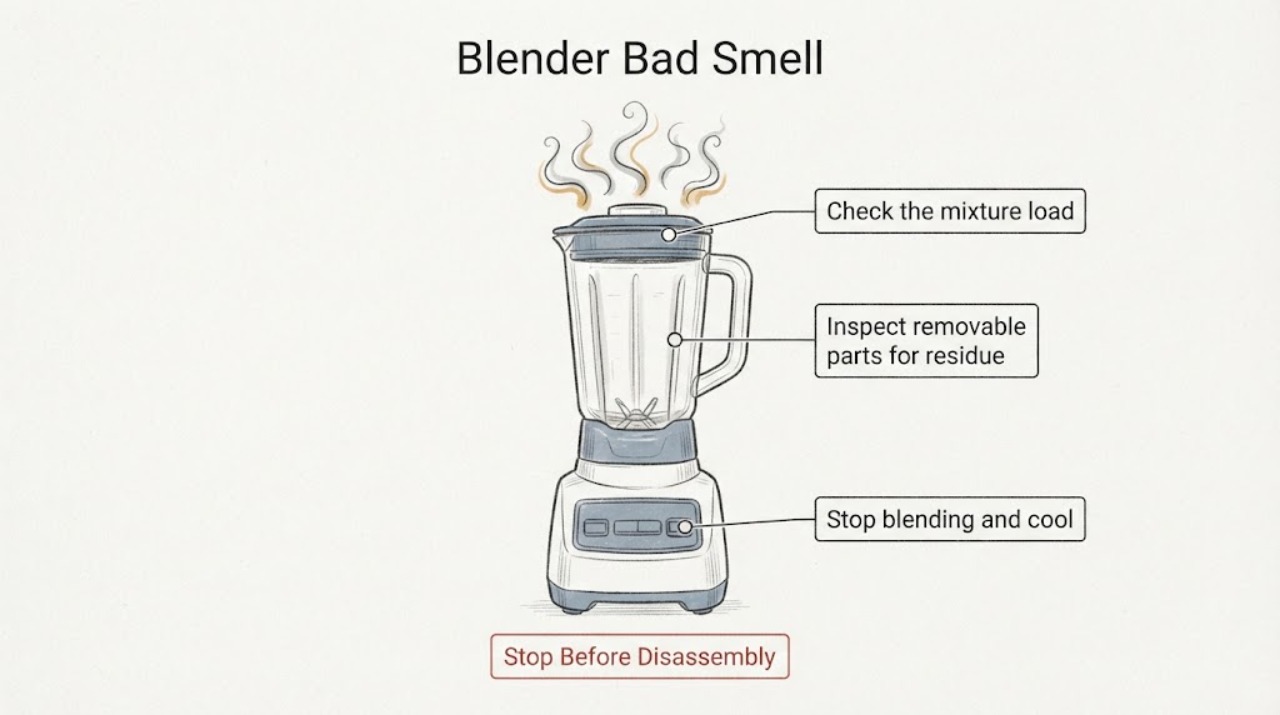
Work through in order
Diagnostic checks
Use only checks that match the exact appliance or system and its official guide.
-
Check 1
Stop blending and cool the motor.
Expected result: Turn the power off, unplug the base, remove the container only when safe, and let the motor cool before another test.
Next step: Do not bypass a thermal protector or cool the motor with water.
Why this matters
Why: Vitamix says overload protection can emit a burning smell and may reset after cooling; continuing to run it can worsen the load.
-
Check 2
Check the mixture load and circulation.
Expected result: When cool, observe whether the mixture was thick/frozen, overloaded, or stalled around the blades; do not put hands or tools into a connected container.
Next step: Use the manual’s safe load and tamper instructions for the exact container.
Why this matters
Why: A heavy or poorly circulating mixture increases motor load; Vitamix recommends reducing quantity, adding liquid where appropriate, and using the tamper through the lid on supported models.
-
Check 3
Inspect removable parts for residue or bearing signs.
Expected result: With the appliance unplugged, clean and dry the container, blade area, lid, and base exterior; note grinding, squeaking, wobble, leakage, or rough bearing movement only as the manual permits.
Next step: Do not disassemble the motor base or blade assembly beyond the model’s user instructions.
Why this matters
Why: Persistent smell with noise, leakage, or rough bearing behavior points toward mechanical wear or contamination rather than a one-time overload.
-
Check 4
Check the electrical stop boundary.
Expected result: Look for dark smoke, melted plastic, damaged cord, hot plug, arcing, or a smell that remains while unloaded and cool.
Next step: Stop using the blender and contact Vitamix service.
Why this matters
Why: Those signs indicate an electrical or internal mechanical fault and are not normal motor curing.
Use your observations
Decision map
Find the observation that best matches what you see, then follow the next safe action.
-
PATH 01Next step
What you see
The smell appears during a thick blend, clears after cooling, and the blender runs normally with a smaller load.
Do this next
Use the manufacturer’s load, speed, and cooling guidance.
Why this path and its safety boundary
Why it matters: A temporary overload or new-motor winding odor is more likely than a confirmed failure.
-
PATH 02Next step
What you see
The smell returns with an unloaded blender, or grinding, squeaking, leakage, or failure to start remains.
Do this next
Stop use and contact manufacturer service for diagnosis.
Why this path and its safety boundary
Why it matters: A bearing, motor, coupling, or control issue is more likely than mixture load alone.
-
PATH 03Next step
What you see
Dark smoke, melting, arcing, damaged cord, or a hot plug is present.
Do this next
Unplug if safely accessible and keep it out of service until repaired.
Why this path and its safety boundary
Why it matters: The blender has an electrical/fire hazard.
Helpful context
Understand the symptom
Classify the smell and timing
Record whether the odor is food residue, rubber/plastic, or electrical/burning; note whether it appears on first use, under a thick load, with grinding, or while idle.
When checks do not resolve it
Need a professional?
Use manufacturer service when odor persists after cooling and load correction, the blender fails to restart, or there is noise, leakage, smoke, heat, or electrical damage.
Common questions
FAQ
Is a burning smell always a failed blender motor?
No. Vitamix says new motor windings may briefly smell during curing and overload protection may emit an odor. Recurrence under a light load needs service.
Can I add more liquid while the blender is running?
Follow the exact container and tamper instructions. Never reach into the container or remove it from the base while the motor is running.
Read the exact guide
Official sources
- Blender Care and Maintenance Guide - VitamixCarrier/LG · This is official manufacturer support; exact model-specific behavior and parts remain limited to the named product or manual.
- Vitamix Product Support FAQsCarrier/LG · This is official manufacturer support; exact model-specific behavior and parts remain limited to the named product or manual.
Community feedback
Share a repair observation
Share a plain-text repair observation. Accepted observations are published automatically; this page may take a moment to update.