
On this page
Start here
Quick answer
First identify where the smell comes from and when it appears. A food or sour odor usually stays in the jar, lid, gasket, collar, or cutting assembly after ingredients; clean and dry only the removable parts as the exact Use & Care guide permits, and store the jar without its lid if the smell is confined to the container. A slight odor on a new blender can be manufacturing varnish or oil burn-off and should fade after the first couple of uses. A hot electrical, plastic, or burning-motor smell during blending is different: turn the blender off, unplug it, let it cool, and do not keep testing it. Hamilton Beach manuals link burning odor to heavy use or heated motor materials on some models and direct continued odor to customer care; smoke, sparks, a damaged cord or plug, a locked blade, grease leaking from the jar bottom, or an odor that returns after cooling requires service rather than a home repair.
Before you begin
Safety first
- The user may unplug the blender, identify the odor location, clean and dry removable food-contact parts according to the exact model guide, and make a visual external check of the cord, plug, jar, and base. Qualified personnel must handle the motor housing, internal wiring, controls, thermal protection, cord repairs, locked mechanical assemblies beyond permitted cleaning, and any live testing.
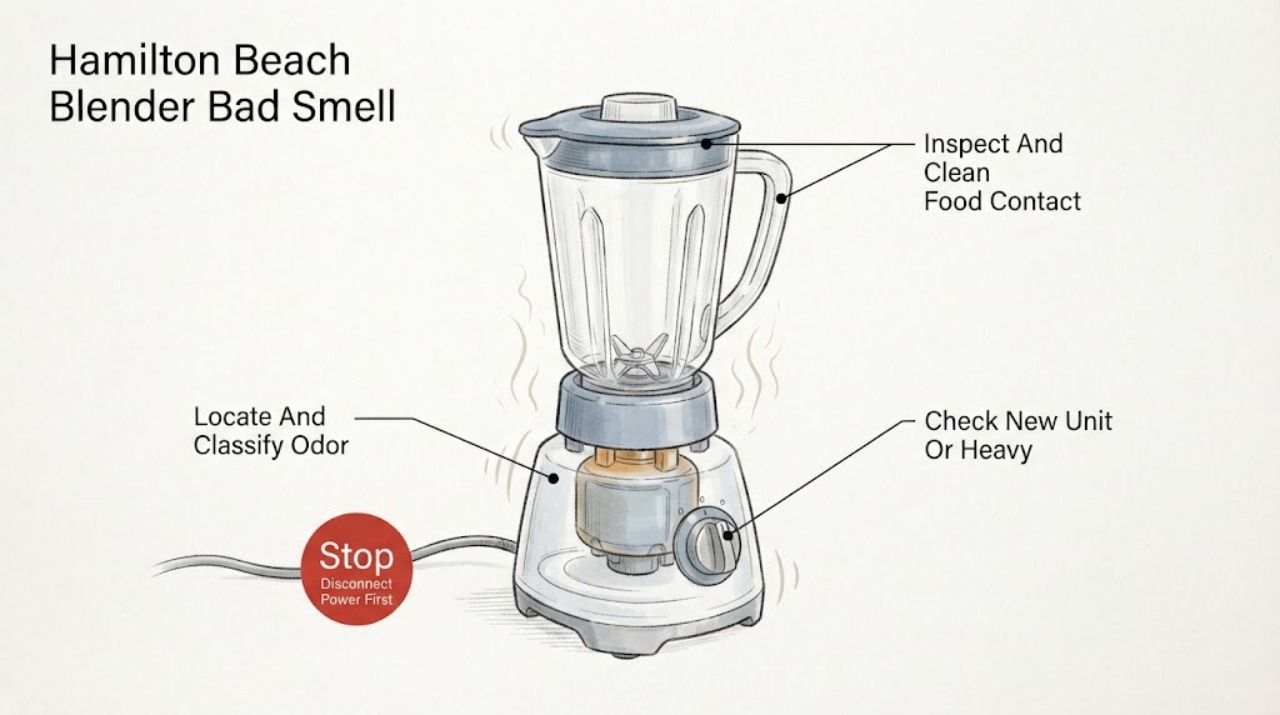
Work through in order
Diagnostic checks
Use only checks that match the exact appliance or system and its official guide.
-
Check 1
Stop blending and unplug the blender. Once it is cool, smell only from a distance and identify whether the odor is in the jar or lid, around the collar and blade assembly, or from the motor base, cord, or plug. Record whether it began with food, a new unit, heavy blending, a jam, or ordinary use.
Expected result: The smell remains in the removable jar; it appears only from the base while blending; it began on a new unit; or it is a strong chemical, electrical, plastic, or burnt odor.
Next step: For a jar-only odor, continue with unplugged removable-part inspection. For any base, electrical, strong, or persistent odor, leave the blender unplugged and arrange Hamilton Beach service.
Stop if: Stop immediately for smoke, sparks, flame, a hot or damaged cord or plug, melted plastic, abnormal heat, or a strong burning or chemical odor.
Why this matters
Why: A jar-only odor is more consistent with ingredient residue or food-contact parts. A base odor tied to motor operation is a heat or electrical clue. A mild first-use odor can be temporary, but strength, smoke, damage, or persistence changes the safety decision.
-
Check 2
With the plug disconnected, remove the jar and inspect the lid, gasket, collar, and visible cutting assembly for trapped food, oily film, discoloration, cracks, or residue. Clean and dry only the removable parts using the exact Use & Care guide; keep the base, motor, cord, and plug out of water and keep fingers away from the sharp blades.
Expected result: Residue or an oily food film is present in the jar or lid; the smell remains after cleaning and complete drying; a jar, collar, blade, or gasket is cracked or loose; or all removable parts are clean and intact.
Next step: Rinse, dry, and store the removable jar without its lid only if the exact model's care instructions allow it. Replace or service a damaged jar, seal, collar, or cutting assembly; do not operate a cracked or loose assembly.
Stop if: Stop for a cracked jar, exposed or loose blade, damaged collar, liquid inside the base, or any need to immerse or open the motor housing.
Why this matters
Why: Residue confined to food-contact parts can explain an odor without a motor fault. A persistent odor after cleaning, damaged food-contact part, or odor from the base makes continued use inappropriate and requires model-specific advice.
-
Check 3
Record whether the blender is new and the odor was slight and limited to initial use, or whether it followed a long, high-speed, overloaded, or difficult blend. Do not deliberately run the blender again to reproduce a smell; wait for complete cooling and consult the exact manual before any normal use.
Expected result: The smell was slight and occurred only during the first use or two; it followed heavy use and faded after cooling; it returns during ordinary use; or it is accompanied by smoke, visible damage, a locked rotor, or a tripped circuit.
Next step: Discontinue use if the initial odor does not fade after the first couple of uses. For a heavy-use odor, follow only the model's cooling guidance; if it returns or any warning sign exists, arrange service.
Stop if: Stop immediately for smoke, sparks, strong burning or plastic odor, abnormal heat, a tripped breaker, a locked blade, or a motor that does not rotate normally.
Why this matters
Why: Hamilton Beach permits that a temporary new-unit varnish or oil odor can fade, and some manuals describe motor odor after heavy use. A returning odor, a fault condition, or an electrical warning is not established as normal by those statements.
-
Check 4
Only while unplugged and without forcing the blade, check the visible cutting assembly for a jam, damage, or inability to move as the exact model's manual permits. Look below the jar for grease or liquid, and check whether the jar was overfilled or the mixture was too thick. Do not touch a sharp blade with bare fingers or open the base.
Expected result: The blade is locked or damaged, the mixture jammed, grease appears around the jar bottom, the jar is cracked or leaking, or the assembly and jar are intact with no leak.
Next step: Leave a locked, damaged, leaking, or grease-marked assembly out of service and arrange model-matched service. If the parts are intact, clean and dry them and review the exact fill and mixture guidance before any future use.
Stop if: Stop for a blade that will not move freely, sharp damage, a cracked jar, grease or liquid at the base, or any need to disassemble the cutting unit beyond the model's cleaning instructions.
Why this matters
Why: A locked cutting assembly can overload or damage the motor, while grease around the jar bottom can indicate jar-bearing trouble. These are mechanical or service clues, not a reason to keep powering the blender or to replace a random part.
-
Check 5
With the blender unplugged, inspect the exterior cord, plug, base, and controls for scorching, deformation, liquid entry, or a loose connection. Note whether a breaker tripped, the motor stopped, the odor returned after cooling, or the blender now operates without odor; do not perform live measurements or remove the housing.
Expected result: There is no visible damage and the odor was confined to removable parts; the odor returns from the base; the motor stops or overheats; the cord or plug is damaged; or smoke, sparks, or a breaker trip occurred.
Next step: Use the blender only when the exact manual supports it and no odor or damage remains. Otherwise keep it unplugged and contact Hamilton Beach service; use an electrician for a damaged household receptacle or supply.
Stop if: Stop immediately for smoke, sparks, flame, strong burning odor, hot or damaged cord or plug, liquid in the base, abnormal heat, or repeated breaker trips.
Why this matters
Why: A cleaned jar with no base odor supports a food-residue explanation. Recurring base odor, overheating, motor stopping, damaged power hardware, smoke, or tripping makes an internal motor, overload, control, or electrical fault possible and unsafe to diagnose at home.
Use your observations
Decision map
Find the observation that best matches what you see, then follow the next safe action.
-
PATH 01Safety boundary
What you see
The odor is confined to the jar, lid, gasket, collar, or cutting assembly, follows a strong ingredient, and there is no base heat, smoke, damage, or electrical symptom.
Do this next
Unplug, clean and thoroughly dry removable parts according to the exact model guide, and store the jar without the lid only if the manufacturer permits it. Replace damaged food-contact parts before use.
Why this path and its safety boundary
Why it matters: Food residue or an ingredient odor is more likely than a motor fault.
Safety stop: Do not use the blender if a chemical or burnt odor remains, the jar is cracked, the blade is loose, or liquid has entered the base.
-
PATH 02Safety boundary
What you see
The blender is new and produces only a slight odor during the first use or two, with no smoke, abnormal heat, visible damage, or continuing fault.
Do this next
Allow the unit to cool and follow the exact Use & Care cleaning and initial-use instructions. Discontinue use if the smell does not go away after the first couple of uses or becomes strong.
Why this path and its safety boundary
Why it matters: Hamilton Beach says manufacturing varnish or oil burn-off can cause a temporary initial odor.
Safety stop: Stop immediately for smoke, sparks, a strong burning or plastic odor, abnormal heat, or a damaged cord or plug.
-
PATH 03Safety boundary
What you see
A burning odor begins after heavy or high-speed blending, the blender is hot, and the smell fades after the unit is turned off and allowed to cool, without smoke or electrical damage.
Do this next
Follow only the exact model's cooling guidance and reduce use according to its manual. If the smell returns during ordinary use or continues after additional use, stop and contact Hamilton Beach service.
Why this path and its safety boundary
Why it matters: Some Hamilton Beach manuals associate heavy-use odor with heated motor materials or curing windings, but this is model-specific and does not validate repeated odor.
Safety stop: Do not keep restarting a hot blender or continue if smoke, sparks, strong odor, a locked blade, or a tripped circuit occurs.
-
PATH 04Safety boundary
What you see
The smell follows a jam or stopped motor, the cutting assembly does not move as the manual permits, or grease appears around the bottom of the jar.
Do this next
Keep the blender unplugged and arrange model-matched service. Do not touch the sharp blade, dismantle the base, or substitute a generic jar or cutting assembly.
Why this path and its safety boundary
Why it matters: A locked cutting assembly, jar-bearing issue, or mechanical overload is more likely than ordinary food odor and can damage the motor if powered again.
Safety stop: Stop for a locked rotor, sharp or loose blade, grease or liquid leak, cracked jar, or any need to open the motor housing.
-
PATH 05Safety boundary
What you see
The odor is strong or returns from the base, or it occurs with smoke, sparks, scorching, abnormal heat, a damaged cord or plug, a stopped motor, or a tripped breaker.
Do this next
Disconnect power when safe, keep the blender out of service, and contact Hamilton Beach service; use an electrician for a damaged household supply. Provide the model, odor location, timing, load, sound, heat, and power observations.
Why this path and its safety boundary
Why it matters: An internal motor, control, overload, cord, or other electrical fault is possible and the immediate safety risk outweighs further home diagnosis.
Safety stop: Do not replug to test, open the base, bypass protection, immerse the motor, or continue operation to see whether the odor improves.
Helpful context
Understand the symptom
The smell's location is the first diagnostic clue
A smell that remains in the jar after blending points toward food residue, oil, the lid, gasket, collar, or blade assembly. A smell that appears only while the motor is running and comes from the base points toward heat or an electrical or motor problem. Do not taste food from a jar that has a chemical or burnt odor, and do not treat a base odor as a cleaning problem.
New-unit odor is a limited exception
Hamilton Beach's FAQ says new blenders can burn off excess varnish or oils during initial use and that the smell should go away. That exception is for a slight, temporary odor without smoke, visible damage, abnormal heat, or a continuing fault. If the smell persists after the first couple of uses, discontinue use rather than trying to mask it.
Clean removable food-contact parts only when unplugged
Unplug before removing the jar or cutting assembly and follow the exact model's cleaning instructions. Hamilton Beach warns not to immerse the cord, plug, base, or motor in water and to handle sharp blades carefully. A removable jar odor can be cleaned and thoroughly dried as directed; a smell from the motor housing cannot be safely washed out by the user.
Heat, smoke, and a locked blade are stop signals
A motor can heat during heavy use, and a model manual may allow cooling before a normal restart. That does not authorize repeated testing when there is smoke, a strong burning or plastic smell, sparks, cord or plug damage, a blade that will not move freely when safely checked while unplugged, or grease around the jar bottom. Those patterns need qualified assessment.
Safety boundary
Stop conditions
- Stop immediately and unplug for smoke, sparks, flame, strong burning or plastic odor, scorching, abnormal heat, a hot or damaged cord or plug, liquid in the base, or a tripped breaker.
- Do not operate a blender with a cracked jar, loose or damaged blade assembly, damaged cord or plug, grease or liquid around the jar bottom, or a locked cutting assembly.
- Unplug before cleaning or adding/removing parts. Do not immerse the cord, plug, base, or motor in water, and keep hands away from sharp blades.
- Do not open the motor housing, perform live measurements, bypass an interlock or overload protector, or repeatedly replug a blender that smells hot or burnt.
- If a strong or recurring odor cannot be confined to removable food-contact parts and resolved by the exact model's care instructions, leave the blender unplugged and arrange qualified service.
Only after diagnosis
Potential parts
- model-matched jar, lid, gasket, collar, or cutting assembly
Consider only when the odor is confined to a removable food-contact part and inspection confirms residue, a cracked jar, worn seal, loose collar, damaged blade, or jar-bearing symptom.
Confirm the complete Hamilton Beach model, type, series, jar design, and blade assembly; do not infer fit from capacity or appearance. - model-matched motor, thermal protector, control, cord, or plug component
These parts are relevant only after qualified diagnosis of recurring base odor, overheating, motor stopping, damaged power hardware, or a control or overload fault; odor alone is not proof of a particular part.
Internal electrical parts and cord repairs require qualified service and exact model identification; do not order from a generic blender listing or open the base.
When checks do not resolve it
Need a professional?
Contact Hamilton Beach service when a smell from the motor base returns after cooling, persists beyond the initial-use period, accompanies a locked cutting assembly, grease or liquid around the jar bottom, motor stopping or overheating, or any control or power symptom. Stop immediately and unplug for smoke, sparks, flame, strong burning or plastic odor, scorching, abnormal heat, a hot or damaged cord or plug, liquid in the base, or a tripped breaker. A jar-only food odor may be handled with unplugged cleaning of removable parts according to the exact Use & Care guide, but a chemical or burnt odor in food-contact parts, cracked jar, loose blade, or damaged seal also requires the blender to remain out of service. Provide the model/type/series information, odor location, when it occurs, recent load or jam, sound, heat, smoke, power behavior, and cleaning or cooling steps already completed.
Safety scope: The user may unplug the blender, identify the odor location, clean and dry removable food-contact parts according to the exact model guide, and make a visual external check of the cord, plug, jar, and base. Qualified personnel must handle the motor housing, internal wiring, controls, thermal protection, cord repairs, locked mechanical assemblies beyond permitted cleaning, and any live testing.
Common questions
FAQ
Why does my Hamilton Beach blender smell like food?
Food odors can linger in the jar, lid, gasket, collar, or cutting assembly. Unplug the blender, clean and thoroughly dry removable parts as the exact manual allows, and store the jar without its lid only if permitted. A smell from the base is a different and potentially unsafe symptom.
Is a burning smell from a new Hamilton Beach blender normal?
Hamilton Beach says a slight varnish or oil odor can occur during initial use and should go away. If it does not fade after the first couple of uses, discontinue use. Smoke, strong odor, abnormal heat, or a damaged cord or plug requires immediate unplugging and service.
What should I do if my Hamilton Beach blender smells like burning after heavy use?
Turn it off, unplug it, and let it cool. Some Hamilton Beach manuals describe heated motor materials or curing windings after heavy use, but the behavior is model-specific. If the odor returns, persists, or comes with smoke, heat, a jam, or a tripped breaker, leave it unplugged and contact service.
Can I wash the Hamilton Beach blender base to remove the smell?
No. Unplug before cleaning and keep the cord, plug, base, and motor out of water. Clean only removable parts using the exact Use & Care instructions; a motor-base odor requires service rather than immersion or disassembly.
Does a locked blade cause a bad smell?
A jammed or locked cutting assembly can overload the motor, and grease around the jar bottom can indicate a jar-bearing issue. Keep the blender unplugged, do not touch sharp blades or open the base, and arrange model-matched service if the blade is locked, damaged, or leaking.
Read the exact guide
Official sources
- Hamilton Beach Professional Blender [58928-CN] - Use & CareHamilton Beach · Applies directly to model 58928-CN; use only as conditional background for other Hamilton Beach blenders because motor protection and odor behavior vary.
- Hamilton Beach FAQsHamilton Beach · Applies to Hamilton Beach blender FAQ guidance; cleaning methods, parts, and initial-use behavior vary by exact model.
- Hamilton Beach Premium Quiet Blender (53604) - Use & CareHamilton Beach · Applies directly to model 53604 and conditionally to similar Hamilton Beach blender designs; verify the exact model guide before applying a procedure.
Community feedback
Share a repair observation
Share a plain-text repair observation. Accepted observations are published automatically; this page may take a moment to update.