
On this page
Start here
Quick answer
Do not tape, glue, wedge, or otherwise bypass a blender lock or lid interlock when a lock/unlock button will not stay engaged. First identify the label, whether this is a hand blender or a countertop jar, and whether the control is designed as a hold-to-run safety control or a true latch. Unplug the appliance, inspect only the visible button, lid, jar, collar, and attachment for food or damage, and follow the exact manual. If the control still will not retain its intended position, stop using the blender and obtain model-specific service; the symptom alone does not identify a switch, spring, latch, or control-board part.
Before you begin
Safety first
- Do not operate with a damaged jar, lid, blade, collar, or attachment. Do not bypass, tape, glue, wedge, shim, or permanently hold a lock or lid interlock, and do not open the housing or perform live electrical tests.
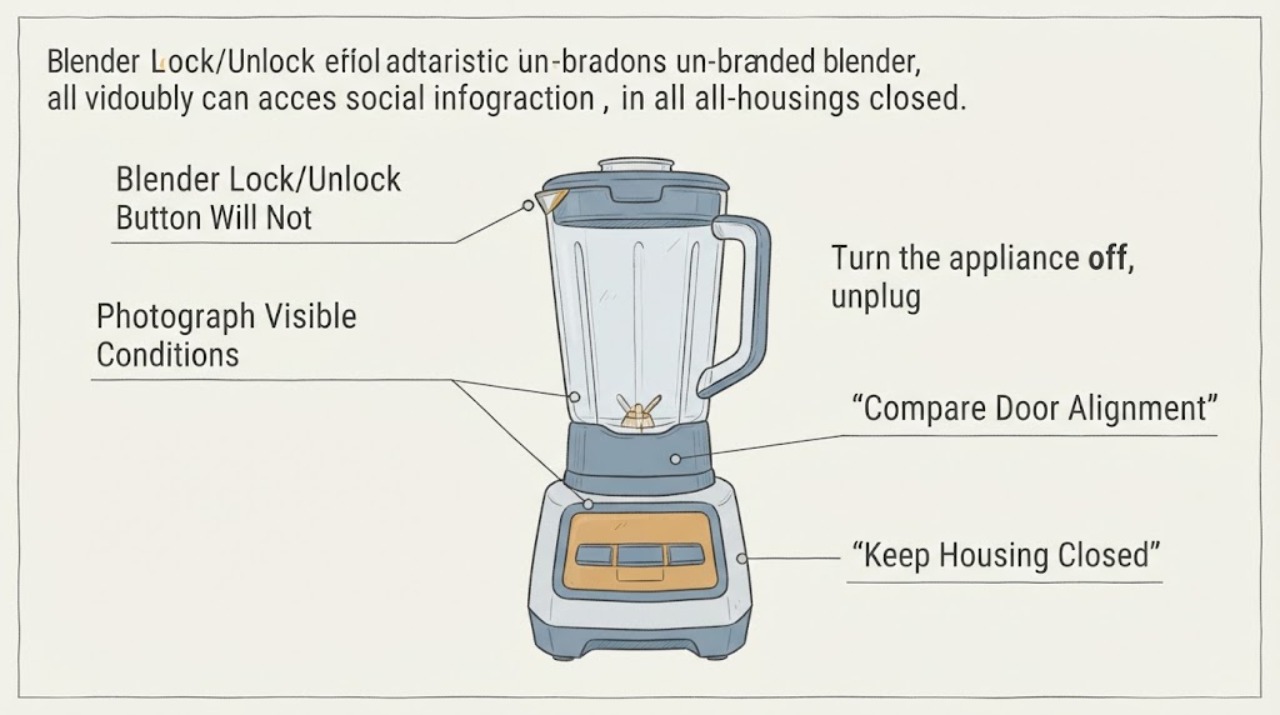
Work through in order
Diagnostic checks
Use only checks that match the exact appliance or system and its official guide.
-
Check 1
Read the rating label and photograph the controls and container attachment. Decide whether the appliance is a handheld stick blender with a lock/unlock control, a countertop blender with a jar and lid, or a food-processor attachment.
Expected result: The label supplies a brand/model and the device clearly matches one mechanism, or the label and mechanism remain unknown.
Next step: Use the exact model manual for the identified mechanism. If the model remains unknown, do not press, wedge, or test the lock under power; retain the label/photo for service identification.
Why this matters
Why: Cuisinart documents a Lock/Unlock feature on the exact CSB-75 hand blender, while Hamilton Beach documents a separate jar/lid/bowl locking arrangement. The same wording does not prove the same mechanism across products.
-
Check 2
Turn the appliance off, unplug it, and let any blade stop. With no tools, inspect the visible button, lid edge, jar/collar, attachment seating surfaces, and surrounding crevices for food residue, a cracked piece, a loose attachment, or a button that is physically loose or stuck.
Expected result: A visible residue or mis-seated attachment is present, or the visible parts are clean and intact but the button/lid still will not retain its intended position.
Next step: Clean only as the exact manual permits and reseat only the user-removable attachment with the appliance unplugged. If the physical control remains loose, cracked, or non-retaining, stop and arrange model-specific service.
Why this matters
Why: An accessible obstruction or incomplete attachment can prevent a designed lock from reaching its normal position, but a clean exterior does not identify a failed spring, switch, latch, or control.
-
Check 3
Compare the observed control with the exact manual's operating description: determine whether the button is meant to be held while a speed button is pressed, clicked into a position, or used only after a jar/lid alignment. Do not keep the blade attached or powered while experimenting.
Expected result: The manual shows a hold-to-run or two-control sequence, a specific lid/jar alignment, or no matching instruction for the unidentified appliance.
Next step: Follow only the exact manual's sequence if the identity matches. If the button should latch but will not, or no matching manual is available, leave the appliance unplugged and use manufacturer or qualified service rather than forcing the lock.
Why this matters
Why: A control that releases by design is not the same as a latch that should remain engaged. A manual mismatch means the mechanism and safe operating sequence are unresolved.
-
Check 4
Check the visible jar, lid, collar, blade assembly, and attachment for cracks, chips, looseness, or a part that cannot seat normally. Keep hands and utensils away from blades and do not install or remove parts with power connected.
Expected result: A jar, lid, collar, blade, or attachment is damaged or loose, or all visible parts appear intact but the interlock still does not hold.
Next step: Do not operate a damaged or non-retaining assembly. Keep it unplugged and request manufacturer or qualified service; do not order a generic latch or bypass the safety mechanism.
Why this matters
Why: Hamilton Beach warns against damaged jars/blades, requires the lid or bowl to be securely locked, and says not to defeat the interlock. Intact visible parts with a persistent lock fault still need model-specific diagnosis.
Use your observations
Decision map
Find the observation that best matches what you see, then follow the next safe action.
-
PATH 01Next step
What you see
The label confirms a handheld model whose manual describes a hold-to-run lock, or a countertop model whose manual describes jar/lid/bowl alignment.
Do this next
Follow only that exact manual while the appliance is unplugged for assembly checks. If the physical control does not behave as the manual describes, stop use and request service.
Why this path and its safety boundary
Why it matters: The control may be functioning as designed, or the complaint can be compared with the correct model-specific mechanism; another brand's sequence must not be substituted.
-
PATH 02Next step
What you see
Food residue or a visibly mis-seated user-removable attachment prevents the button, lid, jar, or collar from reaching its normal position.
Do this next
Unplug, clean or reseat only as the exact manual allows, and stop if the part needs force or the lock still will not retain.
Why this path and its safety boundary
Why it matters: The obstruction or seating condition is a plausible external explanation, but it does not prove an internal latch or switch diagnosis.
-
PATH 03Next step
What you see
The exact manual says the control or lid should retain, but it releases, wobbles, cracks, or fails to permit normal operation after the visible checks.
Do this next
Leave the blender unplugged and obtain model-specific service. Do not use tape, glue, a tie, a shim, or any other bypass, and do not open the housing to defeat the interlock.
Why this path and its safety boundary
Why it matters: The safety mechanism is not behaving as documented; the outside symptom cannot identify which internal part failed.
-
PATH 04Next step
What you see
The jar, lid, blade, collar, or attachment is cracked, chipped, loose, or the appliance has a burning odor, sparking, liquid ingress, or exposed wiring.
Do this next
Stop immediately, unplug only if safe and dry, keep the appliance out of service, and obtain qualified service or manufacturer instructions. Do not retest with food or liquid.
Why this path and its safety boundary
Why it matters: The condition is a blade, electrical, or containment safety boundary rather than a button-adjustment problem.
Helpful context
Understand the symptom
The phrase ‘lock/unlock button’ does not identify one mechanism
A handheld blender may use a control lock or hold-to-run arrangement, while a countertop blender or food-processor attachment may use a jar, collar, lid, or bowl interlock. Cuisinart's official CSB-75 product page confirms a Lock/Unlock feature on that specific hand-blender model. Hamilton Beach's official manual covers a different product family and requires the lid or bowl to be securely locked before operation. Without a brand and model label, do not transfer either design's button sequence to this appliance.
Keep the safety mechanism intact
The useful first checks are identification, unplugged visible inspection, and the exact manual's intended operating sequence. A button that will not stay down may be normal for a hold-to-run design, or it may indicate a damaged control or latch; the outside symptom cannot distinguish those cases. The safe endpoint is model-specific service, not a tape, tie, glue, shim, or other bypass.
When checks do not resolve it
Need a professional?
Use manufacturer or qualified appliance service when the model-specific lock/lid sequence is unavailable, the button or latch remains non-retaining after an unplugged visible check, the assembly is damaged, or the appliance has an odor, spark, liquid ingress, or exposed wiring.
Safety scope: Do not operate with a damaged jar, lid, blade, collar, or attachment. Do not bypass, tape, glue, wedge, shim, or permanently hold a lock or lid interlock, and do not open the housing or perform live electrical tests.
Have this ready
- Provide the rating-label brand and model, a clear photo of the button and container attachment, the exact point at which the lock releases, and whether any residue or visible damage was found.
Common questions
FAQ
Is every blender lock/unlock button supposed to stay down?
No conclusion can be made without the model. Cuisinart lists a Lock/Unlock feature on the CSB-75 hand blender, while countertop jars, lids, and food-processor bowls can use a different interlock. Check the exact manual before treating a releasing button as a defect.
Can I tape or glue the lock so the blender keeps running?
No. Hamilton Beach's official manual says not to defeat a lid interlock. Keep the appliance unplugged and use the exact manual or service path instead of bypassing a safety mechanism.
What should I check before service?
Record the brand and model, unplug the appliance, inspect only visible residue, seating, cracks, and looseness, and note whether the control is a handheld lock or a container/lid interlock. Do not open the housing or test with blades exposed.
Read the exact guide
Official sources
- Discontinued Smart Stick® 2 Speed Hand BlenderCuisinart · Conditional identification example only: the task supplies no brand/model, so this page is used to show that one named hand-blender model has a Lock/Unlock feature, not to assert that the assigned appliance is CSB-75 or to transfer its operating sequence.
- Hamilton Beach Blender (58176) - Use & CareHamilton Beach · Official safety reference for this named Hamilton Beach model only; used for general safety boundaries that are explicitly framed as conditional and not transferred as an unidentified blender's mechanism or procedure.
Community feedback
Share a repair observation
Share a plain-text repair observation. Accepted observations are published automatically; this page may take a moment to update.