
On this page
Start here
Quick answer
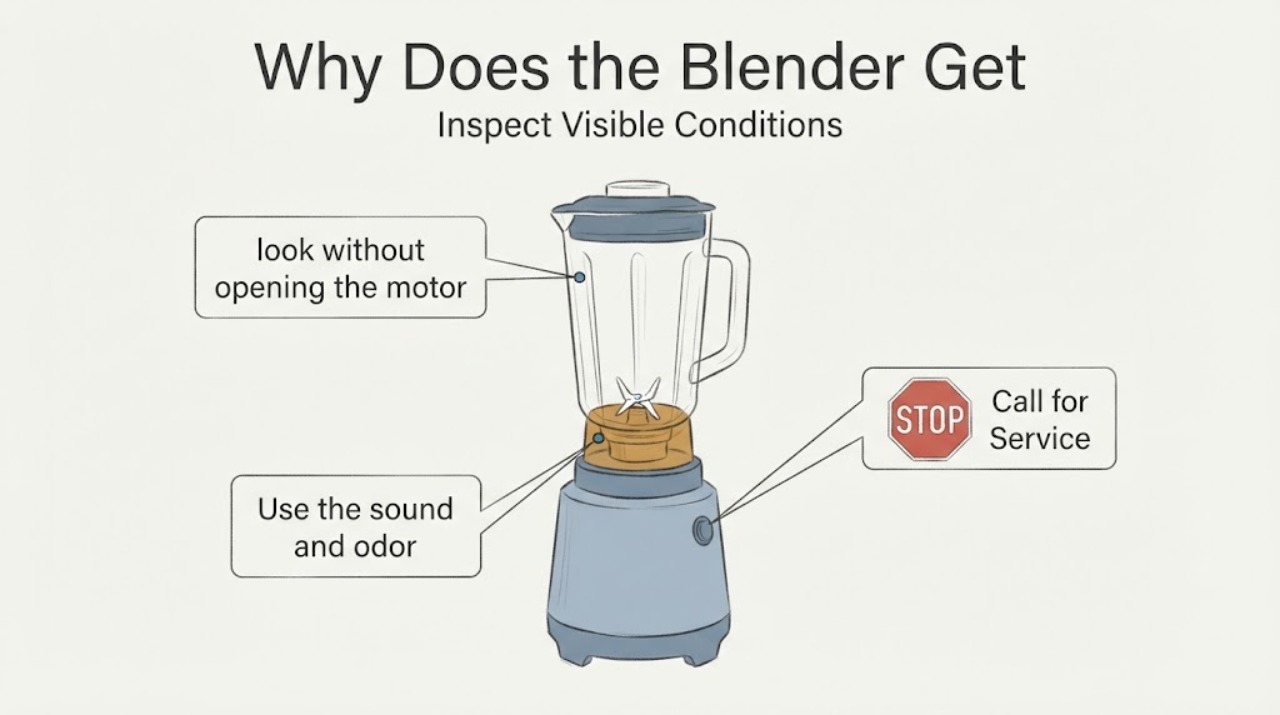
Stop the blender, switch it off, and unplug it before handling the jar or base if you can do so safely. A louder-than-usual sound together with a burning or electrical smell can indicate overheating, overload, a jar or blade assembly problem, or a motor-side fault, but the symptom does not identify one failed part. Do not keep running it to reproduce the noise, open the motor base, touch moving blades, or continue after smoke, heat, sparks, or a damaged cord or plug. Inspect only the unplugged exterior, record when the sound and smell appeared, and use the exact brand/model manual or qualified service path.
Work through in order
Diagnostic checks
Use only checks that match the exact appliance or system and its official guide.
-
Check 1
Stop the blender and switch it off. If the area, plug, and cord are dry and undamaged, unplug it once from a safe position; if there is smoke, sparking, a hot or melted plug, exposed wiring, or water near the electrical base, do not touch the appliance and isolate power only if that can be done safely.
Expected result: The odor is burning/electrical, the base or plug is hot, smoke or sparks occurred, or the cord/plug is damaged; alternatively, the appliance is cool with no visible electrical damage.
Next step: For smoke, fire, sparks, or a dangerous electrical condition, keep people away and contact emergency or qualified electrical help. Otherwise keep the blender unplugged while you continue with the external checks and exact-manual/service path.
Stop if: Do not reconnect the blender or press Start/Pulse to reproduce the sound.
Why this matters
Why: The first group indicates a possible electrical, thermal, or fire hazard. The second group only means that safe external observation may be possible; it does not clear the blender for another cycle.
-
Check 2
After the blender is unplugged and fully cool, look without opening the motor base or touching blades for a cracked jar, loose-looking jar-to-base seating, visible material around the drive interface, damaged cord, liquid on the base, or other obvious damage. Do not turn the blade by hand.
Expected result: Damage, liquid, an abnormal gap, loose-looking blade/jar assembly, or residue at the drive interface is visible; or no external defect is visible.
Next step: Keep it out of service and contact the brand or a qualified small-appliance service provider with the model information. Do not remove the base, blade assembly, or electrical cover as a user repair.
Stop if: Stop the inspection if it would require contact with a sharp blade, energized part, sealed motor housing, or wet surface.
Why this matters
Why: A visible defect or liquid exposure can explain noise or create an injury/electrical risk, but the absence of visible damage does not rule out a bearing, drive, or motor fault.
-
Check 3
Use the sound and odor history from the last safe use to note whether the noise seemed to come from the jar area or motor-base area, and whether it began during a thick/frozen load, at startup, or after extended running. Do not power the blender again just to localize it.
Expected result: The prior sound was clearly jar-side, clearly base-side, or cannot be localized; the odor began under a heavy load or without an obvious load.
Next step: Give the brand, model, age, load, time to odor, sound description, and any visible damage to the exact manufacturer support channel or qualified service provider.
Stop if: Do not run a jar-less, empty, or repeated test unless the exact manual and service provider explicitly authorize it after the odor concern is cleared.
Why this matters
Why: Blendtec documents jar-versus-motor localization for its own products, while Vitamix documents overheating/overload as one possible source of burning smell. These observations guide service questions but do not prove a part failure on an unidentified blender.
-
Check 4
Before seeking service, photograph the rating label and record whether the smell was electrical, rubber-like, or food-related, whether the motor stopped, and whether the jar or base became hot. Keep the unplugged blender, jar, lid, and any damaged pieces together.
Expected result: The smell or noise recurs in the record, the motor stopped, a thermal/overload message appeared, or the event happened only with one jar or load.
Next step: Request model-specific guidance or professional evaluation. Replace parts only when the manufacturer confirms the exact fit and safe procedure.
Stop if: Do not bypass thermal protection, splice a cord, open the motor base, or continue using the blender because it cools down.
Why this matters
Why: Those details help the correct brand or technician choose the matching manual and service route; they are not enough to authorize a replacement motor, bearing, coupling, or blade assembly.
Use your observations
Decision map
Find the observation that best matches what you see, then follow the next safe action.
-
PATH 01Next step
What you see
Smoke, sparks, flame, a hot/melted plug, exposed wiring, or a strong electrical/burning odor is present.
Do this next
Keep the blender unplugged and away from use; contact emergency help for fire or a qualified electrical/service professional for the appliance and cord. Do not touch or retest it.
Why this path and its safety boundary
Why it matters: The symptom may involve an active electrical or thermal hazard, and repeated operation could worsen it.
-
PATH 02Next step
What you see
The blender is cool and unplugged, but the jar, blade area, cord, plug, or base shows visible damage or liquid exposure.
Do this next
Leave it out of service and arrange exact-brand or qualified small-appliance service; do not open the base or handle blades.
Why this path and its safety boundary
Why it matters: A visible safety defect is more urgent than identifying the noise source, and it is not a user-level motor repair.
-
PATH 03Next step
What you see
No external defect is visible, but the prior noise was clearly grinding, squealing, or base-side and was accompanied by odor.
Do this next
Provide the exact model and symptom history to the manufacturer or service provider and do not run another cycle to verify it.
Why this path and its safety boundary
Why it matters: Official manufacturer guidance treats these patterns as a service question; the sound alone does not confirm a bearing, coupling, or motor failure.
-
PATH 04Next step
What you see
The odor occurred only during an unusually heavy or new-machine use, with no smoke, heat, damage, or continuing odor after shutdown.
Do this next
Follow the exact manual’s cooling and first-use guidance. If the odor is strong, returns, or appears with abnormal noise, leave the blender unplugged and seek service.
Why this path and its safety boundary
Why it matters: Vitamix notes that its new motors may have a temporary winding-curing odor and that overheating can also smell like burning; this does not establish the same behavior for another brand.
Helpful context
Understand the symptom
Noise and odor together are a stop-use symptom. They can come from a heavy load or thermal protection, the jar and blade assembly, the drive interface, or the motor base. Without a brand and model, none of those possibilities is a confirmed diagnosis.
Manufacturer instructions are not interchangeable. Vitamix documents an overheating/burning-smell response and service boundary, while a Blendtec manual documents how its own noise guidance distinguishes the jar from the motor. Use those sources to understand the safety boundary, then follow the exact manual for the blender in front of you.
Do not put water on or inside the motor base, and do not handle the blade assembly while it can move. A visible cord or plug defect, smoke, sparking, or a hot base is a reason to leave the appliance unplugged and arrange professional help.
When checks do not resolve it
Need a professional?
Contact the exact manufacturer or a qualified small-appliance technician when the abnormal noise or odor persists, returns, or cannot be localized safely. Give the model, sound location, odor description, load, duration, and visible observations.
Common questions
FAQ
Can I keep running the blender to find out whether the smell goes away?
No. Switch it off and unplug it when safe. A cooling or overload explanation is model-specific, and continued operation with abnormal noise or burning odor can worsen a fault. Use the exact manual or service channel instead.
Does a loud blender need a new blade or motor?
Not necessarily. Official guidance distinguishes jar-side and motor-side noise on some products, and a sound can also arise from the drive interface or load. Do not order a part from the sound alone; have the exact model evaluated.
Is a burning smell always proof that the motor is ruined?
No. Vitamix says its new motors can have a temporary winding-curing smell and that overheating can also emit a burning smell. That brand-specific explanation does not clear an unidentified blender, especially when the smell is strong, recurring, or paired with loud noise.
Can I wash the motor base or open it to inspect the source?
No. Keep water out of the base, unplug before handling parts, and do not open the motor housing as a user repair. Use the exact manufacturer or a qualified technician for internal evaluation.
Read the exact guide
Official sources
- Important SafeguardsVitamix · Official Vitamix safety manual; cited for its explicit unplug-before-handling, damaged/malfunctioning-appliance, water-on-base, and moving-blade boundaries, not for cross-brand repair instructions.
- Blendtec Commercial Blender ManualBlendtec · Official Blendtec commercial manual; cited only for its product-specific distinction between motor-base and jar noise and its service boundary for excessive noise or loose/gravelly jar blade assembly. It does not establish a diagnosis for another brand.
- Frequently Asked QuestionsVitamix · Official Vitamix FAQ; cited only for the Vitamix-specific explanations of overheating/burning smell, grinding or squeaking sounds, and the manufacturer service boundary. It is not a universal diagnosis for unidentified blender brands.
Community feedback
Share a repair observation
Share a plain-text repair observation. Accepted observations are published automatically; this page may take a moment to update.