
On this page
Start here
Quick answer
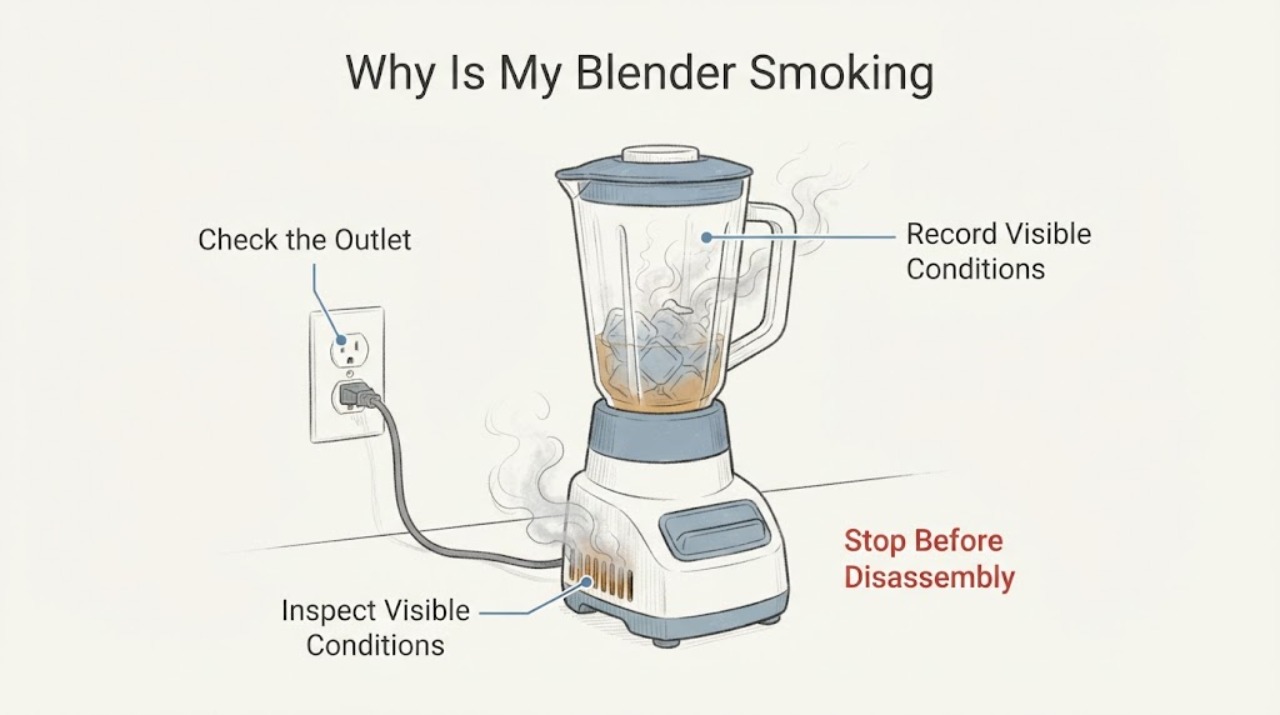
Treat smoke from a blender as a stop-use event, not a reason to try another cycle. Turn the controls off and unplug it only if you can do so without approaching flame, arcing or a hot/damaged connection; keep it away from anything combustible and never add water to a smoking base. Once it is fully cool and disconnected, record whether smoke came from the base, cord, plug, container or food and inspect only for visible damage, moisture or a jam. Do not open the base, reach toward the blades, reset and retry, or guess at a motor or blade replacement. Smoke, melting, a burning electrical smell, repeated trips or an appliance that has been dropped or wet requires qualified appliance or electrical service; active fire requires emergency response.
Work through in order
Diagnostic checks
Use only checks that match the exact appliance or system and its official guide.
-
Check 1
Stop blending immediately. Turn the control to off and unplug the blender only if the plug and outlet are cool and reachable without crossing smoke, flame, sparks or a damaged cord. Move people and combustible items away; do not pour water onto the base or approach an active fire.
Expected result: Smoke or flame continues, an electrical odor or arcing is present, or the appliance is off and no active hazard remains.
Next step: For active fire or heavy smoke, leave the area and contact emergency services. If the unit is safely disconnected, keep it out of use and allow it to cool without another test run before recording external observations.
Why this matters
Why: Continuing smoke, flame, arcing or a hot connection is an immediate fire or shock hazard. A stopped appliance is not thereby proven safe; it still needs a de-energized assessment.
-
Check 2
After the blender is fully cool and unplugged, inspect from outside the cord, plug, outlet, motor-base vents and container underside. Look for scorch marks, melted plastic, frayed insulation, liquid at the base, grease around the jar bottom, a cracked container or a damaged blade assembly; do not remove the base cover or reach toward a blade.
Expected result: Visible heat, melting, liquid, cracks, damaged blades, a damaged cord or an unusual residue is present, or the exterior looks normal.
Next step: Keep the blender disconnected and arrange qualified appliance or electrical service for any damage, wet base, smoke residue or persistent odor. If nothing is visible, still do not reconnect it as a test; continue by documenting the operating context and exact model.
Why this matters
Why: Visible damage or liquid makes continued use unsafe and needs model-specific service. A normal exterior does not rule out an internal electrical or mechanical fault after smoke.
-
Check 3
Record what was in the container, how full it was, whether the mixture was thick or stuck, how long the blender had been running, and whether the smoke came from the food, container, motor base or cord. Do not restart the blender to reproduce the symptom, move the blade by hand, or insert a utensil into the jar while connected.
Expected result: The mixture was unusually thick or stopped moving, the container was overfilled, the base became hot, or smoke was clearly electrical or came from the cord/plug.
Next step: Give the load, timing and smoke location to the manufacturer or qualified technician. Do not compensate by adding liquid, using a higher speed, reducing the load and trying again, or changing parts without the exact manual and professional diagnosis.
Why this matters
Why: A stalled or heavy load is a possible operating context, but it does not prove that only the mixture caused smoke. Smoke from the base, cord or plug is more concerning for an electrical or mechanical fault; the source still needs service diagnosis.
-
Check 4
Identify the brand, model and region from the label or owner manual without powering the appliance, then check the exact manufacturer support and safety instructions. Record whether the blender was recently dropped, wet, cleaned, used with hot liquid, or operated after an earlier stall; do not assume another brand's cooling or overload behavior applies.
Expected result: A matching manual gives a stop-use or service instruction, or the model remains unknown and only generic advice is available.
Next step: Follow only an exact-model stop-use or service instruction and keep the base closed. If identity or guidance is unavailable, provide the recorded details to qualified service rather than guessing at a part or restart interval.
Why this matters
Why: Exact identity may reveal model-specific service or recall information, but generic pages cannot establish a compatible motor, bearing, blade assembly or reset procedure for this unit.
-
Check 5
Inspect the surrounding electrical setup only while disconnected: note whether the outlet, adapter or extension cord is loose, scorched, warm or overloaded, and whether a breaker or GFCI/RCD operated. Do not reset protection repeatedly, use another outlet as a test, or substitute an extension cord; keep the suspected blender isolated.
Expected result: The cord or outlet is hot/damaged, protective equipment tripped, other loads shared the circuit, or the electrical setup looks normal.
Next step: Stop using the outlet and obtain qualified electrical service for heat, damage or repeated trips. Keep the blender disconnected and arrange appliance service even when the receptacle appears normal.
Why this matters
Why: A damaged or overloaded supply can create smoke independently of the blender, while a normal-looking setup does not clear the appliance. Repeated protective operation is an unresolved electrical hazard.
Use your observations
Decision map
Find the observation that best matches what you see, then follow the next safe action.
-
PATH 01Next step
What you see
The smoke stops after the control is turned off and the unplugged blender cools, with no visible cord, plug, base, container or blade damage.
Do this next
Do not run another cycle. Record the model and operating context and arrange manufacturer or qualified appliance evaluation before reuse.
Why this path and its safety boundary
Why it matters: The immediate hazard has stopped, but the smoke source remains unresolved; a normal exterior cannot rule out internal overheating or electrical damage.
-
PATH 02Next step
What you see
Smoke or burning odor came from the motor base, plug or cord, or there is melting, scorching, liquid in the base, a damaged blade assembly or a hot connection.
Do this next
Keep the blender disconnected and obtain qualified appliance or electrical service. Do not open the base, replace a motor or blade, or use the appliance after only wiping away residue.
Why this path and its safety boundary
Why it matters: This pattern is consistent with an unresolved electrical or mechanical safety issue and is outside routine user troubleshooting.
-
PATH 03Next step
What you see
The mixture stopped moving or was unusually thick, but no smoke source can be localized and no active hazard remains.
Do this next
Do not reduce the load and retry. Give the recipe, fill level and timing to service and follow the exact manual for any later use decision.
Why this path and its safety boundary
Why it matters: The load may have stressed the blender, but that context does not prove the motor, drive socket or blade is sound.
-
PATH 04Next step
What you see
Flame, heavy smoke, arcing, a rapidly heating cord or outlet, or another active fire sign remains.
Do this next
Leave the area, keep others away and contact emergency services. Do not approach, pour water on the base or re-enter until responders say it is safe.
Why this path and its safety boundary
Why it matters: This is an emergency fire or shock hazard, not an appliance-repair check.
Helpful context
Understand the symptom
Smoke can come from overheated food, a stalled load, hot residue, a damaged cord or an internal electrical/mechanical fault. Without the model and a controlled inspection, the visible symptom cannot distinguish those causes. The safe decision is whether there is an active fire or electrical hazard, then whether the completely disconnected appliance has visible damage that needs service.
The opened Hamilton Beach and Vitamix documents are manufacturer-specific examples of stop-use and handling boundaries. They do not establish a universal cooling time, compatible part, fuse value or repair procedure for an unknown blender. Use the exact owner manual only for identification and manufacturer support, while keeping the motor base closed.
When checks do not resolve it
Need a professional?
Arrange qualified appliance service for any blender that has smoked, especially when smoke came from the base, cord or plug, the unit was wet or dropped, a blade/container is damaged, or the symptom recurs. Provide the exact model, power label, load, run duration, smoke location, odor, noise, visible damage and protective-device behavior. Arrange electrical service as well for a hot, loose, scorched or repeatedly tripping outlet. Do not perform live testing, disassemble the base or guess a motor, bearing, drive socket or blade replacement.
Common questions
FAQ
Should I run the blender again to find out where the smoke came from?
No. Do not reproduce a smoke event. Turn it off, disconnect power only when safe, let it cool without touching hot parts, and record the source and operating context for qualified service.
Could a thick mixture make a blender smoke?
A thick or stalled load can be relevant operating context, but smoke still does not prove that the load alone caused the event. Do not add liquid and retry, increase speed, or guess at a motor or blade problem; have the disconnected appliance evaluated.
Can I clean the base after it smokes?
Disconnect power first and keep liquid away from the motor base. Wipe only the accessible exterior as the exact manual permits; do not immerse, spray, remove covers or treat cleaning as a repair for smoke or electrical damage.
When is blender smoke an emergency?
Treat flame, heavy or continuing smoke, arcing, a rapidly heating cord or outlet, and exposed electrical damage as an emergency safety condition. Leave the area and contact emergency services; do not approach the appliance or pour water on its base.
Read the exact guide
Official sources
- Blender Mastery: A Comprehensive Guide on How to Use a BlenderVitamix · Vitamix blender safety, owner-manual, unplugging, ventilation, external troubleshooting and professional-service guidance; not a universal model diagnosis.
- Hamilton Beach DV Glass Blender Jar (54210) - Use & CareHamilton Beach · Hamilton Beach 54210 blender operating, cleaning, no-start and burning-smell troubleshooting; used as a manufacturer-specific example and not as proof for an unknown blender model.
- Appliance and Electrical Fire SafetyU.S. Fire Administration (FEMA) · U.S. government fire-safety guidance on small appliances, damaged cords, outlets, power strips and electrical-fire prevention.
- Blender SafetyHamilton Beach · Hamilton Beach commercial blender safety instructions on grounded outlets, no extension cords, disconnect-before-service, damaged appliances and technical service.
Community feedback
Share a repair observation
Share a plain-text repair observation. Accepted observations are published automatically; this page may take a moment to update.