
On this page
Start here
Quick answer
If a Blomberg dishwasher is not draining, switch it off and unplug it before checking the accessible filter system and the external discharge hose. Clean and correctly reseat the filters, then look for a kink, blockage, or incorrect hose position; Blomberg's guidance places the drain hose between 50 cm and 100 cm above the floor. Use the model manual's cancellation or drain procedure for one controlled retest. If water remains after the filter and hose checks, the hose cannot be safely cleared, the appliance leaks, or there is an electrical or mechanical warning sign, stop and arrange qualified appliance service rather than opening the pump area or attempting an internal repair.
Before you begin
Safety first
- The user may perform only the unplugged, accessible filter and external hose checks described by the exact model manual. Internal pump, wiring, control, and hidden drain-path work belongs to qualified service.
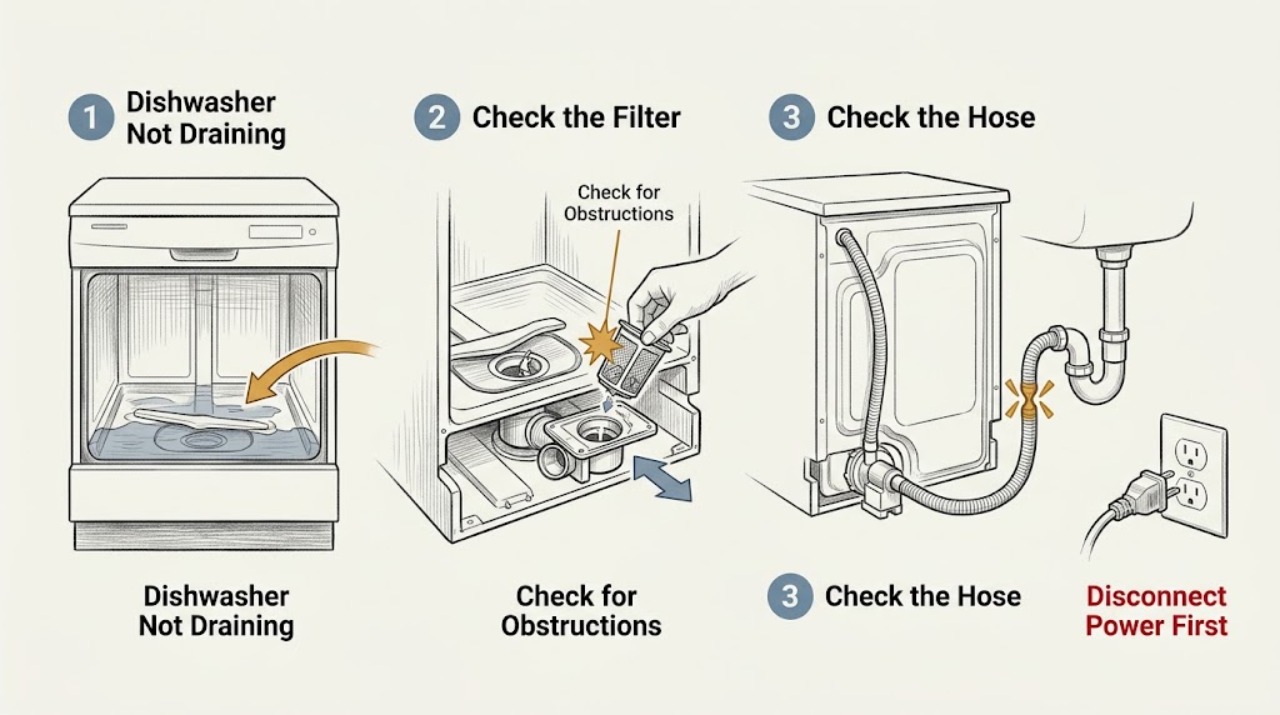
Work through in order
Diagnostic checks
Use only checks that match the exact appliance or system and its official guide.
-
Check 1
Stop the programme, switch the dishwasher off, and unplug it before opening the door or checking the base. Note whether water is pooled around the filter area, whether the programme ended normally, and whether there was an unusual noise, leak, or electrical smell.
Expected result: There is standing water with no warning sign, or there is a leak, damaged cord or plug, burning smell, smoke, sparking, or another unsafe condition.
Next step: If any unsafe condition is present, keep the dishwasher unplugged, avoid wet electrical areas, and arrange qualified appliance service. Otherwise continue with the filter check while the appliance remains disconnected.
Why this matters
Why: Standing water without a warning sign is consistent with a drainage-path problem that can be checked at the accessible filter and hose. A leak or electrical warning makes further user troubleshooting unsafe and does not identify a part that should be replaced at home.
-
Check 2
Remove the Blomberg dishwasher's accessible filter system at the base according to the model manual. Rinse the filters under running water, clear visible food debris without damaging the mesh, and reinstall every filter in its correct seated and locked position.
Expected result: The filters contain food or other debris, the filters were fitted incorrectly, or the filter system is clean and correctly seated.
Next step: If debris or incorrect seating was found, clean and reseat the filters before any retest. If the filter system was already clear and correctly fitted, inspect only the accessible external discharge hose next.
Why this matters
Why: Debris or incorrect seating can obstruct the water path and is a plausible user-correctable cause of water remaining. A clean, correctly installed filter does not rule out a blockage farther along the discharge path or an internal fault.
-
Check 3
Inspect the accessible discharge hose for a kink, crushing, twist, or visible blockage, and check that its installed height follows Blomberg's guidance of 50 cm to 100 cm above the floor. Do not pull the built-in appliance out or disconnect a wet hose unless the model manual gives that procedure and it can be done safely.
Expected result: The hose is kinked, crushed, blocked, or outside the stated height range, or it appears clear and correctly routed.
Next step: Correct only an obvious, safely accessible routing problem and clear an accessible blockage as directed by the exact manual. If the hose cannot be safely inspected or cleared, leave it connected and arrange service.
Why this matters
Why: A restricted or incorrectly positioned hose can prevent the dishwasher from moving water away. A clear, correctly routed hose shifts suspicion toward a hidden obstruction or an appliance-side drainage fault, which cannot be identified reliably by looking at the hose alone.
-
Check 4
After the filters are seated and any safe external hose issue is corrected, follow the exact Blomberg model manual's programme-cancellation or drain procedure for one controlled retest. Keep hands and tools out of the appliance while it runs.
Expected result: The water is discharged and the filter area is left clear, or water remains at the end of the controlled drain attempt.
Next step: If it drains, monitor the next normal programme and keep the filters maintained. If water remains, stop further tests, keep the dishwasher unplugged, and arrange qualified Blomberg or appliance service.
Why this matters
Why: Successful draining after the accessible blockage or routing issue was corrected supports a water-path restriction as the immediate cause. Water that remains after those checks means the accessible steps did not resolve the fault; the pump, a hidden path, or another internal condition cannot be distinguished safely from outside.
Use your observations
Decision map
Find the observation that best matches what you see, then follow the next safe action.
-
PATH 01Next step
What you see
The filter system is visibly dirty or was not seated correctly, and the dishwasher drains after it is cleaned and correctly reinstalled.
Do this next
Use the model's normal maintenance schedule, remove coarse food residue before loading, and stop using the dishwasher if the same symptom returns with a clean, correctly seated filter.
Why this path and its safety boundary
Why it matters: The before-and-after change makes a filter restriction or seating problem the most likely immediate explanation for this episode.
-
PATH 02Next step
What you see
The filters are clear, but the discharge hose is visibly kinked, crushed, blocked, or incorrectly positioned; draining improves after a safe correction.
Do this next
Keep the hose routed as specified for the exact model and do not extend, disconnect, or reroute it beyond the manual's instructions. Arrange service if the hose becomes restricted again or cannot be corrected safely.
Why this path and its safety boundary
Why it matters: The change after correcting the external hose supports a restricted or poorly routed discharge path rather than a confirmed pump failure.
-
PATH 03Next step
What you see
The filters are clean and correctly seated, the accessible hose is clear and correctly positioned, and water still remains after one manual-directed drain attempt.
Do this next
Keep the appliance unplugged and arrange qualified appliance service. Give the provider the model number, amount of water left, filter and hose observations, and the result of the single controlled drain attempt.
Why this path and its safety boundary
Why it matters: The accessible checks have not isolated the cause. A hidden blockage or internal drainage fault remains possible, but the symptom alone does not justify identifying or replacing a pump or other component.
-
PATH 04Next step
What you see
The dishwasher leaks toward electrical connections, has a damaged cord or plug, or shows smoke, sparking, burning smell, or abnormal mechanical noise.
Do this next
Stop using the dishwasher. Disconnect power only if it can be done without touching water or damaged wiring; otherwise keep clear and obtain qualified service.
Why this path and its safety boundary
Why it matters: This is a safety escalation, not a normal filter-and-hose troubleshooting branch. External symptoms cannot make an internal electrical or mechanical repair safe for a homeowner.
Helpful context
Understand the symptom
Start with the water path, not the control panel
A small amount of water can be mistaken for a complete drain failure, so note whether water is left across the filter area at the end of a programme and whether the dishwasher made a normal drain attempt. The useful first distinction is a blocked filter or hose path versus water that remains after those accessible checks are clear. The exact filter layout and cancellation sequence vary by model; use the matching Blomberg manual for anything model-specific.
Safe boundary for standing water
Turn the dishwasher off and unplug it before checking the accessible filters or hose. Do not reach into a wet area while the appliance is connected, remove panels, dismantle the drain pump, probe wiring, or repeatedly reset a breaker. If water is leaking toward an outlet, the cord or plug is damaged, or you cannot disconnect power without touching a wet electrical area, leave it alone and arrange qualified service.
When checks do not resolve it
Need a professional?
A qualified appliance technician should assess persistent water remaining after the model-directed filter, hose, and single drain-procedure checks, as well as any leak or abnormal electrical or mechanical symptom.
Safety scope: The user may perform only the unplugged, accessible filter and external hose checks described by the exact model manual. Internal pump, wiring, control, and hidden drain-path work belongs to qualified service.
Common questions
FAQ
Why is water left in my Blomberg dishwasher?
Start by unplugging the appliance, then check and clean the accessible filters and inspect the discharge hose for a blockage, kink, or incorrect position. If water remains after the model-directed drain procedure, arrange qualified service rather than opening the pump area.
How high should a Blomberg dishwasher drain hose be?
Blomberg's dishwasher FAQ says the drain hose should be between 50 cm and 100 cm above the floor. Confirm the exact installation requirements for your model before changing the routing.
Can I remove the drain pump to clear a Blomberg dishwasher?
No. Limit home checks to the unplugged, accessible filters and the external hose steps described in the model manual. Pump, wiring, hidden blockage, and other internal work should be handled by qualified service.
When should I stop troubleshooting a Blomberg dishwasher that will not drain?
Stop when water remains after the filters and accessible hose are clear and correctly fitted, or immediately if there is a leak toward electrical parts, cord damage, smoke, sparking, burning smell, or abnormal noise. Keep it unplugged and arrange qualified appliance service.
Read the exact guide
Official sources
- What should I do if water is not draining from my Blomberg dishwasher?Blomberg · Blomberg dishwasher water not draining; unplugging, filter cleaning, hose position, and hose blockage checks
- Contact Us | BlombergBlomberg · Blomberg dishwasher not draining after model-specific user checks
- Dishwasher User manual GSN9123Blomberg · Blomberg dishwasher water remains at the end of a programme when filters or the discharge hose may be blocked
Community feedback
Share a repair observation
Share a plain-text repair observation. Accepted observations are published automatically; this page may take a moment to update.