
On this page
Start here
Quick answer
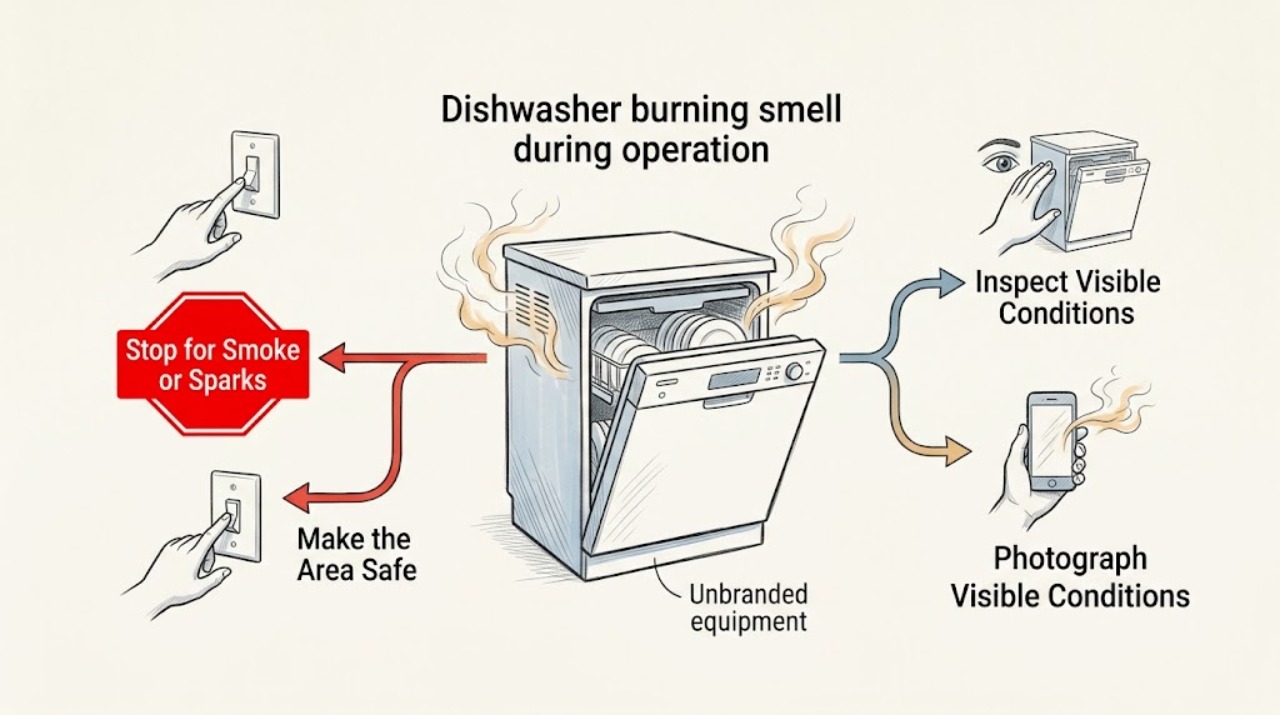
Stop the Bosch SHE43P25UC/64 dishwasher as soon as a burning, hot-plastic, electrical, or smoke-like smell appears during a cycle. Cancel the cycle normally if the controls respond, and disconnect power only from a dry, safely reachable plug or breaker; if the plug, outlet, cabinet, floor, or wiring is hot or wet, do not touch it. Do not run another cycle to identify the source. Once the machine is cool and isolated, record when the smell began and inspect only visible areas for a melted item, food residue, standing water, or a visibly damaged cord/outlet. Bosch's public cleaning guidance explains ordinary odor from food debris in filters or spray arms, but that does not clear a true burning odor. Smoke, melting, a hot plug, repeated tripping, sparking, water near electrics, or an odor that persists after visible debris is removed requires qualified Bosch service and no further use.
Work through in order
Diagnostic checks
Use only checks that match the exact appliance or system and its official guide.
-
Check 1
Stop the cycle and make the area safe without touching a wet electrical connection. Use the normal cancel/off control if it responds; then disconnect power only from a dry, safely accessible plug or breaker. Close the water supply if water is escaping and the shutoff is reachable without entering a wet electrical area. Keep people away if there is smoke or visible flame.
Expected result: There is smoke, flame, a hot or melted plug/outlet, sparking, a repeated breaker trip, water near the cord or electrical area, or only an odor with no visible hazard.
Next step: Leave the dishwasher off and arrange qualified appliance or electrical help. If there is active fire or smoke that does not stop, leave the area and use the appropriate emergency response; do not open panels or re-energize the machine.
Stop if: Never touch a wet plug, outlet, cord, cabinet connection, or standing water near electrics. Do not reset a tripping breaker or run a second cycle to see whether the smell returns.
Why this matters
Why: Smoke, heat damage, arcing, repeated electrical protection, or wet electrics is an immediate stop-use condition, not a cleaning problem. An odor without those signs is still unverified and should not be reproduced under power.
-
Check 2
After the dishwasher is off, cool, and isolated, photograph the rating plate and record the complete E-Nr SHE43P25UC/64, cycle and option, minutes into the cycle, whether water was present, whether the smell was burnt plastic, rubber, electrical, or food-like, and whether the controls or breaker changed.
Expected result: The rating plate confirms SHE43P25UC/64, the model is incomplete or different, or the smell occurred during drying/heating, washing, draining, or immediately after a trip.
Next step: Use the exact Bosch product page to retrieve the matching manual and give the full event record to service. If the E-Nr differs from SHE43P25UC/64, do not apply this model's access instructions.
Stop if: Do not move a built-under dishwasher to read a hidden label, remove the toe-kick, or disconnect hoses/wiring just to identify the model.
Why this matters
Why: Bosch routes manuals and service by the complete E-Nr, and the cycle stage separates a visible food/plastic item from a heat, motor, drain, or electrical event. A partial model cannot establish the correct access or part.
-
Check 3
With power isolated and the tub cool, inspect only visible accessible surfaces: the inner door edge and gasket, the tub bottom and filter area, the spray arms, and the racks. Look for a melted plastic utensil or label, food or grease residue, a loose object, unusual discoloration, standing water, or a damaged gasket. Remove only a cool loose item that can be lifted without tools; do not reach into a pump opening or scrape a heated mark.
Expected result: A cool loose item or food residue is visible, the filter area holds water or debris, a spray arm is obstructed, the gasket is damaged, or all visible surfaces are clean with no standing water.
Next step: Leave the dishwasher off. Only after a qualified person confirms there is no heat/electrical hazard should you follow the exact Bosch manual for filter or spray-arm cleaning; arrange service for melting, discoloration, standing water, a damaged gasket, or a recurring odor.
Stop if: Do not pull out the gasket, remove a pump cover, poke spray-arm holes with metal, chip residue, use a sharp tool, or clean a warm appliance.
Why this matters
Why: Bosch identifies filter and spray-arm debris as ordinary bad-odor sources, and standing water can indicate a drainage problem. Those observations can explain a stale or food odor, but a melted mark, heat discoloration, damaged seal, or unexplained burnt odor needs service and cannot identify a specific part safely.
-
Check 4
From outside the cabinetry, inspect the accessible front, adjacent floor, and visible cord/outlet area only after cooling. Note a wet floor, water under the unit, a cabinet gap, a hot or discolored outlet, a damaged cord, or a smell strongest at the door versus beneath or behind the dishwasher. Do not pull the appliance out or use a probe, meter, or camera inside.
Expected result: The odor is strongest at the door/tub, under the unit with standing water, at the outlet/cord, or its source cannot be localized without removing the dishwasher.
Next step: Keep power and water isolated as appropriate and arrange Bosch appliance service; include an electrician when the outlet, cord, breaker, or household wiring is implicated. Do not resume operation based on a dry exterior alone.
Stop if: Do not open the junction box, loosen mounting screws, pull the dishwasher from the cabinet, or test voltage while energized.
Why this matters
Why: A door/tub observation can fit residue or a melted item; standing water shifts attention to drainage or leakage; an outlet/cord smell is an electrical supply boundary. An inaccessible source cannot be safely distinguished by smell alone.
-
Check 5
Compare the event with Bosch's ordinary odor guidance without running the dishwasher: ordinary food/debris odor is typically associated with a dirty filter or spray arms, whereas a true burning odor is associated here with heat, melting, electrical symptoms, or a repeatable smell during operation. Record whether the odor disappeared only because the machine cooled or whether it remains on the cool appliance.
Expected result: The smell is clearly stale/food-like and no heat, damage, water, or electrical symptom exists; the smell remains burnt on the cool unit; or the cause is uncertain.
Next step: Do not run a cleaning cycle as a diagnostic test. Give Bosch service the complete model, cycle stage, smell description, photos, and visible findings; only resume use after the hazard has been assessed and any manual-authorized cleaning is appropriate.
Stop if: Do not mix cleaners, add chlorine or solvents, use an unapproved product, or run the hottest/longest cycle to test a suspected burning smell.
Why this matters
Why: A stale odor can support a model-authorized cleaning path, but cooling can temporarily hide an overheated fault. A persistent burnt smell or uncertain cause is not cleared by the absence of smoke after shutdown.
Use your observations
Decision map
Find the observation that best matches what you see, then follow the next safe action.
-
PATH 01Next step
What you see
Smoke, flame, a hot or melted plug/outlet, sparking, repeated breaker operation, water near electrics, or visible melting/discoloration is present.
Do this next
Keep the dishwasher off, isolate power/water only from a dry safe location, keep clear, and arrange qualified appliance/electrical help. Do not reproduce the event or reset a tripping breaker.
Why this path and its safety boundary
Why it matters: This is a fire, shock, or water/electrical safety boundary. A food-debris explanation cannot make continued operation safe.
-
PATH 02Next step
What you see
The appliance is cool and isolated, and a loose melted item or food residue is visible at the filter, spray-arm, rack, gasket, or tub surface with no heat or electrical sign.
Do this next
Leave the machine off and provide photos and timing to Bosch service. Only follow filter/spray-arm cleaning after the exact manual and a qualified assessment establish that no electrical or heat damage exists; do not run a test cycle for reassurance.
Why this path and its safety boundary
Why it matters: The visible item may explain an odor, and Bosch documents food debris in the filter or spray arms as a common ordinary smell source. It still does not prove that a heating, motor, or wiring event did not occur during the cycle.
-
PATH 03Next step
What you see
Standing water is present, water is under the unit, or the odor began during draining and the filter area is dirty or cannot be safely accessed.
Do this next
Close the water supply if safe, keep power isolated, do not reach into the sump or remove the unit, and arrange qualified appliance service for leak/drain and odor diagnosis.
Why this path and its safety boundary
Why it matters: Bosch links standing water with a dishwasher that is not pumping water out and links food debris to filter or pump-path problems, but the smell cannot identify a drain pump, hose, or electrical component.
-
PATH 04Next step
What you see
The odor is strongest at the outlet/cord or beneath the cabinet, or it remains distinctly burnt on the cool machine with no accessible cause.
Do this next
Keep the dishwasher out of service and arrange Bosch appliance service; involve a qualified electrician when the receptacle, cord, breaker, or household circuit is implicated. Do not pull the dishwasher out or test live.
Why this path and its safety boundary
Why it matters: An electrical supply, heater, motor, connection, or hidden component issue remains possible. Smell location cannot safely select a replacement part.
-
PATH 05Next step
What you see
The smell is only a familiar stale food odor, the cool machine has no heat damage, no water, no electrical symptom, and Bosch's filter/spray-arm maintenance path matches the observation.
Do this next
Use the exact SHE43P25UC/64 manual for any permitted cool-appliance cleaning only after the burning-risk question is cleared. Stop and request service if the odor returns, changes character, or any heat/electrical symptom appears.
Why this path and its safety boundary
Why it matters: A maintenance odor is plausible, but the original operation-stage description still needs to be distinguished from a transient overheated fault; absence of odor after cooling is not proof.
Helpful context
Understand the symptom
A burnt or hot-plastic odor is not the same evidence as a normal food or drain odor. Bosch says food particles and debris can collect in a filter or spray arms and cause a bad smell, but that guidance does not authorize continuing a machine that smells electrically hot, produces smoke, or has melting or heat damage. Treat the first event as a safety stop and preserve what the technician will need to know.
This page is scoped to the built-under SHE43P25UC/64. The complete E-Nr, market, cycle stage, odor timing, and exact location matter. Do not open the door assembly, pull the dishwasher from the cabinet, reach into the pump area, or make a live test of the heater, motor, wiring, or control.
When checks do not resolve it
Need a professional?
Keep the Bosch SHE43P25UC/64 dishwasher out of service and arrange qualified appliance service for any true burning or hot-plastic odor during operation, an odor that remains after cooling, melted or discolored material, standing water, a damaged gasket, an inaccessible source, or a smell that returns after a safe visible check. Use qualified electrical help when the outlet, cord, breaker, or household wiring is hot, damaged, sparking, or tripping. Stop immediately for smoke or flame, keep clear, and isolate power only from a dry safe location. Do not repeatedly run cycles, reset a tripping breaker, pull out the built-under unit, open the door/cabinet assembly, test live parts, or choose a heater, pump, motor, gasket, or control part from smell alone.
Common questions
FAQ
Is a burning smell from my Bosch SHE43P25UC/64 dishwasher normal?
Do not assume it is normal. Bosch's ordinary odor guidance concerns food debris in filters or spray arms; a burnt, hot-plastic, electrical, or smoke-like odor during operation should be treated as a stop-use event until the appliance is assessed.
Can I run an empty hot cycle to find the burning smell?
No. Do not re-energize the dishwasher to reproduce a burning odor. Keep it cool and isolated, record the cycle stage and smell location, and arrange qualified service; a cool appliance can temporarily hide an overheated fault.
Could food in the filter cause a bad smell in a Bosch dishwasher?
Bosch says food particles and debris can collect in the filter and spray arms and cause an ordinary bad smell. That explanation does not clear a true burning smell, melted plastic, smoke, hot wiring, standing water, or a smell that returns during operation.
Read the exact guide
Official sources
- How to Clean a Smelly Dishwasher | What Causes The Bad Smell? | BoschBosch US · Opened Bosch's odor guide; used to distinguish ordinary food/debris odor from the burning-smell safety boundary, not to authorize a powered test after a burnt odor.
- Dishwasher Error Codes | Support | BoschBosch US · Opened Bosch's dishwasher error-code support page; used for the general service boundary and model-specific caution, not to assign an error code to this no-code burning smell.
- Download Owner Manuals, Specs, CADsBosch US · Opened Bosch's manual lookup page; used to require the complete E-Nr before applying cleaning or access instructions.
- IMPORTANT SAFETY INSTRUCTIONSBosch Home Appliances · Opened Bosch dishwasher safety-instructions PDF; used for the boundary against unsafe cleaning agents and leaving wet areas around/under the dishwasher. It does not diagnose a burning smell.
- Appliance Information - built-under dishwasher | SHE43P25UC/64Bosch US · Opened the exact Bosch product/service page; it confirms the built-under dishwasher E-Nr and routes owners to manuals, parts information, and support.
- Bosch Dishwasher Troubleshooting & Repair Guide | Bosch – Fix Common Dishwasher ProblemsBosch US · Opened Bosch's dishwasher owner-support page; used for separating ordinary odor from standing water, power, and persistent-fault service paths.
Community feedback
Share a repair observation
Share a plain-text repair observation. Accepted observations are published automatically; this page may take a moment to update.