
On this page
Start here
Quick answer
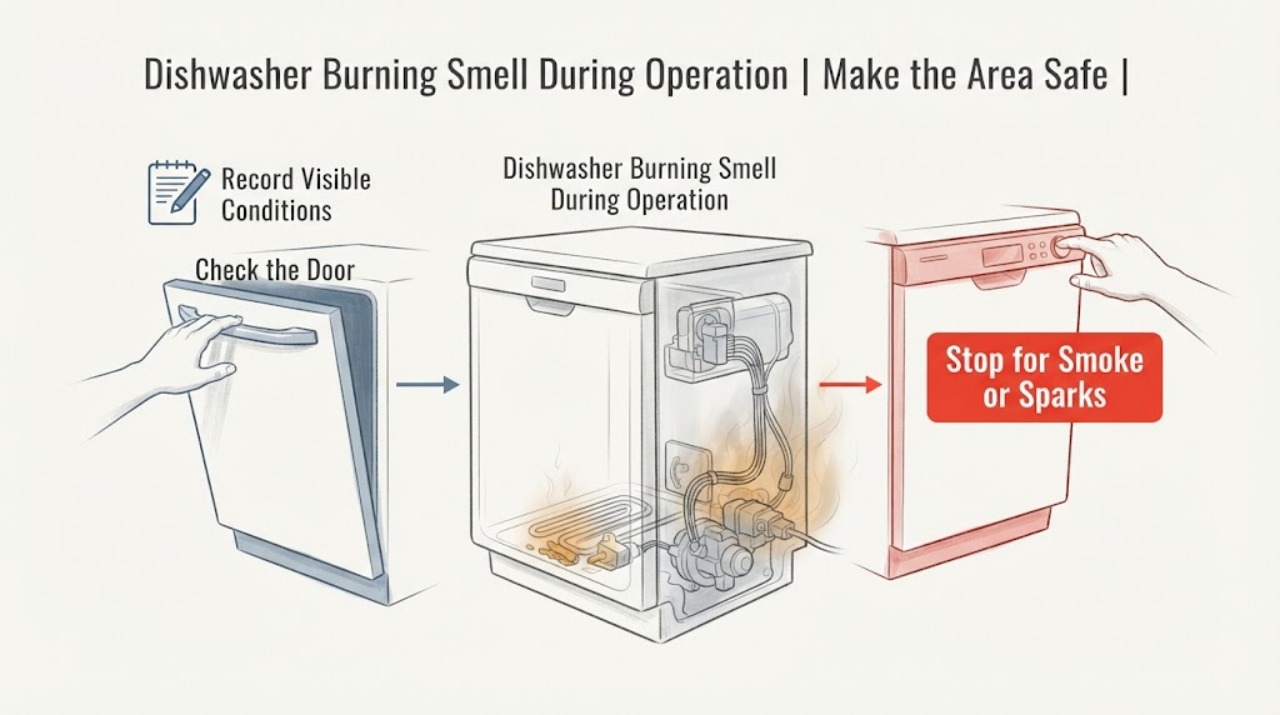
Stop the dishwasher as soon as a burning smell appears during a cycle. Cancel the cycle if the controls respond, isolate power at the breaker or unplug only from a dry, safe location, and do not restart it to identify the source. A manufacturer may document a limited cause such as plastic or food contacting the heating element, but a burning odor can also accompany damaged wiring, a failing component, or a fire hazard. After the unit is completely cool, make only a visual, no-touch observation from the door or tub; do not remove panels, reach under the dishwasher, scrape the heater, or run another cycle. If the smell persists, there is smoke, scorching, melted wiring, a tripped breaker, water near electrical parts or any uncertainty, leave the dishwasher off and arrange qualified appliance service.
Work through in order
Diagnostic checks
Use only checks that match the exact appliance or system and its official guide.
-
Check 1
Stop the cycle immediately. If the controls respond, cancel or switch the dishwasher off; then disconnect power by unplugging only if the plug and area are dry and safe to reach, or by turning off the dishwasher circuit breaker. Do not restart the appliance.
Expected result: The smell stops when operation ends, or there is continuing smoke, heat, arcing, a hot outlet, a tripped breaker or water near electrical parts.
Next step: Leave the dishwasher off and arrange qualified appliance/electrical service. If there is active smoke or fire, evacuate and contact emergency services; do not open the appliance to investigate.
Stop if: Stop all contact for smoke, flame, sparking, a hot outlet, wet electrical parts or a breaker that will not remain off.
Why this matters
Why: A burning smell is an unresolved heat/electrical symptom. Stopping the cycle removes the immediate operating source but does not prove the cause is gone; continuing smoke or electrical damage is an emergency boundary.
-
Check 2
After power is isolated and the unit is fully cool, open the door and look without touching for melted plastic, food debris, scorch marks, smoke residue or a fallen item near the visible heating-element area. Do not scrape, pull, reach under the tub or remove the lower access panel.
Expected result: There is an obvious fallen/melted item or residue, or the visible tub and element area look clear.
Next step: Photograph the finding and provide it to service. If the item is fused to the heater, there is scorching or the source is not clearly removable without contact, leave the unit disconnected and do not attempt cleaning or scraping.
Why this matters
Why: Maytag and GE document plastic or food contacting the heater as one possible source of a burning odor. A clear visible area does not exclude hidden wiring, pump, motor, control or insulation damage, and a visible item is not permission to run a confirming cycle.
-
Check 3
Record the exact model/serial label, cycle and stage when the smell began, whether the smell was plastic/electrical/food-like, whether smoke was visible, and whether the breaker or lights changed. Do not infer a failed heater, pump or control from the odor alone.
Expected result: The smell occurred during wash, drain, heated dry or another identifiable stage, or the stage cannot be determined.
Next step: Give the record and photos to qualified service. Keep the dishwasher off until the source and any heat damage are inspected; do not use a generic part or model-independent repair procedure.
Why this matters
Why: Cycle timing helps a technician scope the inspection, but without the model and a safe observation it does not identify a component. Manufacturer cleaning and heating behavior varies by design.
-
Check 4
From outside the appliance only, inspect the accessible plug, cord, outlet and nearby cabinet area for scorching, melted plastic, looseness, water or a burnt electrical odor. Do not pull out a built-in dishwasher, remove panels or touch hard-wired connections.
Expected result: The external power area is damaged or wet, or it appears intact while the odor remains unexplained.
Next step: Leave power off and call a qualified appliance technician; use a qualified electrician when the receptacle, cord or household circuit is involved. Do not re-energize to test.
Stop if: Stop for any wet electrical area, scorch, melted insulation, sparking or repeated breaker trip.
Why this matters
Why: External damage or moisture increases the electrical hazard and needs professional isolation. An intact exterior does not clear hidden wiring, terminal, heater, pump or control components.
-
Check 5
Before any return to service, have qualified service inspect the heating element and wiring, pump/motor area, controls, power connection and any visible heat damage using the exact model documentation. Do not accept “the smell went away” as proof of a safe repair.
Expected result: The technician identifies and repairs a documented cause with no remaining damage, or the source remains uncertain or the odor returns.
Next step: Keep the dishwasher disconnected until the professional confirms the repair and safe reassembly. If the smell returns, stop use immediately and request further service rather than running another diagnostic cycle.
Why this matters
Why: An odor that disappears after cooling can still leave a damaged connection or component. Persistent or recurring odor is not a normal cleaning issue without model-specific evidence.
Use your observations
Decision map
Find the observation that best matches what you see, then follow the next safe action.
-
PATH 01Next step
What you see
There is smoke, flame, sparking, a hot or wet outlet, melted wiring, repeated breaker trips or an active burning smell after the dishwasher is stopped.
Do this next
Leave the area if needed, keep the dishwasher disconnected from a safe location and contact emergency services for active fire or qualified appliance/electrical service for the appliance. Do not open panels.
Why this path and its safety boundary
Why it matters: This is an electrical/fire hazard and cannot be safely narrowed by user cleaning or another cycle.
-
PATH 02Next step
What you see
The dishwasher is new or recently installed and the odor appears without smoke, scorching or electrical symptoms.
Do this next
Keep the dishwasher off until the manual/installer confirms the condition and the unit is checked for packing material or installation problems. Do not run repeated cycles to clear the odor.
Why this path and its safety boundary
Why it matters: A new-material or packing-related odor is possible on some models, but the exact manual and an inspection are needed before calling a burning smell normal.
-
PATH 03Next step
What you see
A visible plastic item or food residue is found near the heating element after the unit has fully cooled, with no scorch, wiring damage, smoke or electrical symptom.
Do this next
Photograph it and ask qualified service or the exact owner manual whether a safe cool-down cleaning is permitted. Do not touch the element or run a confirming cycle.
Why this path and its safety boundary
Why it matters: The visible item is a possible localized odor source, but the condition is not proven safe to remove or test without model-specific guidance.
-
PATH 04Next step
What you see
No visible cause is found, or the odor began during drain, wash, heated dry or another stage and returns after cooling.
Do this next
Keep the dishwasher off and arrange model-specific qualified service. Provide the stage, odor description, photos and breaker history.
Why this path and its safety boundary
Why it matters: The unresolved pattern may involve hidden electrical, heating, pump, motor or control components; odor alone cannot identify which.
-
PATH 05Next step
What you see
A qualified technician confirms the source and completes a repair, but smoke, heat, odor or breaker trips recur.
Do this next
Stop use again and request immediate reassessment. Do not replace the dishwasher or keep testing until the professional identifies the remaining cause.
Why this path and its safety boundary
Why it matters: The appliance is not verified safe and the initial repair did not resolve the hazard.
Helpful context
Understand the symptom
Treat the smell as a safety symptom first
The task supplies no brand or model and does not establish whether the odor is plastic, food, wiring, a motor/pump or another component. A burning smell during operation is therefore not a cleaning diagnosis. Maytag's support guidance specifically treats burning odor, damaged wiring or repeated breaker trips as reasons to stop and contact qualified service. Do not keep running the dishwasher to see whether the smell returns.
A cool-down visual check is the limit
After power is isolated and the dishwasher has fully cooled, look only through the open door for smoke residue, a fallen plastic item or obvious debris around the visible tub area. Do not touch the heating element, reach below the tub, remove the toe-kick or open an electrical compartment. A visible item may be one possible source, but its presence does not clear hidden wiring or heat damage.
When checks do not resolve it
Need a professional?
Provide the full model/serial, cycle/stage, odor description, smoke or scorch observations, photos taken only after safe isolation, breaker history and whether water or the outlet was involved.
Common questions
FAQ
Can I run one more cycle to see where the burning smell comes from?
No. Stop the dishwasher and isolate power. A recurring smell, damaged wiring or breaker trip needs qualified service; another cycle can re-energize the condition and increase heat or fire risk.
Could melted plastic cause a dishwasher burning smell?
It is one documented possibility when plastic or food contacts the heating element, but the task provides no evidence that this is the cause. Do not touch or scrape the element; have the cooled appliance checked under its exact manual.
Should I clean the filter first?
A filter may explain ordinary food odors, but it does not clear a burning smell during operation. Isolate power and stop at a visual, no-touch observation; leave electrical, heating or recurring odor symptoms to qualified service.
Read the exact guide
Official sources
- Melted Plastic or Charred Food Odor - DishwasherMaytag · The opened Maytag Product Help page supports only the conditional possibility of debris at the heating element and the requirement to wait until fully cool; this article intentionally stops before removal or another cycle because model and safety status are unknown.
- Dishwasher Not Draining - Product Help | MaytagMaytag · The opened Maytag Product Help page is used for its explicit safety boundary: isolate power, stop for burning smell/damaged wiring/repeated breaker trips and call qualified service. It is not used to diagnose this unidentified dishwasher.
- Dishwasher - Burning Odor, Removing Plastic from ElementGE Appliances · The opened GE support article identifies melted plastic/food at the heating element as one possible cause and requires power isolation before maintenance; it is used only as a conditional manufacturer example, not as a universal diagnosis or restart instruction.
- Dishwasher - OdorsGE Appliances · The opened GE article distinguishes ordinary food/new-material odors from abnormal persistent odors and directs model-specific support. It is used to avoid treating a burning smell as ordinary food odor, not to authorize cleaning or rerunning this unidentified unit.
Community feedback
Share a repair observation
Share a plain-text repair observation. Accepted observations are published automatically; this page may take a moment to update.