
On this page
Start here
Quick answer
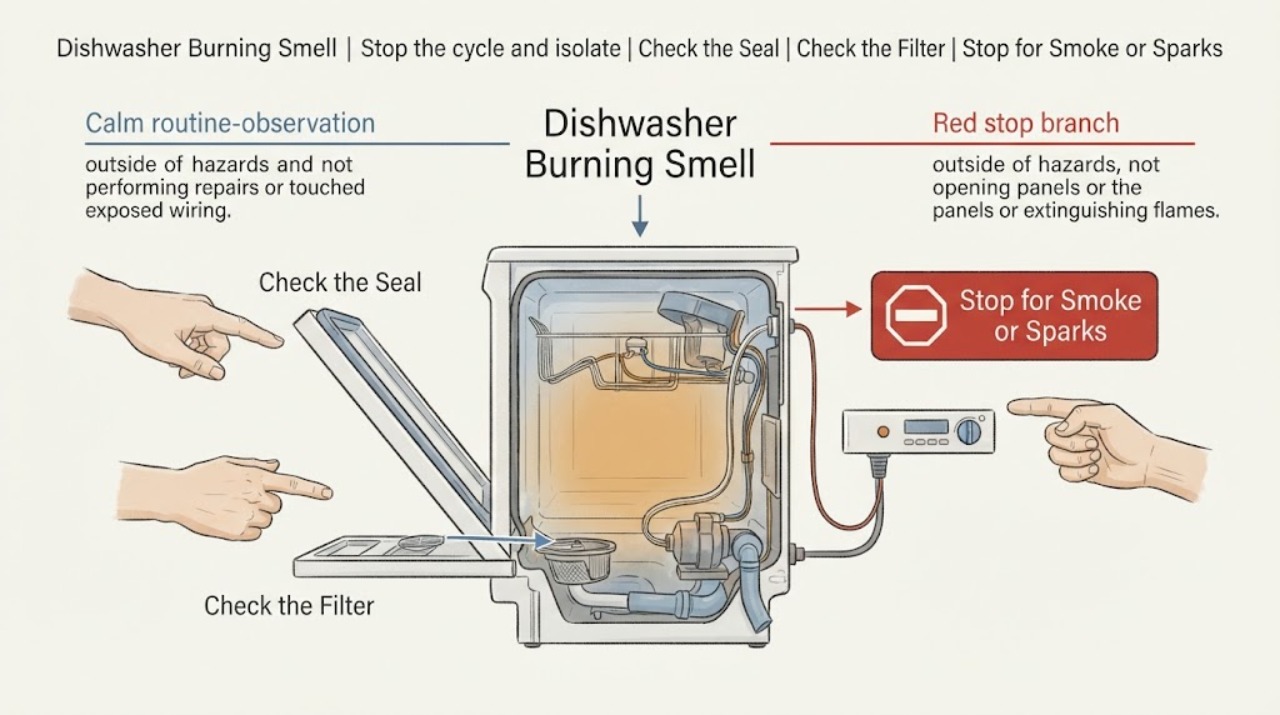
A burning or melting-plastic smell from a 20-year-old Frigidaire dishwasher is a stop-use symptom, not a reason to run another test cycle. Cancel the cycle if the controls respond, isolate power at the breaker or disconnect when it is safe to do so, keep the door closed if there is smoke or visible fire, and call emergency services for flames or spreading smoke. After the unit is cold and de-energized, limit inspection to the accessible tub, racks, door area, cord and nearby cabinet for melted plastic, scorching, water or a damaged connection. Do not remove panels, probe wiring, restore power, or guess whether the motor, heater or control is at fault. Frigidaire's ordinary-odor guidance covers cleaning and drainage, but a burning smell needs model-specific service and a safety assessment.
Work through in order
Diagnostic checks
Use only checks that match the exact appliance or system and its official guide.
-
Check 1
Stop the cycle and isolate the dishwasher from power without reaching through smoke, touching a hot surface or moving the appliance. Use the breaker or a clearly accessible disconnect; if you cannot isolate it safely, leave the area and call for help.
Expected result: The smell stops after power is isolated, or smoke, sparks, flame, crackling or a hot cabinet continues after the cycle is stopped.
Next step: Keep the dishwasher off and do not restore power. Call emergency services for flame, spreading smoke or immediate danger; otherwise arrange qualified appliance service and tell the technician the unit is about 20 years old and was stopped after a burning smell.
Why this matters
Why: A burning smell with smoke, flame, sparks or continuing heat is a potential fire event. A quiet appliance is not proof that the source is safe or repaired.
-
Check 2
After the appliance is cold and de-energized, look only at accessible areas: the tub floor and rack, door edge, gasket, detergent area, visible cord or plug, and the cabinet space immediately around the dishwasher. Do not remove panels or reach into the base.
Expected result: You see melted plastic, a blackened mark, warped rack or utensil, damaged insulation, scorch marks, water near a connection, or no visible change.
Next step: Photograph the accessible condition, leave the breaker or disconnect off, and give the photos and exact model/serial label to the service technician. Do not scrape, pull, bypass or replace an internal part based on appearance alone.
Why this matters
Why: A visible melted or scorched item may explain where heat was noticed but does not prove the internal cause. No visible mark does not rule out a hidden wiring, heater, motor, pump or control fault.
-
Check 3
Separate an ordinary food or standing-water odor from the reported burning smell without operating the unit. Check the accessible filter or glass-trap area only if it can be removed without restoring power or reaching under the machine, and note whether standing water is present.
Expected result: The odor is only stale/food-like with standing water, or it is sharp, electrical, scorched, rubber-like or associated with melted material.
Next step: For a burning or scorched smell, stop and schedule service without a test cycle. For a clearly ordinary odor with no heat, smoke, scorching or electrical smell, use the exact model manual and Frigidaire cleaning guidance rather than this safety branch.
Why this matters
Why: Frigidaire links ordinary odors to soil, filter/glass-trap maintenance and incomplete draining. A sharp burning or melting odor is outside that cleaning branch and should not be treated as a normal odor problem.
-
Check 4
Record the exact model and serial label, the cycle stage when the smell appeared, whether the dishwasher was heating or draining, whether the breaker tripped, and whether any smoke or visible melting occurred. Do not energize the machine to reproduce the event.
Expected result: The service record includes a repeatable stage or visible condition, or the timing is unknown because the machine was stopped immediately.
Next step: Give the notes, photographs and model label to an authorized or qualified appliance technician. Keep the dishwasher isolated until the technician determines whether it can be safely repaired.
Why this matters
Why: Timing can help a technician choose a safe diagnostic path, but it cannot identify a failed component without model-specific inspection. Unknown timing is still useful when paired with the stop-use history.
Use your observations
Decision map
Find the observation that best matches what you see, then follow the next safe action.
-
PATH 01Next step
What you see
There is active smoke, flame, sparking, crackling, spreading heat or a burning smell that continues after the cycle is stopped.
Do this next
Leave the area if needed, call emergency services for immediate danger, and do not open panels or throw water into an energized appliance. Do not restore power after the event.
Why this path and its safety boundary
Why it matters: This is a potential appliance fire or electrical emergency, not an ordinary dishwasher-odor problem.
-
PATH 02Next step
What you see
The unit is cold and isolated, and accessible inspection finds melted plastic, scorching, damaged insulation, a warped rack or a hot-looking connection.
Do this next
Photograph the damage, preserve the appliance in its isolated state, and obtain model-specific professional service. Do not replace the visible item and run the dishwasher to see whether the smell returns.
Why this path and its safety boundary
Why it matters: The visible damage confirms that abnormal heat occurred but does not establish whether the cause was the item, heater area, wiring, motor, pump or control.
-
PATH 03Next step
What you see
There is no smoke, flame, scorching or sharp burning smell; the remaining odor is food-like or associated with standing water.
Do this next
Keep the exact model manual available and follow Frigidaire's filter, glass-trap and drainage guidance only if the appliance is otherwise safe. Stop and arrange service if the smell becomes hot, electrical, scorched or recurrent.
Why this path and its safety boundary
Why it matters: This may fit Frigidaire's ordinary odor and drainage guidance rather than a confirmed electrical-burning event, but the distinction is based on the observed smell and condition.
-
PATH 04Next step
What you see
The smell returned during a prior cycle, the breaker tripped, or the source cannot be localized from accessible areas.
Do this next
Keep power isolated and request a qualified diagnostic visit. Do not use the dishwasher as a test load or make a repair-versus-replacement decision from age alone.
Why this path and its safety boundary
Why it matters: A hidden or recurring fault remains possible even if the dishwasher currently appears normal.
Helpful context
Understand the symptom
Why this smell changes the first decision
The supplied case describes a roughly 20-year-old Frigidaire dishwasher whose cycle was stopped after a burning smell was noticed. Age does not identify the failed part, and the exact model is unavailable. A burning or melting-plastic odor can accompany overheating, an electrical fault, a heated component, trapped plastic or another condition that cannot be separated safely by restarting the appliance. The U.S. Fire Administration identifies electrical and appliance fire risks and warns about damaged appliance cords, so the first decision is isolation and safety rather than a repeat cycle.
Ordinary odor guidance is a different branch
Frigidaire's owner guidance for ordinary dishwasher odors discusses soil, filters, standing water and drainage, and directs owners to service when the issue is not resolved. Those instructions do not authorize running a dishwasher that smells electrically hot, scorched or like melting plastic. Do not substitute a cleaning cycle or vinegar treatment for a safety inspection.
When checks do not resolve it
Need a professional?
Stop using the dishwasher and arrange qualified service for any burning, electrical, scorched or melting-plastic smell, especially if it recurs, trips a breaker or leaves visible heat damage. Call emergency services for active flames, spreading smoke or immediate danger.
Common questions
FAQ
Does a 20-year-old Frigidaire dishwasher with a burning smell need to be replaced?
The age does not identify the failed component or make it safe to keep operating. Isolate power, document the accessible condition and obtain a qualified safety diagnosis before deciding what to do with the appliance.
Can I run an empty cycle to see whether the smell comes back?
No. A burning or melting smell is a reason to keep the dishwasher out of service. A repeat cycle can recreate an overheating or fire condition without adding useful information for a safe owner diagnosis.
Could the smell just be a dirty filter or standing water?
Frigidaire says food soil, filters, standing water and drainage can cause ordinary dishwasher odors. That guidance is for a stale or food-like odor; it does not clear a sharp electrical, scorched or melting-plastic smell for continued use.
What information should I give the service technician?
Provide the full model and serial number, approximate age, cycle stage, whether the unit was heating or draining, whether the breaker tripped, where the odor was strongest, photographs of any visible melting or scorching and whether smoke or flame appeared.
Read the exact guide
Official sources
- Appliance and Electrical Fire SafetyU.S. Fire Administration · Used for appliance electrical-fire risk, damaged-cord and direct-wall-outlet safety boundaries; not a Frigidaire repair manual.
- Dishwasher - OdorsFrigidaire Owner Support · Used only for the non-burning odor branch and not as permission to run a unit with a burning smell.
- Dishwasher - Why does my dishwasher have an odor and how do I fix it?Frigidaire Owner Support · Used to distinguish ordinary odor guidance and the manufacturer service path; not used to diagnose a burning smell or identify a model.
- Dishwasher - Drain Hose GuideFrigidaire Owner Support · Used only to explain ordinary odor/drain context; no model-specific hose change or internal repair is advised.
Community feedback
Share a repair observation
Share a plain-text repair observation. Accepted observations are published automatically; this page may take a moment to update.