
On this page
Start here
Quick answer
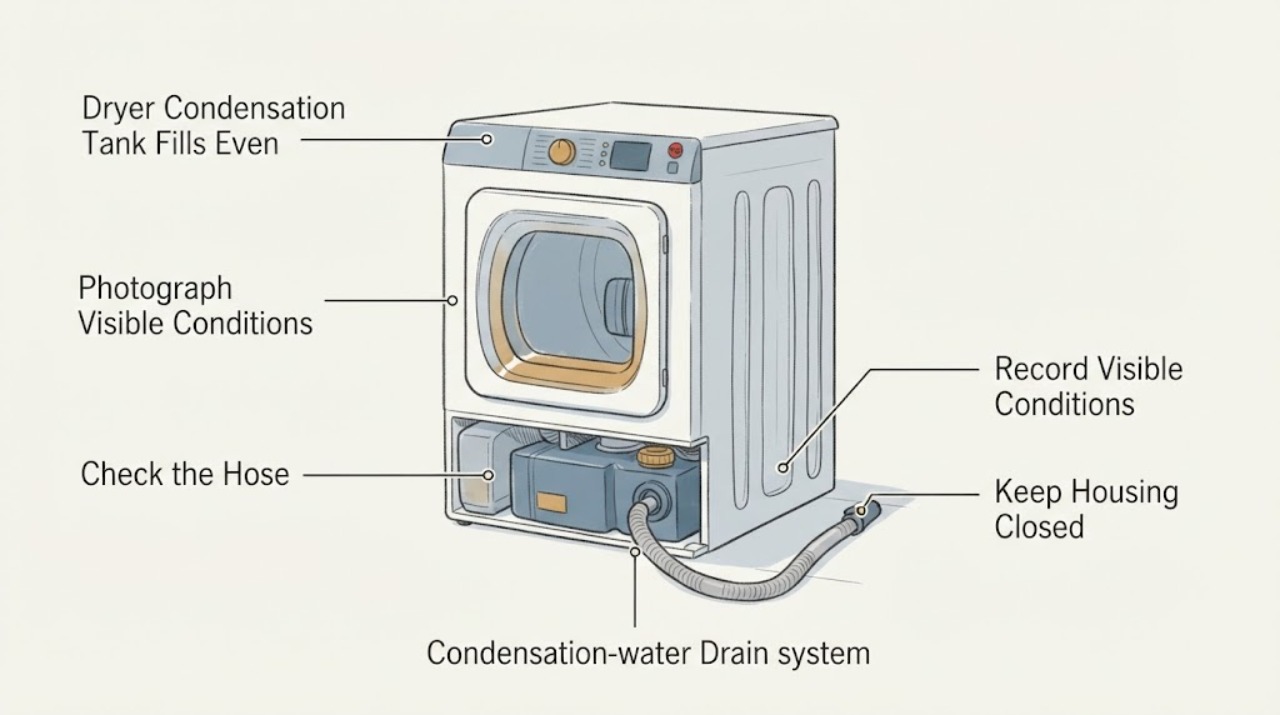
On the Bosch WTW87NH1UC, water in the condensation tank is normal when the dryer is configured to collect condensate in that tank. It is not expected to require emptying when the supplied hose has been moved from the tank inlet to a suitable household drain and that drain path is open. First identify which configuration you actually have: a hose still attached at the tank inlet means tank collection, while a hose routed to a standpipe, sink, or floor drain means direct drainage. With the dryer off, check only the visible hose route for a kink, crushed section, loose connection, blocked or sealed drain opening, backflow, or a hose end sitting in standing water. If the tank still fills in the direct-drain setup, or the hose or connection leaks, stop repeated cycles and arrange Bosch or qualified appliance service; do not disconnect the hose at the sump/pump, tilt the dryer, open the cabinet, or run it while changing the water path.
Before you begin
Safety first
- Do not disconnect the drain hose at the dryer's sump/pump, tilt or pull out a stacked or built-in dryer, open the cabinet, probe wiring, run with a panel removed, or change the water path while the appliance is powered. Keep the dryer off for leaks, overflow, water near electrics, abnormal pump noise, smoke, burning odor, or damaged power components.
Work through in order
Diagnostic checks
Use only checks that match the exact appliance or system and its official guide.
-
Check 1
Switch the dryer off and let hot laundry and nearby surfaces cool. Read the rating plate and record the full E-Nr. suffix if present (the Bosch support page lists WTW87NH1UC variants such as /01, /02, and /05). Without moving the appliance, photograph or note whether the hose is still attached to the tank inlet at the upper rear or runs from the dryer to a standpipe, sink, or floor drain.
Expected result: The hose remains at the tank inlet, the hose outlet is visibly routed to a household drain, the suffix cannot be read, or the appliance identity does not match WTW87NH1UC.
Next step: If the hose is in the tank configuration, empty the tank normally at the end of a cycle and do not treat that water alone as a fault. If direct drainage is intended, continue with the external route checks and use the exact manual for the recorded suffix; if identity is uncertain, pause and obtain the matching Bosch documentation.
Stop if: Do not pull the dryer out, disconnect a hose, or reach behind a tight installation while it is powered or hot. Stop for standing water near electrical parts, a damaged cord, smoke, burning odor, or a damaged hose.
Why this matters
Why: A hose left at the tank inlet is the documented tank-collection configuration, so a filling tank is expected. A drain-hose outlet at a household drain is a different configuration that requires a free, correctly installed drain path. An unreadable suffix or mismatched appliance means the WTW87NH1UC instructions cannot be assumed to apply.
-
Check 2
With power off and without opening the cabinet, inspect the visible length and outlet of the supplied drain hose. Check for a kink, crush, sharp bend, loose clamp or tie, visible split, an end pushed into standing water, or an opening that has been sealed. Confirm the outlet is a suitable open drain and that it is not obviously obstructed; do not disconnect the hose from the dryer's sump/pump connection.
Expected result: The hose is kinked or damaged, its connection is loose, the outlet is sealed or blocked, the hose end sits in standing water, or the accessible route appears open and free-flowing.
Next step: Only correct a plainly visible external kink or loose securing arrangement using the matching Bosch installation instructions, with the dryer stationary and unpowered. If the route is damaged, inaccessible, or still does not drain, stop and arrange service rather than opening the pump area.
Stop if: Do not run the dryer while holding or disconnecting the hose, seal the drain opening, force a fitting, cut or splice the hose, remove the lower sump/pump connection, or tilt the appliance.
Why this matters
Why: Bosch warns that condensate must flow freely, the drain opening must remain open to avoid back-siphon, and the hose end must not sit in pumped-out or standing water. A visible restriction or leak can explain a tank-full indication or water returning to the appliance; a clear external route does not prove that the internal pump or sump path is healthy.
-
Check 3
If the direct-drain route is visibly intact and dry, empty the condensation tank using its normal handle and push it back until it locks. Record whether the tank was empty, partly full, or near full, whether the ð water-drain indicator was lit, and whether water was seen at the household drain after a completed cycle; do not start a cycle solely to watch an exposed connection.
Expected result: Water reaches the household drain and the tank stays at its normal level, the tank fills while no water reaches the drain, the indicator returns, or water leaks under/behind the dryer.
Next step: If water does not reach the drain or the indicator returns, keep the dryer off and contact Bosch service with the exact E-Nr. suffix, setup type, tank level, indicator state, and visible hose findings. If only the tank configuration is being used, empty it after each cycle as the manual directs.
Stop if: Do not repeatedly run cycles to force drainage, pour water into the dryer, probe the pump, or open the housing. Stop immediately for a leak, overflow, water near electrics, unusual pump noise with no discharge, or a hot or damaged cord.
Why this matters
Why: Drain discharge with no abnormal tank rise supports a functioning external route. A filling tank with no drain discharge points to a drainage-routing, restriction, connection, or internal drainage issue, but does not identify a replacement pump. A recurring water-drain indicator means Bosch's accessible hose checks have not resolved the issue.
-
Check 4
Compare the installation with the WTW87NH1UC manual's drainage limits and routing rather than a generic dryer guide: keep the hose free of kinks, keep an open drain connection, and confirm the visible drain height and securing arrangement are appropriate for the installed sink, standpipe, or floor drain. Do not move a stacked or built-in appliance to inspect hidden plumbing.
Expected result: The drain height or outlet arrangement is outside the documented installation examples, the hose is crushed behind the appliance, the connection is hidden, or the installation matches the manual at the visible points.
Next step: Have the installer, building maintenance, or qualified appliance technician correct an inaccessible or nonconforming drain installation. If the visible installation matches Bosch's instructions but the tank still fills, provide the record to Bosch service for model-specific diagnosis.
Stop if: Do not pull out a heavy or stacked dryer, detach household plumbing, alter a standpipe, or remove panels to reach the hidden route.
Why this matters
Why: An unsuitable height, crushed route, or hidden connection can prevent free drainage or permit backflow even when a hose is technically connected. A visually matching installation narrows the issue to a possible inaccessible blockage, pump/sump path, sensor, or control problem; it does not select a part.
Use your observations
Decision map
Find the observation that best matches what you see, then follow the next safe action.
-
PATH 01Next step
What you see
The hose is still attached at the upper tank inlet and there is no separate outlet to a household drain.
Do this next
Empty the tank normally and keep the hose connection as delivered, or have the direct-drain conversion performed exactly as the Bosch manual specifies. Do not change the lower sump/pump connection.
Why this path and its safety boundary
Why it matters: The dryer is configured to collect condensate in its tank. Filling the tank is normal in this configuration, and the direct-drain hose wording does not mean the tank should remain empty.
-
PATH 02Next step
What you see
The hose is routed to a household drain, but the tank fills and no water is observed at the drain outlet.
Do this next
Stop the dryer after the safe external inspection, document the exact setup and E-Nr. suffix, and arrange Bosch or qualified appliance service. Keep the cabinet and sump/pump area closed.
Why this path and its safety boundary
Why it matters: The intended direct-drain decision is not being achieved. An external restriction, kink, sealed opening, back-siphon, loose connection, or an inaccessible internal drainage problem is more likely than a need to replace a part based only on tank level.
-
PATH 03Next step
What you see
Water reaches the drain, but the tank level is also rising abnormally or the ð indicator returns.
Do this next
Do not keep testing. Request Bosch service and report whether the hose is direct-drain or tank-collection, where water was observed, the indicator state, and any leak or noise.
Why this path and its safety boundary
Why it matters: The external outlet is not the whole story. The pattern needs model-specific assessment of the drain routing, tank connection, pump/sump path, sensor, or control; it is not evidence for a particular pump or control part.
-
PATH 04Safety boundary
What you see
The hose, tank, or rear connection is leaking, there is standing water near the appliance, or the power cord/outlet is wet or damaged.
Do this next
Stop the appliance, keep clear of wet electrical areas, isolate power only from a dry and safe position, and arrange qualified service or building maintenance. Address any active electrical or fire hazard urgently.
Why this path and its safety boundary
Why it matters: This is a water-and-electrical safety branch, not an invitation to keep running the dryer to locate the leak.
Safety stop: No restart, live test, hose disconnection, cabinet opening, tilting, or improvised sealing.
Helpful context
Understand the symptom
The WTW87NH1UC is a Bosch 500 Series ventless heat-pump dryer, not a conventional vented dryer. Its condensate can either be collected in the removable tank or sent through the supplied drain hose to a suitable household drain. A tank that fills therefore does not by itself prove a pump or condenser failure: it may simply show that the hose is still in the tank-collection configuration.
The exact distinction is where the hose is connected and where its outlet terminates. Bosch's WTW87NH1UC manual says the supplied hose is delivered connected to the tank inlet; for direct drainage, the top connection is changed to a standpipe or other drain while the hose remains connected to the dryer sump/pump outlet. Do not infer the setup from the phrase 'drain hose connected' alone.
If an external drain was intended but condensate returns to the tank, the useful first question is whether water can leave freely without back-siphoning. A visibly kinked or restricted hose, a sealed drain opening, an incorrectly secured outlet, or an outlet submerged in standing water can defeat the intended drainage path. Checks beyond the accessible hose and drain belong to Bosch or qualified service.
When checks do not resolve it
Need a professional?
Call Bosch or qualified appliance service when the hose is routed to a drain but condensate does not discharge there, the ð indicator returns after the tank and visible hose checks, the external installation is inaccessible or nonconforming, or the tank and drain show conflicting behavior.
Safety scope: Do not disconnect the drain hose at the dryer's sump/pump, tilt or pull out a stacked or built-in dryer, open the cabinet, probe wiring, run with a panel removed, or change the water path while the appliance is powered. Keep the dryer off for leaks, overflow, water near electrics, abnormal pump noise, smoke, burning odor, or damaged power components.
Have this ready
- Provide the rating-plate E-Nr. including suffix, country, whether the hose is at the tank inlet or routed to a household drain, drain type and visible height, tank level, ð indicator state, whether water reaches the drain, any leak or unusual noise, and whether the appliance is stacked or built in.
Common questions
FAQ
Is it normal for the Bosch WTW87NH1UC condensation tank to fill with water?
Yes, when the dryer is left in its tank-collection configuration. Bosch says direct drainage is optional; when the supplied hose is routed to a suitable household drain, the tank should not need emptying. Identify the actual hose configuration before treating tank water as a fault.
Why is the tank filling even though my Bosch dryer has a drain hose?
The hose may still be attached to the tank inlet rather than converted to direct drainage, or the direct route may be kinked, restricted, sealed, incorrectly secured, or allowing back-siphon. Check only the visible route with the dryer off. A connected hose alone does not prove that condensate can reach the household drain.
Can I disconnect the drain hose from the bottom of the WTW87NH1UC?
No. The Bosch installation instructions specifically warn not to disconnect the hose from the sump/pump connection at the bottom. Do not tilt or open the dryer; use the exact installation instructions or qualified service.
What does the Bosch water-drain indicator mean on this dryer?
The WTW87NH1UC manual associates the indicator with water that has not drained completely and directs the owner to empty the tank, check the drain hose for kinks, restrictions, or blockage, and check the hose connection. If the indicator remains, contact Bosch Customer Service rather than selecting a pump or control part from the symbol alone.
Read the exact guide
Official sources
- en-us Use and Care Manual, Installation InstructionsBosch · Exact Bosch manual opened for the WTW87NH1UC family; the document heading identifies WTW87NH1UC2 and the instructions describe the supplied hose, tank inlet, direct-drain setup, hose limits, tank collection, and water-drain troubleshooting.
- 24" Compact Heat Pump DryerBosch · Exact Bosch specification sheet opened for WTW87NH1UC; it confirms the ventless heat-pump platform, drain-hose specification, and installation responsibility without defining a cross-platform fault.
- WTW87NH1UC Heat Pump Dryer | BOSCH USBosch · Exact Bosch US product page opened for the assigned WTW87NH1UC model; it identifies the appliance as a 500 Series heat-pump dryer and links to model support and documents.
- www.bosch-home.comBosch · Exact Bosch support page opened for WTW87NH1UC; it lists model variants and supports confirming the rating-plate suffix before applying instructions.
Community feedback
Share a repair observation
Share a plain-text repair observation. Accepted observations are published automatically; this page may take a moment to update.