
On this page
Start here
Quick answer
For the Bosch 500 Series heat-pump dryer, the official product information describes a Self-Cleaning Condenser that rinses fluff during each cycle and eliminates the need to clean the condenser by hand. Bosch's cleaning guidance says its removable heat-exchanger procedure applies to non-self-cleaning condensers and says it does not recommend cleaning a heat-pump dryer yourself. Clean only the user-accessible lint filter, condensate-container filter, drum/moisture sensor and exterior using the exact manual, and confirm the product number before using any model-specific instruction. Do not pry open the lower assembly, insert tools, flush the heat-pump area, add vinegar or detergent, open the sealed refrigeration circuit, or follow a Bosch 300/European procedure on an unconfirmed Bosch 500. If drying remains slow, lint is visible behind a non-user-serviceable area, water is not being managed normally, or the dryer shows an error, stop improvising and arrange Bosch or qualified appliance service.
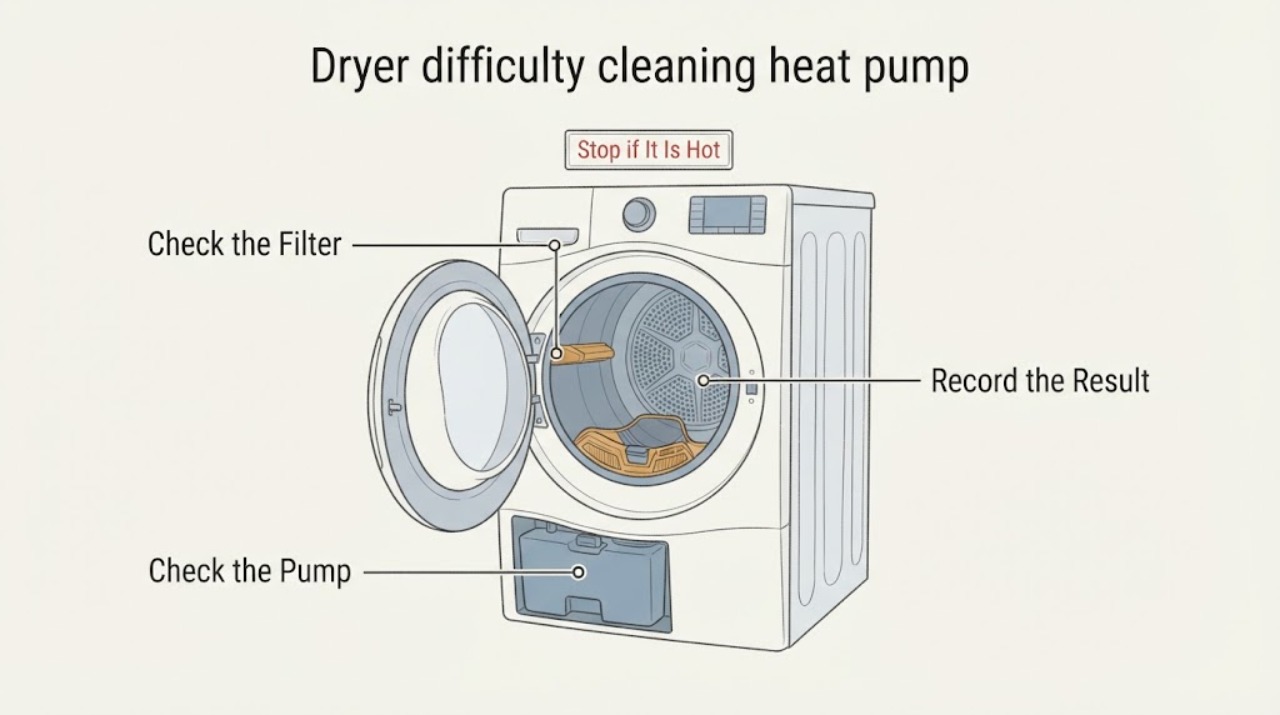
Work through in order
Diagnostic checks
Use only checks that match the exact appliance or system and its official guide.
-
Check 1
Read the complete product number from the dryer rating plate or owner documentation before opening any maintenance flap or choosing a cleaning routine. Confirm that it is the Bosch 500 Series heat-pump dryer covered by the task, rather than a Bosch 300, another Bosch series, or a European model with a different service layout.
Expected result: The label matches a Bosch 500 Series heat-pump dryer, the label identifies a different family, or the product number cannot be read.
Next step: Use the manual for the exact product number. If the product number is different or unavailable, stop at the general accessible-filter checks and ask Bosch or a qualified servicer to confirm the maintenance path.
Why this matters
Why: Bosch's US 500 materials identify specific product numbers such as WQB245B0UC and describe the self-cleaning condenser for that family. A series name alone does not prove that another access panel, cleaning cycle, filter or heat exchanger is the same.
-
Check 2
With the dryer switched off and cool, clean the door lint filter exactly as the identified manual describes. Remove visible lint from the filter area without pushing debris into the shaft, and do not use a tool to reach the heat-pump or condenser compartment.
Expected result: The filter is blocked or coated, the filter is clean but lint is visible behind a fixed/non-user-accessible area, or no abnormal lint is found.
Next step: If the filter is blocked, clean and dry it before the next normal load. If lint is behind a fixed assembly or the problem persists with a clean filter, keep the dryer off for that issue and arrange model-specific service rather than prying or vacuuming inside.
Why this matters
Why: Bosch says lint filters should be cleaned after use; a blocked accessible filter can affect drying, while visible buildup behind a non-user-serviceable assembly is outside the self-cleaning condenser's normal user procedure.
-
Check 3
Check only the accessible condensate container and its user-removable filter, if the exact manual identifies one. Empty the container as instructed, rinse the filter under running water only when the manual permits it, let it dry as directed, and reinstall it fully; do not pour cleaner or hot water into the heat-pump area.
Expected result: The container is full, the filter has lint/deposits, the container is unusually dry after a cycle, or the container/filter appears normal.
Next step: Follow the exact manual for the confirmed product number. If the container does not fill as expected, leaks, or the warning returns after an approved empty/filter clean, stop using improvised cleaning fluids and contact Bosch service.
Why this matters
Why: Bosch identifies the condensate container and filter as maintenance items on applicable dryers, while the self-cleaning condenser is a separate automatic path. A dry container or recurring water-management change may indicate a service issue but does not prove a pump or condenser fault.
-
Check 4
Clean the accessible drum and moisture sensor with the identified Bosch maintenance instructions: unplug or disconnect power as the manual directs, use a soft damp cloth for the drum, and use only the specified mild cleaning method for the sensor. Do not spray or flood the interior, and do not remove panels.
Expected result: The sensor has visible residue, the drum has residue, the accessible surfaces are clean, or drying remains slow despite clean accessible surfaces.
Next step: Dry all cleaned accessible surfaces and use the dryer only according to the manual. For persistent slow drying, error messages, unusual heat or inaccessible lint, record the symptom and arrange qualified Bosch service.
Why this matters
Why: Bosch says residue on moisture sensors can affect sensing and drying results and describes accessible cloth cleaning. Persistent slow drying after these checks points to airflow, condensate, heat-pump or another model-specific service path rather than a reason to open the condenser.
-
Check 5
Document the full product number, cycle/load, drying-time change, filter and condensate observations, error message, and whether the automatic rinse/self-cleaning behavior appears normal. Give that record to Bosch support or a qualified appliance technician.
Expected result: The issue remains after approved accessible maintenance, a warning or error persists, lint is behind a fixed area, or the heat exchanger/heat-pump area appears to need cleaning.
Next step: Keep the dryer off if it is overheating, smells burned, leaks, or has exposed electrical damage; otherwise schedule Bosch or qualified service for model-matched inspection. Do not open the heat pump, sealed refrigeration circuit, or electrical cabinet.
Why this matters
Why: Bosch directs heat-exchanger cleaning on heat-pump dryers to trained or expert service and does not establish a user-removable condenser for the 500 Series from the task's series label alone.
Use your observations
Decision map
Find the observation that best matches what you see, then follow the next safe action.
-
PATH 01Next step
What you see
The product label is not a Bosch 500 Series heat-pump dryer, or the product number cannot be confirmed.
Do this next
Stop using family-level access instructions. Find the exact manual or ask Bosch support/qualified service to identify the machine before cleaning any condenser or heat exchanger.
Why this path and its safety boundary
Why it matters: The Bosch 500 self-cleaning-condenser claim and its maintenance boundary may not apply to the observed machine.
-
PATH 02Next step
What you see
The exact 500 Series model is confirmed, the lint filter and other accessible maintenance items are clean, and drying is normal.
Do this next
Continue the exact manual's lint-filter and accessible-container/sensor care. Do not add a yearly condenser-cleaning routine unless Bosch provides one for that exact product number.
Why this path and its safety boundary
Why it matters: The self-cleaning condenser and ordinary user maintenance are behaving consistently with the official product description; there is no evidence that manual condenser access is needed.
-
PATH 03Next step
What you see
Drying takes substantially longer, an error or water warning returns, the condensate behavior changes, or lint is visible behind a fixed/non-user-accessible assembly.
Do this next
Stop improvising and arrange Bosch or qualified service with the full model number and observations. Do not pry open the condenser, flush the heat-pump compartment, or choose a part from the symptom.
Why this path and its safety boundary
Why it matters: The accessible maintenance path has not resolved the issue; a pump, airflow, sensor, condenser rinse or other internal cause remains unconfirmed.
-
PATH 04Next step
What you see
There is a burning smell, smoke, abnormal heat, water near electrical parts, damaged wiring, or the dryer trips protection.
Do this next
Stop the dryer, disconnect power only if it is safe to do so without touching wet or damaged electrical parts, and arrange qualified appliance/electrical service. Do not restart it to test a cleaning result.
Why this path and its safety boundary
Why it matters: This is a safety/service condition rather than a cleaning question, and repeated operation could increase risk.
-
PATH 05Next step
What you see
A video, forum reply, or another Bosch model suggests removing a condenser, inserting a knife/tool, pouring vinegar or detergent, or entering an undocumented cleaning cycle.
Do this next
Do not follow it. Use the exact Bosch manual or ask Bosch service to confirm the procedure for the product number.
Why this path and its safety boundary
Why it matters: The suggestion is outside the opened Bosch 500 official evidence and may concern a different model or region; the exact heat-pump procedure is not established.
Helpful context
Understand the symptom
The wording “self-cleaning heat pump” describes a maintenance design, not an invitation to reach into the heat exchanger. Bosch's 500 Series materials describe a self-cleaning condenser that rinses fluff as the dryer runs. That is why a Bosch 300 access-panel procedure, a generic condenser-washing video, or advice for another Bosch/Siemens family cannot be transferred without the full product number.
Bosch's own cleaning overview makes the boundary explicit: the removable heat-exchanger instructions are for a non-self-cleaning condenser, and Bosch does not recommend cleaning a heat-pump dryer on your own. The safe user-maintenance path is therefore limited to the accessible lint filter, condensate-container filter, moisture sensor, drum and exterior described for the identified model.
If the real concern is longer drying, lint behind an inaccessible area, a dry condensate drawer, an error, or a change in the automatic rinse behavior, record that observation and request model-matched service. A Reddit discussion confirms the Bosch 500 cleaning question and reports that the poster could not reach the condenser, but its comments include other models and unverified user suggestions; they are not a Bosch 500 cleaning procedure.
When checks do not resolve it
Need a professional?
Tell Bosch service that the appliance is a Bosch 500 Series heat-pump dryer and provide the complete product number, the request to clean the self-cleaning condenser/heat-pump area, the drying-time or lint symptom, filter/container observations, warnings and whether accessible maintenance was completed.
Common questions
FAQ
Does self-cleaning mean I should manually wash the Bosch 500 condenser once a year?
No. Bosch's 500 Series materials say the self-cleaning condenser rinses fluff during each cycle and eliminates the need to clean the condenser by hand. Bosch also says its removable heat-exchanger instructions apply to non-self-cleaning condensers and does not recommend cleaning a heat-pump dryer yourself.
Can I use the Bosch 300 access-panel method or a forum's vinegar-and-hot-water recipe?
Do not assume either applies. The opened Reddit thread itself distinguishes the Bosch 500 access panel from the Bosch 300, and the forum quantities and cycles are not an official Bosch 500 procedure. Confirm the full product number and follow its manual or Bosch service guidance.
What can I clean myself on a Bosch 500 heat-pump dryer?
Use the exact manual for the accessible lint filter, condensate-container filter if fitted, drum, moisture sensor and exterior. Stop before the condenser/heat-exchanger or heat-pump assembly; Bosch directs that work to trained or expert service for heat-pump dryers.
Read the exact guide
Official sources
- How to Clean & Maintain Your DryerBosch Home Appliances · Used for accessible lint-filter, drum, moisture-sensor and exterior care and for the direction to consult the owner's manual for condenser details. It is not used to transfer the removable-condenser procedure to the 500 heat-pump family.
- How to clean your tumble dryerBosch Home Appliances · Official Bosch support page used for the scope boundary: its removable heat-exchanger instructions are stated to apply only to non-self-cleaning condensers, and Bosch says it does not recommend cleaning a heat-pump dryer on one's own. Its accessible lint-filter and condensate-container guidance is used conditionally with the exact manual.
- WQB245B0UC Heat Pump Dryer | Bosch USBosch Home Appliances · Exact official US product page for a 500 Series heat-pump dryer representative of the task's model family. The task supplies only '500', so the product number must still be checked before applying model-specific instructions.
- Cleaning the heat exchanger in your dryerBosch Home Appliances · Official Bosch service page used for the expert-service boundary. It does not identify the task's exact US model or authorize a consumer procedure.
- 500 Series Heat Pump Dryer WQB245B0UC Specification SheetBosch Home Appliances · Official Bosch spec sheet that directly states the 500 Series self-cleaning condenser rinses fluff with every cycle and eliminates the need to clean it by hand. It does not establish a different 500 model's access arrangement.
- Cleaning heat pump on the Bosch 500 dryerReddit · Exact Reddit discussion used only to confirm the assigned Bosch 500 cleaning question and distinguish the poster's access-panel concern from Bosch 300. Comments include unverified suggestions for other models and are not treated as an official Bosch 500 procedure.
Community feedback
Share a repair observation
Share a plain-text repair observation. Accepted observations are published automatically; this page may take a moment to update.