
On this page
Start here
Quick answer
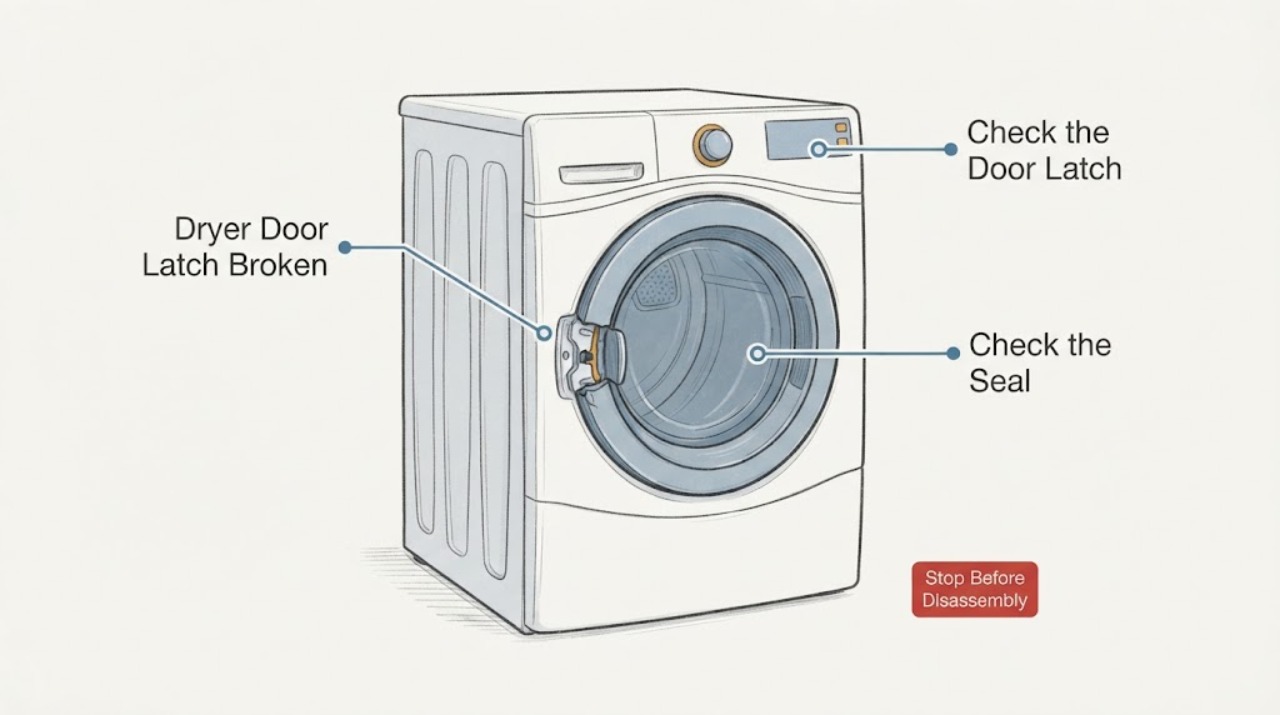
Keep a Bosch dryer stopped if the door latch is broken, the door will not close and stay closed, or the latch area is damaged. Inspect only the cool appliance from the outside, remove an obvious loose obstruction without prying, and record the complete E-Nr. Bosch lists dryer door locking assemblies among its parts but requires the appliance model number to check compatibility, so do not fit a generic latch, tape the door shut, or bypass the door safety. Arrange qualified service when the latch, strike, door frame, or interlock cannot be confirmed intact.
Work through in order
Diagnostic checks
Use only checks that match the exact appliance or system and its official guide.
-
Check 1
Leave the Bosch dryer off and allow it to cool. Look at the latch opening, the door edge, the strike or catch area, and the surrounding plastic from the outside; do not insert a tool, pry the latch, or hold the door closed with tape.
Expected result: The latch or strike is visibly cracked, missing, loose, melted, or obstructed, or the damage is not visible from outside.
Next step: Keep the dryer out of service, photograph the latch and door edge, and continue only with model identification and a service request. If nothing is visible, do not run a cycle just to force a diagnosis.
Why this matters
Why: Visible physical damage can stop the door from engaging, but an external view cannot identify the correct replacement assembly or prove that the interlock is safe.
-
Check 2
With the appliance still stopped and cool, close the door gently once without loading the handle or forcing the latch. Observe whether the door sits evenly, reaches the frame, and remains closed without being held.
Expected result: The door closes and stays latched normally; it springs back or will not engage; or it closes only when pushed, lifted, or held.
Next step: If it does not latch normally, stop using the dryer and arrange qualified service. Do not bypass the door safety or operate with a loose, open, or misaligned door.
Why this matters
Why: A door that will not remain latched is not a usable dryer condition. A door that needs force may involve alignment, the strike, the latch, or the door frame, and the result cannot be narrowed to one component without the exact model and service inspection.
-
Check 3
Inspect the accessible area around the door seal and latch opening for a loose piece of lint or debris only after the dryer is stopped and cool. Remove only a loose item that is already accessible; do not push anything into the latch, remove a cover, or open the cabinet.
Expected result: A loose obstruction is visible and clears without force; the latch remains damaged or stuck; or the area is clean but the door still will not latch.
Next step: After a loose obstruction is removed, reassess the closed-door fit once, without running the dryer. If the latch remains damaged, stuck, or unreliable, leave the dryer off and use service.
Why this matters
Why: An accessible obstruction can prevent the door from reaching the latch, but cleaning cannot repair a broken latch, strike, frame, or interlock.
-
Check 4
Read and record the complete Bosch E-Nr. and any other rating-plate information from the dryer, including suffixes. Bosch places model information on the appliance rating plate; use that exact identity in the Bosch parts or support lookup.
Expected result: The complete E-Nr. is readable; only a partial label or a similar-looking model is available; or the label cannot be read.
Next step: Use the exact E-Nr. for the owner manual, parts compatibility check, and service booking. If the identity cannot be confirmed, provide a clear rating-plate photo to Bosch or a qualified technician instead of ordering by appearance.
Why this matters
Why: Bosch requires the E-Nr. to check a dryer part and compatibility. A latch that fits one Bosch dryer is not established as a fit for another model or region.
-
Check 5
Before requesting repair, note whether there is a cracked or melted door area, scorch mark, burning smell, sparking, a damaged power connection, repeated breaker trips, or a dryer that can start without the door securely latched. Do not make repeated test runs.
Expected result: Any heat, smoke, scorch, spark, electrical symptom, or unsafe door-start condition is present, or the issue is limited to a mechanically broken latch with no such sign.
Next step: For any heat, smoke, spark, electrical damage, or unsafe door-start symptom, stop use and arrange qualified service; isolate power only if it is safe to do so. For an otherwise cool dryer with a broken latch, leave it unused and give service the E-Nr. and photos.
Why this matters
Why: Heat or electrical damage raises the risk beyond a simple visible latch replacement, and a dryer that can operate without a secure door needs immediate professional assessment.
Use your observations
Decision map
Find the observation that best matches what you see, then follow the next safe action.
-
PATH 01Next step
What you see
The door will not close and remain latched, or the latch, strike, door frame, or surrounding plastic is visibly broken.
Do this next
Keep the dryer off, do not tape or bypass the door safety, and arrange qualified Bosch or appliance service with the complete E-Nr. and photos.
Why this path and its safety boundary
Why it matters: The dryer cannot be treated as safe to operate, and the visible symptom does not identify a universally interchangeable part.
-
PATH 02Next step
What you see
The door closes evenly and remains latched, and only a loose accessible obstruction was found with no heat or electrical damage.
Do this next
Leave the door and latch intact, use the exact Bosch model guidance, and stop for service if the latch becomes unreliable or any damage appears; do not run a cycle to challenge the latch.
Why this path and its safety boundary
Why it matters: An obstruction or alignment issue is more plausible than a confirmed broken latch, but a one-time external observation does not prove the door assembly is serviceable.
-
PATH 03Next step
What you see
The E-Nr. is known and Bosch’s lookup identifies a compatible dryer door-latch or locking assembly.
Do this next
Use only the exact model’s documented service path or a qualified technician for replacement and interlock checks. Do not order from a generic description or open the cabinet as a first step.
Why this path and its safety boundary
Why it matters: The lookup has narrowed the part class for that exact appliance; it has not established that an unlabeled or similar-looking latch will fit another model.
-
PATH 04Next step
What you see
There is a burning smell, smoke, scorch, spark, repeated breaker trip, damaged power connection, or the dryer can start without a securely latched door.
Do this next
Stop using the dryer and arrange qualified service; if there is active smoke or fire, leave the area and use local emergency procedures. Do not reconnect, bypass, or repeatedly test it.
Why this path and its safety boundary
Why it matters: This is an electrical, heat, or door-safety escalation rather than a routine latch-identification problem.
Helpful context
Understand the symptom
A broken latch is a door-safety problem, not a reason to hold the door shut with tape or run a cycle with the door partly closed. Bosch support material treats dryer door locking assemblies and related door parts as model-dependent, and its parts lookup asks for the complete E-Nr. before compatibility is checked. The visible symptom may be a cracked latch, a damaged strike, door misalignment, or an obstruction; it does not prove which internal part needs replacement.
The useful user-level decision is whether the door closes and latches normally without force and whether the surrounding plastic or frame shows heat or electrical damage. Keep the dryer cool and stopped while you identify the model and document the condition. Bosch provides owner-support and authorized repair routes for problems that cannot be resolved from the matching model information.
Only after diagnosis
Potential parts
- Bosch dryer door latch or door-locking assembly
Consider this part only after the latch or locking assembly is visibly damaged and the complete Bosch E-Nr. confirms that the part is listed for that dryer.
Bosch requires the appliance E-Nr. to check compatibility; the opened Bosch door-latch product page does not establish universal fit across Bosch dryers.
When checks do not resolve it
Need a professional?
Arrange qualified Bosch or appliance service when the door will not latch, the latch or strike is broken, the door frame is damaged, the E-Nr. cannot be matched to a compatible assembly, or any heat, smoke, spark, power, or unsafe door-start symptom is present. Provide the complete rating-plate identity and clear photos of the door and latch area.
Common questions
FAQ
Can I tape a Bosch dryer door shut if the latch is broken?
No. A tape-held door does not verify the door interlock or safe closure. Leave the dryer off and arrange service with the complete E-Nr. and photos of the latch and door edge.
Is a Bosch dryer door latch universal across models?
Do not assume that. Bosch’s parts lookup and its door-latch product page require the appliance E-Nr. to check compatibility, so match the complete model before considering a replacement.
What should I do if the latch looks fine but the door will not stay closed?
Keep the dryer stopped and cool. Check only for a loose accessible obstruction and whether the door sits evenly; if it still will not latch, the strike, alignment, frame, latch, or interlock needs model-specific service assessment.
Read the exact guide
Official sources
- Door latch Door latch, dryerBosch Home Appliances US · Bosch product page identifying a dryer door-latch part class and requiring E-Nr. compatibility verification; it is not evidence of universal fit.
- Bosch Dryer Replacement PartsBosch Home Appliances US · Bosch dryer model and E-Nr. lookup, dryer doors/hinges/seals and door-locking assembly compatibility, and service routing.
- Bosch DryersBosch Home Appliances US · Bosch dryer support, owner manuals, service assistant and authorized repair routing.
Community feedback
Share a repair observation
Share a plain-text repair observation. Accepted observations are published automatically; this page may take a moment to update.