
On this page
Start here
Quick answer
For a Bosch 300 Series condenser dryer WTG86400UC/01, water at the lower door can be condensation collecting in the door area, but it can also be redirected water from a drain hose, a level or heat-exchanger-seal problem, or a door/seal alignment fault. Record the complete E-Nr including /01 and where the first drop appears. Stop the dryer, let it cool, unplug it, then make only the exact-manual checks that are accessible: confirm the dryer is level, clean the permitted door/filter and heat-exchanger sealing surfaces, and inspect an installed condensation drain hose for kinks, blockage, or a loose connection. A matching community report describes condensation collecting in this exact model's door and leaking from the bottom after about 1,000 loads, but that report does not prove a common failed part. If water returns after the safe checks, stop using the dryer and arrange Bosch or qualified service.
Before you begin
Safety first
- Do not run the dryer with an active uncontrolled leak, water at the outlet or cord, smoke, burning smell, hot or damaged plug, repeated electrical tripping, or a damaged cabinet. Do not remove panels, work on the condenser pump, or bypass a thermal or door safety device.
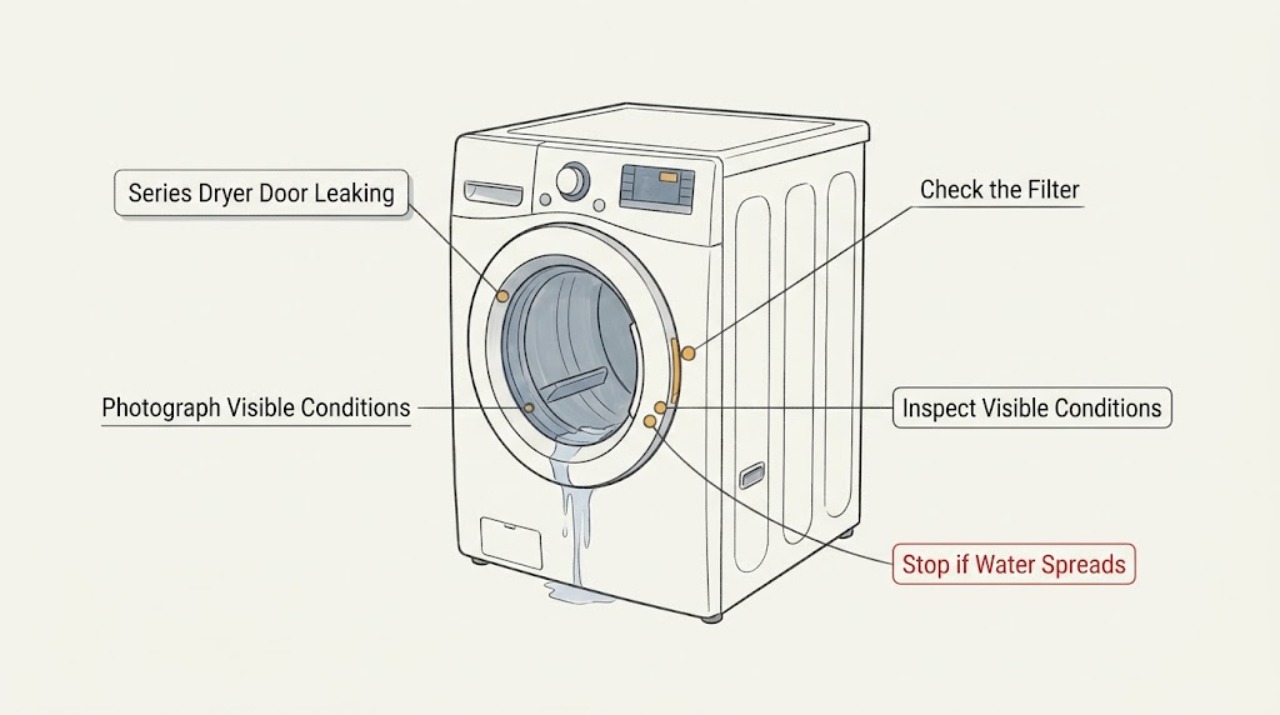
Work through in order
Diagnostic checks
Use only checks that match the exact appliance or system and its official guide.
-
Check 1
Before wiping or moving the dryer, photograph the water trail and record the complete E-Nr WTG86400UC/01, serial or FD information, programme, load size, and whether the first moisture is on the inner window, at the lower door edge, under the front, or at the rear hose. Note whether the water is a thin film, repeated drops, or a puddle.
Expected result: Moisture is confined to the inside of the window, drops from the lower door, appears at the rear hose, or pools under the cabinet; the E-Nr is exact or uncertain.
Next step: Continue only with the branch that matches the observed location and exact model. If the identity is uncertain, read the rating plate and retrieve the matching Bosch manual before disassembling or changing a seal.
Why this matters
Why: The location separates door-area condensation from a drain connection or broader cabinet leak. A complete E-Nr is needed because Bosch routes manuals, parts, and service by the model identifier; a shortened WTG86400UC without /01 is not enough for model-specific instructions.
-
Check 2
Turn the programme selector off, wait for the drum and door to cool, and unplug the dryer before touching the door edge, filters, heat-exchanger access, or any condensation hose. Wipe the inner door and accessible seal contact area with a damp cloth, removing only lint or residue that the exact WTG86400UC/01 manual permits you to remove.
Expected result: The door edge has lint, residue, or a visibly displaced seal, or the surfaces are clean but water is still escaping from the lower door.
Next step: Refit only an accessible seal or filter exactly as the manual describes; do not stretch, glue, cut, or substitute a gasket. If the seal is torn, loose, or the door is misaligned, leave the dryer unplugged and arrange service.
Why this matters
Why: A contaminated or displaced sealing surface can redirect condensation toward the bottom edge, but cleaning does not prove that the seal, hinge, or door assembly is sound. Persistent dripping after a clean surface needs a model-specific diagnosis.
-
Check 3
With the appliance cool and empty, check its front-to-back and side-to-side level using a spirit level, and look for rocking or a foot that is not firmly supported. Do not lift the dryer by the door or remove its feet; adjust only in the manner documented for this model.
Expected result: The dryer is visibly tilted or rocks, or it is level and stable.
Next step: Correct a plainly accessible leveling issue according to the exact manual, then perform at most one monitored test. If it is level already or water returns, stop repeated cycles and move to the drain/seal service branch.
Why this matters
Why: Bosch's condenser-dryer leak guidance names level as a direct check for water leaking out. A level machine makes a slope-related explanation less likely, but does not rule out a door seal, heat-exchanger seal, or drain problem.
-
Check 4
If the dryer has a connected condensation drain, inspect the full visible hose while power is disconnected: look for a kink, crushed section, lint blockage at the accessible connection, a loose clamp, or water tracking from the rear. Do not pull internal tubing or open a pump compartment.
Expected result: The hose is kinked, blocked, loose, or wet at a connection, or the hose is clear and dry while the front door still leaks.
Next step: Correct only a visible kink or securely documented external connection issue, then run one short monitored test with the appliance attended. If the hose leaks, is damaged, or the problem returns, stop using the dryer and arrange service.
Why this matters
Why: Bosch's dryer drainage guidance treats a kinked or blocked condensation hose as a water-flow problem and requires unplugging before inspection. A clear, dry hose shifts attention back toward the door/heat-exchanger path, but does not establish a particular failed part.
-
Check 5
After the level, door-area, and permitted drain checks are complete, run one short suitable programme only if there is no active leak, damaged cord, burning smell, or electrical trip. Observe the lower door, rear hose, and floor without opening the cabinet, and stop immediately if a new drop or puddle forms.
Expected result: The test stays dry, or condensation again collects in the door and leaks from the bottom or water appears elsewhere.
Next step: If it stays dry, monitor the next load and retain the photographs. If water returns, stop using the dryer, provide the exact E-Nr and leak observations to Bosch or qualified service, and do not keep testing to reproduce the leak.
Why this matters
Why: A dry monitored cycle makes a temporary routing or accessible obstruction more plausible, but repeated water at the same point is evidence of an unresolved sealing, drainage, level, or internal condensation-path issue. The approximately 1,000-load history adds context but does not identify a replacement part.
Use your observations
Decision map
Find the observation that best matches what you see, then follow the next safe action.
-
PATH 01Next step
What you see
There is a light film of moisture on the inner window but no drop or puddle outside the door after a completed cycle.
Do this next
Wipe the accessible door area, confirm the dryer is level, and monitor one suitable load. If moisture becomes repeated drops, reaches the floor, or the seal is damaged, stop and arrange service.
Why this path and its safety boundary
Why it matters: This is less consistent with an active external leak than the exact reported pattern of condensation collecting and dripping from the bottom of the door, although it does not prove the door path is normal for every programme or model revision.
-
PATH 02Next step
What you see
The dryer is tilted or rocking, and the leak lessens or stops after a documented leveling correction.
Do this next
Keep the dryer level and monitor it. If the door still leaks or the floor becomes wet, stop using it and have the exact model assessed.
Why this path and its safety boundary
Why it matters: Installation level is a plausible contributor to how condensation or collected water travels, but a successful test does not prove that seals or the drain path are undamaged.
-
PATH 03Next step
What you see
The rear condensation hose is kinked, loose, or visibly leaking, while the lower door is only where water becomes noticeable.
Do this next
With power disconnected, correct only the visible hose routing or connection permitted by the manual and perform one attended test. Replace or repair the hose through qualified service if it remains damaged or wet.
Why this path and its safety boundary
Why it matters: Water may be escaping from the drainage path and travelling to the front; the door location alone does not establish a failed door gasket.
-
PATH 04Next step
What you see
The machine is level, accessible surfaces and the visible drain path are clear, but condensation repeatedly collects in the door and drips from the bottom.
Do this next
Stop using the dryer and arrange Bosch or qualified service with the exact E-Nr, photos, load history, and leak location. Do not remove panels or order a latch, gasket, pump, or heat-exchanger part solely from this symptom.
Why this path and its safety boundary
Why it matters: The remaining possibilities include a door seal or alignment issue, a heat-exchanger sealing or condensation-path problem, or an internal pump or tubing fault. The exact Reddit match shows this symptom on WTG86400UC/01, but neither that report nor the leak symptom selects a part.
-
PATH 05Next step
What you see
Water reaches the power cord or outlet, the cord or plug is hot or damaged, there is a burning smell or smoke, the dryer trips power, or the leak is large or uncontrolled.
Do this next
Stop the programme, disconnect power only if it is safe to do so, keep clear of wet electrical parts, and arrange qualified service. Do not restore power or open the cabinet to reproduce the leak.
Why this path and its safety boundary
Why it matters: The symptom has crossed from an accessible condensation check into a possible electrical, fire, or water-damage hazard.
Helpful context
Understand the symptom
What a leaking door identifies
A wet lower door is a symptom location, not a diagnosis. A condenser dryer makes water from humid air, so the first useful distinction is whether there is only moisture on the inner window or an actual drop or puddle outside the door. Water can also travel from a rear condensation hose or collect after a level, seal, or heat-exchanger problem. Bosch's official guidance treats a leaking dryer as a reason to check level and the heat-exchanger seal, and its model-specific support page confirms that WTG86400UC/01 has its own manual set.
How to use the 1,000-load detail
The exact Reddit report for Bosch 300 Series WTG86400UC/01 describes condensation collecting in the door and leaking from its bottom, with the owner estimating about 1,000 loads. That is a useful match for the reported pattern, but it is a user observation rather than proof that every machine at that usage needs a door part or has the same failure. Use the complete E-Nr, leak location, and repeatability to choose the next safe branch.
Only after diagnosis
Potential parts
- door seal or door/heat-exchanger sealing assembly
Consider this only after a technician confirms that the repeated leak comes from a damaged or misaligned seal. Water at the door does not distinguish a door seal from a heat-exchanger seal, drain path, pump, or level problem.
Verify the complete WTG86400UC/01 E-Nr and parts diagram before ordering; the /01 suffix and rating-plate identity control fit. - condensation drain hose or related drainage component
Consider this only when the visible or technician-tested drainage path is kinked, cracked, loose, or blocked and the leak source is confirmed there.
Confirm compatibility from the exact E-Nr and installation configuration; do not substitute a hose based on appearance or a generic Bosch dryer listing.
When checks do not resolve it
Need a professional?
Arrange Bosch or qualified appliance service when water returns after the safe level, accessible door-area, and visible drain checks; when the door seal is torn or misaligned; when the heat-exchanger seal or internal condensation path cannot be accessed as the exact manual permits; or whenever a safety hazard is present.
Safety scope: Do not run the dryer with an active uncontrolled leak, water at the outlet or cord, smoke, burning smell, hot or damaged plug, repeated electrical tripping, or a damaged cabinet. Do not remove panels, work on the condenser pump, or bypass a thermal or door safety device.
Have this ready
- Provide the complete E-Nr WTG86400UC/01, serial or FD information, programme and load size, approximate load history, photos of the water trail, whether moisture starts inside the window or at the rear, level and hose observations, and whether the leak repeats on a monitored test.
Common questions
FAQ
Why is my Bosch WTG86400UC/01 dryer leaking from the door?
The door may be where condensation becomes visible, but the source can be a level problem, a heat-exchanger or door sealing surface, or a rear condensation drain hose. Record where the first drop appears and check only the accessible items allowed by the exact manual.
Does about 1,000 loads mean the Bosch dryer needs a door seal?
No. A matching user report mentions about 1,000 loads and condensation leaking from the door bottom, but usage count does not identify a failed part. A technician should trace the leak and verify the exact E-Nr before selecting a seal, hose, pump, or other component.
Can I keep running the dryer to see whether the leak gets worse?
Do not repeatedly test an appliance that is actively leaking. Stop, let it cool, unplug it before accessible checks, and arrange service if water returns, reaches electrical parts, or the source is not resolved by the safe manual checks.
Read the exact guide
Official sources
- How To Fix Bosch Dryer Error Code E03Bosch · The opened Bosch dryer support page is used for the safe method of isolating power and checking a condensation drainage hose for kinks, blockages, and secure reconnection. It is not evidence that the assigned WTG86400UC/01 is displaying E03 or that its leak must be a hose fault.
- Bosch 300 series dryer door leakingReddit r/Appliances · The opened Reddit post exactly names Bosch 300 Series WTG86400UC/01, describes condensation collecting in the door and leaking from the bottom, and mentions an estimate of about 1,000 loads. It is a single user report and supports symptom matching only, not cause, lifespan, or part compatibility.
- Bosch Dryer Replacement PartsBosch · The opened Bosch parts page supports the identity and compatibility boundary: parts must be searched by the full E-Nr from the rating plate, which may include the /01 suffix. It does not establish that any listed seal, hose, pump, or door part is needed for this leak.
- Appliance Information - condenser tumble dryer | WTG86400UC/01Bosch · Directly applicable to the assigned model identity. The page confirms WTG86400UC/01 as a 300 Series condenser tumble dryer and routes owners to its manuals, support, replacement parts, and service; it is not itself a leak diagnosis.
- Bosch condenser dryer instruction manualBosch · The opened Bosch-hosted manual gives the manufacturer leak and safety guidance used here: level the dryer and clean the heat-exchanger seal when water leaks out, and stop using defective equipment. Its model identity is not established as WTG86400UC/01, so it supports the general condenser-dryer checks only, not part fit or an internal diagnosis for the assigned unit.
Community feedback
Share a repair observation
Share a plain-text repair observation. Accepted observations are published automatically; this page may take a moment to update.