
On this page
Start here
Quick answer
For the reported Bosch WTVC5330US/09 drum-light problem, first separate a light-only symptom from a dryer that is blank or will not start. Confirm the complete E-Nr. on each machine, note whether the light changes when the door is opened and closed normally, and record whether the drum still runs and heats. Bosch's US support pages route this exact model through its model-specific manuals, parts lookup, and repair support, but the accessible page does not establish a bulb type or a universal light-control sequence. Do not remove a socket, bypass a door switch, open the cabinet, or make a live electrical test. If the dryer otherwise works and the light remains out after the safe identity and door-state checks, request model-specific service rather than buying a guessed part.
Before you begin
Safety first
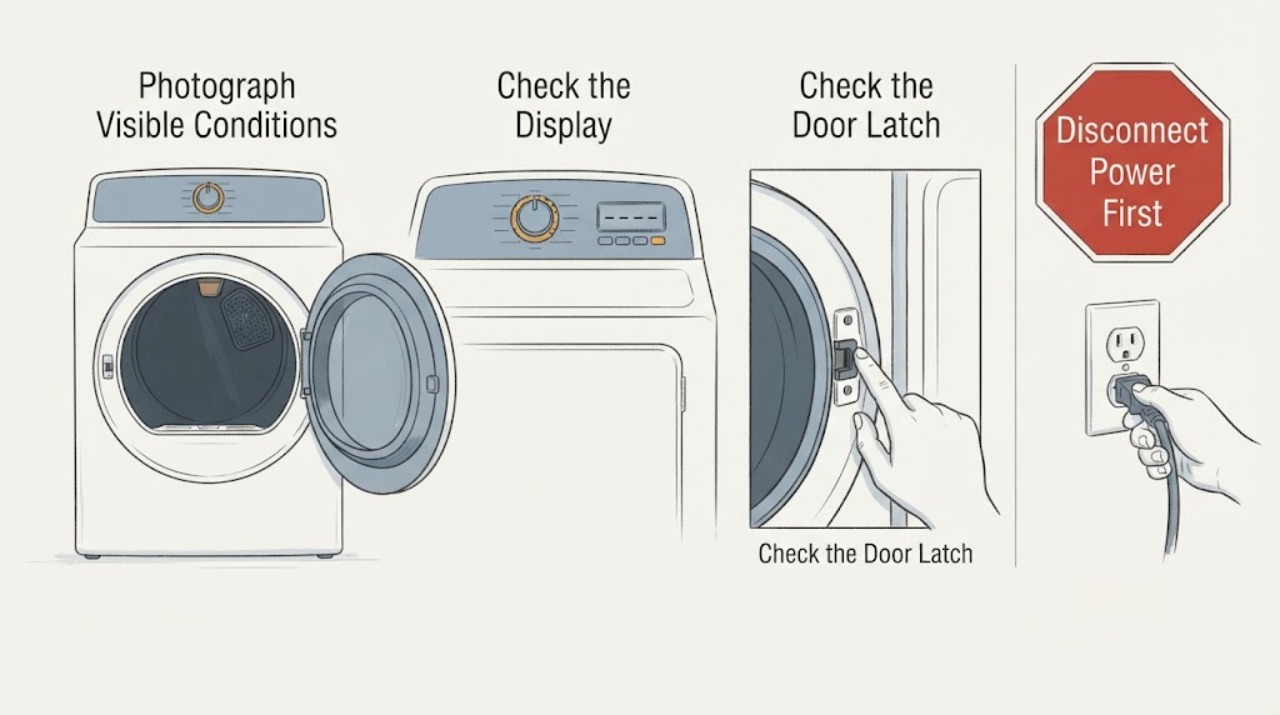
- Keep the dryer off and disconnect power only from a dry, safe, accessible position when there is a hazard or before any manual-permitted inspection. Do not open the cabinet, remove a lamp socket, bypass the door switch, probe live wiring, or operate with a cover or safety part removed. Stop for smoke, burning odor, sparks, abnormal heat, damaged wiring, water near electrical parts, or a repeated breaker trip.
Work through in order
Diagnostic checks
Use only checks that match the exact appliance or system and its official guide.
-
Check 1
On each dryer, read and photograph the complete rating-plate identity, including WTVC5330US/09 if that is the actual E-Nr., and record the serial and market. Do not rely on the 500 Series name alone or assume the second machine has the same suffix.
Expected result: Both labels match exactly, the suffixes differ, the label is unreadable, or one appliance is not the reported Bosch model.
Next step: Use the exact E-Nr. in Bosch's manual and parts lookups, and keep separate notes for the two dryers. If the identity cannot be confirmed, stop model-specific part research and arrange support.
Stop if: Do not order a bulb or light assembly from a generic Bosch listing or another market when the full E-Nr. is not confirmed.
Why this matters
Why: A complete E-Nr. is the gate for the correct Bosch manual and parts information. A differing or uncertain suffix means the two cases must not share a light specification or button sequence.
-
Check 2
With the dryer off, cool, and otherwise safe, check the external controls: does the display or indicator panel respond, can a programme be selected, and does the door close normally? Do not remove panels or reach into the drum while checking.
Expected result: The panel is blank, the panel works but the cycle will not start, or the dryer runs normally while only the interior light is dark.
Next step: Follow the matching power or no-start service path if the appliance is blank or will not run. If it runs normally, continue only with the light-specific observations below.
Stop if: Stop for a damaged cord or plug, heat at the outlet, sparks, smoke, burning odor, repeated breaker operation, or any need to open the cabinet.
Why this matters
Why: A blank or no-start machine is not a light-only case and keeps the diagnosis on the external power, door, or programme path. A running dryer narrows the user-visible problem to the light and its door-state/control path without identifying an internal part.
-
Check 3
Observe the light from outside while opening and closing the door normally, without slamming or bypassing the latch. Note whether the door closes flush, whether the light changes at all, and whether the hinge, latch, or seal looks visibly loose, obstructed, or damaged.
Expected result: The light changes with the door, stays dark in every door position, the door does not close or latch normally, or the door hardware is visibly damaged.
Next step: Remove only accessible fabric or an obvious obstruction from the seal. If the door remains misaligned, will not latch, or the light stays out, stop and provide the observation and model label to Bosch service; do not bypass the door switch.
Stop if: Do not force the door, adjust a spring or hinge, defeat the latch, or run the dryer with a cracked or loose door component.
Why this matters
Why: A response to door state points to a condition or control interaction that must be interpreted from the exact manual. No response in every position does not distinguish a bulb, light assembly, switch, wiring, or control fault. A damaged or misaligned door adds a safety and service issue.
-
Check 4
If the exact manual permits an owner-accessible light inspection, wait until the dryer is cool and isolate power from a dry, safe position before looking only at the visible lens or bulb area. Record an obvious dark bulb, displaced lens, moisture, lint, or visible damage; do not remove a socket or touch wiring.
Expected result: The manual gives an exact owner procedure, the visible light area is clean and intact, an obvious bulb/lens issue is visible, or the manual cannot be matched to the E-Nr.
Next step: Follow only the exact manual's cool, power-isolated procedure if one exists. Otherwise leave the light assembly closed and arrange model-specific service with the E-Nr. and photographs.
Stop if: Never remove a lamp socket, probe contacts, bypass a switch, or restore power with a cover or safety part removed.
Why this matters
Why: Only an exact Bosch instruction can establish whether a user-replaceable light exists and what replacement specification applies. A clean/intact visible area does not isolate the light circuit, and an apparent bulb issue does not justify a cross-model part.
-
Check 5
Compare the two dryers as two independent cases: record exact E-Nr., door behavior, whether each dryer runs and heats, recent bulb or door work, cleaning or moisture exposure, and when the light first failed. Do not run either machine solely to reproduce a light symptom if a safety concern exists.
Expected result: The machines share an exact suffix and the same recent external change, share only the light symptom, have different suffixes, or one has a broader operating fault.
Next step: Give Bosch service the two evidence sets separately and ask what is model-specific before authorizing a part. Keep the otherwise-working light-only case on the service/manual path rather than replacing parts by analogy.
Stop if: Do not swap bulbs, light assemblies, control parts, or door components between the two dryers unless Bosch confirms compatibility for each complete E-Nr.
Why this matters
Why: A shared recent external change is a lead for comparison, not proof of a common internal failure. Different suffixes require separate manuals and parts. A broader operating fault changes the case from a light-only question to power, door, or appliance service.
-
Check 6
If the dryer otherwise operates, make one written observation of the normal cycle result from outside: whether the drum turns, heat is present as expected, and the light remains dark. Stop rather than repeating cycles if any abnormal sound, odor, heat, smoke, sparking, or power event appears.
Expected result: The dryer completes normally with only the light out, the cycle also fails to start or heat, or a safety symptom appears.
Next step: For a light-only result, request Bosch model-specific repair guidance. For any broader fault or hazard, leave the dryer disconnected when safe and arrange qualified appliance or electrical service.
Stop if: Do not continue operating to test a suspected electrical fault, and never perform live measurements or cabinet disassembly.
Why this matters
Why: A normal cycle with a dark light supports a light-only service request but still does not identify a replacement component. A start, heat, or safety failure requires a broader appliance or electrical diagnosis.
Use your observations
Decision map
Find the observation that best matches what you see, then follow the next safe action.
-
PATH 01Safety boundary
What you see
The light is dark but the controls, drum motion, heat, and door operation are otherwise normal.
Do this next
Use the exact WTVC5330US/09 manual if available for an owner-level light procedure; otherwise request Bosch model-specific service and provide the door-state observation.
Why this path and its safety boundary
Why it matters: This is a light-only symptom. The safe evidence does not distinguish a bulb, lens, door-state input, wiring, or control fault, so a part cannot be selected from the symptom alone.
Safety stop: Do not open the cabinet, remove a socket, or make a live electrical test.
-
PATH 02Safety boundary
What you see
The light changes with the door or the door does not close, latch, or sit flush.
Do this next
Remove only an accessible obstruction, do not force or bypass the door, and arrange service if the latch or light behavior remains abnormal.
Why this path and its safety boundary
Why it matters: The door state is relevant, but the observation alone does not identify whether the cause is alignment, latch sensing, the light assembly, or the control interpretation.
Safety stop: Stop for a cracked, loose, sharp, or damaged door, hinge, latch, seal, or cabinet.
-
PATH 03Safety boundary
What you see
The panel is blank, the dryer will not start, the drum will not turn, or the dryer does not heat as well as the light being out.
Do this next
Check only accessible power and door conditions once if safe, then leave the appliance disconnected for persistent faults and arrange qualified Bosch service.
Why this path and its safety boundary
Why it matters: The symptom is no longer light-only. A power, door/programme, drive, or heating branch must be diagnosed separately; a dark light does not select the cause.
Safety stop: Stop immediately for smoke, burning odor, sparks, unusual heat, damaged cord, water near electrical parts, or repeated breaker trips.
-
PATH 04Safety boundary
What you see
Both dryers show the same light symptom, but the exact suffixes, recent work, door behavior, or overall operation do not match.
Do this next
Keep separate evidence and service requests for each E-Nr. Do not transfer a component or repair instruction between them without Bosch fitment confirmation.
Why this path and its safety boundary
Why it matters: The shared report is not enough to establish one internal failure. The machines may have different manuals, light implementations, or unrelated faults.
Safety stop: Do not use one machine as a powered test fixture for a part from the other.
Helpful context
Understand the symptom
A drum light that stays dark is narrower than a dryer that has no power. Start by checking whether the controls respond, whether a normal cycle can run, and whether the light changes with the door state. Those observations tell you whether to stay on the light path or move to a broader power, door, or start problem.
Because the symptom was reported on two dryers, record each machine separately. Matching model labels, door behavior, and recent work can reveal a shared external condition, but identical symptoms do not identify a shared relay, bulb, or light assembly. The Bosch US pages require the complete E-Nr. for model-specific manuals and parts information; do not transfer a bulb specification or procedure from another series or market.
Keep the checks external and low risk. A visible lens or bulb can be noted only from ordinary access and only if the exact manual permits owner replacement after the dryer is cool and isolated. Do not remove a socket, defeat the door switch, open the cabinet, or probe wiring.
When checks do not resolve it
Need a professional?
Request Bosch or an authorized appliance service provider when the light stays out after the identity and door-state checks, the door will not latch, the dryer is blank or will not start, the drum or heat is abnormal, or the exact manual does not establish an owner-level light procedure. Use a qualified electrician for a suspected outlet, cord, or household supply problem.
Safety scope: Keep the dryer off and disconnect power only from a dry, safe, accessible position when there is a hazard or before any manual-permitted inspection. Do not open the cabinet, remove a lamp socket, bypass the door switch, probe live wiring, or operate with a cover or safety part removed. Stop for smoke, burning odor, sparks, abnormal heat, damaged wiring, water near electrical parts, or a repeated breaker trip.
Have this ready
- Provide a photo of each complete E-Nr. and serial label, the market, which machine is affected, whether the controls/drum/heat work, whether the light changes with the door, the door and latch observations, recent work or cleaning, and any odor, heat, smoke, spark, or breaker history.
Common questions
FAQ
Can I replace the drum-light bulb myself?
Only if the exact WTVC5330US/09 manual explicitly provides an owner procedure and specification. The accessible Bosch US pages route you to the complete E-Nr. manual and parts lookup; they do not justify choosing a generic bulb. Isolate power and wait until cool, and do not remove a socket or touch wiring.
If two Bosch dryers have the same dark light, do they need the same part?
No. Compare the full E-Nr., door behavior, recent work, and overall operation separately. A matching symptom can be coincidental or reflect a shared external condition; it does not prove matching internal components or compatibility.
Should I test the light socket with a meter?
Not as a user check. A dryer contains hazardous electrical circuits, and live measurements or cabinet access can create shock and fire risk. Give the exact model and observations to qualified appliance service instead.
What if the dryer runs normally but the light remains out?
Record that it is a light-only symptom, note whether the light changes with the door, and use the exact manual or Bosch service route. Do not let the otherwise-normal cycle lead to a guessed bulb, socket, or control replacement.
Read the exact guide
Official sources
- Bosch Dryer Replacement PartsBSH Home Appliances Corporation (Bosch) · Official Bosch US dryer parts page used to require the complete E-Nr. before looking up a light or door-related part and to support the rating-plate check; it does not establish cross-model compatibility.
- Bosch Dryers Troubleshooting & Repair | Bosch - Owner Support – Error Codes, Parts, Cleaning & MaintenanceBSH Home Appliances Corporation (Bosch) · Official Bosch US dryer support hub used for the available model-specific manual/parts/service routes and the boundary between safe support guidance and professional repair; not used to invent a WTVC5330US/09 light specification.
- Appliance Information - | WTVC5330US/09BSH Home Appliances Corporation (Bosch) · Bosch US product-service page opened for the exact E-Nr. WTVC5330US/09; it establishes the model identity and routes owners to support, but does not by itself define a bulb specification or light repair procedure.
- Owner Manuals | BoschBSH Home Appliances Corporation (Bosch) · Official Bosch US manual portal used to require the complete rating-plate E-Nr. before relying on light-control or owner-repair instructions.
Community feedback
Share a repair observation
Share a plain-text repair observation. Accepted observations are published automatically; this page may take a moment to update.