
On this page
Start here
Quick answer
For a Bosch WTB86200UC compact condensation dryer that suddenly makes a loud buzz with a normal-sized load, stop the cycle if there is a burning smell, smoke, sparking, a hot or damaged cord, scraping, or worsening vibration. Otherwise switch the dryer off and disconnect power before checking only accessible items: foreign objects in the drum or door area, the lint filters and air inlet, and whether the cabinet is level on all four feet. Bosch's exact-model manual says equal foot pressure on a solid, level surface gives the quietest, most vibration-free use, while Bosch's noise guidance says to check the drum for unwanted objects and contact support if the noise remains. A sound alone does not identify a motor, fan, pump, bearing, or other internal part; do not remove panels or continue testing a persistent loud buzz.
Work through in order
Diagnostic checks
Use only checks that match the exact appliance or system and its official guide.
-
Check 1
Stop the dryer and check the outside for smoke, a burning odor, sparking, a hot or damaged power cord, scraping, or severe shaking. If any warning is present, switch the selector to Off and disconnect power only if it is safe to do so; do not restart the cycle.
Expected result: No hazard sign is present, or there is smoke, burning odor, electrical damage, scraping, or severe movement.
Next step: For any hazard sign, keep the dryer out of use and request Bosch or qualified appliance service. Do not open the cabinet, bypass a safety device, or repeatedly reset the appliance.
Why this matters
Why: A loud buzz without a hazard sign still needs bounded troubleshooting, but a hazard sign changes the problem to a stop-use and service situation. The sound does not safely identify an internal part.
-
Check 2
With the dryer off and disconnected, remove the load and inspect the drum, door seal area, and the accessible lint-filter area for coins, fasteners, wires, or other foreign material. Clean the lint filters as the manual directs, and make sure the front air inlet is not covered. Do not reach through openings or remove a panel.
Expected result: An accessible object or lint obstruction is found, or the drum and accessible filter/inlet areas are clear.
Next step: Remove only a loose, accessible object and keep the dryer disconnected while doing so. If the noise returns, remains loud, or the object cannot be removed without disassembly, stop and arrange service.
Why this matters
Why: Bosch identifies unwanted objects in the drum as a first check for loud noise. The manual also warns that foreign objects can damage the laundry or dryer components; a clear accessible area does not prove which internal part is making a persistent buzz.
-
Check 3
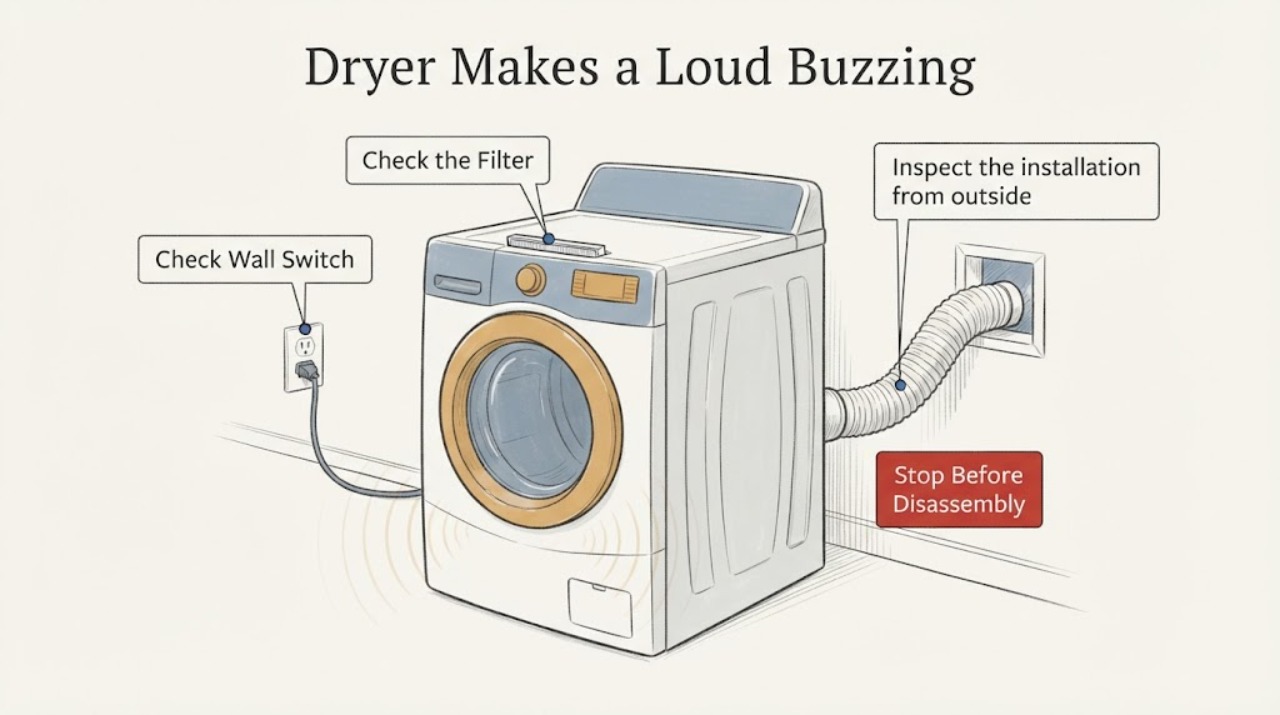
Inspect the installation from outside. The dryer should stand on a solid, level surface with all four feet pressing evenly; press each top corner gently to check for wobble, and verify that the cabinet is not touching a wall or another appliance. Do not place material under a foot or move the heavy dryer alone.
Expected result: The cabinet wobbles, the floor is uneven, one foot is not carrying weight, or the dryer is stable and level.
Next step: If the unit is unstable, have it safely leveled according to the installation instructions. If it is already stable and the loud buzz persists, do not compensate by tightening or opening internal parts; use Bosch service.
Why this matters
Why: The WTB86200UC manual says equal foot pressure and a level, solid surface provide the quietest, most vibration-free use, and that extending the feet farther increases vibration. This can explain vibration-related noise but cannot prove an internal failure.
-
Check 4
If there are no hazard signs and the external checks are clear, document when the buzz occurs without removing covers: at startup, during drum rotation, intermittently during the cycle, or continuously. Record the program, whether the load is normal-sized, whether drying performance changed, and the full E-Nr. suffix from the rating plate.
Expected result: The buzz is repeatable on every cycle, has become louder or harsher, appears with scraping or vibration, or occurs only briefly and the dryer otherwise operates normally.
Next step: If the noise is repeatable, newly loud, or accompanied by changed drying performance, leave the dryer out of use and provide Bosch with the E-Nr., FD number, program and recording or description. If it is brief and unchanged but concerning, still use the exact model support path rather than opening the appliance.
Why this matters
Why: Timing information helps Bosch service distinguish a repeatable appliance symptom from a load or installation condition, but it does not authorize a user to assign the sound to a compressor, pump, motor, fan, bearing, or belt.
Use your observations
Decision map
Find the observation that best matches what you see, then follow the next safe action.
-
PATH 01Next step
What you see
The buzz is accompanied by smoke, a burning odor, electrical arcing, a hot or damaged cord, scraping, or severe cabinet movement.
Do this next
Switch the dryer off, disconnect it only if safe, keep it out of use, and arrange Bosch or qualified appliance service. Do not run another load or remove panels.
Why this path and its safety boundary
Why it matters: This is beyond an ordinary noise observation and may involve an electrical, mechanical, or fire hazard.
-
PATH 02Next step
What you see
A coin, fastener, wire, or other loose object is found in the accessible drum or door area.
Do this next
Remove only the loose accessible object with power disconnected. If the sound continues or the object cannot be reached safely, stop and request service.
Why this path and its safety boundary
Why it matters: Bosch's first noise check identifies a foreign object as a plausible source of rattling or buzzing, but an object that has entered an opening may have damaged or contacted an internal part.
-
PATH 03Next step
What you see
The dryer wobbles or one foot does not press evenly on the floor.
Do this next
Have the dryer leveled on a solid surface using the installation instructions. If it remains loud after stable leveling, use Bosch service rather than adjusting internal parts.
Why this path and its safety boundary
Why it matters: An uneven installation can increase vibration and noise even with a normal-sized load.
-
PATH 04Next step
What you see
The drum, lint-filter area, air inlet and installation are clear and stable, but the loud buzz repeats or the dryer performs differently.
Do this next
Keep the dryer out of use and contact Bosch support or an authorized servicer with the full E-Nr. suffix, FD number, program and timing of the noise. Do not continue test loads or open the cabinet.
Why this path and its safety boundary
Why it matters: Bosch's user-level noise checks have not established a safe external cause. The symptom is not enough to name a failed motor, fan, pump, bearing or belt.
Helpful context
Understand the symptom
Keep the exact Bosch dryer in scope
Bosch's support page identifies WTB86200UC/02 as a compact condensation dryer and links its user documents. The opened manual is labeled for the WTB86200UC family and explains that the final two E-Nr. digits matter for matching the machine and any service information. Check the rating plate before requesting help, especially if the label includes /01, /02, /06 or /07. The checks below stay at the user-accessible level and do not claim that a buzz proves a failed motor, fan, pump, bearing or control.
A loud new sound has a clear stop boundary
A low or changing operating sound cannot be judged safely from the word buzzing alone. Treat smoke, a burning odor, electrical arcing, a hot or damaged cord, a scraping sound, or violent cabinet movement as a reason to switch the dryer off, disconnect it if that can be done safely, and arrange service. Never run the dryer with a cover removed, reach into a moving drum, or try to locate a sound by touching internal parts.
Common questions
FAQ
Is a buzzing sound automatically normal on the Bosch WTB86200UC?
No conclusion is safe from the word buzzing alone. Bosch's exact-model manual and support page identify external checks and a service boundary, but they do not let a user diagnose a motor, fan, pump, bearing or belt from a sound description. A persistent loud or newly worsening buzz should be referred to Bosch service.
What should I check first when the dryer gets loud with a normal load?
After stopping the dryer and disconnecting power, check the accessible drum and door area for coins or other foreign objects, clean the lint filters, make sure the front air inlet is clear, and check that the cabinet is level with all four feet carrying equal pressure. Do not remove panels.
Can leveling cause a loud buzzing or vibration?
An uneven or unstable installation can increase vibration and noise. Bosch says the dryer should be on a solid, level surface with equal pressure on all four feet and warns that extending the feet farther increases vibration. Leveling does not prove or repair an internal noise source.
Should I run the dryer with the cover removed to find the sound?
No. Do not remove panels, reach into a moving drum, bypass a safety device, or perform internal electrical or mechanical tests. If the accessible checks do not resolve a persistent loud buzz, provide Bosch with the full model suffix and arrange qualified service.
Read the exact guide
Official sources
- Bosch Dryer Tips & TricksBosch Home Appliances · Opened Bosch's U.S. dryer tips page. It recommends leveling the dryer to prevent vibrations and noise and points users to the owner's manual for model-specific instructions.
- en-us Use and care manual Dryer WTB86200UCBosch Home Appliances · Opened the Bosch-hosted PDF and verified the cover identifies the WTB86200UC family (WTB86200UC2), while the manual explains that the final two E-Nr. digits matter for model matching. Used only the user-level installation, cleaning, foreign-object and service guidance that is explicitly in this manual.
- Dryer Troubleshooting: Dryer is Making NoisesBosch Home Appliances · Opened Bosch's U.S. dryer troubleshooting page. It directs users to check the drum for unwanted objects such as coins and to contact Bosch support if the noise remains; it does not assign an internal part from the sound alone.
- Appliance Information - Compact Condensation Dryer | WTB86200UC/02Bosch Home Appliances · Opened Bosch's U.S. service page. It identifies WTB86200UC/02 as a compact condensation dryer and presents the official user manual and owner-support resources. The task's unsuffixed model is kept unchanged; the E-Nr. suffix should be checked on the appliance.
Community feedback
Share a repair observation
Share a plain-text repair observation. Accepted observations are published automatically; this page may take a moment to update.