
On this page
Start here
Quick answer
A Bosch Series 6 dryer may send condensation to its container or, when the exact model supports it, through an external drain hose. After changing the setup, first confirm the exact E-Nr and whether the dryer is a heat-pump or another condensation design; Series 6 is a product range, not one universal hose layout. With the dryer off and unplugged, check that the supplied hose is fully seated, not kinked, secured at the waste connection, and routed within the exact manual's height limits. Bosch warns that a blocked outlet can send water back into the dryer and that a loose connection can leak. If the container fills immediately, the hose backs up, water appears inside the cabinet, E03 returns, or the external conversion needs cabinet access, stop using the dryer and arrange Bosch service.
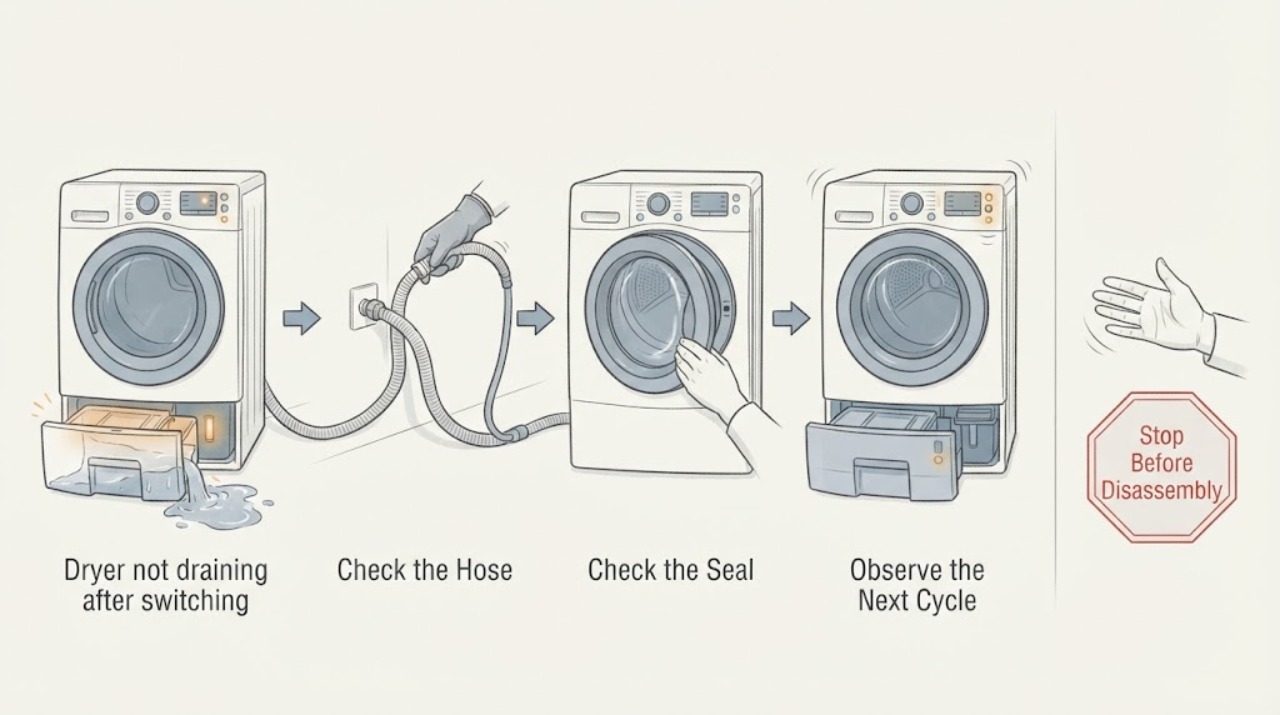
Work through in order
Diagnostic checks
Use only checks that match the exact appliance or system and its official guide.
-
Check 1
With the dryer cool and off, photograph the rating plate and identify the complete E-Nr, then check the matching Bosch manual for the dryer architecture and approved condensation route. Record whether the unit has a condensation container, a factory-fitted condensation hose, an accessory drain hose, and any displayed drainage code.
Expected result: The manual confirms a condenser or heat-pump dryer with an approved direct-drain option, a container-only design, or an architecture that cannot be identified from the available E-Nr.
Next step: Follow only the exact E-Nr manual. If the model or drain option cannot be confirmed, leave the dryer in its last safe configuration and request model-specific support before moving hoses again.
Why this matters
Why: Bosch Series 6 is a range rather than a single hydraulic layout. The external-hose steps in one Bosch manual cannot be assumed for every Series 6 model, and an unidentified architecture cannot support a safe conversion or part choice.
-
Check 2
If the exact manual supports external drainage, unplug the dryer from a dry, safe position and inspect the visible hose at the dryer connection and waste outlet. Confirm the hose is pushed fully onto its connector, is not crushed or kinked, cannot slip out, and is not sealed against a blocked drain.
Expected result: The hose is partly seated, kinked, crushed, loose, slipping out, or the waste outlet is blocked; or the hose and outlet look correctly connected and open.
Next step: Correct only an obvious, safe external routing or seating error exactly as the manual shows, then confirm the outlet accepts water without backing up. Do not pull internal hoses or open the cabinet to reach a hidden blockage.
Why this matters
Why: Bosch's installation guidance says a direct water-drain hose must be connected properly, routed without bends, and secured. A blocked or covered outlet can send accumulated wastewater back into the dryer, while a correct visible route shifts suspicion toward an internal condensate path or sensor.
-
Check 3
Compare the installed hose height and connection type with the exact manual. For the Bosch configuration described in the opened installation manual, a siphon connection uses a secured hose guide between 80 cm and 100 cm above the installation surface; basin and gully connections use the specified elbow and fixing method instead.
Expected result: The hose height is outside the manual's range, the hose end is unsecured, the connection type does not match the illustrated setup, or the routing matches the manual.
Next step: Re-route and secure the hose only within the exact model manual's diagram and limits. If the waste connection backs up or the correct routing cannot be achieved without plumbing or cabinet work, stop and arrange qualified service.
Why this matters
Why: An incorrect height, unsecured hose, or wrong connection can restrict flow, allow the hose to slip, or cause backflow even when the hose itself is not clogged. The 80–100 cm values are for the cited Bosch configuration and are not universal limits for every Series 6 model.
-
Check 4
Check the condensation-container configuration against the manual after the hose conversion. On the Bosch configuration described in the opened manual, the original condensation hose is parked, the external drain hose is fitted to the free connector, the container stopper is moved, and the filter is placed in the container recess before the container is slid home.
Expected result: The original hose remains on the drain connector, the stopper or filter is still in the pre-conversion position, the container is not fully seated, or the model's manual shows a different arrangement.
Next step: Restore the exact manual-approved hose, stopper, filter, and container arrangement with power disconnected. Do not force the container or operate with a missing seal, loose cover, or an arrangement copied from another Bosch model.
Why this matters
Why: A conversion can leave the water path split between the container and external outlet or allow a loose connection to leak. Bosch's documents explicitly make this setup model-dependent; a container that still collects some water is not automatically a fault because some Bosch heat-pump models use condensation for self-cleaning.
-
Check 5
After every connection, cover, and container component is secure and dry, run only the shortest model-approved monitored test if the exact manual permits it. Watch the waste connection and the first place water appears, and stop rather than completing a full load if water backs up or the drainage indication returns.
Expected result: Water leaves through the intended outlet with no leak, the container fills unexpectedly, water backs up at the waste connection, E03 or another drainage indication returns, or water appears inside the cabinet.
Next step: Stop the dryer, preserve the E-Nr and photos, and arrange Bosch-authorized service for any recurrence or unresolved drainage issue. Do not open the heat-pump system, bypass a sensor, or keep repeating tests.
Why this matters
Why: A successful short test supports a seating or routing correction. Immediate tank filling, backflow, a recurring E03, or cabinet water points to a remaining installation, condensate-channel, pump, sensor, seal, or other model-specific problem that ordinary external checks cannot identify.
Use your observations
Decision map
Find the observation that best matches what you see, then follow the next safe action.
-
PATH 01Next step
What you see
The exact manual supports external drainage, the hose and outlet were visibly kinked or loose, and one safe monitored test drains normally after correction.
Do this next
Keep the hose secured as shown in the manual and monitor normal cycles. Request service if the fault returns or the container behaves unexpectedly.
Why this path and its safety boundary
Why it matters: The timing and recovery are consistent with a conversion routing or seating problem, not proof of a failed pump or control.
-
PATH 02Next step
What you see
The hose and waste outlet match the exact manual but water backs up, E03 returns, the tank fills immediately, or the dryer still reports a drainage problem.
Do this next
Stop using the dryer and arrange Bosch service with the E-Nr, conversion details, code, first wet location, and photos. Do not choose a pump or control from a generic Series 6 symptom.
Why this path and its safety boundary
Why it matters: The visible conversion path is less likely to be the only cause; an internal condensate channel, pump, sensor, seal, or model-specific installation fault remains possible.
-
PATH 03Next step
What you see
The model is container-only, the exact drain option cannot be confirmed, or the proposed hose and container arrangement does not appear in the matching manual.
Do this next
Return to the manual-approved configuration without forcing connectors and obtain Bosch model-specific support before operating or ordering accessories.
Why this path and its safety boundary
Why it matters: A direct-drain conversion may not be supported in that configuration, and guidance from another Bosch dryer could create a leak or backflow condition.
-
PATH 04Next step
What you see
Water reaches the plug or controls, the hose or connector is cracked, a cover will not secure, the cabinet must be opened, or the dryer smokes, overheats, or trips power.
Do this next
Keep the dryer disconnected and arrange qualified appliance or electrical service. Do not reproduce the fault, remove heat-pump components, or operate with missing panels or a leaking connection.
Why this path and its safety boundary
Why it matters: This is a water, electrical, heat, or enclosed-component safety boundary rather than an external-drain adjustment.
Helpful context
Understand the symptom
“Series 6” does not identify one exact dryer. Read the complete E-Nr from the rating plate and use that manual before changing hoses or deciding whether a condensation container, direct drain, heat exchanger, or vent arrangement applies. Bosch's Series 6 service page for WQG24509GB/09, for example, identifies a Series 6 heat-pump tumble dryer and routes owners to model-specific documentation.
A new drainage problem immediately after conversion usually makes the conversion path the first thing to verify, not proof that the condensate pump or heat pump has failed. Bosch's installation guidance warns that wastewater can flow back into the dryer if the outlet is blocked or covered, and that a drain hose must be secured and free of kinks.
Keep the dryer off for any active leak, water near the plug or controls, damaged hose or connector, burning smell, smoke, unusual electrical noise, overheating, or cabinet access that the manual does not assign to the owner. Never improvise a sealed drain, bypass the container sensor, or operate with a loose hose or missing cover.
When checks do not resolve it
Need a professional?
Arrange Bosch-authorized service when the exact Series 6 E-Nr or approved drain architecture is unknown, the external hose cannot be routed as the matching manual shows, E03 or another drainage indication returns, the container fills immediately, water backs up or leaks, water reaches the cabinet or controls, a cover or seal is damaged, or the heat-pump or cabinet area would need to be opened. Stop immediately for smoke, burning odor, unusual electrical noise, overheating, a power trip, or water near the plug; keep the dryer disconnected and seek qualified appliance or electrical help. Do not bypass a sensor, operate with a loose hose or missing cover, or keep repeating tests.
Common questions
FAQ
Can every Bosch Series 6 dryer use an external drain hose?
Do not assume so. Series 6 is a range, and Bosch directs owners to the exact E-Nr manual and support page. Use an external hose only when the matching manual lists that configuration and its connector and routing.
Why is the condensation container still collecting some water after the hose conversion?
Some Bosch heat-pump configurations retain residual water in the container for automatic self-cleaning, while an incorrect hose, stopper, filter, or container arrangement can also split or obstruct the water path. Compare every component with the exact manual before treating residual water as a fault.
What should I do if the dryer shows E03 after changing the drain?
Bosch describes E03 on applicable models as a condensation drainage hose that is blocked or kinked. With the dryer unplugged, inspect the visible hose and connection as the exact manual allows. If the route is clear or E03 returns, stop and arrange service rather than opening the cabinet.
Read the exact guide
Official sources
- Service Page - WQG24509GB/09Bosch UK · Opened as an identity-boundary source: it confirms that Series 6 is a range with exact E-Nr documentation and identifies WQG24509GB/09 as a Series 6 heat-pump dryer; it is not proof that every Series 6 model has the same hose layout.
- User manual and installation instructions WQG24201AU | BoschBosch · Opened Bosch heat-pump dryer manual used for general safety and installation boundaries: connect the drain hose properly, prevent kinks and backflow, and keep exact model limits separate from the Series 6 assignment.
- Cleaning the condensation channel and drainage holeBosch · Opened Bosch care instruction indicating that a condensation channel or drainage hole should be cleaned carefully to maintain drainage; it does not authorize cabinet or heat-pump disassembly.
- Installation and connectionBosch · Opened Bosch instruction manual describing a model-dependent condensation drain conversion, connector/stopper/filter arrangement, anti-backflow warning, hose securing, and 80–100 cm siphon routing for the illustrated configuration.
- Instruction manualsBosch Home Appliances Japan · Opened Bosch's manual-search guidance to support the requirement to retrieve documentation by the exact model/E-Nr rather than by the Series 6 label alone.
- How To Fix Bosch Dryer Error Code E03 | Bosch – Clean Drain Hose Clog & Resolve ErrorBosch US · Opened Bosch E03 support page. It defines E03 as a blocked or kinked condensation drainage hose and directs power isolation, visible hose checks, secure reconnection, and service if the code persists; the code is applicable only to models that use this code.
Community feedback
Share a repair observation
Share a plain-text repair observation. Accepted observations are published automatically; this page may take a moment to update.