
On this page
Start here
Quick answer
First separate a normal condensate-container condition from water on the floor and identify the odor. With the dryer switched off and cool, clean the drum, lint filter, condenser or heat exchanger only as the exact Bosch manual permits, and wipe the moisture sensor as Bosch describes. If water is leaking, a drain path is blocked, or the odor is burning, chemical, or persistent, stop using the dryer and arrange model-specific Bosch service. Do not infer a pump, hose, seal, or condenser failure from the phrase alone.
Before you begin
Safety first
- Do not run repeated test cycles, open the cabinet, reach into a condenser or fan, perform live electrical tests, disconnect hidden hoses, bypass a thermal or door safety, or replace a pump, seal, hose, or control without model-specific service instructions.
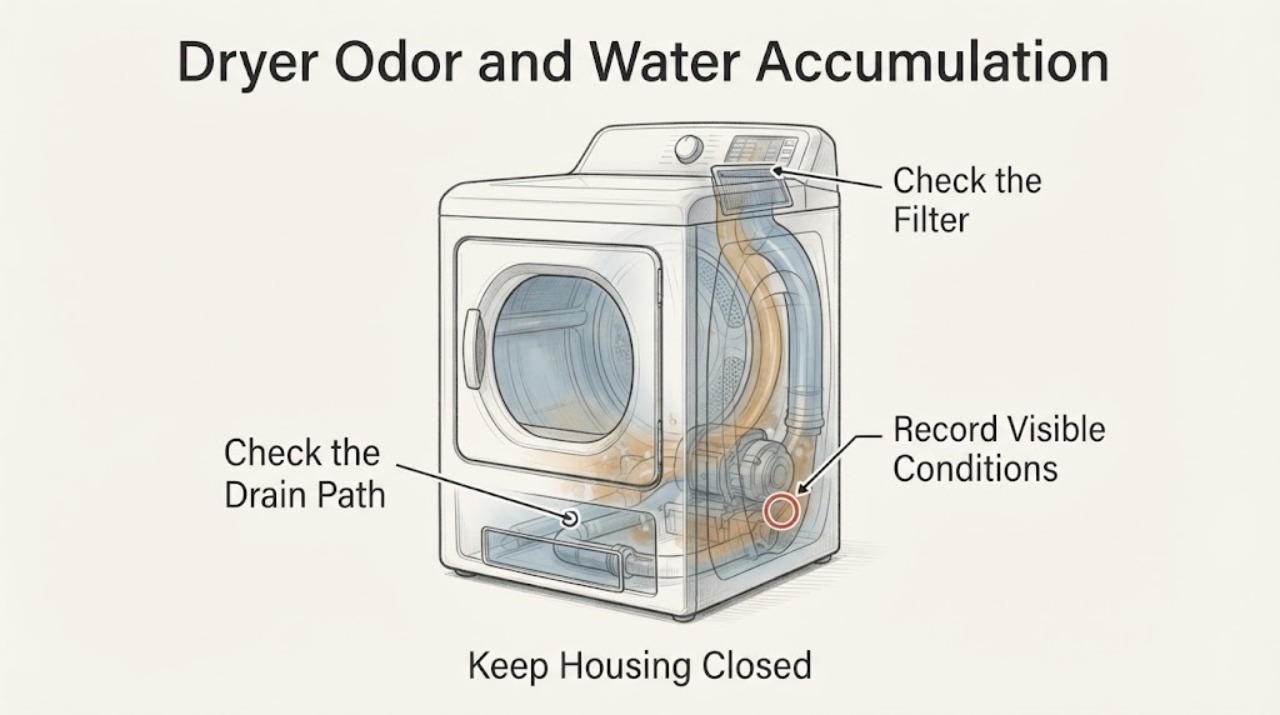
Work through in order
Diagnostic checks
Use only checks that match the exact appliance or system and its official guide.
-
Check 1
Stop the cycle, let the dryer cool, and identify the odor and water location from the outside: drum, condensate-container area, drain-hose area, or floor. Record any exact display text or code before resetting anything.
Expected result: The odor is burning or chemical, water is on the floor, water is only in a named container, or no water location/code is known.
Next step: Use the matching branch below. Stop and arrange service for burning/chemical odor, an active floor leak, or an unidentified persistent condition.
Why this matters
Why: These observations represent different safety and drainage paths; the task wording alone does not identify a Bosch part or an E03 condition.
-
Check 2
With the appliance switched off and cool, wipe the drum interior, remove lint from the lint filter, wash the filter under running water if the exact manual allows it, and let it dry completely before reinserting it.
Expected result: The odor is reduced after the drum and filter are clean, or the odor remains.
Next step: If the odor remains, continue only with the condenser and moisture-sensor checks permitted for the model; stop for burning or chemical odor.
Why this matters
Why: Bosch lists drum residue and lint-filter buildup among the user-level odor checks; improvement does not prove that an internal water component is sound.
-
Check 3
Use the exact Bosch manual to identify whether the dryer has a user-accessible condenser or heat exchanger and, when the appliance is cool, clean it only by the documented method; wipe the moisture sensor near the lint filter with a soft damp cloth and dry it.
Expected result: The exact manual supports the check and the odor or drying improves, or the dryer has no matching user procedure and the symptom persists.
Next step: If the manual does not match or the odor/water remains, stop user cleaning and provide the E-Nr., FD number, display text, and observations to Bosch service.
Why this matters
Why: Bosch supports model-bounded condenser and sensor care, but the task has no model and the result cannot diagnose a pump, thermostat, seal, or control board.
-
Check 4
If and only if the display shows Bosch E03, switch off and unplug the dryer, then inspect the visible condensation-drain hose for a kink or blockage and reattach it only as the Bosch E03 guide and model manual permit.
Expected result: The exact E03 code is present and the hose is visibly kinked/blocked, or there is no E03 code or no visible external issue.
Next step: For a persistent E03, no E03, or any hose connection/service-flap work outside the manual, stop and arrange authorized service.
Why this matters
Why: Bosch assigns E03 to condensation-drain hose restriction; the same meaning cannot be inferred from water accumulation without that code and applicable model context.
-
Check 5
Inspect only the accessible floor, plug, cord, door area, and surrounding ventilation for active water, heat damage, or a damaged cord; do not open the cabinet, reach into the condenser path, or run a cycle to reproduce a leak.
Expected result: Water reaches the floor, the cord or plug is damaged/hot, the odor is burning/chemical, or the exterior is dry and the issue is only a mild drum odor.
Next step: Stop using the appliance and arrange service for any hazard; otherwise complete only the documented cool-appliance cleaning and monitor for recurrence.
Why this matters
Why: A leak or electrical/chemical odor is a stop condition; a mild drum odor can follow Bosch's external cleaning guidance, but neither observation proves a specific part failure.
Use your observations
Decision map
Find the observation that best matches what you see, then follow the next safe action.
-
PATH 01Next step
What you see
The odor is burning or chemical, the cord/plug is hot or damaged, or water is reaching the electrical connection or floor.
Do this next
Stop the dryer, disconnect power only if it can be done without touching a wet or damaged connection, keep clear, and arrange Bosch or qualified appliance service. Do not retry the cycle.
Why this path and its safety boundary
Why it matters: This is a safety or active-leak condition, not a routine odor-cleaning result.
-
PATH 02Next step
What you see
The drum odor is non-burning, the dryer is cool and dry externally, and cleaning the drum, lint filter, condenser or moisture sensor is explicitly supported by the exact model manual.
Do this next
Perform only the documented cleaning, dry and reseat filters, then monitor. Escalate if the smell or water returns.
Why this path and its safety boundary
Why it matters: Residue, lint, or sensor/condenser maintenance may explain the odor or drying change, but the result does not identify a water pump or drain failure.
-
PATH 03Next step
What you see
The dryer shows E03 and the visible condensation-drain hose is kinked or blocked.
Do this next
With power disconnected, correct only the visible hose condition described by the Bosch guide and model manual; arrange service if E03 or the leak persists.
Why this path and its safety boundary
Why it matters: Bosch's E03 guidance supports a condensation-drain restriction for that exact displayed code.
-
PATH 04Next step
What you see
Water accumulates but there is no exact E03 code, the dryer model is unknown, or the location is not a user-accessible container or hose.
Do this next
Stop before opening panels or disconnecting hidden hoses. Find the E-Nr. and FD number, consult the matching Bosch manual, and arrange model-specific service if the condition persists.
Why this path and its safety boundary
Why it matters: The drainage layout and code meanings cannot be safely scoped from the supplied identity; a generic reset or part suggestion would be unsupported.
Helpful context
Understand the symptom
“Water accumulation” does not identify one Bosch dryer design or one failed part. A condensation dryer may collect water in a container or route it through a drain hose, while water on the floor is a different condition. Record where the water is, whether an exact display code appears, and whether the odor is musty, sour, chemical, or burning before choosing a check.
If the odor is burning or chemical, or the dryer is visibly leaking near the power connection, stop the cycle and do not keep testing it. Bosch directs owners with a burning smell to support, and its dryer documentation treats a suspected defect, damaged cord, and solvent-contaminated laundry as reasons not to operate the appliance.
For a non-burning drum odor, work only with the dryer switched off, unplugged where the manual calls for it, and cool. Bosch's odor guidance starts with wiping the drum, removing and washing the lint filter, cleaning the condenser, and wiping the moisture sensor near the lint filter.
Water in a named condensate container is not the same as water escaping onto the floor. If the display says to empty the condensate container, follow the exact model manual for removing, emptying, filtering, and reseating it. If the water is on the floor, stop before pulling hoses or opening a service flap; Bosch's model support path is needed to determine the permitted user check.
If the exact display is E03, Bosch defines that code as a blocked or kinked condensation drainage hose and gives an unplugged external hose inspection path. That code-specific instruction should not be copied to a dryer that shows no E03 or to a different display message.
Lint and moisture can contribute to odor and poor drying, but the public Bosch guidance does not establish that an odor-plus-water report proves a pump, condenser, seal, drain hose, or control fault. Keep the E-Nr. and FD information ready so the exact manual and service route can be matched.
When checks do not resolve it
Need a professional?
Arrange Bosch or authorized service immediately for burning or chemical odor, a damaged cord, an active floor leak, repeated water accumulation, or an unidentified condition that persists after the exact model's documented external cleaning. Do not order a drainage part from the symptom alone.
Safety scope: Do not run repeated test cycles, open the cabinet, reach into a condenser or fan, perform live electrical tests, disconnect hidden hoses, bypass a thermal or door safety, or replace a pump, seal, hose, or control without model-specific service instructions.
Have this ready
- Bosch E-Nr. and FD number, exact display text, odor description, water location, whether the dryer uses a condensate container or drain hose, filter/condenser state, and photographs of the dry exterior or visible leak area if safe.
Common questions
FAQ
Does water in a Bosch dryer always mean the drain hose is blocked?
No. Bosch assigns a blocked or kinked condensation-drain hose to E03, but the task has no display code or model. Water in a condensate container, water on the floor, and an E03 message require different, model-bounded decisions.
What can I clean when a Bosch dryer drum smells bad?
With the dryer off and cool, Bosch recommends wiping the drum, cleaning and fully drying the lint filter, cleaning the condenser, and wiping the moisture sensor near the lint filter. Follow the exact manual for access and cleaning differences.
Can I keep using the dryer if it smells burnt?
Stop using it and arrange Bosch support. Bosch's dedicated burnt-odor guidance directs owners to troubleshooting support; do not keep running cycles to see whether the smell clears.
Why is the exact Bosch model needed for water accumulation?
Bosch provides model manuals and model-specific support, and dryers can use different condensate-container and drainage arrangements. Without the E-Nr. and display text, a page cannot safely identify a hose, container, pump, seal, or internal leak.
Read the exact guide
Official sources
- Dryer drum smells badBosch · Official Bosch US dryer support page; it supports family-level drum, lint-filter, condenser, and moisture-sensor cleaning, while access and exact parts remain model-specific.
- Bosch Dryer Error CodesBosch · Official Bosch US dryer error-code guide; it explicitly asks owners to identify the dryer model and applies code meanings only to the displayed code.
- Bosch Dryers Troubleshooting & RepairBosch · Official Bosch US dryer support hub; it routes owners to model manuals, cleaning guidance, error codes, and authorized service without establishing a model-independent water diagnosis.
- Dryer smells burntBosch · Official Bosch US support page; it supports stopping the generic self-diagnosis path and using Bosch troubleshooting support for a burning smell.
- How To Fix Bosch Dryer Error Code E03Bosch · Official Bosch US code-specific guidance; only applicable when the dryer actually displays E03 and the model's manual permits the described external hose check.
- How to Clean & Maintain Your DryerBosch · Official Bosch US dryer cleaning guidance; condenser access and the permitted cleaning method must be checked against the exact owner manual.
Community feedback
Share a repair observation
Share a plain-text repair observation. Accepted observations are published automatically; this page may take a moment to update.