
On this page
Start here
Quick answer
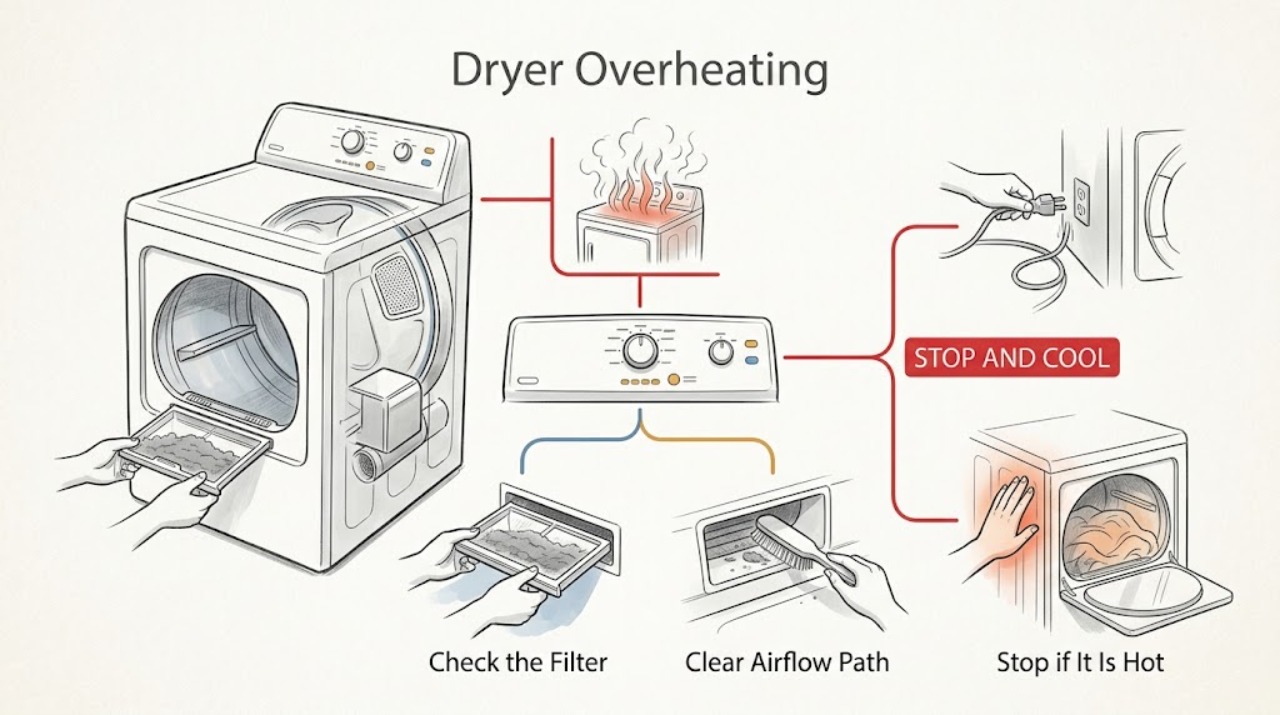
Stop the Bosch dryer and let it cool if the cabinet, drum, or laundry is unusually hot. Do not keep running a dryer that has smoke, a burning or scorching odor, visible damage, or repeated overheating. Once it is cool and safe, clean the lint filter, check that the outside vent and hose are not blocked or kinked, and clean the condenser or heat exchanger only as the model manual allows. Check the load and program, and wipe residue from the moisture sensor if your model has one. If overheating returns, an E12 or other fault remains, airflow is still restricted, or the dryer needs panels opened, leave it unplugged and arrange qualified Bosch appliance service.
Work through in order
Diagnostic checks
Use only checks that match the exact appliance or system and its official guide.
-
Check 1
Turn the Bosch dryer off and allow the drum, door, and laundry to cool before opening maintenance areas. If the controls do not respond and the plug or disconnect is safely accessible without touching hot or damaged parts, isolate power; do not reach into a hot drum or move the appliance.
Expected result: There is smoke, a burning or scorching odor, visible melting or charring, sparking, a damaged cord, repeated breaker or safety trips, or only ordinary heat with no damage signs.
Next step: For any hazard sign, leave the dryer off and arrange qualified appliance service; seek emergency help for an active fire. If no hazard sign is present, continue only with the cool, accessible maintenance checks below.
Why this matters
Why: Smoke, scorching, damage, or repeated protection trips are a stop condition and may indicate an electrical, heating, or lint-fire hazard. Ordinary heat after a cycle can be assessed only after the appliance is fully cool.
-
Check 2
With the dryer cool and off, remove the lint filter and clear the lint. If the filter is heavily soiled, rinse it under running water and let it dry completely before reinstalling it. Remove only accessible lint around the filter opening with a soft tool or vacuum; do not push objects deep into the opening.
Expected result: The filter is coated or blocked with lint, residue, or hair, or it is already clean and dry with the indicator still returning.
Next step: Run no further cycle until a rinsed filter is fully dry and correctly seated. If overheating returns with a clean filter, stop and check the external airflow path once cool.
Why this matters
Why: A dirty filter restricts airflow and can extend drying time or contribute to overheating. A clean filter with a recurring symptom points to the vent path, condenser, sensor, load, or an internal fault rather than just surface lint.
-
Check 3
From outside the appliance and without pulling it out or opening panels, check the dryer vent exit for lint, a flap that cannot open, or another obstruction. Where visible and safely reachable, check that the hose is not sharply kinked or crushed; do not dismantle a concealed or rigid vent run.
Expected result: The outside exit is blocked, airflow is weak or absent during an otherwise safe test, the hose is kinked or crushed, or the exit and visible hose appear clear.
Next step: Keep the dryer off until an accessible obstruction is removed safely. Have the concealed duct or persistent airflow restriction cleaned or assessed by a qualified vent or appliance professional; do not run repeated tests to compensate for weak airflow.
Why this matters
Why: A blocked or restricted exhaust path can trap heat and is a leading airflow branch to correct before suspecting a heater or control. A clear visible path does not prove that the concealed duct or internal air path is clear.
-
Check 4
If the Bosch model has a user-removable condenser or heat exchanger, clean it only while the dryer is cool and following that model's manual. For models covered by Bosch's procedure, open the lower maintenance flap, remove the condenser carefully, rinse away lint with water, let it dry fully, and reinstall the condenser and cap securely; do not use sharp tools.
Expected result: The condenser or heat exchanger has visible lint buildup, is clean and correctly installed, or cannot be removed without force or without exposing internal parts.
Next step: After a complete cool-down and correct reassembly, monitor only a normal, supervised cycle. If heat remains excessive or the maintenance area cannot be safely serviced as the manual describes, leave the dryer off and call qualified service.
Why this matters
Why: Buildup can reduce heat exchange and efficiency. A part that will not come out easily, a damaged seal, or an unfamiliar design is a stop point rather than permission to pry or disassemble further.
-
Check 5
Review the load and selected program against the Bosch owner manual after the airflow path is clear. Avoid a tightly packed load, and wipe the accessible moisture sensor near the lint filter with a soft damp cloth; use the manual's specified cleaning method for the model.
Expected result: The load is packed or unsuitable for the selected program, the sensor has residue, or the load and sensor appear appropriate but the dryer still becomes too hot or stops.
Next step: Use a suitable smaller load and the documented program only after the dryer is cool and no hazard signs are present. Stop if the cabinet or laundry again becomes unusually hot; do not open panels to test a thermostat, heater, fuse, or control.
Why this matters
Why: An unsuitable load or sensor residue can alter drying control and leave laundry hot or damp, but a correct load and clean sensor with recurring overheating shifts suspicion toward airflow or an internal heating/control fault.
-
Check 6
Record the exact Bosch model information, program, load type, when the overheating began, whether the dryer stopped, and any displayed code. If the display specifically shows E12, compare the lint and external-airflow findings with Bosch's E12 guidance; do not remove a panel merely to reset a thermal device.
Expected result: The code clears after the documented maintenance check and the dryer remains normal, or the code returns, overheating recurs, the dryer stops mid-cycle, or no code is shown despite excessive heat.
Next step: Keep the appliance off and arrange Bosch or qualified appliance service for any recurring overheating, returning code, unusual odor, or need for internal access. Give the technician the model, code, maintenance performed, and observed temperature behavior.
Why this matters
Why: A cleared message does not prove an underlying restriction is gone. A returning E12 or recurring heat indicates unresolved airflow or a possible internal heating, sensor, or control fault that requires diagnosis rather than a guessed part.
Use your observations
Decision map
Find the observation that best matches what you see, then follow the next safe action.
-
PATH 01Next step
What you see
Smoke, scorching, melting, sparking, a damaged cord, or repeated safety trips are present.
Do this next
Leave it off, keep clear of damaged parts, and arrange qualified service; use emergency services for an active fire.
Why this path and its safety boundary
Why it matters: The dryer may present a fire or electrical hazard; routine cleaning is not an adequate response.
-
PATH 02Next step
What you see
The lint filter is visibly blocked or coated.
Do this next
Clean and fully dry the filter, reinstall it correctly, and continue to the external vent check rather than immediately restarting a hot dryer.
Why this path and its safety boundary
Why it matters: Restricted filter airflow is a plausible contributor to excess heat and long cycles.
-
PATH 03Next step
What you see
The outside vent exit is blocked or the visible hose is kinked or crushed.
Do this next
Keep the dryer off until the accessible restriction is safely corrected; use a qualified professional for concealed duct or persistent airflow work.
Why this path and its safety boundary
Why it matters: Heat and moist air may not be leaving the dryer normally.
-
PATH 04Next step
What you see
A model-specific condenser or heat exchanger contains lint and can be removed and cleaned exactly as the manual describes.
Do this next
Clean with the model's approved cool-appliance procedure, dry and reinstall completely, then stop and call service if heat returns.
Why this path and its safety boundary
Why it matters: Reduced heat exchange may explain excess temperature or poor drying, but force or unfamiliar construction is a stop signal.
-
PATH 05Next step
What you see
The airflow path is clear, but the load is packed, the program is unsuitable, or the moisture sensor has residue.
Do this next
Correct the load or sensor only through accessible maintenance and the owner manual; do not keep operating if unusual heat persists.
Why this path and its safety boundary
Why it matters: The dryer may be using an unsuitable cycle or receiving an inaccurate moisture signal.
-
PATH 06Next step
What you see
Overheating returns after accessible cleaning, E12 or another fault returns, or the dryer still overheats with a suitable load.
Do this next
Leave the dryer off and arrange qualified Bosch appliance service. Do not bypass a safety or replace an internal part based only on the symptom.
Why this path and its safety boundary
Why it matters: An unresolved duct restriction or internal heater, sensor, thermostat, fuse, or control fault may remain.
Helpful context
Understand the symptom
Why overheating needs an airflow-first check
A clogged filter, blocked vent, kinked hose, dirty condenser, or an overloaded or unsuitable program can keep heat from leaving the dryer normally. Bosch also lists heating, thermostat, thermal-fuse, power, sensor, and control faults among possible dryer problems; those internal causes cannot be identified safely from surface temperature alone. Clear the user-serviceable airflow path first, then stop if the symptom returns.
Keep the check limited to accessible maintenance
Do not remove the rear panel, heating assembly, thermal fuse, thermostat, control board, or wiring to investigate overheating. Do not bypass a safety device or repeatedly restart a hot appliance. If the dryer is smoking, smells scorched, shows melted material, or trips protection, keep it off and use qualified service.
Only after diagnosis
Potential parts
- lint filter or filter frame
Consider this category only if the installed filter is damaged, missing, or cannot seat correctly after a professional or manual-based inspection; lint buildup alone calls for cleaning first.
Confirm the complete Bosch model and the owner's manual fit information before ordering or installing. - condenser or heat exchanger assembly
Relevant only if qualified service finds a damaged or blocked condenser or heat exchanger after the model-specific cleaning procedure and airflow diagnosis.
Verify exact model fitment and the manufacturer's installation requirements; do not substitute a visually similar assembly. - temperature sensor, thermostat, or thermal safety
Consider this category only when qualified service confirms an internal temperature-control or safety fault after accessible airflow causes are ruled out.
Confirm the exact Bosch model and approved replacement specification; never bypass or defeat a thermal safety. - heating element or heater control
Relevant only when a technician diagnoses an internal heater or control fault; overheating alone does not identify a safe replacement.
Use model-specific fitment and qualified installation for internal electrical or heating components.
When checks do not resolve it
What to give the service professional
Provide the complete Bosch model information, the program and load used, when the overheating began, whether the dryer stopped or displayed a code, whether the lint filter, vent exit, condenser, or sensor was checked, and whether there was smoke or a burning odor. Do not recreate a hazardous symptom for the appointment and do not open the appliance to test internal parts.
Common questions
FAQ
Why is my Bosch dryer overheating?
Start with restricted airflow: a blocked lint filter, blocked or kinked vent, or dirty condenser or heat exchanger can interfere with normal heat removal. A packed load, sensor residue, or an internal heating or control fault can also be involved. Clean only accessible parts as the model manual allows, and stop if overheating returns.
What does E12 mean on a Bosch dryer?
Bosch's dryer error-code guide associates E12 with overheating that may be related to restricted airflow and directs users to clean the lint screen and check the external vent. If the code returns after those checks, leave the dryer off and arrange qualified service rather than opening the appliance.
Can I keep running a Bosch dryer if the clothes or cabinet feel very hot?
No. Turn it off and let it cool. Smoke, scorching, melting, sparking, a damaged cord, repeated safety trips, or returning abnormal heat requires the dryer to remain out of service and be assessed by a qualified professional.
How do I clean the Bosch dryer lint filter when it overheats?
With the dryer off and cool, remove the filter and clear the lint. Bosch says a heavily soiled filter may be rinsed under running water, but it must be completely dry before it is reinserted. Then check the external vent for blockage or kinks.
Should I replace the Bosch dryer thermostat or heating element myself?
Not from overheating alone. A thermostat, thermal safety, heater, sensor, or control requires diagnosis and exact model fitment, and opening the appliance exposes electrical and hot components. Keep the dryer off and use qualified service when internal access is needed.
Read the exact guide
Official sources
- Dryer troubleshooting: Dryer is not drying clothes completelyBosch Home Appliances · Bosch dryers with long cycles, incomplete drying, heat, or airflow concerns
- Dryer Maintenance: Cleaning your dryer’s lint filterBosch Home Appliances · Bosch dryers with lint filters requiring cleaning or rinsing
- Bosch Dryer Troubleshooting & RepairBosch Home Appliances · Bosch dryers with heating, airflow, sensor, stopping, odor, or other unresolved faults
- Bosch Dryer Error CodesBosch Home Appliances · Bosch dryers displaying E12, filter, airflow, or other fault conditions
- Bosch DryersBosch Home Appliances · Bosch dryer owners needing model-specific manuals or repair service
- Dryer Maintenance: How to Clean Your Dryer’s CondenserBosch Home Appliances · Bosch dryers with a user-serviceable condenser or heat exchanger
Community feedback
Share a repair observation
Share a plain-text repair observation. Accepted observations are published automatically; this page may take a moment to update.