
On this page
Start here
Quick answer
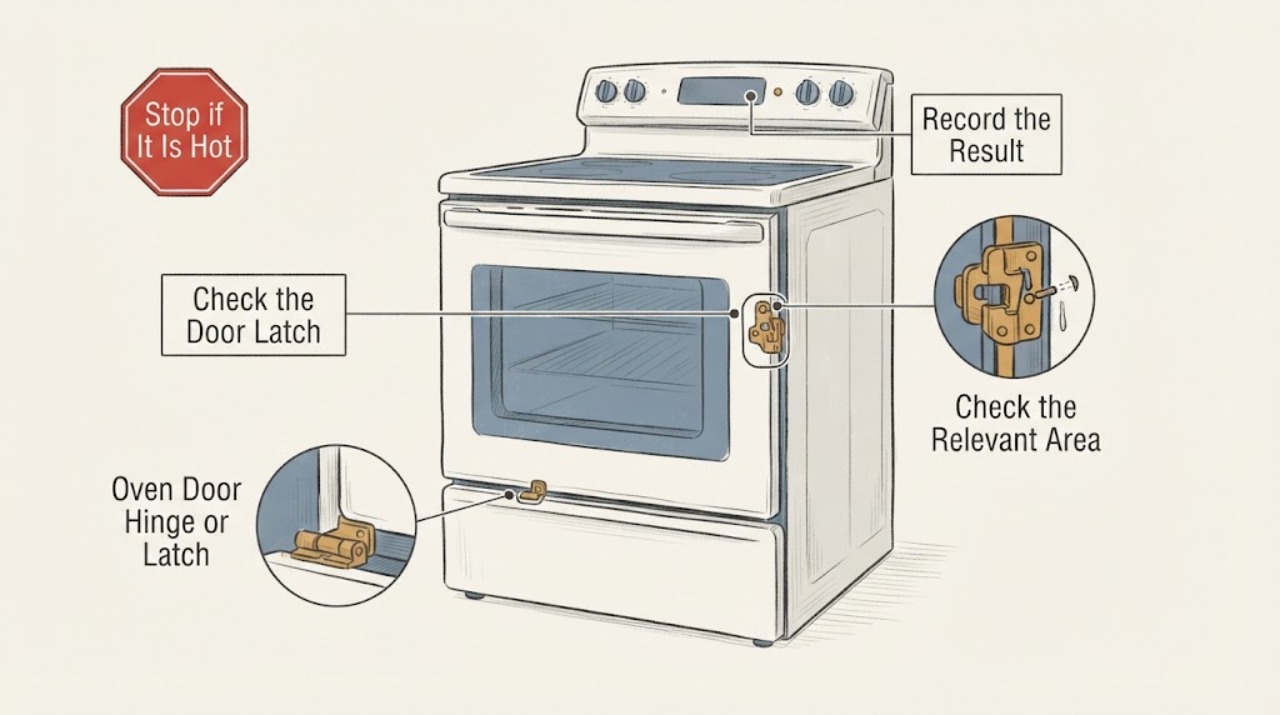
Do not force a Bosch HBL5055AUC oven door when a latch pin, hinge lever, or hinge area appears broken. Bosch's HBL53/HBL54/HBL55/HBL56 manual warns that the oven must be cool and powered off before door removal, that the door is heavy and fragile, and that hinge brackets can snap shut unless both levers are secured. Limit the user check to stopping the oven, keeping the door supported, noting visible misalignment or obstruction, and recording the exact model/data plate. Do not pull the door off, release a spring, drill or replace a pin, remove glass, or order a hinge from a generic listing; arrange Bosch or qualified appliance service for a broken latch-pin or hinge repair.
Work through in order
Diagnostic checks
Use only checks that match the exact appliance or system and its official guide.
-
Check 1
Stop using the oven and allow it to cool fully. If the door is hanging, rubbing, unable to latch, or supported by only one side, keep hands clear of the hinge gap and do not force it closed or open.
Expected result: The door is stable and closes without force, or it sags, binds, leaves a gap, has a loose pin/lever, or shows broken glass or a damaged hinge bracket.
Next step: Leave the oven out of service and arrange qualified appliance service for any instability, gap, damaged glass, broken bracket, or loose hinge hardware. Do not run a heat cycle to test it.
Stop if: Stop immediately for broken glass, a hinge that moves suddenly, a door that can fall, exposed sharp edges, or any sign that the hinge spring or latch is not retained.
Why this matters
Why: A stable appearance does not prove the latch is secure; sagging, binding, a gap, or visible damage means the door retention or hinge geometry may be unsafe.
-
Check 2
From outside the oven, look for a visible food utensil, rack edge, loose trim, or other obstruction at the door edge and latch area. Check only with the oven cool and power off; do not insert a tool into the latch or hinge and do not remove trim or glass.
Expected result: A clearly external obstruction is present, or the latch-pin/hinge area itself is bent, loose, missing, or inaccessible behind the door structure.
Next step: Remove only a loose item that can be lifted away without touching the hinge or latch. If the hardware is damaged or the obstruction is not clearly external, keep the oven off and request service.
Why this matters
Why: An external obstruction may explain a door that will not close, but a broken or concealed pin remains a mechanical repair question and cannot be confirmed by appearance alone.
-
Check 3
Read the complete model and serial information from the Bosch data plate without moving or dismantling the door. Compare the model to the HBL5055AUC/01 support page and use the matching manual or service path.
Expected result: The label confirms HBL5055AUC/01, identifies a different suffix/model, or cannot be read safely because the door or trim is unstable.
Next step: Give the complete label information and photographs taken from a safe position to Bosch or a qualified servicer. Do not order a latch pin based only on the HBL5055 name or a visual match.
Why this matters
Why: Bosch uses the data plate to identify the appliance for manuals, parts and service. A similar-looking HBL55-family oven does not prove that a hinge, pin, or door assembly fits this exact model and revision.
-
Check 4
If a technician or the exact Bosch manual requires door removal, confirm first that the oven is cool, power is off at the circuit, the door is supported on both sides, and both hinge levers are in the specified secured position. Do not attempt this check when a latch pin or hinge cannot hold its position.
Expected result: The exact manual shows a matching hinge arrangement and the levers remain fully secured, or a lever/pin will not stay secured or the hinge is visibly bent.
Next step: If any part cannot be secured exactly as the matching manual specifies, stop and have the door removed and repaired by qualified service. Do not improvise a locking pin, clamp, wire, or spring restraint.
Why this matters
Why: Bosch's manual says door weight, spring tension and hinge-lever position control the risk of the door falling or the hinge snapping shut. A broken retention part invalidates a casual door-removal attempt.
-
Check 5
After service, do not use the oven until the door closes and latches evenly, both sides sit correctly, and the service provider confirms the hinge and latch assembly is secure. Never release a repaired door by pulling the handle or forcing a stiff hinge.
Expected result: The repaired door remains misaligned, will not close without force, leaves a visible gap, or makes the hinge move unexpectedly.
Next step: Stop using the oven and have the installation or repair corrected. Do not compensate with a temporary latch, tape, shim, or improvised pin.
Why this matters
Why: Bosch's reinstallation instructions require both hinges to engage before the door is released; misalignment can let the door fall or allow excessive heat to escape.
Use your observations
Decision map
Find the observation that best matches what you see, then follow the next safe action.
-
PATH 01Next step
What you see
The door is loose, sagging, cracked, unable to latch, or a hinge/pin can move without staying secured.
Do this next
Keep the oven cool and powered off, keep people away from the hinge gap, and arrange qualified Bosch or appliance service. Do not remove the door or attempt to restrain the hinge yourself.
Why this path and its safety boundary
Why it matters: The door may fall or the spring-loaded hinge may move unexpectedly; Bosch specifically warns about door weight, fragile glass, and hinge brackets snapping shut.
-
PATH 02Next step
What you see
The door is stable and the only problem is a clearly visible loose object at the door edge that can be removed without touching the latch or hinge.
Do this next
Remove only the loose obstruction with the oven cool and power off, then check closure gently. If the door still binds, gaps, or needs force, leave the oven off and request service.
Why this path and its safety boundary
Why it matters: An external obstruction may be preventing closure, but it does not prove that a reported broken pin or hinge is intact.
-
PATH 03Next step
What you see
The exact model label is different from HBL5055AUC/01, or the hinge design cannot be matched to the Bosch HBL55-family manual.
Do this next
Stop parts research until the complete data plate is confirmed, then use the exact Bosch support/manual path or a qualified servicer. Do not transfer a pin or hinge procedure from another model.
Why this path and its safety boundary
Why it matters: Door and hinge hardware is model- and revision-dependent; a similar name or appearance cannot establish compatibility.
-
PATH 04Next step
What you see
A repair has been attempted and the door does not close evenly, leaves a gap, or either hinge is not fully engaged.
Do this next
Keep the oven off and have the repair corrected by qualified service. Do not add a temporary latch, shim, wire, or substitute pin.
Why this path and its safety boundary
Why it matters: Bosch warns that an incompletely engaged hinge can let the door fall and allow heat to escape; the repair is not safe to validate by cooking.
Helpful context
Understand the symptom
A broken pin changes the safe scope
A latch pin or hinge part that is bent, missing, loose, or no longer retaining the door is a mechanical safety problem. It can leave the door unsupported, allow heat to escape, damage the seal or glass, or let a spring-loaded hinge move unexpectedly. Bosch's manual gives a door-removal procedure only with explicit warnings about power, door weight, hinge levers, and correct hinge engagement; it does not make an unknown latch-pin repair a generic user procedure.
Keep the door and hinge assembly stable
Until the exact repair is confirmed, keep the oven off and avoid leaning on, lifting by, or forcing the door. Do not treat a temporary alignment change as proof that the latch pin is the only failed part. A Bosch or qualified appliance technician should identify the correct hinge/latch configuration and any related glass, bracket, seal, or mounting damage from the exact model and data plate.
When checks do not resolve it
Need a professional?
Provide the complete HBL5055AUC suffix, serial/data-plate information, whether the pin is missing or bent, which hinge or latch side is affected, whether the door is sagging or rubbing, and photographs taken without moving the unstable door.
Common questions
FAQ
Can I replace the Bosch HBL5055AUC latch pin myself?
Do not assume that a visible pin is a user-replaceable part. Bosch's manual warns about the heavy door and hinge brackets that can snap shut, but it does not establish a generic pin replacement or part fit. Have the exact model and hinge configuration verified by Bosch or qualified appliance service.
Can I remove the oven door to inspect the broken hinge?
Only follow the exact Bosch manual if the hinges and levers can be secured exactly as specified and the door is cool, powered off, and supported by both sides. If a latch pin or hinge will not stay secured, do not remove the door; arrange service instead.
Is the HBL5055AUC model number enough to order a hinge or pin?
No. Confirm the complete data-plate model and revision, then use the Bosch support path or a qualified servicer. A visual match or a generic HBL55-family listing does not establish fitment for the broken latch or hinge assembly.
Can I use the oven if the door still closes but the latch pin is loose?
No. A door that appears closed may not be securely retained or sealed. Keep the oven off until the pin, hinge and door alignment have been checked and confirmed by qualified service.
Read the exact guide
Official sources
- Use and Care Manual - Built-in Ovens HBL53, HBL54, HBL55, HBL56Bosch · Opened Bosch manual whose cover identifies the HBL55 family; used for family-level door and hinge safety. It does not establish a latch-pin replacement part or authorize repair of a broken hinge without model-specific confirmation.
- Appliance Information - HBL5055AUC/01Bosch · Exact Bosch US support page for the assigned HBL5055AUC/01 model; used for model identity and routing, not for an unverified latch-pin part number.
Community feedback
Share a repair observation
Share a plain-text repair observation. Accepted observations are published automatically; this page may take a moment to update.