
On this page
Start here
Quick answer
A Bosch oven can still run its cooling fan after the oven is turned off; Bosch’s opened owner manual says the fan may be heard after the oven is off and warm air may leave the vent while the oven cools. That normal explanation is most plausible when the oven was recently hot and the sound fades as it cools. Do not assume every buzzing sound is normal: keep the vent clear, note whether the sound is airflow from the vent or an unexplained electrical buzz, and check the exact model manual for model-specific behavior. If the noise continues after the oven has cooled, the display flashes or beeps with an error, or there is smoke, burning odor or abnormal heat, stop using the oven, disconnect power only if safe and accessible, and arrange qualified Bosch service. Do not open the cabinet or perform a live test.
Before you begin
Safety first
- Limit owner checks to observing recent-use timing, keeping the vent clear, reading the visible display and recording the model. Do not remove panels, reach into the vent, probe wiring, repeatedly reset the breaker, or operate a smoking, damaged or abnormally hot oven.
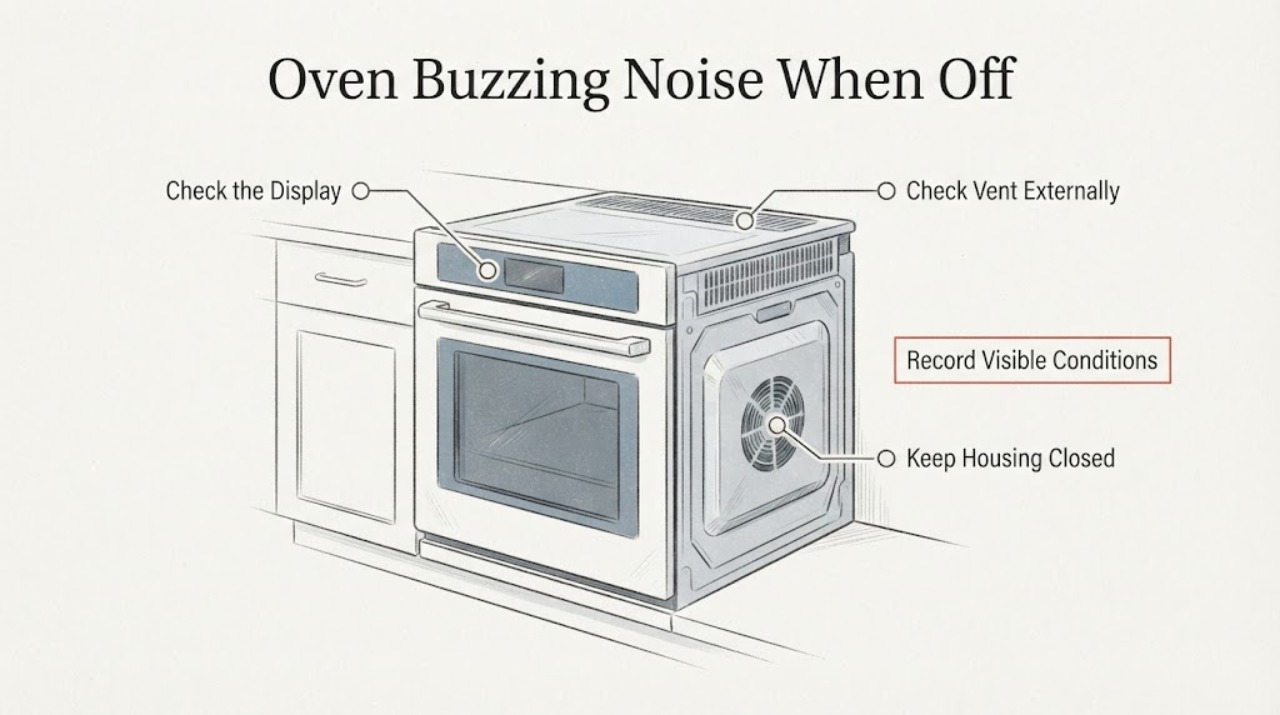
Work through in order
Diagnostic checks
Use only checks that match the exact appliance or system and its official guide.
-
Check 1
Record whether the oven was recently used or self-cleaned, whether it is still warm, where the sound is loudest, and whether the sound fades as time passes.
Expected result: The sound occurs after heating and fades while the oven cools, or it continues after the oven is cool or was never recently used.
Next step: Use the cooling-fan branch for a temporary post-use sound; use the service branch for a persistent or unexplained buzz.
Why this matters
Why: Bosch documents post-use cooling-fan operation, but a persistent sound without a cooling context is not established as normal by the model-less task.
-
Check 2
Look at the oven vent from outside and confirm that cookware, foil, towels or nearby objects are not blocking it. Do not insert anything into the vent or remove covers.
Expected result: The vent is clear and warm air or airflow is present, or the vent is blocked or the sound does not resemble airflow.
Next step: Remove only a loose external obstruction after the oven is safe to touch. If the noise remains or the obstruction is built in, stop use and arrange service.
Why this matters
Why: Bosch says warm air may leave the vent and the vent must remain unobstructed; a blocked vent or non-airflow buzz needs model-specific evaluation.
-
Check 3
Read the visible display without opening the appliance and record any E-code, flashing message, continuous beeping or control behavior.
Expected result: No error is shown, or an error message flashes or beeps continuously.
Next step: For a repeated error display or continuous beeping, stop testing, disconnect power only if safe and accessible, and call qualified service with the code and model.
Why this matters
Why: Bosch’s manual treats a continuously flashing and beeping error condition as a fault requiring power disconnection and qualified service; an unspecified noise alone does not identify the fault.
-
Check 4
If there is smoke, a burning odor, sparking, abnormal heat or visible damage, stop using the oven and keep people away from hot surfaces. Do not open the cabinet or restore power to repeat the test.
Expected result: The oven is visibly unsafe or the noise is accompanied by smoke/odor/heat, or none of those conditions is present.
Next step: Disconnect power at the breaker only if safe and accessible and arrange qualified service. For an active fire that does not go out immediately, evacuate and call emergency services.
Why this matters
Why: Bosch says not to operate an appliance that is not working properly or damaged and routes repair to an authorized servicer; fire conditions require the manual’s emergency response.
-
Check 5
Find the exact Bosch model and serial information and report the sound timing, duration, vent behavior, display state and any safety symptom through Bosch’s model-specific support route.
Expected result: The sound stops after cooling with no error or hazard, or it persists/returns or needs internal access.
Next step: For persistent buzzing, recurring errors or any internal access need, leave the oven off and arrange Bosch or authorized qualified service.
Why this matters
Why: A temporary cooling-fan sound fits the opened manual’s normal behavior; a persistent or hazardous sound is not a basis for owner component diagnosis.
Use your observations
Decision map
Find the observation that best matches what you see, then follow the next safe action.
-
PATH 01Next step
What you see
The oven was recently hot, the sound is airflow at the vent, and it fades as the oven cools with no error or hazard.
Do this next
Leave the vent clear and monitor without opening the appliance. Use the exact model manual if the fan behavior changes or does not stop after cooling.
Why this path and its safety boundary
Why it matters: Bosch documents that the cooling fan may continue after the oven is off while the appliance cools.
-
PATH 02Next step
What you see
The buzzing continues after the oven has cooled, occurs when the oven was not recently used, or is not coming from normal vent airflow.
Do this next
Keep the oven off and arrange Bosch or authorized qualified service; do not open the cabinet or perform a live test.
Why this path and its safety boundary
Why it matters: The available model-less evidence cannot establish a normal cooling-fan explanation or identify an electrical component.
-
PATH 03Next step
What you see
The display flashes, shows an E-code or beeps continuously while the oven is off.
Do this next
Record the exact code, disconnect power only if safe and accessible, and provide the model and code to service rather than repeatedly resetting the appliance.
Why this path and its safety boundary
Why it matters: Bosch treats a continuously flashing and beeping error as a fault condition requiring power disconnection and qualified service.
-
PATH 04Next step
What you see
Smoke, burning odor, sparking, abnormal heat or visible damage accompanies the noise.
Do this next
Stop use, keep clear of hot surfaces, disconnect at the breaker only if safe and accessible, and arrange qualified service. For an active fire that does not go out immediately, evacuate and call emergency services.
Why this path and its safety boundary
Why it matters: The oven is not a normal post-shutdown cooling case and presents a safety stop condition.
-
PATH 05Next step
What you see
The model is unknown and the only description is “buzzing noise when off.”
Do this next
Find the model/serial information and use Bosch’s oven support route; do not replace a fan, control or relay by guesswork.
Why this path and its safety boundary
Why it matters: Bosch’s support and manuals are model-specific, so the available evidence supports external classification and service boundaries but not a universal fan or electrical diagnosis.
Helpful context
Understand the symptom
Decide whether the oven is still cooling
Note whether the oven was recently used, whether the cavity or control area is still warm, and whether the sound comes from the vent as moving air. Bosch’s opened owner manual says the cooling fan runs during cooking, may be heard, and may continue after the oven is off while warm air leaves the vent. The exact fan run time is model-dependent, so a recently hot oven can explain a temporary sound without proving a fault.
Keep the vent clear and observe from outside
Do not cover or block the oven vent. Observe the sound without putting a hand into the vent or removing a panel. A steady airflow sound that fades as the oven cools fits the cooling-fan explanation better than a buzz that continues after cooling or comes from the controls, wiring or an unseen compartment.
Check for an error display or repeated beeping
Look only at the visible control display for an E-code, flashing message or continuous beeping. Bosch’s manual says a continuously flashing and beeping error condition requires the appliance to be disconnected from power and checked by a qualified technician. Do not convert an unspecified buzz into a control-board diagnosis or repeatedly reset the breaker to keep testing it.
Treat smoke, odor or abnormal heat as a stop condition
If the buzzing is accompanied by smoke, a burning odor, sparking, an unusually hot control area or another sign that the oven is not operating properly, stop using it and keep clear of hot surfaces. Bosch says not to operate a damaged or improperly working appliance and to refer repairs to an authorized servicer. If materials inside ignite, Bosch instructs owners to keep the door closed, turn off the appliance and disconnect the circuit at the breaker; an active fire that does not go out requires emergency help.
Use the exact model for service
Record the complete model and serial information and describe whether the noise began after cooking, self-cleaning or an error display. Bosch’s oven support page provides model-specific manuals and a service route. Because the task has no model, do not open the oven, reach the cooling fan, replace a control or run a live electrical test based only on the word “buzzing.”
When checks do not resolve it
Need a professional?
Use Bosch’s model-specific support route or an authorized qualified servicer for a persistent or unexplained buzz, recurring error, continuous beeping or any internal electrical/fan access.
Safety scope: Limit owner checks to observing recent-use timing, keeping the vent clear, reading the visible display and recording the model. Do not remove panels, reach into the vent, probe wiring, repeatedly reset the breaker, or operate a smoking, damaged or abnormally hot oven.
Common questions
FAQ
Is it normal for a Bosch oven to make a sound after it is turned off?
Bosch’s opened owner manual says the cooling fan may continue after the oven is off and warm air may leave the vent while the oven cools. Confirm the exact model manual if the sound does not fade or is not airflow-related.
What if the Bosch oven keeps buzzing after it is cool?
That is not established as normal cooling-fan behavior from the model-less task. Leave the oven off, record any display message and arrange Bosch or qualified service rather than opening the cabinet or testing live wiring.
What should I do if the buzzing comes with smoke or a burning smell?
Stop using the oven. Bosch says not to operate an appliance that is not working properly or damaged; disconnect power at the breaker only if safe and accessible and arrange qualified service. If materials ignite and the fire does not go out immediately, evacuate and call emergency services.
Read the exact guide
Official sources
- Use and Care ManualBSH Home Appliances Corporation / Bosch · Opened the Bosch-hosted owner manual PDF directly. The manual notes that appliance appearance and features can vary by model; the article uses its cooling-fan, vent and safety statements as family-level guidance and sends model-specific differences to the exact manual. It does not diagnose the task oven’s buzzing source.
- Bosch Oven & Microwave Error CodesBosch Home Appliances US · Opened the Bosch US error-code page directly. It says to note an E-code and contact Bosch when the code persists; it is used only for an explicitly visible error branch, not to infer an error from the word buzzing.
- Oven FAQs | Top TipsBosch Home Appliances US · Opened the Bosch US oven tips page directly. It says oven vents should be clear and provides a visible E-code response that sends persistent errors to Bosch support. It is used for external checks only, not a universal buzzing diagnosis.
- Get Support - Ovens & RangesBosch Home Appliances US · Opened the Bosch US oven support page directly. It provides model-specific manuals, troubleshooting, accessories and service resources, supporting the article’s boundary because the task supplies no model.
Community feedback
Share a repair observation
Share a plain-text repair observation. Accepted observations are published automatically; this page may take a moment to update.